


Oil Hovers Near Six-month High with Nuclear Talks and US Tariffs in Focus

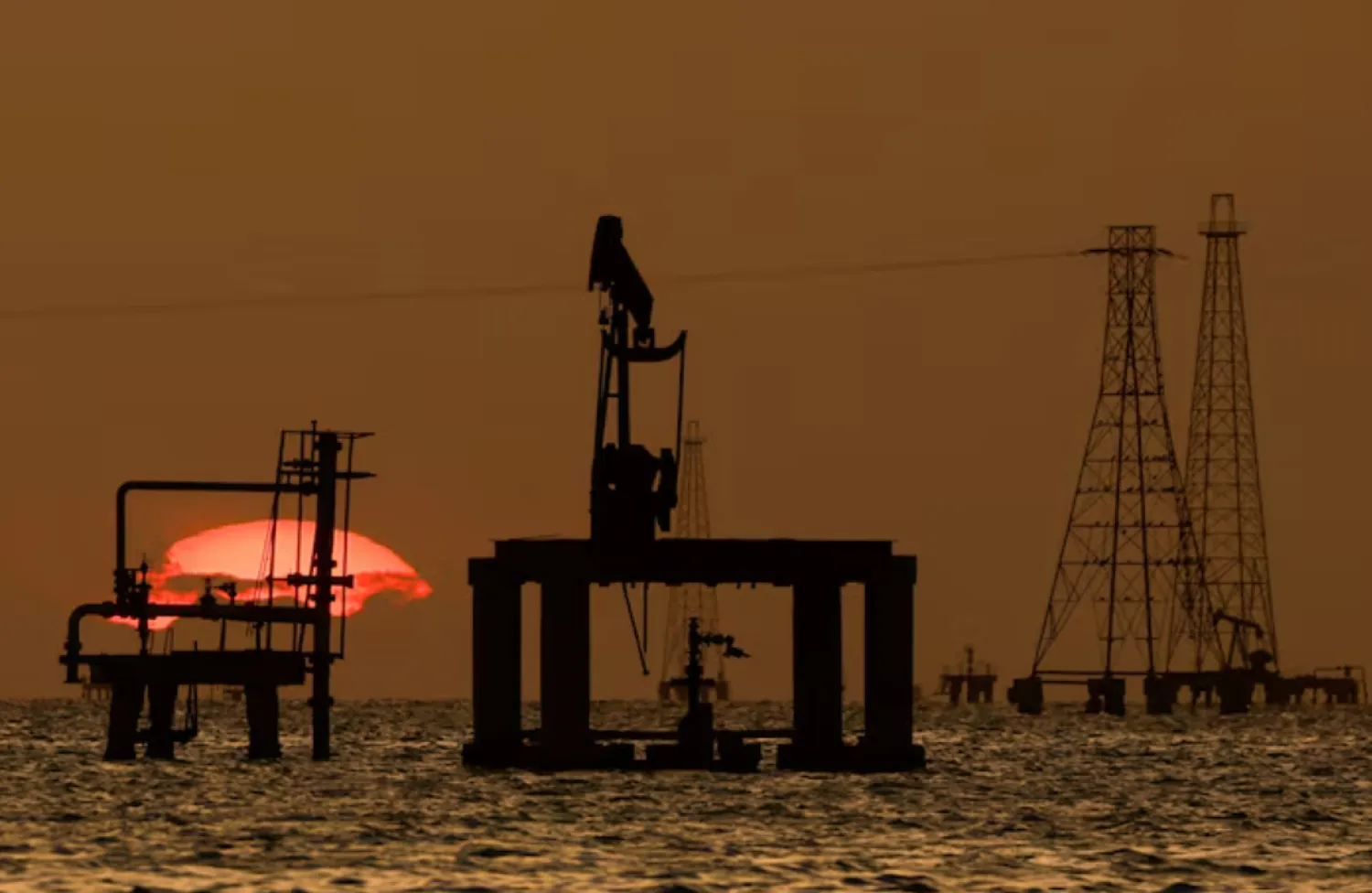
Oil platforms and pumpjacks at Lake Maracaibo, in Cabimas, Venezuela, January 26, 2026. REUTERS/Leonardo Fernandez Viloria/File Photo
TT

Oil Hovers Near Six-month High with Nuclear Talks and US Tariffs in Focus

Oil platforms and pumpjacks at Lake Maracaibo, in Cabimas, Venezuela, January 26, 2026. REUTERS/Leonardo Fernandez Viloria/File Photo

Oil prices steadied near a six-month high on Monday as the US and Iran prepared for a third round of nuclear talks while increased economic uncertainty was also in focus after the latest US tariff upheaval.

Brent crude futures were up 9 cents at $71.85 a barrel by 1308 GMT while US West Texas Intermediate crude gained 15 cents to $66.63, Reuters reported.

Growing concern over potential military conflict between the US and Iran pushed Brent prices up more than 5% last week to their highest since July 2025 at $72.34.

"With the next, and possibly last, round of the Iranian nuclear talks not until Thursday, focus is on the US Supreme Court’s decision to strike down import tariffs and the subsequent reaction from the government," said PVM Oil Associates analyst Tamas Varga.

The US Customs and Border Protection agency said it would halt collections of tariffs imposed under the International Emergency Economic Powers Act at 12:01 a.m. EST (0501 GMT) on Tuesday.

However, Trump said on Saturday that he would raise a temporary tariff from 10% to 15% on US imports from all countries, the maximum allowed under the law, after the US Supreme Court struck down his previous tariff program.

"This morning’s weakness is a defensive move, and needless to say, with the uncertainty surrounding a US military intervention in Iran, the ongoing Russian-Ukrainian war and now the US Supreme Court’s decision, oil price direction is not (clear), but volatility is guaranteed," PVM's Varga said.

Iran has indicated it is prepared to make concessions on its nuclear program in return for the lifting of sanctions and recognition of its right to enrich uranium, a senior Iranian official told Reuters ahead of Thursday's third round of nuclear talks between the two nations.

While prices on paper had moved higher, softer prompt spreads and weaker physical differentials pointed to pricing being based on geopolitical concerns rather than an actual lack of oil in the market, Morgan Stanley analysts said in a note.



UK Economy Slows Amid Political Unrest, Middle East War

A person cycles through parched parkland in Birmingham, Britain, 13 August 2026. (EPA)
TT

UK Economy Slows Amid Political Unrest, Middle East War

A person cycles through parched parkland in Birmingham, Britain, 13 August 2026. (EPA)

Britain's economy slowed in the second quarter, the national statistics office reported Thursday, saying that output remained "robust" despite domestic political unrest and fallout from the US-Iran war.

Gross domestic product increased 0.4 percent in the April-June period after GDP expansion of 0.6 percent in the first quarter, the Office for National Statistics (ONS) said in a statement.

Keir Starmer resigned as British prime minister in late June and was replaced around one month later by Andy Burnham, as the Labour government was overtaken in opinion polls by the hard-right party Reform UK.

Following Thursday's data, the country's new finance minister, John Healey, said that under Burnham, Labour was a "hands-on government, putting British interests first -- giving breathing space to those feeling the strain, making our country more resilient and bringing hope back".

Struggling already with elevated inflation, millions of Britons have seen their situation worsen after the US-Iran war sent energy costs soaring.

"I know people are worried about the impact of the conflict in the Middle East on their cost of living, which has been too high for too long and it has added pressure on British businesses," Healey added in a statement.

- World Cup boost -

The latest GDP data showed that output from the services sector grew 0.5 percent in the second quarter, and construction also expanded while production flattened.

"Growth (overall) slowed in the second quarter of the year, following a strong start to 2026, but remained relatively robust," said ONS director of economic statistics, Liz McKeown.

"Services were once again the main driver of growth," she added.

The second quarter had a strong finish, growing 0.3 percent in June after zero expansion in May and a slight dip in April, the ONS said.

It cited the recent football World Cup "as a reason for an increase in turnover in June... by businesses in industries such as wholesale, food and beverage serving activities, publishing activities, television production and advertising".

But Stuart Morrison, research manager at the British Chambers of Commerce, said in a statement that "the headline figures shouldn't disguise the cocktail of cost pressures choking long-term business growth".

He said Healey's first budget, due October 28, "must be a game changer for stronger, sustainable growth", adding that Britain needed "measures that boost trade, investment and productivity".

Burnham has so far concentrated on easing the cost of living for households, with tax on their electricity bills set to be removed this winter.

The Bank of England recently warned that British inflation was set to rise as the Middle East war keeps energy prices high.


Gold Off Two-month Peak as Traders Seek Inflation Cues

Gold bars and 'sovereign pounds' coins at Bird & Co. in Hatton Garden, London (Reuters)
TT

Gold Off Two-month Peak as Traders Seek Inflation Cues

Gold bars and 'sovereign pounds' coins at Bird & Co. in Hatton Garden, London (Reuters)

Gold edged lower on Thursday, after touching a more than two-month high earlier in the session, as traders paused after a rally fueled by cooling US inflation, with attention turning to an upcoming producer price report for clues to prospects of near-term Federal Reserve rate hikes.

Spot gold fell 0.5% to $4,383.53 per ounce ‌by 0601 GMT, after ‌jumping about 1% to its highest since ‌June ⁠5. US gold futures ⁠for December delivery fell 0.6% at $4,440.80.

"Gold is in consolidation mode today after its post-CPI gains, with near-term expectations of a Fed rate hike being dialed back another notch," said Tim Waterer, chief market analyst at KCM Trade.

"Traders appear content to wait for confirmation from the upcoming PPI data before committing to the next leg higher."

Prices have ⁠risen over 8% so far this month, ‌as traders scale back US interest rate ‌hikes bets amid recent softer economic data.

On the geopolitical front, Iran and ‌the US remain at loggerheads over efforts to agree on a ‌permanent end to the war, according to a senior Iranian source, who said there had been no progress in talks to revive the interim deal agreed in June.

On monetary policy, Fed policymakers are likely ‌to feel little fresh urgency to raise interest rates next month after data on Wednesday showed inflation ⁠cooled on ⁠a year-over-year basis for a second straight month.

The consumer price index rose 3.4% in the 12 months through July, down from 3.5% in June, in line with economists' expectations. Traders are now pricing in only a 40% chance of a hike at the September meeting, down from about 54% seen a week before, according to the CME FedWatch Tool.

Lower rates tend to support gold by lowering the opportunity cost of holding the non-yielding asset.

In other metals, spot silver lost about 0.3% to $65.09 per ounce, having climbed to its highest since June 22 in the previous session.

Platinum lost 0.8% at $1,741.96, and palladium fell 0.9% at $1,357.29.


Oil Eases as Weaker Demand Outlook Counters Mideast Supply Concerns

Oil pumpjacks are pictured in an Ecopetrol oil field in Barrancabermeja, Colombia October 11, 2024. (Reuters)
TT

Oil Eases as Weaker Demand Outlook Counters Mideast Supply Concerns

Oil pumpjacks are pictured in an Ecopetrol oil field in Barrancabermeja, Colombia October 11, 2024. (Reuters)

Oil prices eased on Thursday after gains in previous sessions, as attention turned to expectations of weaker global oil demand this year, while there was no progress on opening the vital Strait of Hormuz.

Brent futures slipped 42 cents, or 0.47%, to $88.56 a barrel by 0405 GMT. US, trimming gains made over the previous six sessions.

West Texas Intermediate (WTI) crude fell 55 cents, or 0.66%, to $82.72, after advancing over the past five sessions.

A senior Iranian source said ‌on Wednesday there ‌had been no progress in talks to revive an interim ‌deal ⁠agreed in June ⁠and define a timeframe to implement it.

"There was little in the way of fresh developments between the US and Iran, with both sides remaining in a deadlock," said ING analysts in a note on Thursday.

"Meanwhile, the latest large drone attack on Russia's Novorossiysk port appears to have spared oil infrastructure, with no reports of damage to oil terminals as of now."

With no change in the prospect of reopening the ⁠Strait of Hormuz, the key factor that had driven prices ‌higher over the past week, attention turned to ‌the demand outlook following a surprise build in US crude stocks and lower consumption forecasts from ‌OPEC and the International Energy Agency.

US commercial crude oil inventories posted their ‌largest weekly gain since January 2023 as exports slumped, data from the Energy Information Administration showed on Wednesday.

Crude inventories rose by 17.4 million barrels to 424.4 million barrels in the week ended August 7, their highest since June 5, the EIA said, compared with analysts' ‌expectations in a Reuters poll for a 1.4-million-barrel draw.

On the same day, the Organization of the Petroleum Exporting Countries ⁠lowered its world ⁠oil demand growth forecast for 2026 to 580,000 barrels per day in its monthly oil market report.

At the same time, the International Energy Agency said it expects a 1.6 million bpd contraction in consumption this year, down from a forecast of 1 million bpd last month, with demand curtailed by higher prices and restricted supply due to the US-Israeli war with Iran.

Still, the deadlocked talks between Iran and the US to end the war in the region have kept a floor under prices.

"The safety situation for navigation in these waters has further deteriorated, forcing vessels to turn off their signals, which reduces transparency in shipping and makes it more difficult for the market to track and assess actual supply levels," analysts at Haitong Futures said in a note.
