

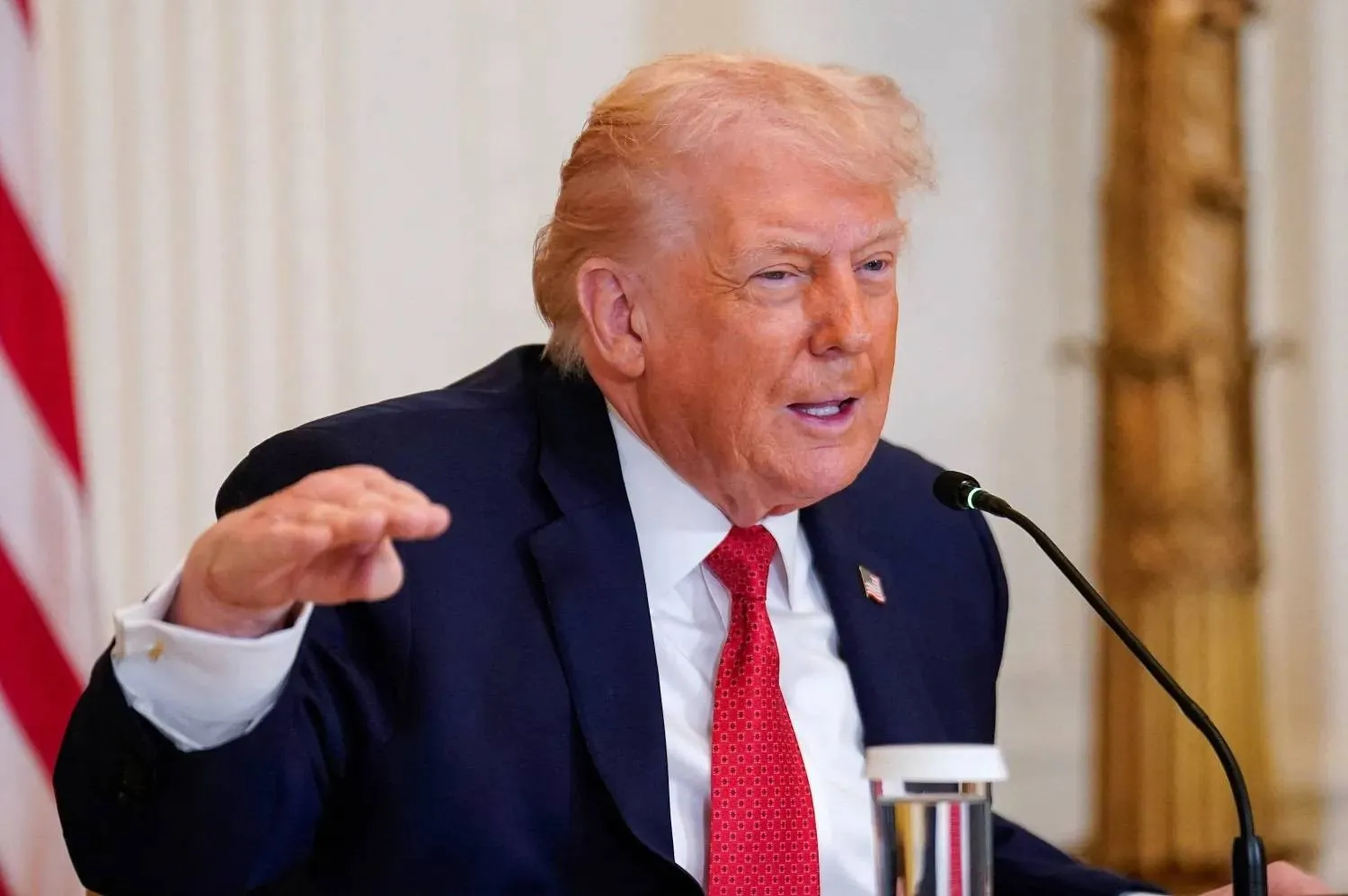

State of the Union Offers Trump a Chance to Make the Case for His Foreign Policy Approach

US President Donald Trump (Reuters)
TT

State of the Union Offers Trump a Chance to Make the Case for His Foreign Policy Approach

US President Donald Trump (Reuters)

President Donald Trump's State of the Union address is expected to tilt heavily on domestic issues, but it's also a chance for the Republican to make the case for his foreign policy efforts to Americans who are increasingly demonstrating uneasiness about his priorities.

The president counts brokering a fragile ceasefire deal in Gaza, capturing autocratic leader Nicolás Maduro in Venezuela and pressing fellow NATO members to increase defense spending among his biggest wins, The Associated Press said.

At a moment when polls show the American public increasingly concerned about the economy, Trump's assignment Tuesday evening also is to cut through thickening skepticism that he’s staying true to his “America First” philosophy after a year in which his focus was often far from home. It's a wariness shared by some who once counted themselves among Trump's closest allies.

“If you had put America FIRST from the start, instead of your rich donor class and foreign policy, you wouldn’t have to strategize on how to gaslight Americans,” former Rep. Marjorie Taylor Greene, a Georgia Republican who resigned from Congress last month after a bitter split with Trump, grumbled on X as the White House prepared its messaging blitz around the address.

Sixty-one percent of US adults said they disapprove of how Trump is handling foreign policy, while 56% say Trump has “gone too far” in using the US military to intervene in other countries, according to surveys from The Associated Press-NORC Center for Public Affairs Research conducted earlier this month and in January.

Here are a few things to look out for in Trump's major address:

Will he take action against Iran? The growing unease comes as Trump weighs whether to carry out new military action on Iran. He last week warned Iran that “bad things will happen” soon if a deal is not reached over its nuclear program.

Trump envoys Steve Witkoff and Jared Kushner are scheduled to meet again Thursday in Geneva with Iranian officials as US warships and fighter jets mass in the Mideast.

The administration appears flummoxed that Iran has not blinked to the mounting pressure.

“He’s curious as to why they haven’t — I don’t want to use the word capitulated — but why they haven’t capitulated,” Witkoff said of Trump in a weekend Fox News appearance.

Trump could use the moment to explain to Americans why military action could be needed, just eight months after he claimed that US strikes had “obliterated” three critical Iranian nuclear facilities and left “the bully of the Middle East" with no choice but to make peace.

The pathway to a deal seems murky as the authoritarian clerics who rule Iran say they will only discuss the nuclear issue. The US and Israel also want to address Iran’s ballistic missile program and its support for regional armed proxies, including Hezbollah, Hamas and the Houthis.

Trump struggles to end the war in Ukraine Tuesday also marks the four-year anniversary of Russia's invasion of Ukraine.

On the campaign trail, Trump boasted that he would be able to end Russia's war on Ukraine in one day, but he has struggled to fulfill his pledge.

Russian and Ukrainian officials are negotiating in US-mediated talks but are at loggerheads over key issues, including Russian demands that Kyiv concede Ukrainian territory still in its control and who will get the Zaporizhzhia nuclear power plant, the biggest in Europe.

Russian troops have moved only about 30 miles (about 50 kilometers) into eastern Ukraine's Donetsk region in the past two years.

Despite the slow pace, Russian President Vladimir Putin maintains his maximalist demands, saying Kyiv must pull its forces from four Ukrainian regions that Moscow illegally annexed but never fully captured.

Trump argues it's inevitable that Russia will win control of the Ukrainian territory and has pressured President Volodymyr Zelenskyy to make a deal to save lives.

“Russia wants to make a deal, and Zelenskyy is going to have to get moving," Trump said last week.

Trump appears eager for a peace deal before the US midterm elections despite the challenges. Zelenskyy says the White House has set a June deadline for the war’s end and will likely pressure both sides to meet it.

Ukraine, Russia and the rest of Europe will be listening closely to hear what Trump has to say about ending the war.

Another victory lap on Maduro and focus on Western Hemisphere Expect Trump to once again celebrate last month's capture of the Venezuelan leader in an audacious military operation.

Maduro and his wife were whisked to New York where they are being held to face trial on federal drug conspiracy charges.

In the aftermath, Trump has called on US oil executives to rush back into Venezuela as the White House tries to quickly secure $100 billion in investments to fix the country’s neglected infrastructure and fully tap into its expansive reserves of petroleum.

Trump’s action against Maduro, coupled with an increasingly aggressive posture in the Western Hemisphere aimed at eliminating drug trafficking and illegal migration, are a concern for many in the region — although they also have won support from some smaller countries.

Trump has likened the strategy to the Monroe Doctrine, with its rejection of outside influences and assertion of US primacy throughout what the administration considers to be “America’s backyard."

US forces, under Trump's orders, have carried out dozens of military strikes on alleged drug-running vessels in the Caribbean, seized sanctioned oil tankers and tightened the embargo of Cuba as part of what the president is referring to as the “Donroe Doctrine.”

Brian Fonseca, a scholar at Florida International University who studies the Americas, said Venezuela is a work in progress for Trump. But it may be the rare issue where he can clearly articulate how a foreign policy directive benefits Americans, Fonseca said.

“With Venezuela, he has the chance to say, ‘The US military under my direction displaced a violent, narco-dictator that was repressing his own people and perpetuating the global drug trade,'” Fonseca said. "'And, by the way, there are now opportunities for America to make a lot of money in Venezuela.'”

Tariff strategy following Supreme Court ruling The president has ridiculed the six justices, including two conservatives he appointed in his first term, who last week struck down his use of a 1977 legal authority he had cited for most of the tariff hikes he imposed over the past year on friends and foes alike.

Trump on Monday threatened countries around the world to abide by any tariff deals they have already agreed to.

Any country that wants to “play games” with the Supreme Court decision, Trump posted on social media, will be met with “a much higher Tariff, and worse, than that which they just recently agreed to.”

Over the weekend, Trump announced he would increase to 15% a new global tariff aimed at replacing many of the import taxes ruled illegal by the Supreme Court last week.

He’s already signed an executive order enabling him to bypass Congress and impose a 10% tax on imports from around the world, starting Tuesday. Those tariffs are limited to 150 days unless they are extended legislatively.

Bharat Ramamurti, who served as a deputy director of the White House National Economic Council in the Biden administration, predicted that Trump's tack will lead to businesses and investors sitting on the sidelines because “they’re just not sure what the tariff outlook is going to be.”

“This decision and the follow-up to pursue other forms of tariffs under other legal authorities is only going to add to that confusion,” Ramamurti added.



Modi Breaks Netanyahu’s Isolation with 16 Cooperation Agreements

The Indian Prime Minister listens to the Israeli Prime Minister during an exceptional session of the Knesset on Wednesday (EPA)
TT

Modi Breaks Netanyahu’s Isolation with 16 Cooperation Agreements

The Indian Prime Minister listens to the Israeli Prime Minister during an exceptional session of the Knesset on Wednesday (EPA)

In a move seen as breaking Israel’s relative international isolation amid its ongoing war in Gaza, Indian Prime Minister Narendra Modi signed 16 agreements with Israel during a two-day visit to the country.

Modi arrived in Israel on Wednesday for talks aimed at strengthening ties in trade and defense. The visit was marked by an unusually warm reception. Israeli Prime Minister Benjamin Netanyahu personally welcomed Modi at the airport and later accompanied him to address the Knesset, Israel’s parliament, where lawmakers applauded and cheered.

Netanyahu hailed Modi as “a great global leader and a great friend; more than that, a great brother.”

He added: “They say India has achieved tremendous accomplishments. That is not accurate. It should be said that thanks to your leadership, your wisdom, and your determination, India has achieved its successes.”

The Israeli premier also thanked Modi for India’s assistance during the recent Gaza war, noting that New Delhi had supplied Israel with ammunition and drones.

Sixteen Agreements and a Historic Honor

The Israeli government announced the signing of 16 bilateral agreements during the visit. In a symbolic gesture, Knesset Speaker Amir Ohana awarded Modi the “Knesset Medal,” marking the first time the honor has been bestowed on a visiting leader.

This is Modi’s second visit to Israel since taking office, nearly nine years after his first trip in 2017.

Beyond political symbolism, the relationship carries significant economic weight. India is Israel’s second-largest trading partner in Asia. According to India’s Ministry of Commerce and Industry, total bilateral trade reached $3.62 billion in fiscal year 2025.

Renewed Indian Condemnation of October 7

For his part, Modi declared that “India stands with Israel at this moment and beyond.” Addressing the Knesset plenary, he offered condolences for those killed in the Oct. 7, 2023 attack launched by Hamas, describing it as a “terrorist and brutal attack.”

Modi also praised a plan proposed by US President Donald Trump that he said would safeguard Palestinian national rights.

Expanding Strategic Ties, Secrecy

Observers view the visit not merely as a reflection of improved relations, but as a major step in advancing strategic cooperation. The agreements include memoranda of understanding designed to deepen coordination across several sectors, particularly in security, with officials describing the partnership as a “distinguished strategic relationship.”

Security sources revealed that the two sides reached an arrangement establishing a “confidentiality framework,” allowing India access to previously restricted Israeli systems. These reportedly include advanced air defense systems and integration into Israel’s laser-based air defense network. India is also expected to receive licenses to manufacture certain Israeli weapons systems domestically.

The Israeli daily Yedioth Ahronoth quoted a senior political official as saying the agreement would provide greater flexibility to security agencies and enable both countries to rely on one another when necessary, calling it “a major revolution.”

Writing in the right-leaning newspaper Israel Hayom, columnist and former lawmaker Zvi Hauser, a political ally of Netanyahu, said one of the key issues Modi and Netanyahu would discuss is Iran’s future and the prospects for the fall of its regime. Hauser suggested that Israel, India, and a post-Revolution Iran could form a powerful strategic alliance in the region.


Cuba Says It Killed Four Gunmen on Speedboat Trying to Infiltrate from US

Cuban coast guard ships docked at the port of Havana. (AFP) 
TT

Cuba Says It Killed Four Gunmen on Speedboat Trying to Infiltrate from US

Cuban coast guard ships docked at the port of Havana. (AFP) 

Cuba said it thwarted the attempt of gunmen trying to infiltrate from the United States as its coastguard opened fire on Wednesday at a Florida-registered speedboat near its shores, killing four people and wounding six.

Havana's Interior Ministry said the speedboat's passengers opened fire on a coast guard vessel that approached them near an island off the country's northern coast.

The ministry claimed the passengers were armed and intended to “carry out an infiltration for terrorist purposes.”

Handguns, assault rifles and improvised explosive devices were recovered on the speedboat, according to the statement, along with other tactical gear.

The ministry said the 10 passengers are all Cuban citizens living in the US.

US Secretary of State Marco Rubio said Washington was seeking its own facts about the shooting and would “respond accordingly.”

“We're not going to base our conclusions on what they've (Cuba) told us, and I'm very, very confident that we will know the full story of what happened here,” Rubio told reporters while on a trip to the Caribbean nation of St Kitts and Nevis. “As we gather more information, then we'll be prepared to respond accordingly.”

James Uthmeier, Florida's attorney general, said he would direct local law enforcement to investigate the incident.

“The Cuban government cannot be trusted, and we will do everything in our power to hold these communists accountable,” he said.

In an earlier statement posted on X, the Cuban interior ministry said the Florida-registered vessel was detected near Cayo Falcones, in the country's central Villa Clara province on Wednesday morning.

When a Cuban boat carrying five members of the ministry's border guard approached the vessel for identification, “the crew of the violating speedboat opened fire” and wounded the Cuban commander, the statement said.

It added that “As a consequence of the confrontation, as of the time of this report, four aggressors on the foreign vessel were killed and six injured.”

Those injured were evacuated and given medical assistance, the statement said.

In Washington, US Vice President JD Vance said the White House was “monitoring” the incident but added that he hoped it was not a serious one.

“Certainly, you know, a situation that we're monitoring, hopefully it's not as bad as we fear it could be. But can't say more, because I just don't know more,” Vance told reporters.

The confrontation comes amid heightened tensions between the United States and Cuba, which lies just 160 km across the Florida Straits. It also comes as the US softened a virtual oil siege of the island imposed by President Donald Trump in January after the US ouster of top Cuba ally, Nicolas Maduro of Venezuela.

Before Maduro's capture by US forces on 3 January, Cuba had relied on Venezuela for about half its fuel needs.

Faced with an outcry from Caribbean leaders, worried that starving Cuba of oil would cause the economy to quickly collapse, the US said it would allow shipments of Venezuelan oil for “commercial and humanitarian use.”


US Arrests Ex-Air Force Pilot for Training Chinese Military

Former Air Force pilot Gerald Brown (photo circulated on social media)
TT

US Arrests Ex-Air Force Pilot for Training Chinese Military

Former Air Force pilot Gerald Brown (photo circulated on social media)

The US Justice Department announced the arrest on Wednesday of a former Air Force fighter pilot who allegedly trained Chinese military personnel without authorization.

Gerald Brown, 65, was arrested in Indiana after having recently returned to the United States from China, where he had been since December 2023, a Justice Department statement said.

He is accused of having "conspired with foreign nationals to provide combat aircraft training to pilots in the Chinese Air Force" without a required license from the US State Department, AFP quoted the statement as saying.

FBI director Kash Patel posted on X: "Major story... the FBI and our partners have arrested a former US Air Force Pilot who was allegedly training pilots in the Chinese military."

Brown had a 24-year career in the US Air Force during which he "commanded sensitive units with responsibility for nuclear weapons delivery systems, led combat missions, and served as a fighter pilot instructor and simulator instructor on a variety of fighter and attack aircraft."

He had retired from the military in 1996 and worked as a cargo pilot, the statement said, but he later began a role as a US defense contractor training pilots to fly the A-10 and state-of-the-art F-35 fighter jets.

He allegedly began negotiating a contract in August 2023 with Stephen Su Bin -- a Chinese national who was imprisoned in the United States for four years beginning in 2016 over another espionage scheme -- and traveled in December 2023 to China to begin his training job.

"The Chinese government continues to exploit the expertise of current and former members of the US armed forces to modernize China's military capabilities," said Roman Rozhavsky, an official with the FBI's Counterintelligence and Espionage Division.

"This arrest serves as a warning that the FBI and our partners will stop at nothing to hold accountable anyone who collaborates with our adversaries to harm our service members and jeopardize our national security," he added.