Rights Group Slams Treatment of Viral Japanese Monkey https://english.aawsat.com/varieties/5244231-rights-group-slams-treatment-viral-japanese-monkey%C2%A0
Rights Group Slams Treatment of Viral Japanese Monkey
This photo taken on February 19, 2026 shows a seven month-old male macaque monkey named Punch, who was abandoned by his mother shortly after birth, sitting with a stuffed orangutan toy at Ichikawa City Zoo and Botanical Gardens in Chiba Prefecture. (AFP/Jiji Press)
TT
TT
Rights Group Slams Treatment of Viral Japanese Monkey
This photo taken on February 19, 2026 shows a seven month-old male macaque monkey named Punch, who was abandoned by his mother shortly after birth, sitting with a stuffed orangutan toy at Ichikawa City Zoo and Botanical Gardens in Chiba Prefecture. (AFP/Jiji Press)
The plight of a baby monkey in Japan who has become an internet sensation shows the cruelty of zoos, an animal rights group said, as sales of the plush IKEA orangutan the animal clings to boomed.
Punch, a baby macaque abandoned by its mother, shot to stardom after being pictured getting bullied by other monkeys and seeking comfort from the orangutan toy at Ichikawa City Zoo outside Tokyo.
"Zoos are not sanctuaries -- they are places where animals are confined, deprived of autonomy, and denied the complex environments and social lives they would have in the wild," said People for the Ethical Treatment of Animals (PETA).
"What some are calling 'cute' is actually a glimpse into the trauma of a young, highly social primate coping with isolation and loss," the group's Asia director, Jason Baker, said in a statement.
"Until facilities stop treating sentient beings as attractions, animals like Punch will continue to suffer in captivity," Baker said, calling for Punch to be moved to a "reputable sanctuary, where he could live in a more natural environment".
Spurned by its mother, Punch was raised in an artificial environment after being born in July, and began training to rejoin his troop last month.
Punch's predicament sparked huge interest online, spawning a devoted fanbase under the hashtag #HangInTherePunch, as large crowds thronged the zoo.
Meanwhile, Swedish interior furnishings giant IKEA, the maker of the orangutan soft toy, said it was seeing "unprecedented" interest and "significantly" higher sales than usual.
"As a result, the product is currently out of stock in some markets, including Japan and the United States," Ingka Group, the holding company controlling most of IKEA's stores, told AFP by email.
Over a long holiday weekend in Japan, fans queued for up to an hour to catch a glimpse of Punch, the Ichikawa zoo said in a post on X, with more than 5,000 visitors recorded on Monday.
The zoo said it had set up a "restricted zone" around part of the monkey enclosure to reduce stress for the animals.
A large number of people have asked how they can donate cash or goods, it added.
In an update on Punch's plight on Sunday, the zoo said he "was meticulously groomed by two monkeys and is steadily fitting into the group".
A huge thermometer mounted on a wall of the headquarters of the United Nations Framework Convention on Climate Change (UNFCCC) shows a temperature of 39 degrees Celsius, during an Europe-wide heatwave, in Bonn, Germany July 1, 2025. REUTERS/Wolfgang Rattay
A huge thermometer mounted on a wall of the headquarters of the United Nations Framework Convention on Climate Change (UNFCCC) shows a temperature of 39 degrees Celsius, during an Europe-wide heatwave, in Bonn, Germany July 1, 2025. REUTERS/Wolfgang Rattay
The EU's climate monitor said Thursday that August was the hottest single month ever recorded globally, with ocean temperatures also reaching unprecedented highs as western Europe capped its warmest summer.
In response to the assessment by the Copernicus Climate Change Service, the UN warned that until humanity weaned off fossil fuels, the planet would only push deeper into uncharted territory.
Copernicus observations go back to 1940 but other evidence -- such as ice cores, tree rings and coral skeletons -- allow scientists to place today's climate against a much longer historical context.
"Humans haven't seen temperatures as hot as today for, arguably, at least the last 100,000 years," Samantha Burgess from the European Centre for Medium-Range Weather Forecasts, which oversees Copernicus, told AFP.
Global average air temperatures in August were 16.96C, Copernicus said -- surpassing by 0.01C the previous all-time monthly record set in July 2023.
Copernicus said it considered the two months joint-highest given the narrow difference.
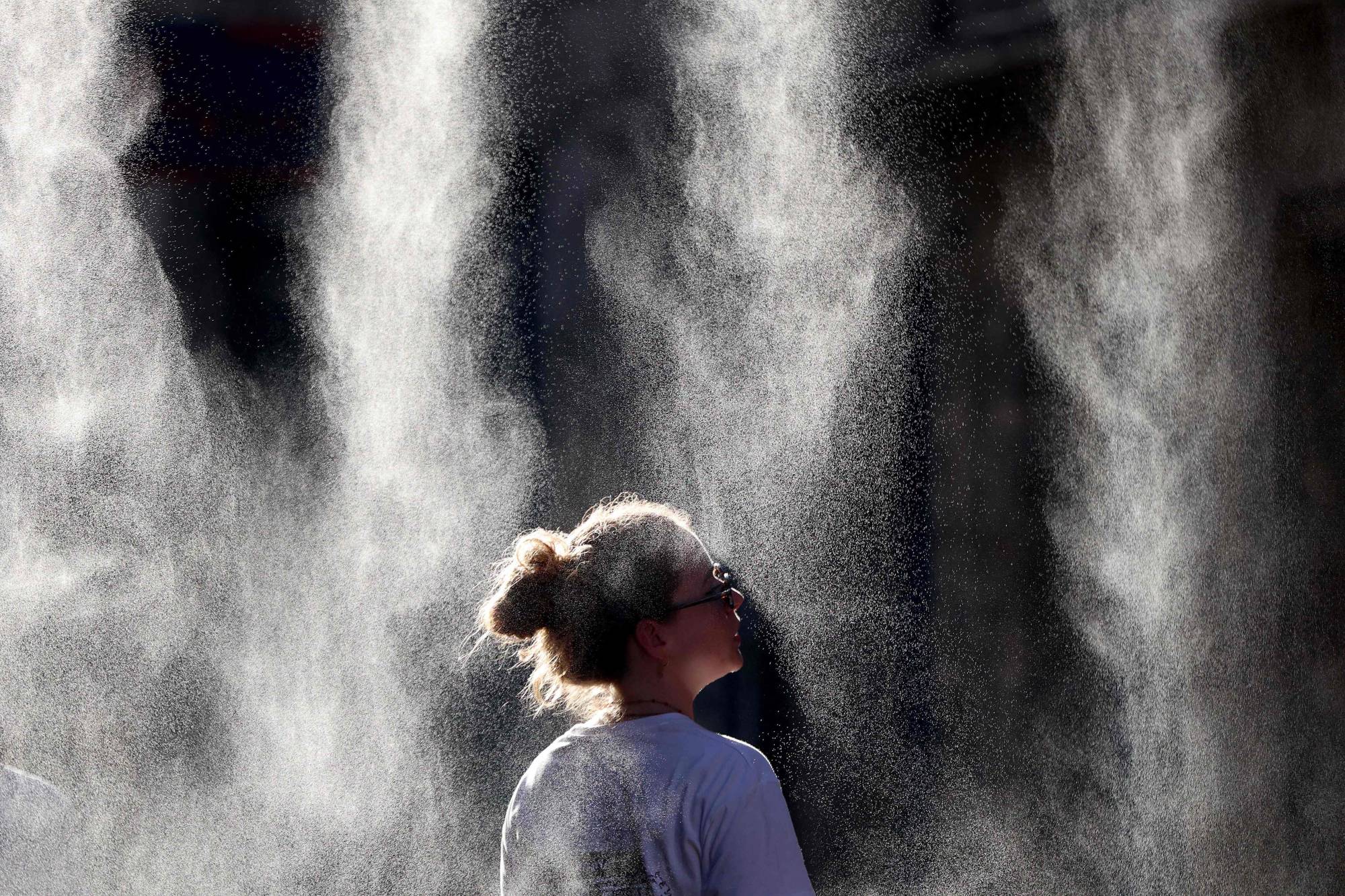
A woman cools off under a water mist during a music festival amidst a heatwave in Bordeaux, southwestern France (AFP)
Scientists say that human activity -- primarily the burning of coal, oil and gas -- has warmed the planet by roughly 1.4C since pre-industrial times and increased the severity and likelihood of extreme weather.
Yet heat-trapping greenhouse gas emissions rose to new highs in 2025.
"The evidence is irrefutable: this is the spiraling price of humanity's fossil fuel addiction, and the global climate crisis it is fueling," United Nations climate chief Simon Stiell said of the Copernicus report.
Global sea surface temperatures also set a new daily high and tied equal-hottest for August, extending a three-month streak of record-breaking warmth across the world's oceans.
More than 90 percent of excess heat trapped by greenhouse gas emissions has been absorbed by the oceans, sparing land from warming but at severe cost to marine life, reefs and coastal communities.
Records tumbled in overheated basins like the Atlantic and Mediterranean and also the tropical Pacific, where the strongest El Nino weather pattern in the modern era is fast accumulating strength.
These events are marked by unusually warm Pacific waters but raise the odds of wild weather thousands of miles away, from floods in Peru to droughts in Africa and wildfires in Australia.
The warmer phase of a natural climate cycle, El Nino episodes usually deliver a temporary spike in global temperatures already elevated by long-term background warming.
Scientists expect records to keep falling in the months ahead as this "super" El Nino approaches peak intensity around December and for 2027 -- and maybe even 2026 -- to become the hottest years ever observed.
"Climate change makes every El Nino hotter, and until we stop burning coal, oil, and gas these record-shattering months will simply keep on coming," said Friederike Otto, a climate scientist from Imperial College London.
A traditional fast-food shop worker tries to cool down a person by pouring water over his head, along Nakamise Street in the Asakusa district, a popular sightseeing spot, in Tokyo, Japan, July 22, 2026. REUTERS/Issei Kato
Copernicus also said that August "marked the end of western Europe's warmest summer" that surpassed the long-standing record set in 2003.
The June to August season was defined by severe, back-to-back heatwaves that shut schools, dried up rivers and primed the land for devastating wildfires.
Between mid-July and mid-August, the continent's EuroMomo monitoring platform estimated that Europe saw more than 32,000 excess deaths.
Scientists from the World Weather Attribution network concluded that a particularly strong heatwave in June would have been "virtually impossible" without the influence of climate change.
But extraordinary heat was felt around the globe.
On Wednesday, the National Oceanic and Atmospheric Administration said the contiguous United States has endured its hottest summer on record.
And regions home to around 900 million people lived through the hottest July ever observed, according to AFP analysis of Copernicus data.
"We've had an exceptional summer -- not only in Europe, but other parts of the world where records that have existed for close to a century have fallen," said Burgess, an ocean scientist and strategic lead for at ECMWF.
The climate would "continue to get more extreme unless we turn off the tap to global emissions", she added.
As Oceans Warm, Florida Scientists Hunt for Heat-resistant Coralhttps://english.aawsat.com/varieties/5316670-oceans-warm-florida-scientists-hunt-heat-resistant-coral
A mass of bleached staghorn coral, its pale and white branches a sign of stress after prolonged exposure to abnormally warm ocean waters, is seen off the coast of Florida on August 28, 2026. (Photo by Jesus Olarte / AFP)
As Oceans Warm, Florida Scientists Hunt for Heat-resistant Coral
A mass of bleached staghorn coral, its pale and white branches a sign of stress after prolonged exposure to abnormally warm ocean waters, is seen off the coast of Florida on August 28, 2026. (Photo by Jesus Olarte / AFP)
Off Florida's coast, a team of scientists and trained volunteers in scuba gear descends to the ocean floor and begins planting young coral onto a reef and examining how others are faring in the increasingly warm waters.
It is part of a long-running "Rescue a Reef" program run by the University of Miami that aims to advance conservation efforts and raise public awareness.
Part of that work involves researching which coral species are able to better withstand rapidly warming oceans as a result of human-caused climate change.
"Certain species may be more resilient, where they're able to better survive and recover from thermal stress events," program manager Devon Ledbetter explained to AFP during a recent dive to Rainbow Reef about three miles offshore from Key Biscayne.
Coral reefs support vibrant marine ecosystems, but also act as breakwaters, protecting coastlines from storm-driven erosion and flooding.
The situation, however, is increasingly dire.
A record-breaking marine heat wave that began in 2023 left two ecologically vital coral species, elkhorn and staghorn, "functionally extinct" in Florida's Coral Reef, highlighting the growing dangers a warming climate poses for the world's oceans.
The National Oceanic and Atmospheric Administration believes that this fourth global coral bleaching event likely concluded in mid-2025. But the arrival of a very strong El Nino could bring a return to more widespread bleaching -- including in Florida's waters.
During the expedition, the participants go about their tasks diligently. Some coral species with fast-growing branches are planted onto "coral trees" that look like old television antennas and are suspended in the water column, with floats to keep them upright.
Others are placed onto table frames fixed to the ocean floor, and yet others are mounted onto plugs, screwed into a three-hole "cookie" and planted onto the reef.
These are given predation umbrellas to protect them from the hungry fish having a nibble.
Researchers place color reference charts around newly planted coral to record the pigmentation, a method used to monitor its health and detect early signs of heat stress.
Coral is made up of tiny individual animals called polyps, which maintain a symbiotic relationship with microscopic algae that live within their tissues.
When the algae are stressed by heat or pollution, however, they leave, causing the coral to "bleach" and become vulnerable to disease and death.
"Anecdotally, we've seen that Mountainous Star Coral tends to be the most resilient to bleaching and thermal stress," Ledbetter explained. So far, this summer the program has planted 615 coral, with 228 of those part of the thermal bleaching study. Their results are then given to state environmental and wildlife authorities.
The program began in 2015 and Ledbetter explained it exists both to serve science and educate the public -- but also to rebuild the ecosystem "one coral at a time."
The risks have never been higher. Even with the end of the fourth global bleaching event, sea surface temperatures are still higher than 25 to 30 years ago, when the first global coral bleaching event occurred, according to recent research published by NOAA in the journal Coral Reefs.
Indonesian Wildfire Emissions Surge to World’s Highest, Data Showshttps://english.aawsat.com/varieties/5316324-indonesian-wildfire-emissions-surge-world%E2%80%99s-highest-data-shows
This aerial photo taken from a commercial aircraft shows haze from Indonesian forest fires blanketing a bridge in Kuching, the capital city of Malaysia's Sarawak state on the island of Borneo on September 5, 2026. (AFP)
TT
TT
Indonesian Wildfire Emissions Surge to World’s Highest, Data Shows
This aerial photo taken from a commercial aircraft shows haze from Indonesian forest fires blanketing a bridge in Kuching, the capital city of Malaysia's Sarawak state on the island of Borneo on September 5, 2026. (AFP)
Indonesia is facing a surge in emissions from wildfires burning through parched stretches of forest and peatland on the islands of Borneo and Sumatra, with carbon dioxide readings currently the highest in the world, data showed on Wednesday.
Fire emissions from Indonesia from September 1 to September 7 reached 19.7 million metric tons, overtaking Russia this week and making up more than a third of the global total, according to Fire Emissions Watch, a portal developed by the European Union's Copernicus climate monitoring service.
Indonesia is one of the world's most fire-prone countries, but as "super-El Nino" weather conditions drive up temperatures and cause punishing droughts, the country is battling what authorities say is its most intense wildfire season in 11 years.
"We do expect to see some fires across the region at this time of year, but with El Nino, it clearly just gives a big enhancement to them," said Mark Parrington, senior scientist at the Copernicus Atmosphere Monitoring Service in Bonn.
"It's much drier, it's hotter, and when there's ignition, these fires burn in a far more extreme way."
From September 1 to September 7, fire emission intensity exceeded 1,500 kg/sq km, more than 10 times the Russian level, with the highest concentrations in Kalimantan in Indonesia's part of Borneo and eastern parts of Sumatra, Copernicus data showed on Wednesday.
Emissions were 273% higher than the seasonal average, though still lower than the 21.7 million tons emitted in the same week of 2015, when Indonesia was battling similarly intense El Nino conditions.
Among the hardest hit areas has been the city of Pontianak in West Kalimantan, where the air quality index was 394 on Wednesday, according to Swiss air quality monitoring firm IQAir. A reading of 300 is considered hazardous.
Indonesia's environment ministry told Reuters in a statement that it viewed the hazardous air quality readings in Kalimantan and elsewhere "with concern".
It said it was monitoring Copernicus's data, but added it "does not directly reflect air quality conditions in a specific area", and other factors needed to be taken into account.
'BELOW THE DETECTION LIMIT'
From January to July this year, fires burned around 202,000 hectares (780 square miles) of Indonesian land, about a third the amount over the same period in 2015, said Nisa Novita of the environmental group YKAN, which helps communities tackle fires.
"However, August data are estimated to show a significant increase of around 600,000 hectares, particularly in Kalimantan, Sumatra and South Papua," she said.
Indonesia lost a total of 2.6 million hectares to fire in the whole of 2015, an area bigger than Wales.
The number of recorded hotspots from August 1 to September 8 reached 13,443, compared to 9,454 over the same period of 2015, according to Indonesian forest ministry monitoring platform Sipongi, based on data from NASA's Terra and Aqua satellites.
A record monthly high for hotspots was recorded in October 2015, Sipongi data showed.
Fire Emissions Watch uses satellite observations to estimate concentrations of particulate matter, volatile organic compounds, greenhouse gases and other fire-fuelled pollutants, but Parrington said it could actually be underestimating the extent of the problem.
"One of the aspects with peat fires is if they're burning at low temperatures or underground, they'd be below the detection limit of the sensors, which means we're not actually seeing them," he said.
Studies have shown that fires in Indonesia in 2015 produced more emissions per day than the whole of the EU, and caused more than 100,000 excess deaths throughout Indonesia, Malaysia and Singapore.
"We have to remember that this is still the beginning of the season, and we expect the fires to continue and the emissions to keep increasing, potentially through to the end of October, which is what we saw in 2015," said Parrington.
"In two months we'll know how extreme this year has been, but the early indications are that it is at pace, if not slightly above those previous El Nino years."
لم تشترك بعد
انشئ حساباً خاصاً بك لتحصل على أخبار مخصصة لك ولتتمتع بخاصية حفظ المقالات وتتلقى نشراتنا البريدية المتنوعة