
Macron to Set Out How France’s Nuclear Arms Could Protect Europe

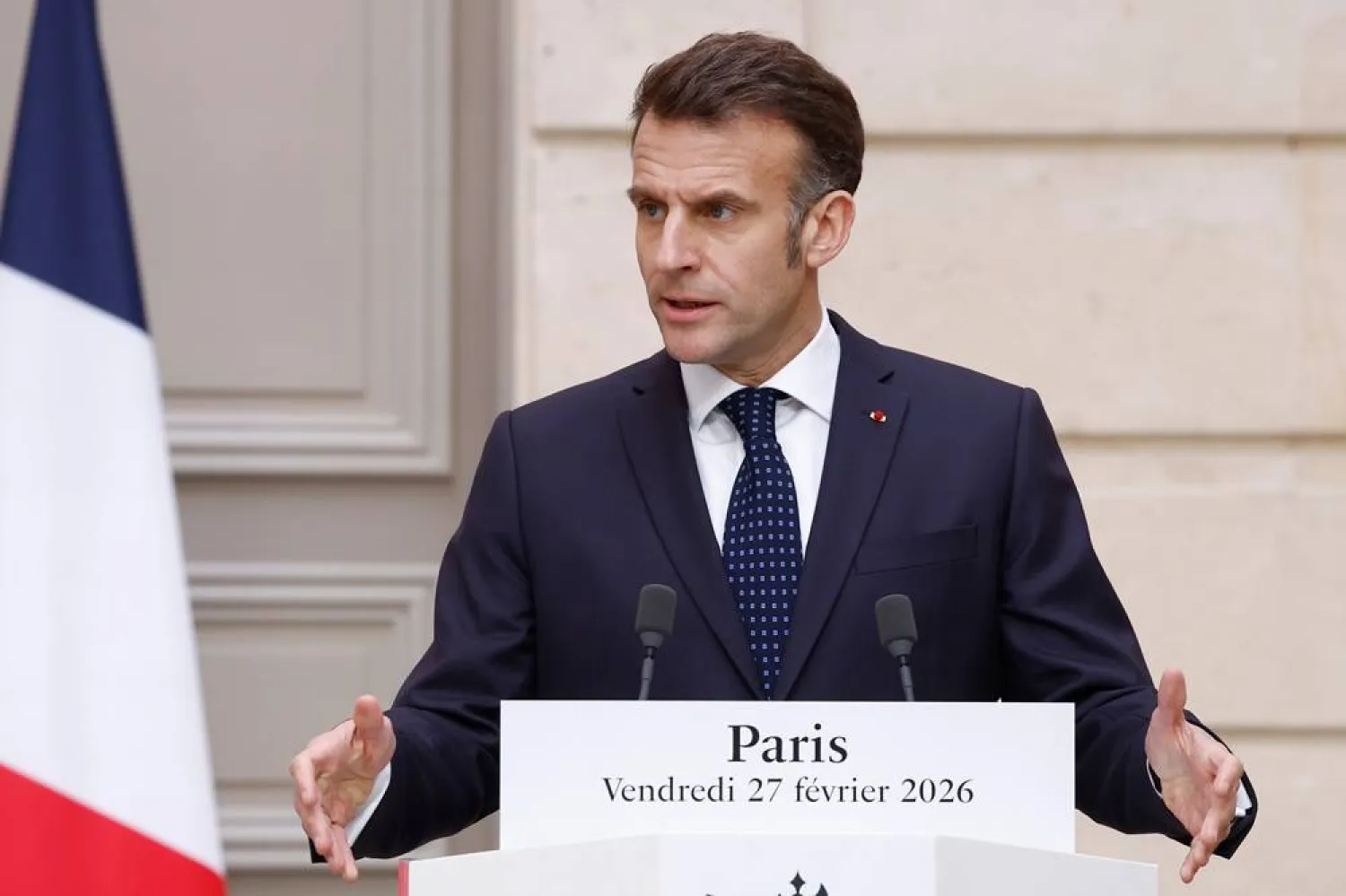
 French President Emmanuel Macron attends a joint news conference with Slovenia's Prime Minister Robert Golob at the Elysee Palace in Paris, France, Friday, Feb. 27, 2026. (AP)
French President Emmanuel Macron attends a joint news conference with Slovenia's Prime Minister Robert Golob at the Elysee Palace in Paris, France, Friday, Feb. 27, 2026. (AP)
TT

Macron to Set Out How France’s Nuclear Arms Could Protect Europe

 French President Emmanuel Macron attends a joint news conference with Slovenia's Prime Minister Robert Golob at the Elysee Palace in Paris, France, Friday, Feb. 27, 2026. (AP)
French President Emmanuel Macron attends a joint news conference with Slovenia's Prime Minister Robert Golob at the Elysee Palace in Paris, France, Friday, Feb. 27, 2026. (AP)

French President Emmanual Macron is Monday to reveal his vision for how France's nuclear arsenal could bolster defense in Europe, with the continent scrambling to re-arm against an aggressive Russia and as Washington turns away.

The speech by Macron, at France's Ile Longue nuclear submarine base, will be closely watched across Europe, which for decades has relied on the United States' nuclear deterrent but is now increasingly debating whether to bolster its own arsenals.

He is expected to update France's nuclear doctrine, with a member of his team telling AFP to expect "fairly significant shifts and developments" but declining to give any further details.

Macron has previously proposed to consider how France -- the European Union's only nuclear power -- could contribute to protecting Europe.

He said this month he is considering a doctrine that could include "special cooperation, joint exercises, and shared security interests with certain key countries".

Last year, Macron said he was ready to discuss possible deployment of French aircraft armed with nuclear weapons in other European countries.

France maintains the world's fourth-largest nuclear arsenal, estimated at around 290 warheads. Britain, which exited the EU in 2106, is the only other European nuclear power.

By contrast, the United States and Russia, the world's two main atomic powers, have thousands of nuclear warheads each.

Reassurances from US officials that Washington's deterrent would continue to cover Europe under the NATO alliance have done little to quell European fears of fickleness under US President Donald Trump.

"It is clear that we will need to reflect together on how French and British deterrence can fit into a more assertive European defense," Bernard Rogel, who served as top military adviser to Macron, told AFP.

- '27 buttons' -

This month, German Chancellor Friedrich Merz said that he was holding "confidential talks with the French president about European nuclear deterrence".

Britain's Prime Minister Keir Starmer has said the UK's nuclear deterrent already protects fellow NATO members, but stressed that he was "enhancing our nuclear cooperation with France".

But how exactly nuclear cooperation would work between the EU's 27 states is another story.

Rogel insisted that control over the launch decision will remain in French hands.

"I can't see us having 27 buttons. From a credibility standpoint, that just doesn't work," he said.

On top of that, France's austerity drive and strains in the relationship between it and fellow EU powerhouse Germany, have exposed fault lines in any potential security agreement.

This month, German Foreign Minister Johann Wadephul criticized French defense spending, calling for Paris to do more to turn calls for European security sovereignty into concrete action.

"We are looking forward to and eagerly await another speech by the French president," Wadephul added.

But Rafael Loss, a policy fellow at the European Council on Foreign Relations, said leaders should find confidence in European support for strengthening nuclear deterrence.

He said people in Bulgaria, Denmark, Estonia, Germany, Poland, Portugal, Spain and Switzerland now tend to support rather than oppose the idea of developing an alternative European nuclear deterrent.

"French and British nuclear forces -- as the core of a future European strategic deterrent -- likely need to grow in size and change composition (or both)," he wrote.

While a NATO member, France does not make its atomic weapons available to the alliance.

But in his last nuclear doctrine update in 2020, Macron called for dialogue among EU countries about what role the French nuclear deterrent could play.

- 'Expectations' -

NATO's secretary-general at the time, Jens Stoltenberg, dismissed Macron's call for strategic dialogue in Europe, arguing that a "tried and tested" deterrent was already in place.

But the picture changed after Russian leader Vladimir Putin invaded Ukraine in 2022, repeatedly brandishing the threat of Moscow's nuclear arsenal, while Trump has pushed Europe down his list of priorities.

Florian Galleri, a historian specializing in contemporary military studies and nuclear doctrines, also warned that Macron would have to tread carefully, pointing to his low approval ratings one year before the end of his presidency.

"This speech creates expectations," he said. "If it is weak, people will wonder why it was made in the first place. If it is strong, with real changes, the consequences could be significant."

But Macron's address could also spark a domestic political backlash ahead of the 2027 presidential election, in which Marine Le Pen's Euroskeptic far right is seen as having its best chance yet at winning the top job.

"The fear is that it could discredit any form of European dimension," said Galleri.


Rubio Designates Iran 'State Sponsor of Wrongful Detention'

US Secretary of State Marco Rubio arrives for US President Donald Trump's State of the Union address to a joint session of Congress at the US Capitol in Washington, D.C., US, February 24, 2026. REUTERS/Nathan Howard/File Photo
TT

Rubio Designates Iran 'State Sponsor of Wrongful Detention'

US Secretary of State Marco Rubio arrives for US President Donald Trump's State of the Union address to a joint session of Congress at the US Capitol in Washington, D.C., US, February 24, 2026. REUTERS/Nathan Howard/File Photo

The United States on Friday designated Iran a "state sponsor of wrongful detention," its first such move under a new blacklist that could eventually result in a travel ban.

The step comes as the United States builds up its military near Iran and threatens to strike over concerns led by its disputed nuclear program.

"The Iranian regime must stop taking hostages and release all Americans unjustly detained in Iran, steps that could end this designation and associated actions," Secretary of State Marco Rubio said in a statement, AFP reported.

If Iran makes no progress, Rubio said that the United States could eventually decide that US passports are invalid for travel to Iran.

The United States only forbids its nationals from traveling to one country -- North Korea -- and many Iranian-Americans routinely travel to Iran, ruled since 1979 by clerics after the overthrow of the pro-US shah.

President Donald Trump in September signed an executive order that created the blacklist on wrongful detention, similar to designations by the United States on terrorism.

Iran becomes the first country to be placed on the blacklist. The Islamic republican has detained a number of Americans in recent years, usually dual nationals whom the government considers Iranian citizens.

"No American should travel to Iran for any reason. We reiterate our call for Americans who are currently in Iran to leave immediately," Rubio said.


Israel Greets Iran Talks With Pessimism, Prepares for War

Man uses binoculars to watch the Mediterranean ahead of the expected arrival of the aircraft carrier Gerald Ford at Haifa port (EPA)
TT

Israel Greets Iran Talks With Pessimism, Prepares for War

Man uses binoculars to watch the Mediterranean ahead of the expected arrival of the aircraft carrier Gerald Ford at Haifa port (EPA)

Despite cautious optimism over negotiations between Iran and the US and hopes for a new nuclear deal, Israel’s political leadership and most of its media have struck a starkly different tone: pessimism, and open preparation for failure and war.

A growing conviction that a confrontation with Iran is inevitable has taken hold among Israelis, with opinion polls showing broad support for military action.

Political leaders have reinforced the mood, citing what they call “Iranian intransigence” and warning that any agreement Washington might reach with Tehran would be a bad one.

Military officials have stressed the Israeli army’s readiness for all scenarios, while media reports describe intensified Israeli and US military movements inside Israel.

On Friday, Yedioth Ahronoth splashed a headline reporting that US F-22 fighter jets that arrived in Israel were placed on maximum alert on the runway at Ovda airport in the Negev desert.

The F-22 is among the most advanced aircraft in service and is not sold to any other military because of the sensitivity of its combat technology. The newspaper said 26 of the 45 jets produced for the US military had reached Israel.

Tensions have also been fueled by reports that the aircraft carrier Gerald Ford docked at an Israeli port, that several airlines suspended flights to Israel, and that large numbers of US troops are stationed at Israeli bases to operate US air defense systems deployed to the country in recent weeks.

Some analysts say the flurry of activity could be part of a coordinated US pressure campaign on Iran. But most argue the main aim is to prepare for negotiations collapsing, allowing a swift pivot from diplomacy to war.

Israeli media reported that the army has privately signaled unease over what it sees as a drift toward support for war without reckoning with the potential cost to Israel.

Israeli army spokesperson Brigadier General Effie Defrin said there had been no change in public guidance.

In a recorded statement, he said the military was closely monitoring developments in Iran and remained on alert, ready to defend in full coordination with partners to bolster air defenses.

If there is any change, authorities will provide the public with an immediate update, he said.

Yedioth Ahronoth reported that the government is preventing the army from speaking openly about the risks. In a report two days earlier, it said the army was refraining from briefing the public under pressure from the political echelon not to disclose potential consequences.

The paper added that none of the army’s scenarios for the current year, including the possibility of a sudden round of fighting with Iran, envisioned a full-scale war with a major regional power like Iran, which has drawn lessons from the previous war.

It said Tehran is working to replenish its missile arsenal and restore its air defenses.

While 30 Israelis were killed in the previous war against Iran, the army is now warning that in a future conflict, scenarios such as an Israeli warplane being shot down inside Iran or greater destruction inside Israel, including the deaths of dozens of civilians, are more plausible.

It also cautioned against being dragged into a “war of attrition” lasting many months and imposing a heavy economic toll, with heavy missiles launched from Iran at a steady pace, disrupting operations at Ben Gurion Airport and striking the home front.

Media leaks continued on Friday, with reports that Israeli military chief of staff Eyal Zamir warned Prime Minister Benjamin Netanyahu that Hezbollah could join such a war, even though it stayed out of the previous conflict and recently said it did not intend to take part.

Zamir was quoted as saying Iran pumped $1 billion into the party’s coffers last year alone through smuggling operations, expanding its arsenal to include tens of thousands of precision missiles, long-range rockets, explosive drones and tens of thousands of fighters ready to confront Israeli forces if they enter Lebanon — a major challenge for Israel.

In contrast, Amos Harel, military analyst for Haaretz, struck a different note.

Entering a major, and possibly prolonged, war in the Middle East runs counter to US President Donald Trump’s instincts and everything he has advocated for years, he wrote.

Trump, Harel noted, has long argued that the United States became mired in costly wars in Vietnam, Afghanistan and Iraq, favoring swift, decisive outcomes that allow him to declare victory.

With US public support for war against Iran low and Americans more concerned about the cost of living and domestic turmoil, Harel suggested this may explain Trump’s reluctance to escalate his rhetoric and his repeated delays, while keeping a narrow opening for Tehran to step back and accept a new nuclear deal.


Tram Derails in Central Milan, Leaving One Dead, 40 Injured

Emergency services work at the scene of a derailment on Line 9 in Milan, Italy, Friday, Feb. 27, 2026. (AP)
TT

Tram Derails in Central Milan, Leaving One Dead, 40 Injured

Emergency services work at the scene of a derailment on Line 9 in Milan, Italy, Friday, Feb. 27, 2026. (AP)

One person was killed and around 40 injured, including one in a critical condition, when a tram derailed in central Milan on Friday, a spokesperson for local ‌firefighters said.

The ‌tram, one of ‌the ⁠newest models in ⁠operation in Milan, came off the tracks in Vittorio Veneto street, one of the city's key downtown corridors, crashing into the ⁠window of a shop, the ‌spokesperson ‌Vittorio Di Giacomo told Reuters.

Local ‌emergency services said 13 ‌ambulances were on the scene.

Civil protection teams set up a tent to assist the injured, according ‌to a Reuters eyewitness.

The Milan transport company, ATM, ⁠said ⁠in a statement it was "deeply shocked" by the accident, expressed its sympathy to all those affected and said it was working with judicial authorities to try to understand what caused it.