


Iran President, 2 Officials to Lead Transition after Khamenei's Death

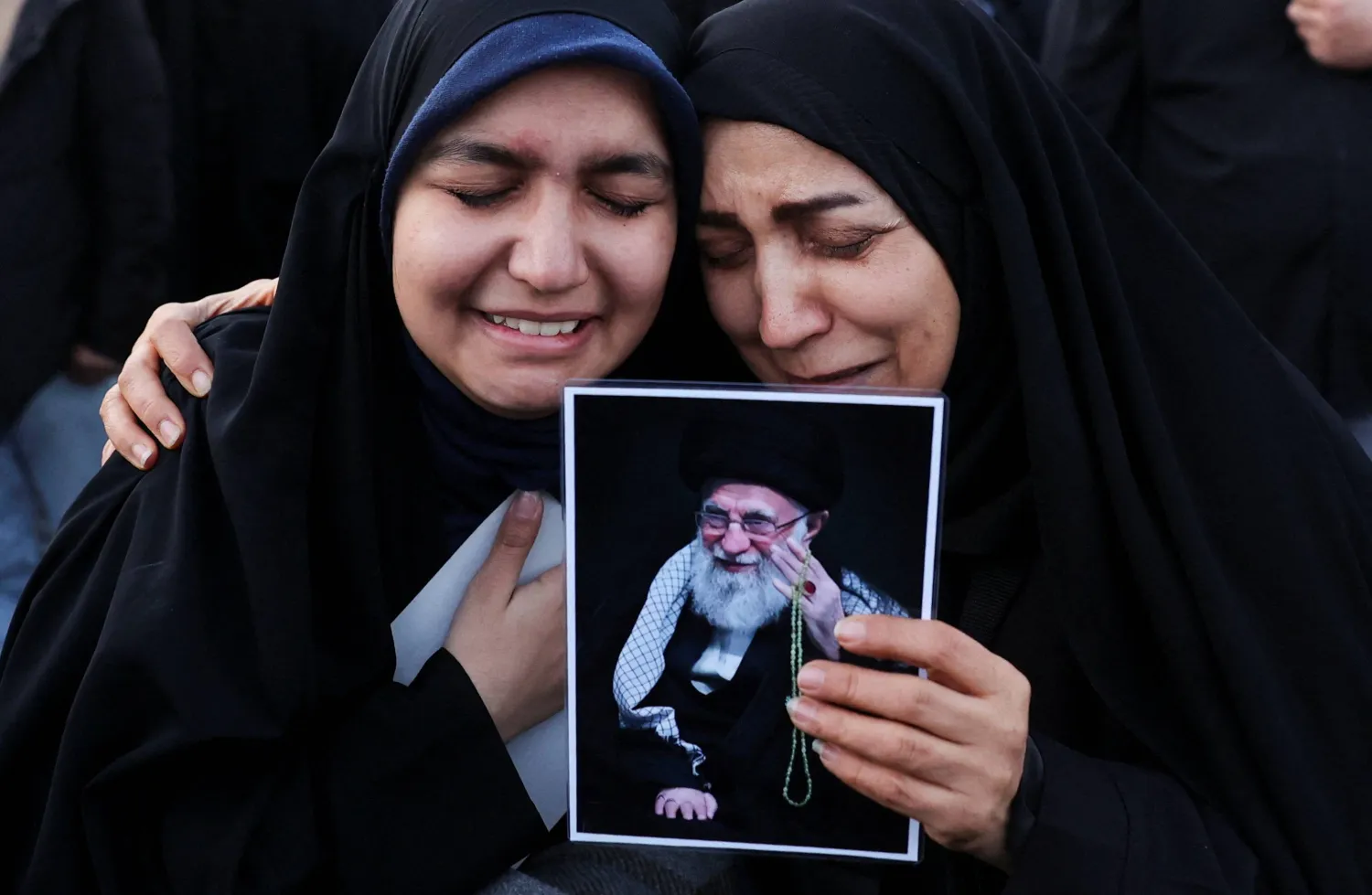
People react as they gather at the Enghelab Square, after Iran's Supreme Leader Ali Khamenei was killed in Israeli and US strikes on Saturday, in Tehran, Iran, March 1, 2026. Majid Asgaripour/WANA (West Asia News Agency) via REUTERS
TT

Iran President, 2 Officials to Lead Transition after Khamenei's Death

People react as they gather at the Enghelab Square, after Iran's Supreme Leader Ali Khamenei was killed in Israeli and US strikes on Saturday, in Tehran, Iran, March 1, 2026. Majid Asgaripour/WANA (West Asia News Agency) via REUTERS

Iranian President Masoud Pezeshkian and two top other officials will lead Iran in the transitional period following the death of supreme leader Ali Khamenei, state television reported on Sunday.

Judiciary chief Gholamhossein Mohseni Ejei and another official from the country's legal council will be part of the trio overseeing the transition, according to state television which cited Mohammad Mokhber, one of Khamenei's advisors.

The United States and Israel launched waves of strikes Saturday against targets in Iran, sparking swift retaliation by the Iranian republic.

US President Donald Trump said that Iran's supreme leader Ali Khamenei was dead. Iranian state television confirmed the news early Sunday.

The death of Khamenei raises paramount questions about the country's future. And while a clerical panel is tasked with replacing him, succession is a complex matter in Iran's theocracy: 

Here is what to know: 

A clerical council selects a new supreme leader  

An 88-member panel called the Assembly of Experts appoints the supreme leader. The panel can remove one as well, although that has never happened. 

The panel consists entirely of Shiite clerics who are popularly elected every eight years and whose candidacies are approved by the Guardian Council, Iran's constitutional watchdog. That body is known for disqualifying candidates in various elections in Iran and the Assembly of Experts is no different. The Guardian Council barred former Iranian President Hassan Rouhani, a relative moderate whose administration struck the 2015 nuclear deal with world powers, from election for the Assembly of Experts in March 2024. 

A temporary leadership council may assume duties in case of delay Iranian law says the Assembly of Experts “must, as soon as possible” pick a new supreme leader. But until then, a leadership council can step in and “temporarily assume all the duties of leadership.” 

The assembly is made up of Iran's sitting president, the head of the country's judiciary and a member of the Guardian Council chosen by Iran's Expediency Council, which advises the supreme leader and settles disputes with parliament. If that were to happen now, Iran's reformist President Masoud Pezeshkian and hard-line judiciary chief Gholamhossein Mohseni Ejei would be on that leadership council. 

Khamenei's son could be a possible contender  

Clerical deliberations about succession and machinations over it take place far from the public eye, making it hard to gauge who may be a top contender. 

Previously, it was thought Khamenei's protégé, hard-line President Ebrahim Raisi, may try to take the mantle. However, he was killed in a May 2024 helicopter crash. That has left one of Khamenei's sons, Mojtaba, a 56-year-old Shiite cleric, as a potential candidate, though he has never held government office. But a father-to-son transfer in the case of a supreme leader could spark anger, not only among Iranians already critical of clerical rule, but also among supporters of the system. Some may see it as un-Islamic and in line with creating a new, religious dynasty after the 1979 collapse of the US-backed Shah Mohammad Reza Pahlavi's government. 

A transition like this has happened only once before  

There has been only one other transfer of power in the office of supreme leader of Iran, the paramount decision-maker since the country's 1979 Iranian Revolution. 

In 1989, Grand Khomeini died at age 86 after being the figurehead of the revolution and leading Iran through its bloody eight-year war with Iraq. This transition now comes after Israel launched a 12-day war against Iran in June 2025 as well. 

The vast powers of a supreme leader  

The supreme leader is at the heart of Iran’s complex power-sharing Shiite theocracy and has final say over all matters of state. 

He also serves as the commander-in-chief of the country's military and the powerful Revolutionary Guard, a paramilitary force that the United States designated a terrorist organization in 2019 and which Khamenei empowered during his rule. The Guard, which has led the self-described “Axis of Resistance,” a series of militant groups and allies across the Middle East meant to counter the US and Israel, also has extensive wealth and holdings in Iran. 


Iranian Leaders Want to Talk, Says Trump

US President Donald Trump delivers remarks during an event at the Port of Corpus Christi in Corpus Christi, Texas, US, February 27, 2026. (Reuters)
TT

Iranian Leaders Want to Talk, Says Trump

US President Donald Trump delivers remarks during an event at the Port of Corpus Christi in Corpus Christi, Texas, US, February 27, 2026. (Reuters)

US President Donald Trump said on Sunday that Iran's new leadership wants to talk to him and that he has agreed, according to an interview with the Atlantic magazine.

"They want to talk, and I have agreed to talk, so I will be talking to ‌them. They ‌should have done it ‌sooner. ⁠They should have given what ⁠was very practical and easy to do sooner. They waited too long," Trump said in the interview from his Florida residence.

Trump did not specify who he would be speaking with or say whether ⁠it would occur on Sunday ‌or Monday.

Iranian ‌President Masoud Pezeshkian said a leadership council composed of ‌himself, the judiciary head and a ‌member of the powerful Guardians Council had temporarily assumed the duties of supreme leader following the death of Ali Khamenei.

Trump said some ‌of the people who were involved in recent talks with the ⁠US are ⁠no longer alive.

"Most of those people are gone. Some of the people we were dealing with are gone, because that was a big - that was a big hit," he was quoted as saying in the interview with Atlantic staff writer Michael Scherer.

"They should have done it sooner, Michael. They could have made a deal. They should've done it sooner. They played too cute."


Iran Insists ‘No Limit’ Its Right to Self-Defense, Says FM

Iran's Foreign Minister Abbas Araghchi addresses a special session of the Conference on Disarmament at the United Nations, aside of US-Iran talks in Geneva, Switzerland, February 17, 2026. (Reuters)
TT

Iran Insists ‘No Limit’ Its Right to Self-Defense, Says FM

Iran's Foreign Minister Abbas Araghchi addresses a special session of the Conference on Disarmament at the United Nations, aside of US-Iran talks in Geneva, Switzerland, February 17, 2026. (Reuters)

A top Iranian official on Sunday rejected President Donald Trump's warning not to retaliate against massive US-Israel bombardments, saying there would be "no limit" to the country's self-defense.

"Nobody can tell us that you don't have any right to defend yourselves. We are defending ourselves whatever it takes, and we see no limit for ourselves to defend our people, to protect our people," Foreign Minister Abbas Araghchi told ABC News.

"What the United States is doing is an act of aggression. What we are doing is the act of self-defense. There are huge differences between these two," he said.


Three US Military Members Killed in Iran Operation

Aircraft attached to Carrier Air Wing (CVW) 9 sit on the flight deck of the US Navy Nimitz-class aircraft carrier USS Abraham Lincoln in support of the Operation Epic Fury attack on Iran, February 28, 2026. (US Navy/Handout via Reuters)
TT

Three US Military Members Killed in Iran Operation

Aircraft attached to Carrier Air Wing (CVW) 9 sit on the flight deck of the US Navy Nimitz-class aircraft carrier USS Abraham Lincoln in support of the Operation Epic Fury attack on Iran, February 28, 2026. (US Navy/Handout via Reuters)

The US military Sunday said three service members have been killed and five seriously wounded in the operation against Iran -- the first casualties of any kind announced on the US side.

The United States launched massive bombardments against Iran and killed its supreme leader Saturday, with attacks ongoing Sunday.

"Three US service members have been killed in action and five are seriously wounded as part of Operation Epic Fury. Several others sustained minor shrapnel injuries and concussions -- and are in the process of being returned to duty," US Central Command (CENTCOM) said in a statement.

"Major combat operations continue and our response effort is ongoing. The situation is fluid, so out of respect for the families, we will withhold additional information, including the identities of our fallen warriors, until 24 hours after next of kin have been notified."

US air and naval forces, together with Israeli forces, are heavily bombarding Iran and President Donald Trump has said the goal is to destroy the country's military capacity.

In response, Iran has fired missiles at targets in Israel and at US military facilities around the region.

Earlier Sunday, Iran's Revolutionary Guards said they had successfully hit the aircraft carrier USS Abraham Lincoln in the Gulf with four ballistic missiles.

However, CENTCOM said the aircraft carrier "was not hit."

"The missiles launched didn't even come close. The Lincoln continues to launch aircraft in support of CENTCOM's relentless campaign to defend the American people by eliminating threats from the Iranian regime," a statement said.
