

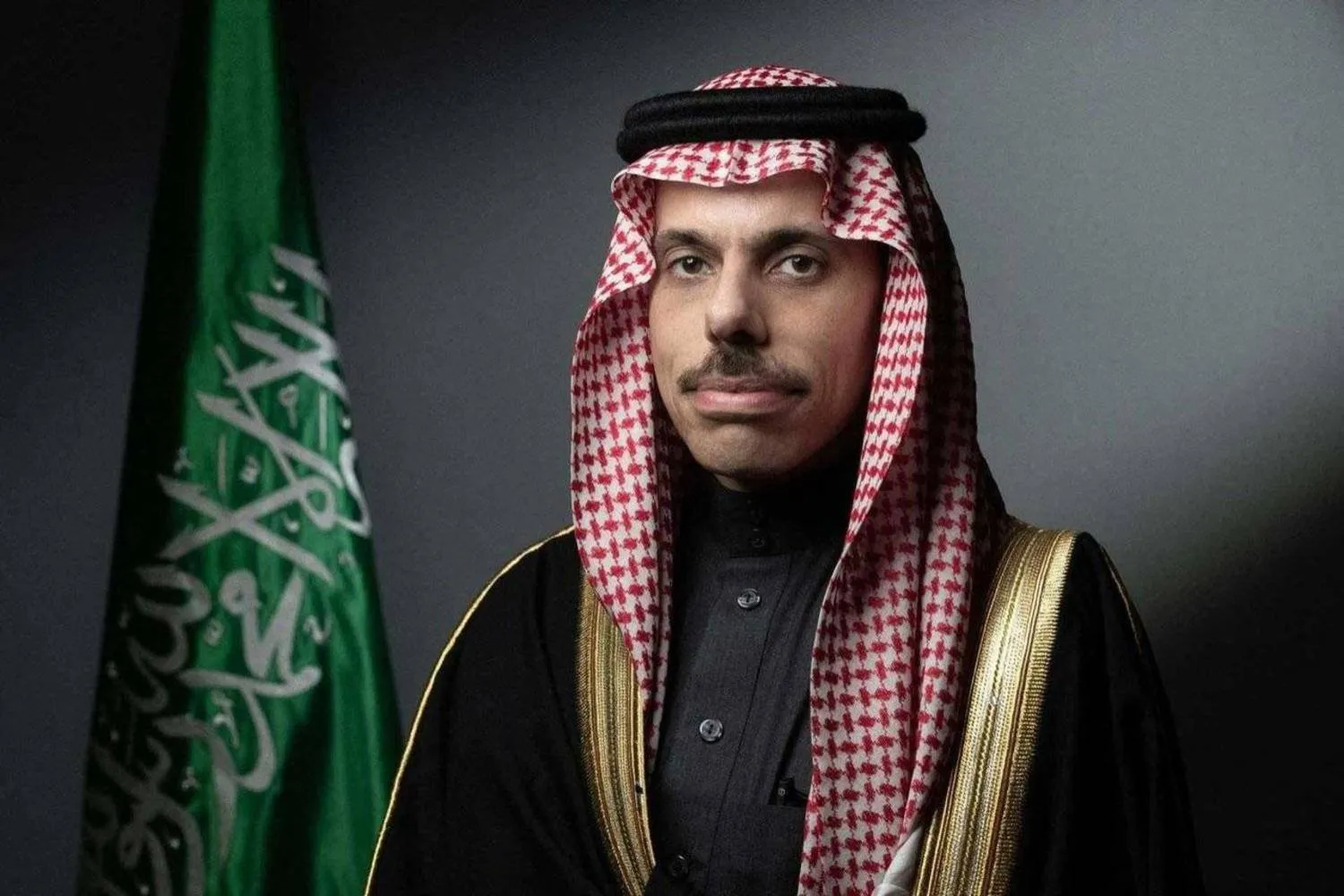

Saudi FM Holds Series of Calls with Regional, Int'l Counterparts on Escalation and Iranian Attacks

Saudi Minister of Foreign Affairs Prince Faisal bin Farhan bin Abdullah
TT

Saudi FM Holds Series of Calls with Regional, Int'l Counterparts on Escalation and Iranian Attacks

Saudi Minister of Foreign Affairs Prince Faisal bin Farhan bin Abdullah

Saudi Minister of Foreign Affairs, Prince Faisal bin Farhan bin Abdullah, held a series of phone calls on Sunday with a number of regional and international counterparts to discuss the latest developments and their implications for regional and international security.

During a call with Subrahmanyam Jaishankar, India’s Minister of External Affairs, the two sides exchanged views on the current regional situation and explored ways to enhance joint efforts to promote security and stability.

In a separate call with Mohammed bin Abdulrahman bin Jassim Al Thani, Prime Minister and Minister of Foreign Affairs of Qatar, discussions focused on the dangerous escalation in the region and the Iranian attacks targeting the Kingdom, Qatar, and several other countries. Both sides affirmed their full right to take the necessary measures to safeguard their security and stability.

The minister also received a call from Yvette Cooper, UK Secretary of State for Foreign, Commonwealth and Development Affairs, during which they reviewed regional developments, condemned the Iranian attacks targeting Saudi Arabia and other countries in the region, and stressed the importance of continuing efforts to maintain regional security and stability.

In addition, Antonio Tajani, Deputy Prime Minister and Minister of Foreign Affairs and International Cooperation of Italy, affirmed Italy’s solidarity with the Kingdom and its condemnation of the Iranian attacks during a phone conversation addressing the broader security repercussions in the region.

The minister further received a call from Hussein Al Sheikh, Vice President of the State of Palestine, who expressed his country’s condemnation of the Iranian attacks and reiterated Palestine’s solidarity and full support for the Kingdom and the brotherly Arab states.



Smoke Rising from US Embassy in Kuwait as Drones Intercepted

A drone view shows Kuwait City, in the aftermath of strikes by Israel and the US on Iran, in Kuwait, February 28, 2026. REUTERS/Stephanie McGehee
TT

Smoke Rising from US Embassy in Kuwait as Drones Intercepted

A drone view shows Kuwait City, in the aftermath of strikes by Israel and the US on Iran, in Kuwait, February 28, 2026. REUTERS/Stephanie McGehee

The US Embassy in Kuwait said Monday that people should not come to the facility, as smoke was seen rising from the diplomatic mission on Iran's third day of retaliatory attacks.

"There is a continuing threat of missile and UAV attacks over Kuwait. Do not come to the Embassy. Take cover in your residence on the lowest available floor and away from windows. Do not go outside," the Embassy said in a statement.

"US Embassy personnel are sheltering in place," it added.

The statement came as Kuwait said it intercepted hostile drones.

A series of loud blasts was heard on Monday ⁠morning in Dubai and ⁠the Qatari capital of Doha. Loud bangs and sirens were heard earlier in Kuwait.

No ⁠injuries were reported after Kuwait air defenses intercepted the majority of the drones near Rumaithiya and Salwa neighborhoods, the state news agency cited the director-general of the civil defense as saying.


Gulf Ministerial Council: GCC States Retain Right to Respond to Iranian Aggression

The Council held a virtual meeting on Sunday to discuss the Iranian aggression. Photo: GCC
TT

Gulf Ministerial Council: GCC States Retain Right to Respond to Iranian Aggression

The Council held a virtual meeting on Sunday to discuss the Iranian aggression. Photo: GCC

The Ministerial Council of the Gulf Cooperation Council has expressed its firm rejection and strongest condemnation of “heinous” Iranian attacks targeting GCC states and Jordan, saying they retain their legal right to respond.

The Council held a virtual meeting on Sunday to review “the extensive damage resulting from the treacherous Iranian attacks on these countries, including strikes on civilian facilities, service sites, and residential areas, causing significant material damage, posing threats to the security, safety, and lives of citizens and residents, and terrorizing innocent civilians.”

A statement said that the Council “also discussed the necessary measures and steps to coordinate efforts to restore security and stability and achieve peace in the region.”

It “expressed its firm rejection and strongest condemnation of these heinous attacks targeting GCC states” as well as Jordan, saying they constitute “a serious violation of the sovereignty of these states, the principles of good neighborliness, and a clear breach of international law and the Charter of the United Nations.”

The statement added that the targeting of civilians and civilian objects constitutes a grave violation of the rules of international humanitarian law.

The Council underscored full solidarity among its member states, affirming their united stance in confronting the Iranian attacks, and stressed that the security of each member state is indivisible and that any attack against one member constitutes a direct attack on all.

“The GCC states retain their legal right to respond under Article 51 of the United Nations Charter, which guarantees the right of self-defense, individually or collectively, in the event of aggression, and to take all necessary measures to safeguard their sovereignty, security and stability,” said the statement.

The Council commended the armed forces of the member states, which “successfully intercepted missile and drone attacks with high professionalism, thereby neutralizing the threats, mitigating their effects, and protecting lives, facilities, and critical infrastructure.”

The conferees stressed that “in light of this unjustified Iranian aggression against GCC states, the member countries will take all necessary measures to defend their security and stability and to protect their territories, citizens, and residents, including the option to respond to the aggression.”

The Council also called on the international community to condemn and strongly denounce the Iranian attacks, and urged the UN Security Council to assume its responsibilities by taking an immediate and firm stance to prevent such violations.


Germany, France Call on Iran to Cease Attacks on Gulf

 German Chancellor Friedrich Merz makes a statement on the situation in the Middle East, after Israel and the US launched strikes on Iran, at the chancellery in Berlin, Germany, March 1, 2026. (Reuters)
German Chancellor Friedrich Merz makes a statement on the situation in the Middle East, after Israel and the US launched strikes on Iran, at the chancellery in Berlin, Germany, March 1, 2026. (Reuters)
TT

Germany, France Call on Iran to Cease Attacks on Gulf

 German Chancellor Friedrich Merz makes a statement on the situation in the Middle East, after Israel and the US launched strikes on Iran, at the chancellery in Berlin, Germany, March 1, 2026. (Reuters)
German Chancellor Friedrich Merz makes a statement on the situation in the Middle East, after Israel and the US launched strikes on Iran, at the chancellery in Berlin, Germany, March 1, 2026. (Reuters)

German Chancellor Friedrich Merz on Sunday called on Iran to "immediately stop" its "indiscriminate attacks", while predicting that the country's rule by clerics was coming to an end with the death of supreme leader Ali Khamenei.

Germany shares Iranians' "relief" to see the "mullah regime come to an end", Merz said, though he cautioned that the killing of Khamenei in US and Israeli strikes on Tehran had set Iran on a path to an "uncertain future".

France slammed Iran's "massive and unjustifiable" attacks on the Gulf states and Jordan Sunday, with Foreign Minister Jean-Noel Barrot saying they were being "drawn into a war they did not choose".

"I have expressed to each of them France's unequivocal condemnation, full solidarity and complete support," he added in a post on X.

- 'Day after' in Iran - 

Merz also called on US and European partners to start planning for the future of Iran and the region, saying the people of Iran deserved a better future after US and Israeli strikes killed its supreme leader. 

Merz said his government agreed with ‌US goals ‌to end Tehran's nuclear armament ‌and ⁠finish a "destructive game" ⁠being played by Iran, but he warned of possible dangers ahead. 

"This is not without risk. We do not know how far the region will be drawn into escalation by ⁠Iran's harsh counterstrikes," Merz told ‌reporters. 

Pointing to some ‌reservations over the US and Israeli actions, ‌Merz said now was not the ‌time to lecture partners and allies, despite doubts. 

"We want to work with our partners in the US, Israel, the region, ‌and Europe to develop an agenda for the day after," ⁠said Merz. 

His ⁠four aims were to ensure peace and stability in the region, to get Iran to end its nuclear and ballistic missile program, to contribute to a stable future for Iran and to help Iranians decide their own fate. 

Merz also said Germany would not tolerate attacks on US or Israeli institutions in the country.