

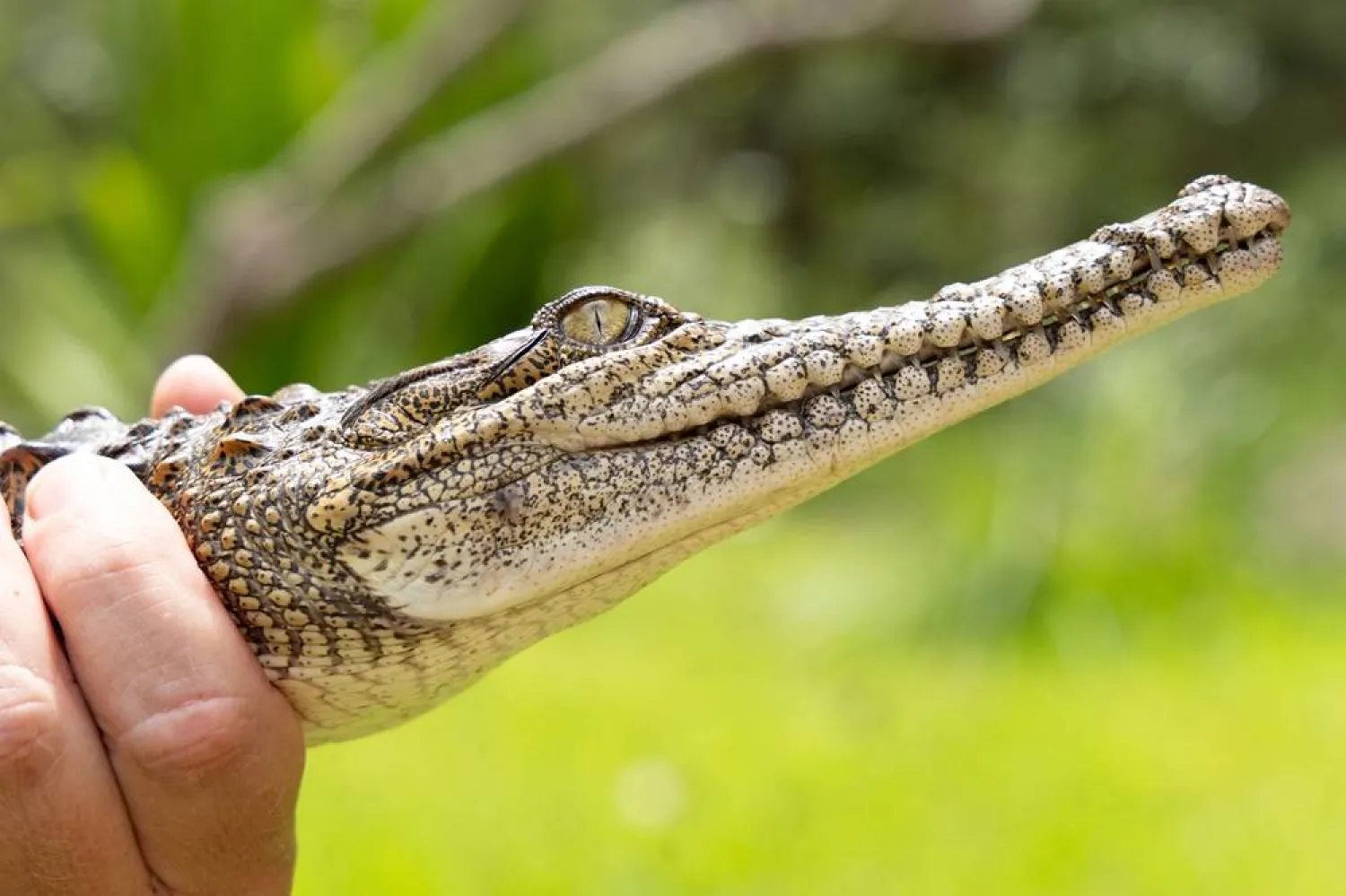

Crocodile Caught in an Australian Creek 1,200 Miles from Its Tropical Habitat

In this photo provided by Australian Reptile Park, its manager Billy Collett holds a freshwater crocodile caught in a creek near Newcastle, Australia, Monday, March 2, 2026. (Chloe Burgess-Jones/Australian Reptile Park via AP)
TT

Crocodile Caught in an Australian Creek 1,200 Miles from Its Tropical Habitat

In this photo provided by Australian Reptile Park, its manager Billy Collett holds a freshwater crocodile caught in a creek near Newcastle, Australia, Monday, March 2, 2026. (Chloe Burgess-Jones/Australian Reptile Park via AP)

Stephanie Kirsop didn’t believe her son when he phoned to say a crocodile was lurking in a creek near their home.

The family live in the temperate coastal city of Newcastle, which is 2,000 kilometers (1,200 miles) south of Australia's crocodile habitat in the tropical north.

Lionel Saunders, 12, and his friends had spotted the juvenile meter-long (39-inch-long) croc early Saturday afternoon. Authorities were initially skeptical of the reported find but had caught the elusive reptile by Sunday night.

“My son took videos because he was trying to convince me it was real and I didn’t believe him. It did look like a crocodile but I was like, no it’s a log,” Kirsop said Tuesday.

“He rang me back a little bit later and he’s like: ‘I’m so serious mom. You have to come down here and have a look,’” Kirsop said. “The whole drive down there I’m thinking this is going to be a trick. They’re going to laugh at me.”

She was in no doubt it was a crocodile when she arrived.

“There is a little crocodile just swimming around in the creek where local kids go to fish and sometimes kids swim in there. Wow,” Kirsop said.

She phoned a wildlife rescue service and was told crocodiles don’t live in the area. Kirsop sent her own photos and video as proof.

Kirsop was referred to the Australian Reptile Park, which keeps its own crocodiles in a temperature-controlled environment.

Park manager Billy Collett said he suspected the images might have been artificial intelligence-generated fakes. But police confirmed there was a croc in Ironbark Creek.

“I was a bit suspicious because we get a lot of phone calls. These days with AI, it’s just so crazy,” Collett said.

He recognized it was an Australian freshwater crocodile, or crocodylus johnstoni, a smaller and less dangerous species than saltwater crocodiles.

“They’re capable of inflicting a serious injury,” Collett said of the smaller species.

Collett’s team caught the croc Sunday night 3 kilometers (2 miles) from where it was first spotted.

“I just wanted to get him out of there because he would’ve perished in winter,” Collett said. It is currently autumn in the Southern Hemisphere.

The croc is healthy and will stay at the park until authorities decide where it should go permanently, Collett said. Crocs are protected under Australian law.

He suspects the croc was a pet that had been released into the wild after growing too big for a fish tank or too dangerous.



Russia Successfully Test Launches New Soyuz-5 Rocket from Kazakhstan, Space Agency Says

The ⁠new rocket is ‌capable of ‌carrying payloads of up to ‌17 metric tons. (AP file)
TT

Russia Successfully Test Launches New Soyuz-5 Rocket from Kazakhstan, Space Agency Says

The ⁠new rocket is ‌capable of ‌carrying payloads of up to ‌17 metric tons. (AP file)

Russia has test launched its new Soyuz-5 rocket for the first time, the country's space agency said late on Thursday, saying it had lifted off from the Baikonur cosmodrome in Kazakhstan without any issues.

The Soyuz-5, which Roscosmos, ‌Russia's space ‌agency, describes as a ‌launch ⁠vehicle equipped with ⁠the world's most powerful liquid-fueled engine, lifted off successfully at 2100 Moscow time (1800 GMT) on April 30, it said in a statement.

The ⁠new rocket is ‌capable of ‌carrying payloads of up to ‌17 metric tons, will significantly ‌reduce launch costs, and is more effective than its predecessors at placing objects like satellites in near ‌earth orbit, the agency said.

Dmitry Bakanov, the head ⁠of ⁠Roskosmos, said the rocket - which he hailed as a "new step in space exploration" - would create new jobs in Russia and Kazakhstan.

Bakanov has previously told President Vladimir Putin that the Soyuz-5 is the first new launch vehicle that Russia has developed since 2014.


Afghans Celebrate Spring in Bright Red Poppy Fields

This photograph taken on April 24, 2026 shows Afghan men taking a selfie as they stand among the common poppy flowers on a hillside in the Jalayer Valley of Northern Afghanistan’s Shirin Tagab district. (AFP)
TT

Afghans Celebrate Spring in Bright Red Poppy Fields

This photograph taken on April 24, 2026 shows Afghan men taking a selfie as they stand among the common poppy flowers on a hillside in the Jalayer Valley of Northern Afghanistan’s Shirin Tagab district. (AFP)

In the middle of a field filled with bright red poppies, Afghans frolic among the spring flowers in a tradition deeply rooted in the country's north.

Families flocked to the valleys of Shirin Tagab district, near the border with Turkmenistan, to be among thousands of flowers that appeared after abundant rain.

"There has been a drought for almost 10 years. No flowers or greenery grew," said Ghawsudin, who only uses one name.

"This year has been very good, and God is merciful," said the 79-year-old, who drove for three hours just to see the flowers.

Mohammad Ashraf, a 35-year-old visitor, said he hadn't seen so many poppies for more than a decade.

"Now there are so many red flowers, and you see people come here for picnics," he told AFP.

The landscape in Shirin Tagab is brightened by the common poppy, not the opium poppy that authorities have banned.

- 'Vitality and freshness' -

Many Afghans living in the north used to travel to see the poppies after celebrating Persian New Year, Nowruz, in the city of Mazar-i-Sharif.

The Taliban government, which applies a strict interpretation of religious law, has stopped such celebrations each spring.

But the tradition of visiting the poppies, which are widely revered in poems and songs, has endured.

Oriane Zerah, a photographer who published a book about Afghans and flowers, said they are an integral part of daily life.

"As soon as an Afghan has a little space in their garden, they plant a flower. Even in displacement camps, there'll be a flower somewhere. They put them on their pakol, one of their traditional hats, and there are desserts made with flowers," she told AFP.

The poppy has also been associated with wartime in the country, with the flower often placed on the coffins of fighters, according to Afghan writer Taqi Wahidi.

"Dying in the path of the homeland, or in the path of religion and faith, was considered a kind of new resurrection and entry into a new life," he told AFP.

The same flower is widely used in countries, such as Britain, Australia and New Zealand, where people wear artificial poppies to remember those killed in past conflicts.

Nowadays in Afghanistan, however, the poppy "symbolizes vitality and freshness", according to Wahidi.

"At the same time that nature is renewed, human beings also want to bring new colors into their lives," he said.


A Citizen Campaign Returns Iconic Kiwi Birds to New Zealand's Capital after a Century-long Absence

A staff member of a conservation organization carries a kiwi bird during an event at Parliament in Wellington, New Zealand, on Tuesday, April 28, 2026. (AP Photo/Charlotte Graham-McLay)
TT

A Citizen Campaign Returns Iconic Kiwi Birds to New Zealand's Capital after a Century-long Absence

A staff member of a conservation organization carries a kiwi bird during an event at Parliament in Wellington, New Zealand, on Tuesday, April 28, 2026. (AP Photo/Charlotte Graham-McLay)

The kiwi, New Zealand’s sacred national bird, vanished from the hills around Wellington more than a century ago. Now the capital's residents are waging an improbable citizen campaign to return the endangered flightless birds to the city.

“They are a part of who we are and our sense of belonging here,” said Paul Ward, founder of the Capital Kiwi Project, a charitable trust. “But they’ve been gone from these hills for well over a century and we decided as Wellingtonians that wasn’t right.”

On a hill wreathed in mist above the dark sea that runs between New Zealand’s North and South Islands, Ward and others crossed rugged farmland late on Tuesday night, carrying seven crates in silence by dim red torchlight.

Inside each one nestled a kiwi, including the 250th bird relocated to Wellington since the Capital Kiwi Project began.

Birds receive a quiet welcome to new homes The kiwi gives New Zealanders the name by which they’re often known. It’s a shy and odd-looking bird with underdeveloped wings and a whiskery face.

Spiritually significant for many New Zealanders, the kiwi’s image appears everywhere, including on the tail of the country’s air force planes — curious for a bird with no tail which can’t fly.

It’s thought that there were 12 million of the birds roaming the landscape before humans arrived in New Zealand. Today only about 70,000 kiwi are left across the country, with the population dropping 2% each year.

In the hills where Wellington’s kiwi now live and breed, the only late-night sound on Tuesday was the whoosh of wind turbines. Ward and his friends set their crates down in pairs, slid them open and gently tilted the boxes.

Some in the small group of hushed onlookers were tearful. One man chanted a karakia, a Māori prayer.

From each crate, a long, curved beak eventually protruded as kiwi took their first tentative steps into the shadowed landscape, then sped to a run and disappeared into the darkness.

Kiwi make their first Parliament visit One place kiwi had never set foot until this week was inside New Zealand’s Parliament. Hours before Wellington’s seven newest residents were transported to their hillside home, they were carried into Parliament’s grand banquet hall by handlers for a celebration of the 250th kiwi's arrival in the city.

Lawmakers and schoolchildren alike expressed whispered delight at seeing the timid, nocturnal birds up close, many for the first time, as conservation workers cradled the large birds like human babies, with their gnarled feet outstretched.

“This animal has given us as a people so much in terms of our sense of identity,” Ward told The Associated Press. “We want to challenge our civic leaders, our politicians and say this is a relationship we need to honor.”

Rare birds move from sanctuaries to urban life New Zealand is home to some of the world’s strangest and rarest bird species. Some have only survived because of against-all-odds conservation programs, at times with uncertain funding.

Initiatives decades ago saw all surviving birds of some species moved onto offshore, predator-free islands or into sanctuaries where they could be carefully monitored and protected, but where few New Zealanders would ever see one.

Ward and his group had a different dream: that New Zealand’s iconic national bird could flourish alongside people in a bustling capital city, where human encroachment and introduced predators had wiped out the kiwi before.

“Where people are is also the places where we can bring them back because we’ve got the means to do that guardianship,” Ward said.

Thousands of traps protect capital’s kiwi Although unmanaged kiwi populations are shrinking, their numbers have thrived in carefully managed wild bird sanctuaries — so much, in fact, that some of these protected areas have run out of room for them.

That’s prompted their relocation to places like Wellington, where groups such as Ward’s rally residents to embrace their new neighbors. Kiwi have been spotted by late night mountain bikers and on backyard security camera footage in the capital, he said.

“They’re living and calling and being encountered on the hills surrounding our city,” Ward said.

That's taken work. Over the past decade, efforts between landowners, the local Māori tribe and the Capital Kiwi Project have produced a sprawling, 24,000-hectare tract of land where kiwi can roam.

It’s dotted with more than 5,000 traps for stoats, the main predator of kiwi chicks. So far, the Wellington population has a 90% chick survival rate.

New Zealand aims to become predator free The kiwi initiative is part of New Zealand’s quest to rid the island nation of introduced predators, including feral cats, possums, rats and stoats, by the year 2050. Since a previous government established the target in 2016 its chances of success have been debated, but community groups have taken up the work in earnest.

Parts of Wellington are now entirely free of mammalian predators apart from household pets, and native birds flourish. Volunteers monitor suburbs with military precision for the appearance of a single rat.

“When I think of endangered species globally, for the most part you can’t do much other than campaign or donate money,” said Michelle Impey, chief executive of Save the Kiwi. “But we have this incredible movement throughout the country where everyday people are taking it on under their own steam to do what they can to protect a threatened species.”