


Gold Retreats as Firmer Dollar Offsets Geopolitical Safe-haven Support

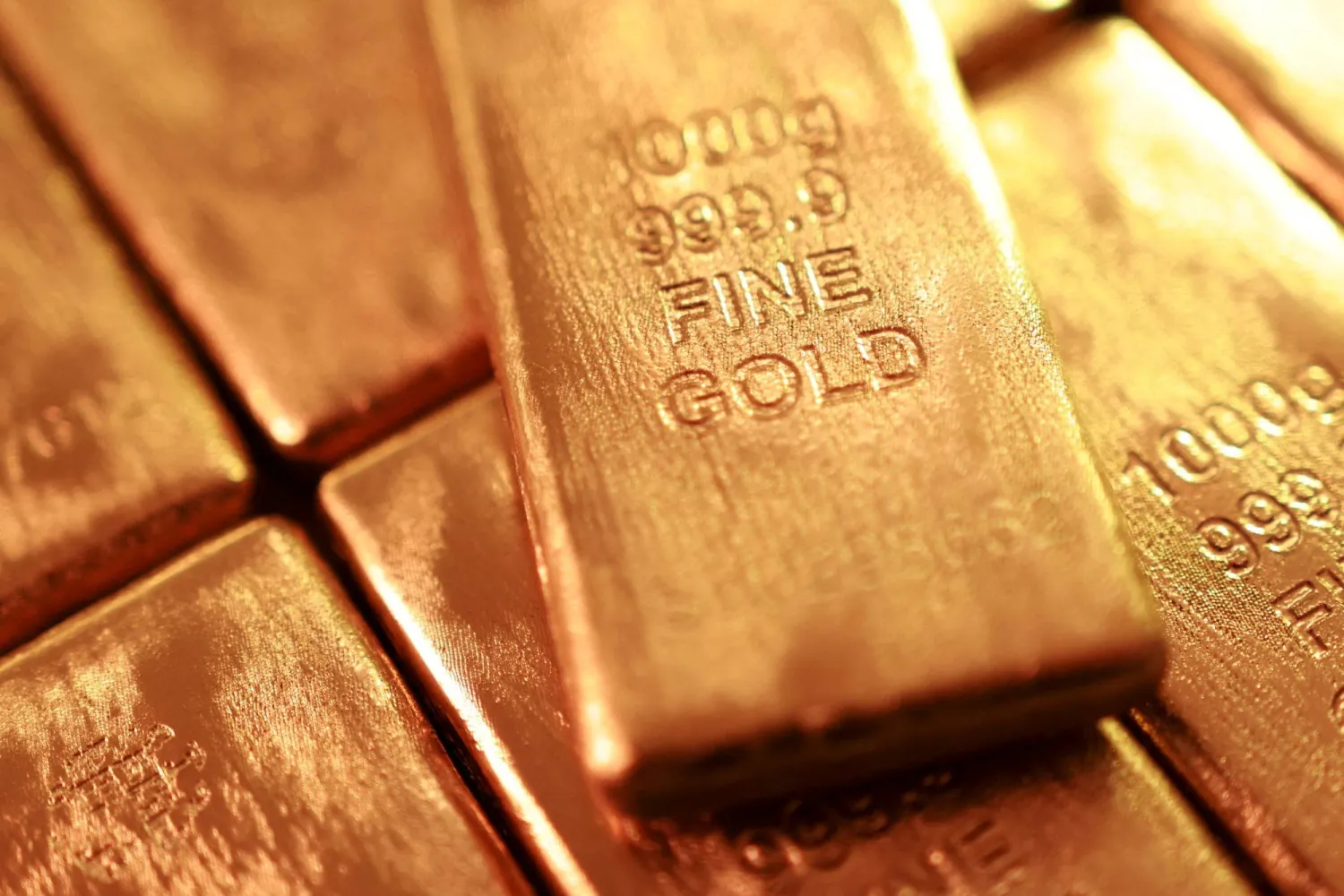
FILE PHOTO: Gold imitations are seen in this illustration picture taken February 20, 2026. REUTERS/Dado Ruvic/Illustration/File Photo
TT

Gold Retreats as Firmer Dollar Offsets Geopolitical Safe-haven Support

FILE PHOTO: Gold imitations are seen in this illustration picture taken February 20, 2026. REUTERS/Dado Ruvic/Illustration/File Photo

Gold prices eased on Tuesday, pulled back by a stronger dollar, while investors assessed the impact of an escalating US and Israeli air war against Iran.

Spot gold was down 0.4% at $5,305.23 per ounce, as of 0646 GMT. In the previous session, bullion climbed to its highest point in more than four weeks after the US and Israel launched strikes on ‌Iran over ‌the weekend.

US gold futures for April delivery ‌were ⁠up 0.3% at $5,326.40.

The ⁠dollar hovered close to a more than five-week high reached on Monday, supported by firm demand and cautious market sentiment. A stronger greenback typically makes dollar-denominated assets such as bullion more expensive for foreign buyers.

"Inflationary concerns are proving to be of benefit to the dollar while being of some hindrance to the gold ⁠price," KCM Trade chief market analyst Tim Waterer ‌said.

"Gold would arguably be trading ‌higher than current levels were it not for dollar appreciation since the ‌conflict intensified."

A senior official from the Iranian Revolutionary Guard Corps (IRGC) ‌said the Strait of Hormuz has been closed and warned Iran would fire on any ship trying to pass through the strategic waterway, according to Iranian media.

This is Iran's most explicit warning since ‌telling ships it was closing the export route on Saturday, a move that threatens to choke a ⁠fifth of ⁠global oil flows and send crude prices sharply higher.

US President Donald Trump has warned of a "big wave" of further attacks coming soon, without providing specific details.

"Persistent safe-haven demand due to the ongoing conflict is keeping a floor under the gold price," Waterer added.

The attack on Iran has pitched the Gulf into war, killing scores of civilians in Iran, Israel and Lebanon, thrown global air transport into chaos and shut down shipping through the Strait of Hormuz.

Silver fell 5.8% to $84.25/oz, after climbing to a more than four-week high on Monday. Platinum lost 4.4% to $2,200.89/oz, palladium fell 1.2% to $1,745.26.



World Bank Chief to Asharq Al-Awsat: No One Can Gauge Fallout of the Regional Escalation

World Bank President Ajay Banga visits the Geyushi bus manufacturing factory to review projects funded by the lender and assess how economic reforms are translating into job creation, in the 10th of Ramadan suburb of Cairo, Egypt, March 3, 2026. (Reuters)
TT

World Bank Chief to Asharq Al-Awsat: No One Can Gauge Fallout of the Regional Escalation

World Bank President Ajay Banga visits the Geyushi bus manufacturing factory to review projects funded by the lender and assess how economic reforms are translating into job creation, in the 10th of Ramadan suburb of Cairo, Egypt, March 3, 2026. (Reuters)

Rising geopolitical tensions are clouding the outlook for growth, inflation and capital flows across the Middle East, raising questions about the region’s ability to absorb fresh shocks.

Instability is not good for any region, World Bank President Ajay Banga told Asharq Al-Awsat, saying the scale of the fallout hinges on one factor: how long this escalation continues.

Banga was speaking on Tuesday on the sidelines of a visit to a factory in 10th of Ramadan City, northeast of Cairo.

He was responding to questions by Asharq Al-Awsat about the impact of the current escalation, the risk of disruption to the Strait of Hormuz, the possibility of oil prices topping $100 a barrel, and the implications for global growth, inflation and capital flows to emerging markets in 2026.

The answers, he said, are interlinked. The duration of the disruption will determine the depth of the economic impact.

Egypt offers a case in point. In recent years, it has navigated successive waves of uncertainty, from the COVID-19 pandemic to global volatility and, more recently, pressures linked to Suez Canal revenues, said Banga.

It is not hard to imagine the scale of challenges that creates for economic development, he added, pointing to strains on public finances, the currency and inflation in an unsettled global environment.

Fears are mounting that widening tensions in the Middle East could rattle energy markets and global supply chains. A sustained surge in oil prices would feed directly into higher global inflation, leaving central banks balancing price stability against growth.

At the same time, tighter global financial conditions could slow capital flows to emerging markets that depend, to varying degrees, on external financing and foreign investment.

On the short and medium term, Banga suggested the damage could be contained if instability proves short-lived.

Prolonged tensions, however, would amplify the pressure, he warned. The World Bank’s approach is to frame its outlook around time-based scenarios rather than issue numerical forecasts amid uncertainty.

Regarding Egypt, Banga said the World Bank continues to work with the government through a broad package of programs that extends beyond financing to support business and governance reforms and strengthen the private sector.

The cooperation spans physical infrastructure and investment in human capital to help generate sustainable jobs.

During his Cairo visit, Banga toured a Social Housing Project in 10th of Ramadan City and electric bus manufacturing lines. He described the housing project as among the largest globally in ambition and scale, noting that many beneficiaries are first-time buyers under 40.

Key lessons, he said, include government ambition, building a mortgage market and promoting financial inclusion - pillars he sees as essential to empowering young people and expanding home ownership.

More broadly, Banga linked infrastructure investment in housing, transport and energy to bolstering emerging economies against external shocks. Diversifying growth and backing sectors such as agriculture, tourism and manufacturing can help cushion volatility in energy markets and global trade.

The World Bank’s message, as outlined by its president, is clear: instability carries risks, but forecasts must be tempered by uncertainty over timing.

Whether 2026 is shaped by a brief disruption or a prolonged crisis will depend on how long tensions persist. Until then, resilience, structural reform and a stronger private sector remain central to weathering the storm in Egypt and across the region, Banga said.


IMF: Mideast War Economic Impact to Depend on Duration, Damage, Energy Cost

FILE PHOTO: A view of the International Monetary Fund (IMF) logo at its headquarters in Washington, D.C., US, November 24, 2024. REUTERS/Benoit Tessier/File Photo
TT

IMF: Mideast War Economic Impact to Depend on Duration, Damage, Energy Cost

FILE PHOTO: A view of the International Monetary Fund (IMF) logo at its headquarters in Washington, D.C., US, November 24, 2024. REUTERS/Benoit Tessier/File Photo

The Middle East war's impact on the global economy will depend on its duration and damage to infrastructure and industries in the region, particularly whether energy price increases are short-lived or persistent, the International Monetary Fund's number ⁠two official said on ⁠Tuesday.

IMF First Deputy Managing Director Dan Katz told the Milken Institute Future of Finance conference in Washington ⁠that the conflict "certainly has the potential to be very impactful on the global economy across a range of across a range of metrics, whether it's inflation, growth and so on. But it's very early ⁠at this ⁠point to, you know, have any sort of firm conviction about what the likely impact is going to be."

Katz added that the economic impact will follow from the geopolitical developments and the persistence of the conflict.


Iraq Could Widen Oil Production Cut to More Than 3 Million bpd Within Days

FILE PHOTO: The company logo of Lukoil is seen at the West Qurna 2 oilfield in Iraq's southern province of Basra, March 29, 2014. REUTERS/Essam Al-Sudani/File Photo
TT

Iraq Could Widen Oil Production Cut to More Than 3 Million bpd Within Days

FILE PHOTO: The company logo of Lukoil is seen at the West Qurna 2 oilfield in Iraq's southern province of Basra, March 29, 2014. REUTERS/Essam Al-Sudani/File Photo

Iraq has cut oil production by nearly 1.5 million barrels a day and those cuts could widen to more than 3 million bpd within days as the country runs out of storage and cannot export crude due to the Iran crisis, two Iraqi oil officials told Reuters on Tuesday.

As of Tuesday, Iraq has cut production from the Rumaila oil field by 700,000 bpd, from the West Qurna 2 field by 460,000 bpd and from the Maysan field by 325,000 ⁠bpd, the officials, ⁠who did not wish to be named, said.

That output cut could grow to over 3 million bpd if oil tankers cannot move freely through the Strait of Hormuz and reach loading ports, they added.

The oil ministry said later in the day that the reduction in its crude oil production, owing to the halt in exports after the closure of the Strait of Hormuz, ⁠would not affect operations at its refineries, state media reported.