
Michelangelo’s Works Hidden in ‘Secret Room’, Researcher Says

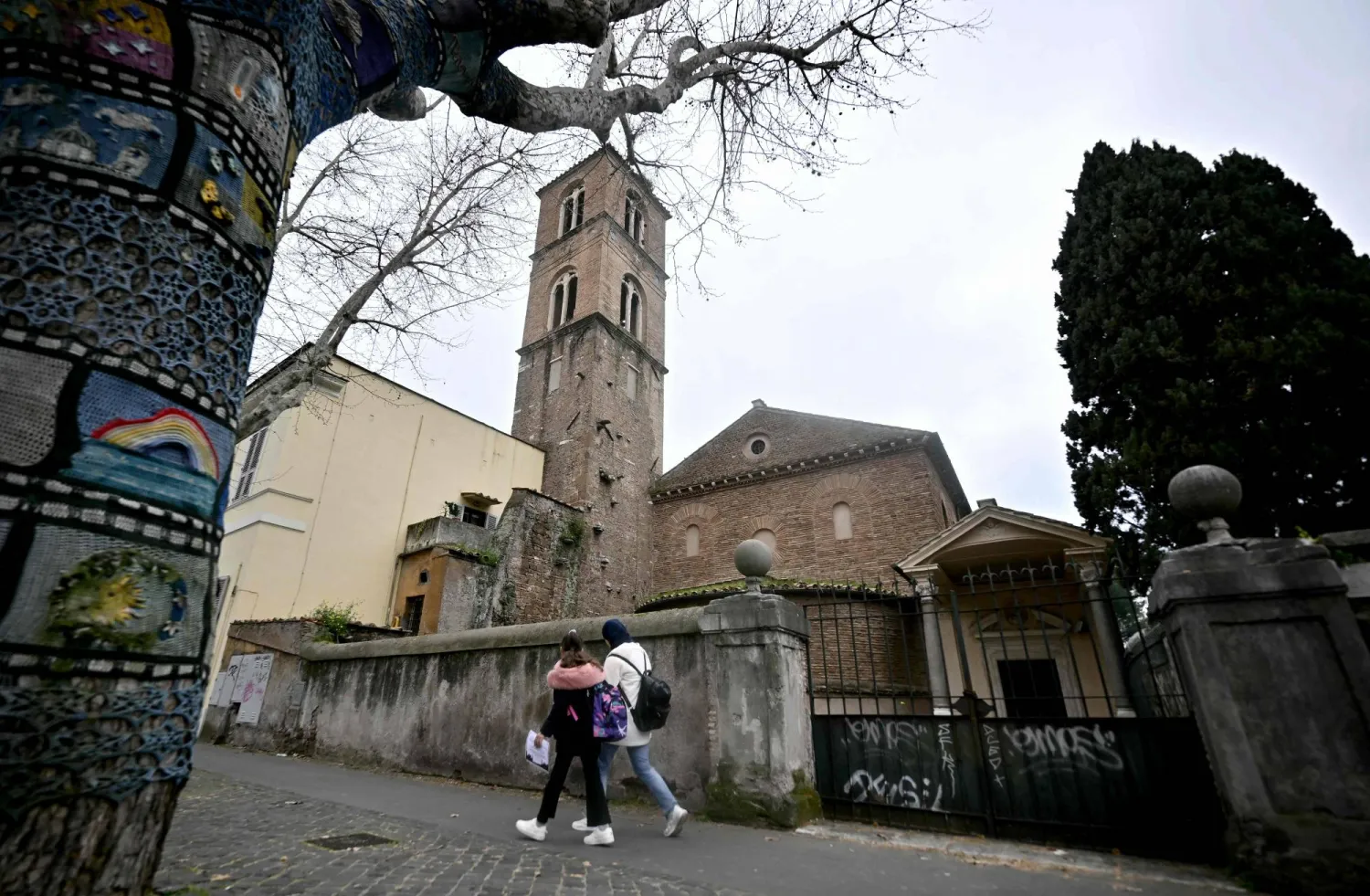
Pedestrians walk past the Basilica of Santa Agnese Outside the Walls as a marble bust is displayed inside after being identified as a work by Michelangelo Buonarroti after centuries without attribution, following a decade of archival research by Italian researcher Valentina Salerno in Rome on March 4, 2026. (AFP)
TT

Michelangelo’s Works Hidden in ‘Secret Room’, Researcher Says

Pedestrians walk past the Basilica of Santa Agnese Outside the Walls as a marble bust is displayed inside after being identified as a work by Michelangelo Buonarroti after centuries without attribution, following a decade of archival research by Italian researcher Valentina Salerno in Rome on March 4, 2026. (AFP)

Renaissance artist Michelangelo ordered many of his artworks to be hidden by his pupils in a secret room to protect them for posterity, an Italian researcher claimed Wednesday.

According to renowned art historian Giorgio Vasari, the Italian genius burned a large number of his own drawings and sketches before his death in Rome in 1564.

But researcher Valentina Salerno says she has unearthed unpublished archival documents that reveal a plot to squirrel away his works.

"One of these three unpublished documents I found in the archives speaks of a room" kept by students of the Michelangelo school, the origins of which "can be traced back" to the artist, Salerno told AFP on the sidelines of a press conference in Rome.

"Assets are hidden inside this room. These assets are locked away so tightly that they require a system of multiple keys, so that no one can access them without the permission of others," she said.

Salerno was researching a book on Michelangelo when she came across a document that showed the artist had in 1550 joined the Brotherhood of the Most Holy Crucifix. Those close to him in his final years were members too.

Over a decade of research, she followed the document trail between a series of archives in the Vatican, Italy and European cities including Paris.

As part of what she called a "maniacal plan" cooked up by Michelangelo, his works were to be hidden "because otherwise it would all end up with a nephew he detested".

"The goal was to pass on to his poor, vulnerable, non-noble descendants the material to be able to continue studying, to transmit his art to future generations," she said.

Those involved in the plan went on to form the famous art Academy of San Luca in the 16th century, she added. It still exists today.

Salerno believes the secret room designed to safeguard the artist's creations was likely somewhere inside the Saint Peter in Chains church in central Rome.

- Michelangelo bust -

During her research, she also stumbled across a reference to a bust at the Basilica of Sant'Agnese, also in Rome, currently attributed to an anonymous artist.

She found documents attributing the white bust to Michelangelo down the centuries.

In the 1930s it appears to disappear from documentation, only to reappear in the 1980s, attributed to a minor artist.

Italy's cultural authorities later declared it to be a work by an unknown sculptor instead.

But Salerno insists the bust is a genuine Michelangelo, not just due to the paper trail, but also because it shares a striking resemblance to Tommaso dei Cavalieri, a young nobleman.

Salerno's work has not yet been peer reviewed, but she is a member of the Vatican committee for the celebrations marking the 500th anniversary of Michelangelo's birth.
Nigerian Museum Revamp Brings Treasures within Reach

Tinuke Odunfa, the interior designer of the gallery, aimed to modernize the space and present Nigerian history in an an 'immersive' environment. OLYMPIA DE MAISMONT / AFP
TT

Nigerian Museum Revamp Brings Treasures within Reach

Tinuke Odunfa, the interior designer of the gallery, aimed to modernize the space and present Nigerian history in an an 'immersive' environment. OLYMPIA DE MAISMONT / AFP

Gazing at two large engraved 16th-century elephant tusks on display at Nigeria's National Museum Lagos, a guide surprised visitors by telling them: "You can touch them gently".

One of the three galleries at the museum in Nigeria's cultural and entertainment hub has been remodeled to allow visitors to interact with some artefacts, reversing the typical ban on touching exhibits, as well as take unrestricted photographs in an effort to engage younger audiences, curator Nkechi Adedeji told AFP.

As the group felt the texture of the elephant tusks to the tune of Afrobeats softly playing on overhead speakers, a young photographer was busy snapping away, likely for a social media post.

According to Tinuke Odunfa, the interior designer of the gallery, the plan was to modernize the space and present Nigerian history in an "intentional" and "immersive" environment.

"Everything was intentional in terms of how the space should be experienced, in terms of the colors, how the space leads you," Odunfa told AFP.

The gallery holds one of the country's most extensive collections, including major archaeological and ethnographic artefacts such as 5th-century terracotta by indigenous Nok people.

Its white walls are lined with artefacts encased in glass, arranged chronologically from the oldest to the newest, each accompanied by brief notes.

A few other items of the permanent exhibition, "Echoes of the Past", especially those made of wood and metal, are laid out in such a way that visitors can touch and "feel them", the museum's head of exhibition Olusegun Adeleye, 51, said.

Low ambient lighting casts a soft glow across the gallery, giving the space a quiet, reflective atmosphere.

Lagos, the vibrant mega city of more than 20 million people, and often described as Nigeria's melting pot, inspired Odunfa's design.

- 'Coming in droves' -

Since the renovated gallery opened to the public in April, it has been drawing more visitors than before, Adedeji said, without giving figures.

Its Instagram-ready spaces are drawing more schoolchildren and young adults, with pictures and videos increasingly shared online, making it a popular destination among "content creators".

"They come here, do content and before you know it, it is all over the place," Adedeji said. "Youths are coming in droves now".

"I love the way the artefacts are displayed," Oyin Isioye, a 25-year-old photographer, visiting the museum for the first time, told AFP. "I learned a lot of things... where the artefacts are from, what they represent."

- Repatriation calls -

In one corner of the gallery, three empty cases contain a sheet of paper bearing the inscription "British museum, how far??" (meaning "what's up?" in Nigerian Pidgin).

The installation sends a message to foreign museums that Nigeria is ready to pursue the repatriation of its looted artefacts.

Western museums, including those in Britain, the Netherlands and Germany, have in recent years returned several hundred artefacts, but countless more remain in galleries in Europe and America.

"This renovation shows that we can protect and preserve our objects ourselves, we do not need any other country to do it for us," said Adedeji.

The remodeling, funded by a private entity, also aimed at creating more display areas for the collection, the bulk of which are kept in storage.

More projects are in the works. Another gallery at the Lagos museum has been shut for renovation, along with other sites nationwide.

And Nigerian authorities are seeking partners to support future upgrades in preparation for more repatriated artefacts.


Archaeological Replicas Showcase Saudi Arabia's Rich History at Kuala Lumpur Int’l Book Fair

The replicas include selected examples of historical artifacts discovered across various regions of the Kingdom. (SPA)
TT

Archaeological Replicas Showcase Saudi Arabia's Rich History at Kuala Lumpur Int’l Book Fair

The replicas include selected examples of historical artifacts discovered across various regions of the Kingdom. (SPA)

Saudi Arabia's Heritage Commission, through the Kingdom's pavilion at the Kuala Lumpur International Book Fair 2026, showcased a collection of rare archaeological replicas, offering visitors an educational experience that highlights the depth of Saudi history and the diversity of civilizations that flourished on the Arabian Peninsula over thousands of years.

The replicas include selected examples of historical artifacts discovered across various regions of the Kingdom, including stone inscriptions, ancient writings, and carved artifacts dating back to different periods before Christ.

These pieces reflect the cultural, civilizational, and commercial activity that characterized the Arabian Peninsula throughout history.

The pavilion features a documentary film on the ancient city of Al-Faw, highlighting its history and cultural significance, in addition to an interactive digital screen presenting archaeological sites from across the Kingdom.

The exhibition has attracted strong interest from history and heritage enthusiasts as part of the Kingdom’s extensive cultural presence at the fair, led by the Literature, Publishing and Translation Commission. The event runs through June 7.


Elizabeth Blackadder Exhibition Reveals Wintry Tuscan Landscapes

"Winter Hillside", circa 1955-56, is one of the works to be exhibited at the Jenna Burlingham Gallery. (Jenna Burlingham Gallery)
TT

Elizabeth Blackadder Exhibition Reveals Wintry Tuscan Landscapes

"Winter Hillside", circa 1955-56, is one of the works to be exhibited at the Jenna Burlingham Gallery. (Jenna Burlingham Gallery)

She may be best known for accessible paintings of flowers and cats, but a new exhibition of Elizabeth Blackadder’s work focuses instead on chilly landscapes and pared-back still life compositions.

The show in Hampshire, far from Blackadder’s Scottish home, presents a less familiar side of the artist, with most of the pieces exhibited for the first time, reported The Guardian.

Earlier works include a series of Italian landscapes rendered in gouache and watercolor in the 1950s soon after Blackadder left art college. The still life oil paintings are from the 1960s and 1970s.

The art writer and editor Anna Brady said Blackadder, who died in 2021 aged 89, painted the Italian landscapes after winning a travelling scholarship.

Writing in the show’s catalogue, she said: “Based in Florence, Blackadder would take a bus out into the countryside to paint. While we may have romantic ideals of painting trips to Tuscany, the reality of being a young woman, painting outside and alone, through a bitter winter in postwar Italy would have been altogether harsher. We can almost feel the chill on her fingertips in the group of inky Tuscan landscapes.”

In the later still life paintings, personal objects, such as a coffee pot, appear time and again.

Brady said: “Blackadder seems to gain confidence in doing more with less, her compositions becoming increasingly refined and pared back to the essentials.”

The gallery director, Jenna Burlingham, said: “What makes this exhibition so exciting is that it shines a light on works from the first two decades of Elizabeth Blackadder’s career.”