
Syrians on Alert to Prevent Accommodation of Displaced Hezbollah Supporters from Lebanon

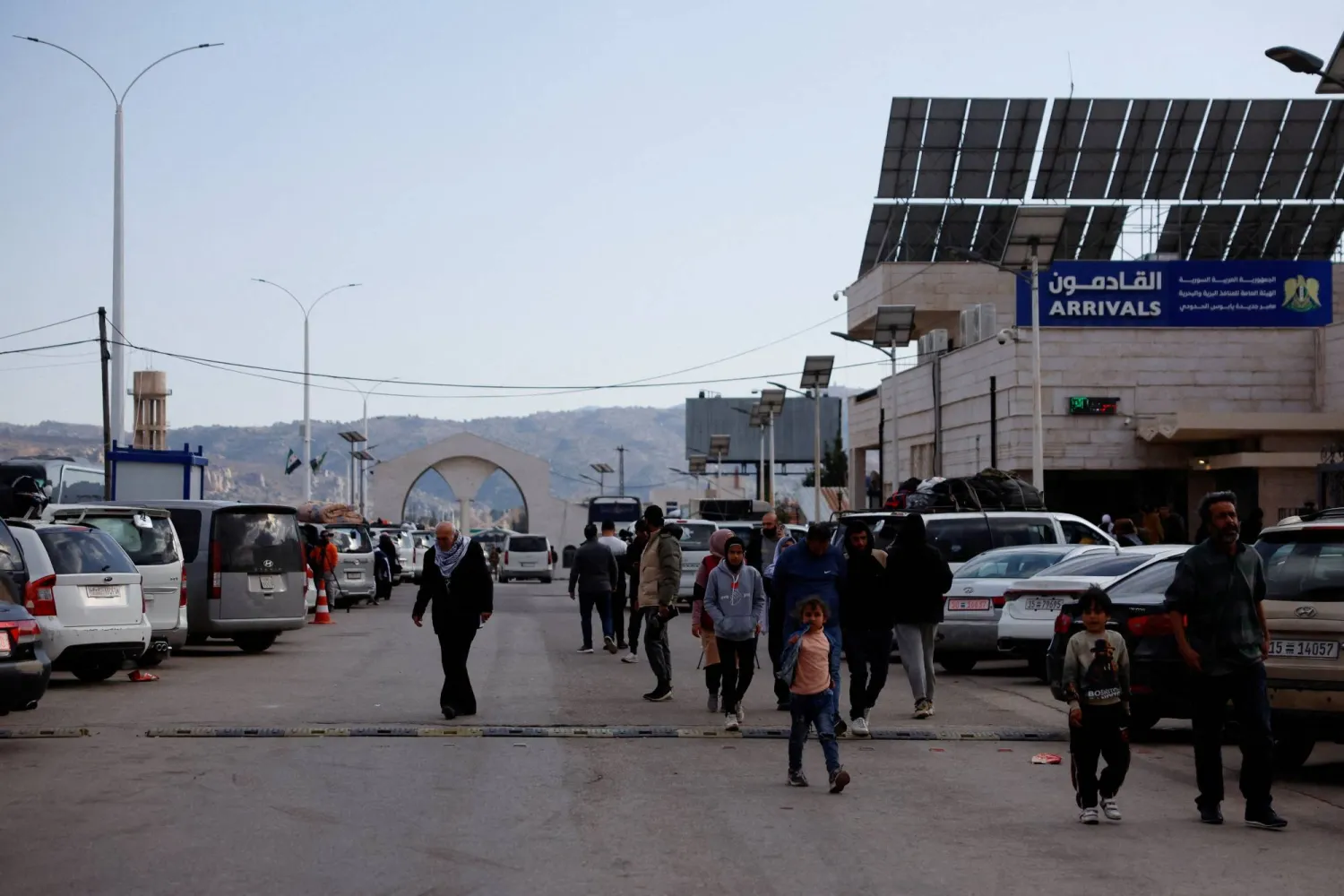
 Syrians living in Lebanon wait outside the Ministry of Interior Immigration and Passports Department, at the Syrian-Lebanese border, as they return to Syria due to ongoing hostilities between Hezbollah and Israeli forces, amid the US-Israeli conflict with Iran, in Jdaydet Yabous, Syria, March 3, 2026. (Reuters)
Syrians living in Lebanon wait outside the Ministry of Interior Immigration and Passports Department, at the Syrian-Lebanese border, as they return to Syria due to ongoing hostilities between Hezbollah and Israeli forces, amid the US-Israeli conflict with Iran, in Jdaydet Yabous, Syria, March 3, 2026. (Reuters)
TT

Syrians on Alert to Prevent Accommodation of Displaced Hezbollah Supporters from Lebanon

 Syrians living in Lebanon wait outside the Ministry of Interior Immigration and Passports Department, at the Syrian-Lebanese border, as they return to Syria due to ongoing hostilities between Hezbollah and Israeli forces, amid the US-Israeli conflict with Iran, in Jdaydet Yabous, Syria, March 3, 2026. (Reuters)
Syrians living in Lebanon wait outside the Ministry of Interior Immigration and Passports Department, at the Syrian-Lebanese border, as they return to Syria due to ongoing hostilities between Hezbollah and Israeli forces, amid the US-Israeli conflict with Iran, in Jdaydet Yabous, Syria, March 3, 2026. (Reuters)

Syrians in Damascus, its countryside, and western Homs countryside are on alert to prevent displaced Lebanese supporters of Hezbollah from entering Syrian territory or being hosted by locals.

The stance marks a sharp departure from previous Israeli wars on Lebanon, when Syrian cities received tens of thousands of Lebanese fleeing the fighting.

As Israel broadened its strikes in the region to include Hezbollah, not just Iran, displacement from southern Lebanon and Beirut's southern suburbs has resumed. This time, however, those fleeing include not only Lebanese but also Syrians who had been living as refugees in Lebanon.

The scene in and around Damascus appears markedly different from past years. No private cars carrying Lebanese displaced people have been seen in the capital Damascus and its outskirts, unlike during earlier Israeli wars on southern Lebanon under the rule of ousted leader Bashar al-Assad.

In previous waves of displacement, tens of thousands of Lebanese fled to Damascus. Some stayed in hotels, others rented apartments, while a small number were housed in shelters.

The same pattern now applies to Eastern Ghouta. Hezbollah and Iran had turned the area into a strategic rear base while fighting alongside Assad's government during the years of the Syrian uprising.

Hezbollah also housed large numbers of fighters' families there during its war with Israel.

Omar Mohammad Safi, known as Abu Firas, from the town of Beit Sahm in Eastern Ghouta, said the town has not seen the arrival of any Lebanese during the current war, whether Hezbollah supporters or others.

“When Israel attacked Hezbollah the last time, large numbers of fighters' families came and stayed in homes the party had seized in Ghouta, Sayeda Zeinab and elsewhere, but in this war, we have not seen any of them at all in any town,” he told Asharq al-Awsat.

Over the past two days, activists circulated a statement purportedly issued by residents of Damascus and its countryside, especially Eastern Ghouta, warning against renting property to or hosting strangers from southern Lebanon, or Lebanese individuals or families, particularly those linked to Hezbollah.

The statement said Hezbollah, during its support for the former regime, had “committed crimes and massacres,” adding: “We will not forget the massacres of Eastern Ghouta and the chemical massacre.

“Whoever dared to kill us and gloat over us will have no place among us, and we will expel him from the area immediately, along with anyone who shelters him, by all means,” it warned.

During the war in Syria, Hezbollah turned the western Qalamoun area in the Damascus countryside, adjacent to Lebanon's Bekaa region, into a strategic regional rear base.

During the previous war with Israel, the area also hosted tens of thousands of displaced people from Beirut's southern suburbs and southern Lebanon, with facilitation from Assad's government.

But Mahmoud Qusaibiya, known as Abu Alaa, from the town of Jarjir in western Qalamoun, said the town has not seen the arrival of any displaced Lebanese Hezbollah supporters.

“A warning was circulated by elders and prominent figures telling residents not to receive anyone from Hezbollah or their families, because we supported the revolution and they stood with the former government and its remnants,” he told Asharq al-Awsat.

The clearest development has been in the city of Qusayr in western Homs countryside, which Hezbollah seized during the Syrina war.

Rashid Jammoul, known as Abu Mohammad, who comes from the city, said Syrians at the border with Lebanon around Qusayr were on high alert to prevent Hezbollah members, their families, or people linked to them from entering Syrian territory.

“There have been some attempts, but there is an alert by the army and by residents at all legal and illegal crossings,” the man in his sixties told Asharq al-Awsat.

“We will not allow any of them or anyone linked to them to enter or be received after they committed massacres against us, destroyed our villages, and burned our homes.”

Since Israel launched its new war on southern Lebanon, more than 25,000 Syrians have returned to their country.

Syria’s General Authority for Ports and Customs denied that families of Hezbollah members were among those arriving from Lebanon.

Mazen Alloush, director of relations at the authority, said two days ago that since the first day families began fleeing from Lebanon to Syria, social media had been flooded with rumors claiming that families of Hezbollah fighters and supporters were entering Syrian territory through border crossings.

As the rumors spread, some buses leaving the Jousieh border crossing were stopped by young men in the city of Qusayr and attacked on that pretext.

Seeking to clarify the situation, Alloush said all the passengers on those buses were Syrians who had been living in Lebanon and who came from different Syrian provinces.

He said they had entered the country legally.


Trump Keeps Talking About Iran’s ‘Nuclear Dust.’ What Is It?

A satellite imagery taken on February 1, 2026, shows a new roof over a previously destroyed building at Isfahan nuclear site, Iran. 2026 (PLANET LABS PBC/Handout via Reuters/ File photo)
TT

Trump Keeps Talking About Iran’s ‘Nuclear Dust.’ What Is It?

A satellite imagery taken on February 1, 2026, shows a new roof over a previously destroyed building at Isfahan nuclear site, Iran. 2026 (PLANET LABS PBC/Handout via Reuters/ File photo)

Luke Broadwater, David E. Sanger*

In recent weeks, US President Donald Trump has been talking about a substance he says is key to ending the United States’ war against Iran: “nuclear dust.”

In the president’s telling, Iran’s nuclear program was so badly damaged by US bombs last year that all that remains under the rubble is a sort of powdery aftermath.

The phrase “nuclear dust” seemed designed to diminish the importance of what Trump is actually talking about — Iran’s stockpile of near-bomb-grade uranium, which is stored in canisters about the size of large scuba tanks.

The material is not, in fact, “dust.” It is typically a gas when stored inside the canisters, though it becomes a solid at room temperature. It is a volatile and highly toxic substance if it comes into contact with moisture and, if mishandled, can trigger a nuclear reaction.

Trump’s phrase oversimplifies the complex tasks of enriching uranium, to say nothing of negotiating an end to the war. It’s also a phrase nuclear experts say they’ve never heard before.

“I just interpreted it as Trump’s kind of colorful way of talking,” said Matthew Kroenig, the senior director of the Atlantic Council’s Scowcroft Center for Strategy and Security, according to the New York Times.

Here’s a closer look at what Trump means when he talks about “nuclear dust,” and why it’s important for an end to the conflict.

What is ‘nuclear dust’?

Trump is referring chiefly to the uranium Iran has enriched to 60%, near the 90% purity normally used to make a bomb. There is no use for fuel enriched to that level for, say, producing nuclear power.

So it is a warning sign to the international community that Iran could quickly convert the fuel to bomb-grade, even though there would still be many steps to then build a nuclear bomb.

The United States struck three key nuclear sites in June 2025, including a complex outside Isfahan, where much of the near-bomb grade material was believed to be stored.

“It’s not yet bomb-grade, but it’s on the way there, and it was being stored on the nuclear facility at Isfahan,” Kroenig said.

“And so when Isfahan was bombed, that material was presumably entombed there,” he added.

American intelligence officials believe that the Iranians dug down to gain access to the material, though there is no evidence any of it has been moved.

Uranium contains a rare radioactive isotope, called U-235, that can be used to power nuclear reactors at low enrichment levels and to fuel nuclear bombs at much higher levels.

The goal of uranium enrichment is to raise the percentage levels of U-235, which is often done by running it through gas centrifuges, machines that spin at supersonic speeds to increase the purity of the fuel.

Why is it important to ending the war?

Trump has said that Iran had agreed to turn over its nuclear materials to the United States, though Tehran has denied that claim.

“The US will get all nuclear dust,” Trump told a crowd in Arizona last week. “You know what the nuclear dust is? That was that white powdery substance created by our B-2 bombers.”

Iranian enrichment levels have been rising since Trump withdrew the United States from the Obama-era nuclear deal, known as the Joint Comprehensive Plan of Action, or JCPOA, saying the agreement wasn’t tough enough.

Trump then imposed several rounds of American sanctions on Iran. In response, Tehran repeatedly moved beyond the strict limits that the agreement had placed on its uranium enrichment, and began to resume production of nuclear material.

“They were enriching at very low levels before Trump administration withdrew the United States from the JCPOA,” said Justin Logan, the director of defense and foreign policy studies at the Cato Institute, a libertarian-leaning think tank. “So what he is calling ‘nuclear dust’ did not exist inside Iran after the signing or the first several months of the JCPOA”

Can the material be removed during wartime?

Trump acknowledges removing Iran’s enriched uranium would be difficult. On Truth Social, he said this week that “digging it out will be a long and difficult process.”

It could be almost impossible without Iranian agreement.

“This would be a mission that would take a lot of time, and there would be a lot of nerds that aren’t good at killing people that would need to be involved here,” Logan said. “So the idea of doing this while we have our swords drawn strikes me as crazy.”

He said it would be similarly difficult for the Iranians to extract the material during the war.

“Trump is correct to say that we have eyes over the target pretty much all the time, and the Iranians couldn’t just swoop in the middle of the night and spirit it out; it’s an extremely volatile substance,” he said.

“We don’t know the conditions of the underground storage. Those tanks in which it has been stored might not be in great condition. It’s going to require a lot of nerds on the ground. And that’s true for the Iranians as much as it is true for us,” Logan added.

*The New York Times


Khartoum Mines Pose Hidden Threat to Returning Residents

A member of the Danish Refugee Council and Jasmar Human Security Organization uses a metal probe as he searches for land mines in Al-Mogran Park in Khartoum on April 19, 2026. (AFP)
TT

Khartoum Mines Pose Hidden Threat to Returning Residents

A member of the Danish Refugee Council and Jasmar Human Security Organization uses a metal probe as he searches for land mines in Al-Mogran Park in Khartoum on April 19, 2026. (AFP)

Specialized Sudanese army teams are clearing landmines and unexploded ordnance across Khartoum, amid suspicions the Rapid Support Forces had planted explosives in residential neighborhoods when they held large parts of the capital.

The work comes as authorities seek to stabilize security and as more residents return home.

An Asharq Al-Awsat correspondent accompanied a National Mine Action Center team in Al-Mogran, in central Khartoum to observe operations to detect and remove buried explosives.

The center considers Al-Mogran among the most dangerous areas in the capital. Teams began work after the army retook Khartoum in May 2025, uncovering thousands of mines and unexploded remnants.

Field supervisor Jumaa Ibrahim Abu Anja said the team is clearing about 45,000 square meters in Al-Mogran, an area that saw some of the fiercest fighting between the army and RSF.

He said indicators suggest the group planted thousands of mines across central Khartoum, particularly in streets and residential areas.

“We have found more than 300 hazardous items, including mines fitted with smaller charges and highly explosive materials, designed to inflict the highest possible number of casualties upon detonation,” Abu Anja said.

He added that the aim was to slow the army’s advance and inflict losses. Teams have removed multiple types of mines, including anti-vehicle and anti-personnel devices.

A member of the Danish Refugee Council and Jasmar Human Security Organization sweeps a metal detector as he searches for land mines in Al-Mogran Park in Khartoum on April 19, 2026. (AFP)

The team advances along a line marked with white indicators, moving in measured steps before stopping at a point. A member sweeps the ground with a detector to scan for buried objects.

The team halts again at a triangular area known as the “hot line,” signaling a potential minefield. Work pauses to ensure strict safety checks. Before entering the site, all members must wear armored vests, with journalists kept at a safe distance.

A sharp signal breaks the silence. It may indicate a mine or unexploded ordnance, though it may also be only scrap metal. Every alert is treated as a threat. Once confirmed, the team extracts the device with slow, precise steps to avoid detonation. Photos are taken only from a designated safe zone, with no approach allowed during removal.

Teams mark hazards clearly, placing red signs reading “Danger Mines” to warn residents. When a device is located, a green wooden marker is placed to identify the spot before disposal.

Anti-personnel mines are destroyed the same day under controlled procedures.

Alongside fieldwork, the National Mine Action Center runs awareness campaigns, sending text messages urging residents to report suspicious objects and to avoid them. Authorities also warn against burning waste in neighborhoods due to the risk of hidden explosives.

Abu Anja said about 80 percent of Al-Mogran and other parts of Khartoum have been cleared, but risks remain, especially as residents return.

Progress is slowed by limited funding, affecting the pace of clearance and disposal. Abu Anja warned that delays raise the danger, noting that dozens of civilians have been killed or injured by mines and war remnants.


Macron Leaves Future Open as Political Curtain Nears

 24 April 2026, Cyprus, Nikosia: French President Emmanuel Macron arrives at the informal meeting of the EU heads of state and government. (dpa)
24 April 2026, Cyprus, Nikosia: French President Emmanuel Macron arrives at the informal meeting of the EU heads of state and government. (dpa)
TT

Macron Leaves Future Open as Political Curtain Nears

 24 April 2026, Cyprus, Nikosia: French President Emmanuel Macron arrives at the informal meeting of the EU heads of state and government. (dpa)
24 April 2026, Cyprus, Nikosia: French President Emmanuel Macron arrives at the informal meeting of the EU heads of state and government. (dpa)

With just one year left in his second five-year term, French President Emmanuel Macron has said he will quit politics in 2027 -- leaving observers and supporters guessing about his next moves.

"I wasn't in politics before and I'm not going to be after," Macron said Thursday during a visit to a high school in Cyprus.

He added that at this late stage in office, the "hardest thing" was to strike a balance between defending his record and acknowledging what "didn't work out".

France's political and media world is already abuzz as the race for 2027 has "already begun", said Philippe Moreau-Chevrolet, a communications expert at Sciences Po university.

For now, would-be candidates are playing up their softer sides, with far-right National Rally (RN) party chief Jordan Bardella showing off a romance with Princess Maria Carolina of Bourbon-Two Sicilies in glossy magazine Paris Match.

And Gabriel Attal, one of Macron's string of former prime ministers, has offered personal revelations in a book as he shores up his bid to lead the centrist camp into the 2027 vote.

"Now is a good time for the president-- who in any case won't be in charge of much anymore -- to announce and lay the groundwork for his departure," Moreau-Chevrolet said.

"He needs to tell an alternative story while leaving what's next up to speculation."

- Rear-view mirror -

Macron has sought in recent weeks to spruce up public perceptions of his legacy -- even as would-be successors in his own ranks try to distance themselves from a historically unpopular leader.

The 48-year-old may be hoping to mimic the trajectory of Jacques Chirac, president in the late 1990s and 2000s.

Once out of the cut and thrust of daily politics and with his various scandals fading, conservative Chirac's public image recovered and many now look back on his era with nostalgia.

"At some point there'll be a change in perspective, because he won't be a political personality any longer," a person close to Macron said.

"There'll be a re-emergence of some of the key elements and consistency" in his policy, the person added, such as his push for "industrial and European independence in the face of crises."

Macron remains highly visible outside France, standing up to US President Donald Trump over his threats to annex Greenland and criticizing the war against Iran.

His long-vaunted White House relationship has cooled in recent months as Trump becomes a liability even for his supposed political allies in Europe's far right.

"I didn't speak to him in the last few hours because I didn't see a need for it," Macron said dismissively of Trump Monday during a visit to Poland.

The president's "true role has been on the international stage," said Moreau-Chevrolet.

In January, Macron energized the World Economic Forum in Davos with a "defense of European democracies and Gaullist position" of technological and military emancipation from the United States.

Images raced around the internet of the French leader wearing aviator-style sunglasses to protect a broken blood vessel in his eye, as he called for Europe to stiffen its spine.

- #Macron2032? -

Macron's stated intent to leave active politics "doesn't mean that he'll be out of the picture altogether," Moreau-Chevrolet said.

The person close to Macron said that "he was talking about politics in the party-political sense".

Some observers suggest he could seek a post heading an intergovernmental body such as the International Monetary Fund (IMF) or European Commission.

One centrist leader predicted that "he'll start up an outfit of his own after 2027. And there will be people calling for #Macron2032," the next presidential election when he could stand again.

In the meantime, "he's not taking leave of the questions he's passionate about, reindustrialization of France, AI, the defense industry, international affairs. He leaves the rest to the prime minister and doesn't bother about it," one sitting minister said.

As the 2027 campaign progresses, Macron will likely leave the battle up to the centrist candidate to succeed him -- with the subtext that "I have a legacy and you must stand up for it," the minister added.