


Days After Iran Strikes, Trump Hosts Latin American Leaders to Form Anti-Cartel Coalition

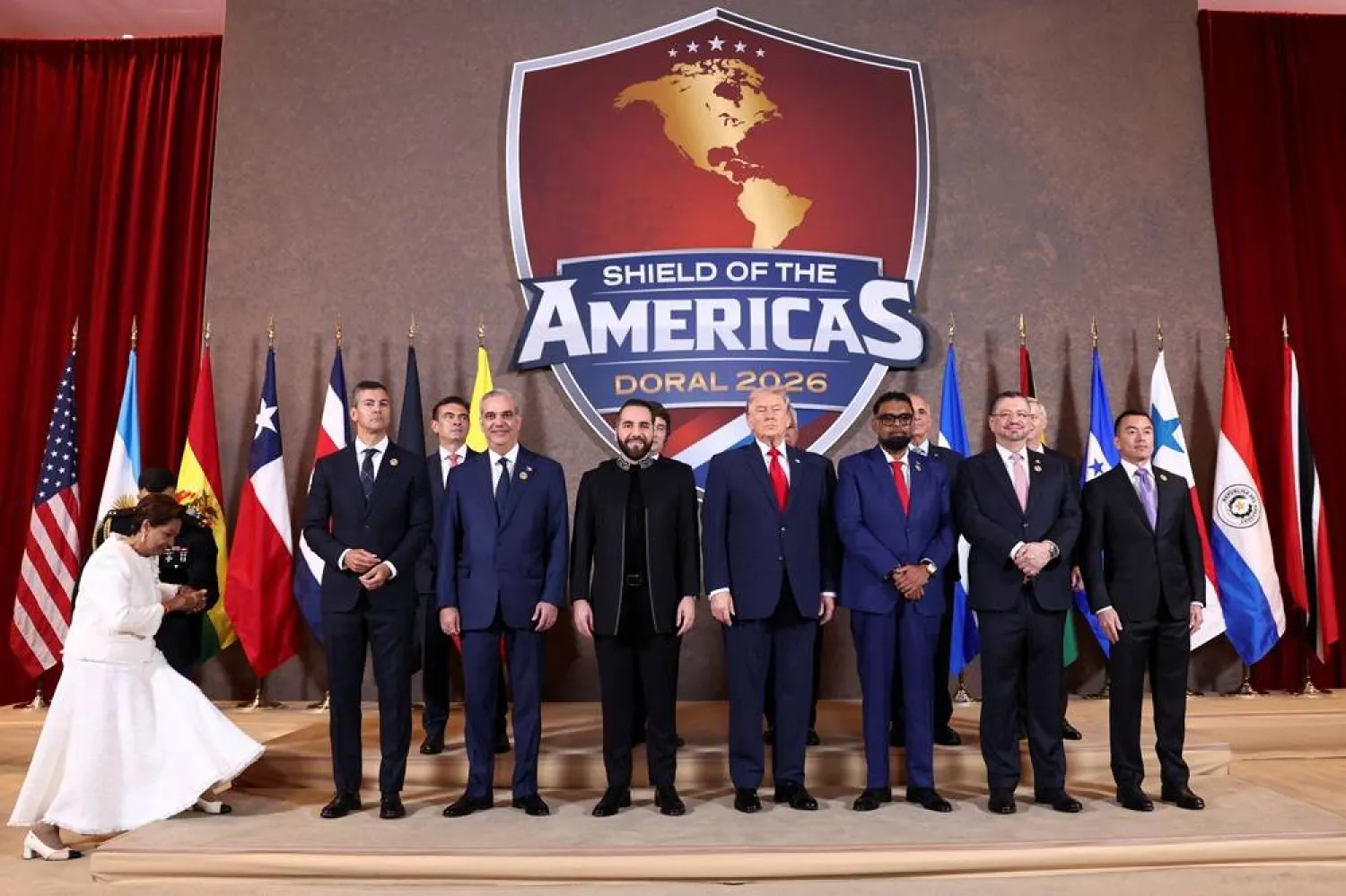
US President Donald Trump, Dominican Republic President Luis Abinader, Argentina's President Javier Milei, El Salvador's President Nayib Bukele, Guyana's President Mohamed Irfaan Ali, Costa Rica's President Rodrigo Chaves Robles, Bolivia's President Rodrigo Paz, Ecuador's President Daniel Noboa, Paraguay's President Santiago Pena and Chile's President-elect Jose Antonio Kast pose for a family photo during the "Shield of the Americas" Summit in Miami, Florida, US, March 7, 2026. (Reuters)
TT

Days After Iran Strikes, Trump Hosts Latin American Leaders to Form Anti-Cartel Coalition

US President Donald Trump, Dominican Republic President Luis Abinader, Argentina's President Javier Milei, El Salvador's President Nayib Bukele, Guyana's President Mohamed Irfaan Ali, Costa Rica's President Rodrigo Chaves Robles, Bolivia's President Rodrigo Paz, Ecuador's President Daniel Noboa, Paraguay's President Santiago Pena and Chile's President-elect Jose Antonio Kast pose for a family photo during the "Shield of the Americas" Summit in Miami, Florida, US, March 7, 2026. (Reuters)

US President Donald Trump welcomed Latin American leaders to Florida on Saturday to announce the formation of a military coalition against drug cartels, in line with an argument that he has been making throughout his second term in office.

Trump has cited drug cartels as a primary reason for ramping up his administration's involvement in Latin America, pressuring Venezuela over the past several months and seizing Venezuelan President Nicolas Maduro in January.

At least a dozen leaders from Central America, South America and the Caribbean joined the "Shield of the Americas" summit convened by Trump, who signed a proclamation launching the coalition.

"It's a great part of the world, but to fill that tremendous potential, we must smash the grip of the cartels and criminal gangs and horrible organizations run by, in some cases, absolute animals and truly liberate our people," Trump said.

Kristi Noem ‌will be special envoy ‌for the "Shield of the Americas", Trump posted Thursday. Noem was Homeland Security secretary until Trump ‌removed ⁠her from that ⁠post this week after mounting criticism of her from Congress.

Saturday's gathering gives Trump a chance to project strength closer to home even as the conflict in the Middle East leads to consequences he may not fully control, such as rising prices for oil and gas.

But the Trump administration also has been looking for ways to counter growing Chinese influence in the region.

Saturday's summit took place as Trump prepares for talks with Chinese President Xi Jinping in Beijing at the end of March. The Trump administration hopes to pull Latin America closer to Washington after years of growing Chinese trade, lending and infrastructure investment in the region.

The summit brings ⁠together conservative leaders aligned with Trump on security, migration and economics.

RIGHT-WING ALLIES ATTEND SUMMIT

Among those ‌attending are Argentine President Javier Milei, Chile's president-elect Jose Antonio Kast and ‌Salvadoran President Nayib Bukele, whose gang crackdown, criticized by human rights groups, has become a model for parts of Latin America's right.

Politicians from across ‌the region have toured Bukele's sprawling "mega-prison", where the United States last year deported more than 200 Venezuelans without trial.

Also joining ‌the gathering are Honduran President Nasry Asfura, who narrowly won a disputed election with Trump's backing, and Ecuador's President Daniel Noboa, who has echoed parts of Trump's economic agenda and recently announced joint operations with the US in a military crackdown on drug trafficking.

Many of the leaders share Trump's hardline view of crime and migration, favoring crackdowns over deeper social fixes and private business over the state. Their rise ‌reflects a broader rightward turn in parts of Latin America at a time when the region is being pulled between Washington and Beijing.

COUNTERING CHINA'S GROWING REGIONAL INFLUENCE

Ryan Berg, who ⁠heads the Americas Program at ⁠the Center for Strategic and International Studies, said China's trade with the region hit a record $518 billion in 2024, with Beijing loaning more than $120 billion to governments across the Western Hemisphere.

China's increased involvement in Latin America — from satellite tracking stations in Argentina and a port in Peru to economic support for Venezuela — has been an irritant for successive US administrations.

China has expanded its reach through trade, loans and infrastructure, while the Trump administration has pushed governments in the region to curb Beijing's role in ports, energy projects and other strategic assets.

That pressure was on display recently when Panamanian authorities moved against a Hong Kong-based firm tied to operations in the Panama Canal, a key global freight channel.

Washington has also taken more direct steps in the region.

The United States captured Maduro on January 3 and moved to seize control of the country's oil exports, and has tightened enforcement of the decades-long US embargo on Cuba.

Several Trump administration officials have told Reuters that Trump's move against Maduro was intended in part to counter China's ambitions, and that Beijing's days of leveraging debt to get cheap oil from Venezuela were "over."



German FM, in Call with Iranian Counterpart, Demands Hormuz Reopening

An IRGC boat participates in an operation to intercept vessels attempting to cross the Strait of Hormuz on April 23 (AFP)
TT

German FM, in Call with Iranian Counterpart, Demands Hormuz Reopening

An IRGC boat participates in an operation to intercept vessels attempting to cross the Strait of Hormuz on April 23 (AFP)

German Foreign Minister Johann Wadephul said he on Sunday demanded that Iran reopen the Strait of Hormuz and give up its nuclear weapons programme in a telephone call with Iranian counterpart Abbas Araghchi, AFP reported.

"I emphasized that Germany supports a negotiated solution," Wadephul said in a post on X about the call.

"As a close US ally, we share the same goal: Iran must completely and verifiably renounce nuclear weapons and immediately open the Strait of Hormuz, as also demanded by" US Secretary of State Marco Rubio.


Rubio to Visit Vatican, Rome after Trump Row

Secretary of State Marco Rubio, speaks during a Memorandum of Understanding signing ceremony with EU Commissioner for Trade and Economic Security Maros Sefcovic, at the State Department, Friday, April 24, 2026, in Washington. (AP Photo/Rod Lamkey, Jr.)
TT

Rubio to Visit Vatican, Rome after Trump Row

Secretary of State Marco Rubio, speaks during a Memorandum of Understanding signing ceremony with EU Commissioner for Trade and Economic Security Maros Sefcovic, at the State Department, Friday, April 24, 2026, in Washington. (AP Photo/Rod Lamkey, Jr.)

US Secretary of State Marco Rubio will visit Rome and the Vatican this week, an Italian government source said Sunday, weeks after President Donald Trump's stinging criticism of Pope Leo XIV.

Italian media reported that Rubio would meet the US pontiff himself on Thursday.

The government source told AFP that Rubio would meet Vatican Secretary of State Pietro Parolin and Italian Foreign Minister Antonio Tajani.

The meetings come just weeks after Trump's extraordinary criticism of Pope Leo over the Catholic leader's anti-war rhetoric.

The source said Rubio had asked for a meeting with Italian Prime Minister Giorgia Meloni, one of Trump's closest European allies, whom he turned on after she defended the pope.

Media reports said he was also due to meet Defense Minister Guido Crosetto, amid a deepening rift in transatlantic ties over the Middle East war.

Leo, 70, will on Friday mark one year as leader of the world's 1.4 billion Catholics, after being elected by cardinals on May 8, 2025, following the death of Pope Francis.

As the first ever pope from the United States, his words have arguably carried more weight in Washington than previous pontiffs -- and he has used them, criticising notably the Trump administration's crackdown on immigration.

But it was the pontiff's increasing anti-war rhetoric, particularly following the US-Israeli attacks on Iran, that triggered Trump's ire.

Leo declared Trump's threat to destroy Iran "unacceptable" and urged Americans to demand that US lawmakers "work for peace".

The US president slammed the pontiff in a social media post as "WEAK on Crime, and terrible for Foreign Policy".

Trump also said he was "not a big fan of Pope Leo" and that he does not "want a pope who thinks it's OK for Iran to have a nuclear weapon."

The pontiff responded by saying he had a "moral duty to speak out" against war -- and then sparked more headlines with a speech in Cameroon lambasting "tyrants" ransacking the world.

However, he insisted afterwards that the remarks were written long before the row, and said he had not intended to start a new debate with the US president.

Christians across the world expressed their solidarity with the pope, and Meloni condemned Trump's remarks as "unacceptable" -- prompting the president to turn his fire on her.

"I'm shocked at her. I thought she had courage, but I was wrong," the US president said in an interview with Italian daily Corriere della Sera.

He accused Meloni -- a far-right leader who has sought to act as a bridge between diverging US and European views -- of failing to help the United States with NATO.

Trump has threatened to pull US troops from Italy, saying Rome "has not been of any help to us" in the Iran war.

He has made a similar threat towards Spain, while the Pentagon has announced it will withdraw 5,000 US troops from Germany.

As of December 31, 2025, there were 12,662 active-duty US troops in Italy and 3,814 in Spain. In Germany, there were 36,436.


Israel Court Extends Detention of Gaza Flotilla Activists

Brazilian activist Thiago Avila gestures upon his arrival at a court in Ashkelon on May 3, 2026. Photo by Ilia YEFIMOVICH / AFP)
TT

Israel Court Extends Detention of Gaza Flotilla Activists

Brazilian activist Thiago Avila gestures upon his arrival at a court in Ashkelon on May 3, 2026. Photo by Ilia YEFIMOVICH / AFP)

An Israeli court has extended by two days the detention of two activists arrested aboard a Gaza-bound flotilla that was intercepted by Israeli forces in international waters near Greece, their lawyer said on Sunday.

Saif Abu Keshek, a Spanish national, and Brazilian Thiago Avila were detained by Israeli authorities late on Wednesday and brought to Israel, while more than 100 other pro-Palestinian activists aboard the boats were taken to the Greek island of Crete.

A court spokesperson confirmed that their remand had been extended until May 5.

The governments of Spain and Brazil issued a joint statement on Friday calling their detention illegal.

The activists were part of a second Global Sumud flotilla, launched in an attempt to break Israel’s blockade of Gaza by delivering humanitarian assistance. The ships had set sail from Barcelona on April 12.

Israeli authorities requested a four-day extension of their arrest on suspicion of offences that include assisting the enemy during wartime, contact with a foreign agent, membership in and providing services to a terrorist organisation, and the transfer of property for a terrorist organization, said rights group Adalah, which is assisting in the activists' defense.

Hadeel Abu Salih, the men's attorney, said that the two deny the allegations. Their arrest was unlawful due to a lack of jurisdiction, she told Reuters at the Ashkelon Magistrate's Court after the hearing, adding that the mission was meant to provide aid to civilians in Gaza, not to any militant group.

Abu Salih said that Abu Keshek and Avila were subjected to violence en route to Israel and kept handcuffed and blindfolded until Thursday morning.

The Israeli military did not immediately respond to a request for comment.

Israel's foreign ministry had on Thursday called the flotilla organizers "professional provocateurs".

"Israel will not allow the breach of the lawful naval blockade on Gaza," it said.