


North Korea’s Kim Yo Jong Says US-South Korea Drills to Harm Regional Stability

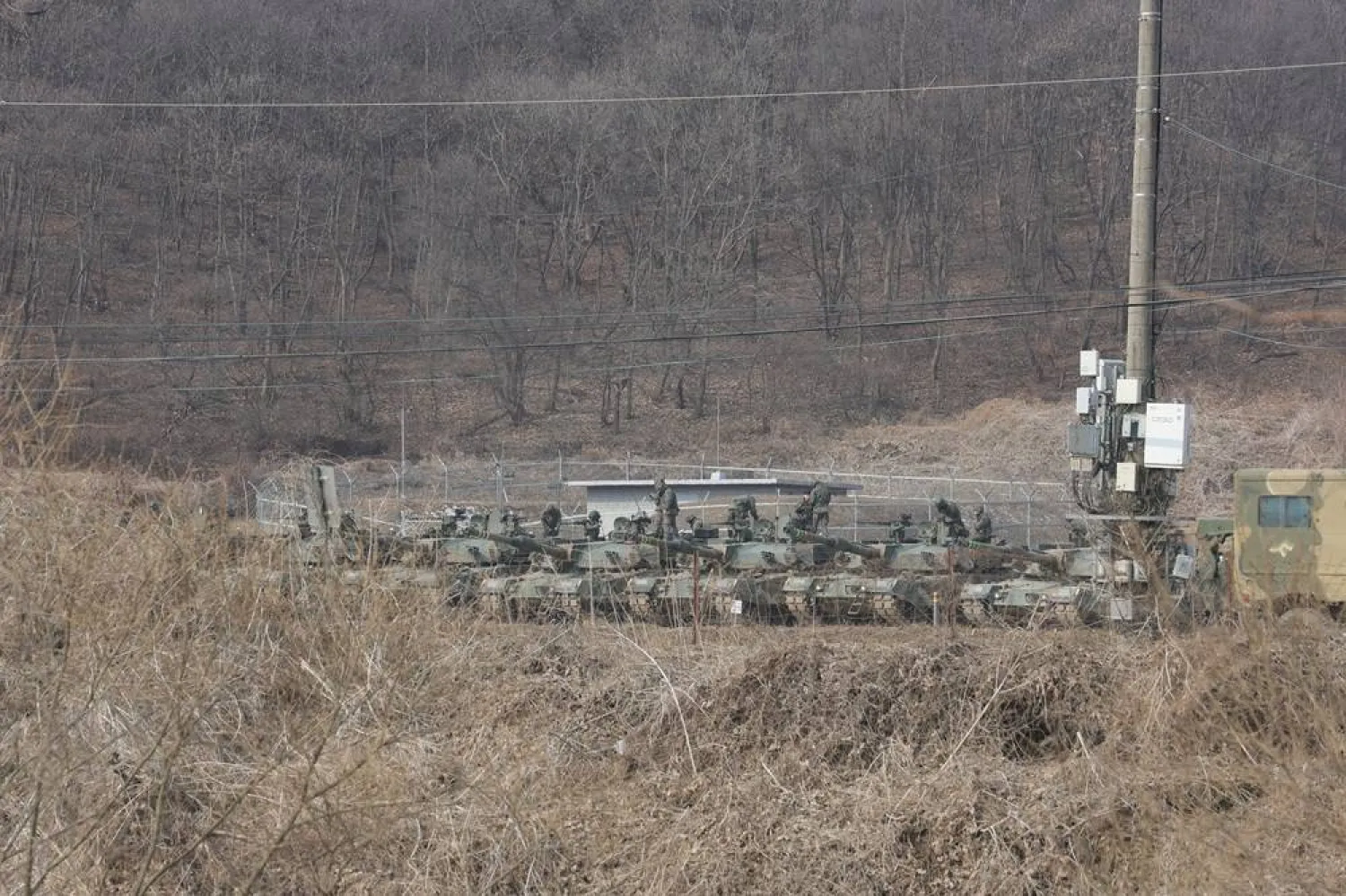
 09 March 2026, South Korea, Paju: South Korean tanks stand on standby at a training ground in Paju as South Korea and the United States begin their annual joint springtime military exercise to strengthen their combined defense posture. (YNA/dpa)
09 March 2026, South Korea, Paju: South Korean tanks stand on standby at a training ground in Paju as South Korea and the United States begin their annual joint springtime military exercise to strengthen their combined defense posture. (YNA/dpa)
TT

North Korea’s Kim Yo Jong Says US-South Korea Drills to Harm Regional Stability

 09 March 2026, South Korea, Paju: South Korean tanks stand on standby at a training ground in Paju as South Korea and the United States begin their annual joint springtime military exercise to strengthen their combined defense posture. (YNA/dpa)
09 March 2026, South Korea, Paju: South Korean tanks stand on standby at a training ground in Paju as South Korea and the United States begin their annual joint springtime military exercise to strengthen their combined defense posture. (YNA/dpa)

North Korea's Kim Yo Jong, the sister of leader Kim Jong Un, said US-South Korea military drills that began this week were a "provocative and aggressive war rehearsal" that would harm regional stability, state media KCNA reported on Tuesday.

The annual Freedom Shield military exercises revealed the allies' "habitual hostile policy" toward North Korea and "will further destroy regional ‌stability," Kim said ‌in a statement.

Kim described the drills in ‌South ⁠Korea as involving ⁠more than 18,000 South Korean and US forces and being staged "day and night across the territorial ground, sea, air, outer space and cyberspace" of North Korea.

She said the display of military force could "lead to terrible consequences that are unimaginable."

Recent global geopolitical crises and various international events demonstrate that in all military maneuvers carried out by hostile forces, there ⁠is no distinction between defense and offense, nor between ‌drills and actual combat, Kim ‌said.

South Korea and the United States have said the drills, which run from ‌March 9 to 19, were "defensive in nature" and would incorporate ‌deterrence scenarios related to North Korea's nuclear weapons.

The exercise will also serve as an opportunity to support ongoing preparations for the transfer of US wartime operational control to South Korea, officials from both countries have said. South Korea aims to ‌complete the handover of military command from the US before President Lee Jae Myung's term ends ⁠in 2030.

Analysts say ⁠the drills come at a sensitive time for North Korea, as it witnesses the US and Israel carry out leadership-targeting operations against Iran that may reinforce Pyongyang's reliance on its nuclear capacity.

Kim's remarks that offensive power is the most reliable deterrent "reflects a determination not to suffer the same fate as Iran, serving as both a justification for self-defense and a renewed message at home and abroad that giving up nuclear weapons would mean doom," said Lim Eul-chul, a North Korea expert at South Korea's Kyungnam University.

The US-South Korea drills follow North Korea'sruling Party Congress in February, where leader Kim Jong Un said he would focus on expanding his country's nuclear arsenal.



Kremlin Declines to Say if US Warned Against Iran Intel Sharing

This photograph shows Tehran's skyline covered with clouds and smoke after overnight strike on the Tehran Oil Refinery, on March 8, 2026. (AFP)
TT

Kremlin Declines to Say if US Warned Against Iran Intel Sharing

This photograph shows Tehran's skyline covered with clouds and smoke after overnight strike on the Tehran Oil Refinery, on March 8, 2026. (AFP)

The Kremlin declined on Tuesday to say whether the United States had warned it against sharing intelligence with Iran, as the war in the Middle East entered its 11th day.

The United States and Israel began striking Iran on February 28, prompting a storm of retaliatory Iranian strikes across the Gulf.

The Washington Post reported on Friday that Moscow had passed sensitive intelligence to Tehran, including the locations of US warships and aircraft in the region.

US special envoy Steve Witkoff said Saturday he had "strongly" communicated to Russia not to share targeting information with Tehran.

When asked by AFP about Witkoff's statement, or whether US President Donald Trump and his Russian counterpart Vladimir Putin had discussed this in a phone call on Monday, Kremlin spokesman Dmitry Peskov said:

"All I can say is that Witkoff is in constant contact with his Russian counterparts, and that this channel of communication indeed allows us to hand each other signals about the most sensitive issues."

Trump said Saturday he had no indication Russia was supporting Iran in the war, but that if they were, it was not "helping much".

Russia is a close ally of Iran, with the two agreeing last year to help each other counter "common threats".


Trump Tells Fox News It's Possible He Would Talk with Iran

US President Donald Trump delivers remarks to members of the Republican Party, at Trump National Doral Miami in Miami, Florida, US, March 9, 2026. REUTERS/Kevin Lamarque
TT

Trump Tells Fox News It's Possible He Would Talk with Iran

US President Donald Trump delivers remarks to members of the Republican Party, at Trump National Doral Miami in Miami, Florida, US, March 9, 2026. REUTERS/Kevin Lamarque

US President Donald Trump told Fox News that it's possible he would be willing to talk with Iran but that it depends on the terms, the ‌cable news network ‌said on Tuesday.

Asked ‌in ⁠an interview on ⁠Monday evening about the possibility of negotiations with Tehran, Trump told Fox he heard Tehran wanted to talk badly, ⁠according to the news ‌network.

The ‌Republican president also reiterated ‌his unhappiness with Iran's new ‌Supreme Leader Mojtaba Khamenei, telling Fox: "I don’t believe he can live in peace."

Trump also ‌echoed his comments at a press conference ⁠earlier on ⁠Monday, telling Fox the results of the US military operation in Iran were "way beyond expectation." Trump added that he was surprised that Iran was striking Gulf countries with missiles and drones, according to the network.


Iran Launches New Attacks Targeting Israel as It Seeks to Ramp up Pressure on US

 10 March 2026, Iran, Tehran: Members of the Iranian Red Crescent Society (IRCS) rescue teams work at the site of a building damaged in a US-Israeli airstrike in Resalat Square. (dpa)
10 March 2026, Iran, Tehran: Members of the Iranian Red Crescent Society (IRCS) rescue teams work at the site of a building damaged in a US-Israeli airstrike in Resalat Square. (dpa)
TT

Iran Launches New Attacks Targeting Israel as It Seeks to Ramp up Pressure on US

 10 March 2026, Iran, Tehran: Members of the Iranian Red Crescent Society (IRCS) rescue teams work at the site of a building damaged in a US-Israeli airstrike in Resalat Square. (dpa)
10 March 2026, Iran, Tehran: Members of the Iranian Red Crescent Society (IRCS) rescue teams work at the site of a building damaged in a US-Israeli airstrike in Resalat Square. (dpa)

Iran launched new attacks on Tuesday at Israel and Gulf Arab countries as it kept up pressure on the Middle East in a war started by Israel and the United States that has sent oil prices surging and stunned global economies.

Sirens warned of incoming missiles in the futuristic business hub of Dubai, and in Bahrain, authorities said an Iranian attack hit a residential building in the capital, killing a 29-year-old woman and wounding eight others. Saudi Arabia said it destroyed two drones over the Eastern Region and Kuwait's National Guard said it shot down six drones.

Later in the morning, sirens also sounded in Jerusalem, and sounds of explosions could be heard in Tel Aviv as Israel's defense systems worked to intercept incoming fire, not long after the military said it detected an Iranian missile launch.

“We are definitely not looking for a ceasefire,” Iran's parliament speaker, Mohammad Bagher Qalibaf, wrote on X. “We believe that the aggressor should be punched in the mouth so that he learns a lesson so that he will never think of attacking our beloved Iran again.”

Another top Iranian security official, Ali Larijani, appeared to threaten US President Donald Trump himself, writing on X that “Iran doesn’t fear your empty threats. Even those bigger than you couldn’t eliminate Iran. Be careful not to get eliminated yourself.” Iran has been accused of plotting attempts to kill Trump in the past.

Witnesses reported hearing several explosions in Tehran in the afternoon as Israel commenced a new wave of airstrikes.

Attacks aimed at pressuring the US

Along with firing missiles and drones at Israel and at American bases in the region, Iran has also been targeting energy infrastructure and traffic through the Strait of Hormuz, a vital waterway for traded oil, sending oil prices soaring. The attacks appear aimed at generating enough global economic pain to pressure the US and Israel to end their strikes.

Brent crude, the international standard, spiked to nearly $120 on Monday before falling back but was still at around $90 a barrel on Tuesday, nearly 24% higher than when the war started on Feb. 28.

Trump, who has previously said that the war could last for a month or longer, sought to downplay growing fears that it could take even longer, saying it was “going to be a short-term excursion.”

Still, Israeli Prime Minister Benjamin Netanyahu vowed the strikes on Iran would continue.

“Our aim is to bring the Iranian people to cast off the yoke of tyranny, (but) ultimately it depends on them,” Netanyahu said during a meeting with Israel’s hospital and health system leaders. “There is no doubt that with the actions taken so far, we are breaking their bones.”

Oil is rerouted

Iran has effectively stopped tankers from using the Strait of Hormuz, which connects the Gulf and the Gulf of Oman — the gateway to the Indian Ocean — through which 20% of the world's oil is carried. Attacks on merchant ships near the strait have killed at least seven sailors, according to the International Maritime Organization.

A bulk carrier likely came under attack in the Gulf on Tuesday off the coast of the United Arab Emirates, with the captain reporting a splash and a loud bang nearby, according to a monitoring center run by the British military.

In a post on social media, Trump seemed not to acknowledge that, saying that “If Iran does anything that stops the flow of Oil within the Strait of Hormuz, they will be hit by the United States of America TWENTY TIMES HARDER than they have been hit thus far.”

Iran's paramilitary Revolutionary Guard doubled down, saying in a statement that it “will not allow the export of even a single liter of oil from the region to the hostile side and its partners until further notice.”

Meanwhile, Amin Nasser, the president and CEO of Saudi Arabia’s oil giant Aramco, said tankers were being rerouted to avoid the Strait of Hormuz, and that its East-West pipeline would reach its full capacity of 7 million barrels a day being brought to the Red Sea port of the Yanbu this week.

“The situation at the Strait of Hormuz is blocking sizable volumes of oil from the whole region,” he said, adding that tighter supplies would likely push the price per barrel globally even higher, translating to higher costs for gasoline and jet fuel.

“If this takes a long time, that will have serious impact on the global economy,” Nasser said.

Airstrike on Iran-linked militia in Iraq kills 5

As the conflict spread across the region, Israel launched multiple attacks on the Hezbollah group in Lebanon, which responded by firing missiles into Israel.

Iran-backed militias in Iraq have also launched attacks at US bases in the country since the beginning of the conflict.

Early Tuesday, one such militia — the 40th Brigade of the Popular Mobilization Forces in the city of Kirkuk — was hit with an airstrike that killed at least five militiamen and wounded four, according to officials who spoke on condition of anonymity because they were not authorized to talk to reporters.

It was not immediately clear who was behind the strikes.

Israel's military meanwhile reiterated a call for all residents of southern Lebanon to evacuate their homes, saying it planned to “operate forcefully” there against Hezbollah.

Since the war began, at least 1,230 people have been killed in Iran, at least 397 in Lebanon and 11 in Israel, according to officials.

A total of seven US service members have been killed.