


February Fifth Warmest on Record, Extreme Rain in Europe, Says EU Monitor

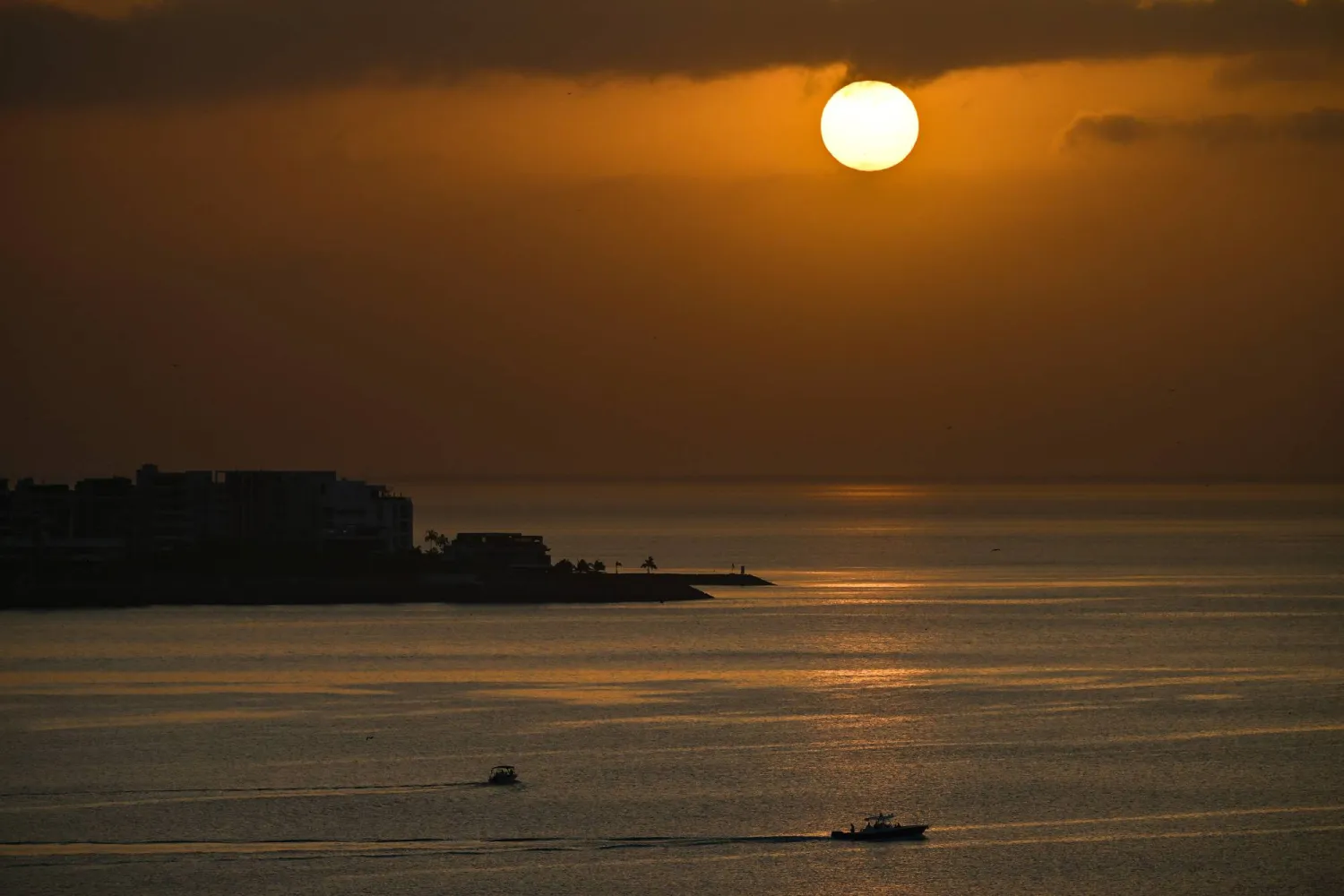
The sun rises over Panama Bay in Panama City on March 7, 2026. (AFP)
TT

February Fifth Warmest on Record, Extreme Rain in Europe, Says EU Monitor

The sun rises over Panama Bay in Panama City on March 7, 2026. (AFP)

The world logged its fifth hottest February on record, with western Europe drenched by extreme rainfall and widespread flooding, the European Union's climate monitor said on Tuesday.

Global temperatures last month were 1.49C above pre-industrial times, defined as the 1850-1900 period before large-scale fossil fuel use drove climate change.

Temperatures and precipitation varied widely in Europe.

The average temperature in Europe was among the three coldest in the past 14 years at -0.07C.

But western, southern and southeast Europe experienced above-average temperatures, according to the Copernicus Climate Change Service.

Colder conditions were experienced in northwest Russia, Baltic countries, Finland and its Scandinavian neighbors.

"Wet and dry conditions across the continent showed a pronounced contrast: much of western and southern Europe was wetter than average, whereas the rest of the continent... was mostly drier than average," the service said in its monthly report.

The United States, northeast Canada, the Middle East, Central Asia and east Antarctica had warmer-than-average temperatures.

- Need for global action -

Sea surface temperatures were the second highest for the month of February.

In the Arctic, the average sea ice extent was at its third lowest level for the month at five percent below average.

In the Antarctic, the monthly sea ice extent was close to average for February -- a "sharp contrast to the much below-average" levels observed over the past four years, Copernicus said.

"The extreme events of February 2026 highlight the growing impacts of climate change and the pressing need for global action," said Samantha Burgess, strategic lead for climate at the European Center for Medium-Range Weather Forecasts, which operates Copernicus.

"Europe experienced stark temperature contrasts," Burgess said.

"Exceptional atmospheric rivers -- narrow bands of very moist air -- brought record rainfall and widespread flooding to western and southern Europe," she said.

Human-driven climate change intensified torrential downpours that killed dozens and forced thousands of people from their homes across Spain, Portugal and Morocco between January and February, according to the World Weather Attribution (WWA) network of climate scientists.



Saudi Arabia, Russia Mark 100 Years of Diplomatic Ties with Historical Photo Exhibition in Moscow

The event was hosted at the Russian Ministry of Foreign Affairs in the presence of Russian Deputy Foreign Minister Borisenko Georgy Evgenievich and Saudi Arabia's Ambassador to the Russian Federation Sami Al-Sadhan. (SPA)
TT

Saudi Arabia, Russia Mark 100 Years of Diplomatic Ties with Historical Photo Exhibition in Moscow

The event was hosted at the Russian Ministry of Foreign Affairs in the presence of Russian Deputy Foreign Minister Borisenko Georgy Evgenievich and Saudi Arabia's Ambassador to the Russian Federation Sami Al-Sadhan. (SPA)

The Russian Ministry of Foreign Affairs, in cooperation with the King Abdulaziz Foundation for Research and Archives (Darah), held an exhibition of historical photographs on Monday in Moscow, marking 100 years since the establishment of diplomatic relations between Saudi Arabia and Russia.

The event was hosted at the ministry in the presence of Russian Deputy Foreign Minister Borisenko Georgy Evgenievich and Saudi Arabia's Ambassador to the Russian Federation Sami Al-Sadhan.

Al-Sadhan underlined the importance of the exhibition in showcasing key milestones in the history of relations between the two countries through a collection of historical photographs and documents.

“The exhibition, featuring carefully selected historical photographs and documents, serves to revive a historical memory filled with achievements, initiatives, and strategic partnerships between two pivotal states that hold significant weight and standing on the international stage,” he said.

Saudi Arabia and Russia are commemorating the centenary of their diplomatic relations this year through a series of celebrations and events across various fields, most notably in the economic, cultural, tourism, and sports sectors, he added.

Saudi-Russian relations, which date back to February 1926, are witnessing rapid growth across various sectors, he stressed. This turns the centenary into a unique occasion to revive a diplomatic legacy rich in ambitious projects and pave the way for a new phase of strategic partnership, the ambassador said, wishing continued progress and prosperity for the two countries and their peoples.

For his part, Evgenievich highlighted the growing momentum in air travel between the two countries, noting that Russian flights to Saudi Arabia increased by 42% in 2025, while Saudi flights to Russia rose by more than 35%.

He noted that the mutual visa exemption agreement for Saudi and Russian citizens will come into effect on May 11, stressing that joint efforts have made relations between Moscow and Riyadh more constructive and diversified.


Sherpas Cross Icefall, Open Route for Climbers to Move up on Everest

Mount Pumori, center left, looms in the background as a mountaineer negotiates Khumbu Icefall to descend to Everest Base Camp, in Nepal, May 4, 2025. (AP)
TT

Sherpas Cross Icefall, Open Route for Climbers to Move up on Everest

Mount Pumori, center left, looms in the background as a mountaineer negotiates Khumbu Icefall to descend to Everest Base Camp, in Nepal, May 4, 2025. (AP)

A group of Sherpa climbers have opened the route to Mount Everest that had been blocked for two weeks by chunks of ice and a giant serac, allowing mountaineers to make attempts to reach the summit, officials said on Tuesday.

The annual climbing season for the 8,849-m (29,032-ft) peak runs from April to May, months which offer the best weather conditions in which to reach the windswept summit.

But a massive 100-ft (30-m) serac, or ‌column of ice, ‌had blocked the path above base camp this month. ‌Parts ⁠of it have now ⁠melted and broken away, allowing Sherpa climbers, called the icefall doctors, to fix ropes, place ladders and carve a safe route through the treacherous Khumbu icefall to Camp I located at 6,060 meters (19,880 ft).

Lhakpa Sherpa of the 8K Expedition hiking company, who is coordinating the opening of the route, said 19 Sherpa climbers had crossed the difficult portion of the icefall and reached the site of Camp I.

“They are expected ⁠to fix ropes to Camp II, which is not difficult,” ‌Sherpa told Reuters from the base camp. ‌Camp II is located at about 6,400 meters (21,000 ft).

Hundreds of mountaineers from different countries have ‌been stranded at the Everest base camp for more than two weeks ‌ahead of making summit attempts next month.

Department of Tourism official Nisha Thapa Rawal said climbers could now begin to climb from the base camp.

Some climbers said they hoped to complete their expedition in time despite the delay.

“I think there is some hope ... But such a ‌delay will push summits back and possibly create crowding in the icefall and maybe the summit as teams try to ⁠make up ⁠for lost time,” said British climber Kenton Cool, who is trying to climb the peak for the 20th time, the most by any foreigner.

Authorities have issued 425 Everest permits so far this season, at a cost of $15,000 each. Another 153 climbers to neighboring Lhotse and Nuptse peaks also share part of the same route.

There is no limit on how many permits are issued, which has led to criticism in the past from mountaineering experts about the risk of long queues forming in what is known as the death zone because the air is dangerously thin.

American climber Garrett Madison of the Madison Mountaineering company said despite the opening of the route the area was still challenging.

"It’s not easy going around the serac, and perhaps a little bit dangerous," said Madison, 47, who is trying to make his 16th ascent.


Camera Shows Sumatra Orangutan Using a Canopy Bridge to Cross a Road in Indonesia

This screengrab from a handout video taken on December 14, 2025, and released by the Sumatran Orangutan Society (SOS) on April 26, 2026, shows a Sumatran orangutan using a canopy bridge constructed by conservation NGO Tangguh Hutan Khatulistiwa (TaHuKah) in collaboration with government partners and UK-based charity SOS to cross a road in Pakpak Bharat district, North Sumatra. (Handout / Sumatran Orangutan Society (SOS) / AFP)
TT

Camera Shows Sumatra Orangutan Using a Canopy Bridge to Cross a Road in Indonesia

This screengrab from a handout video taken on December 14, 2025, and released by the Sumatran Orangutan Society (SOS) on April 26, 2026, shows a Sumatran orangutan using a canopy bridge constructed by conservation NGO Tangguh Hutan Khatulistiwa (TaHuKah) in collaboration with government partners and UK-based charity SOS to cross a road in Pakpak Bharat district, North Sumatra. (Handout / Sumatran Orangutan Society (SOS) / AFP)

A Sumatran orangutan has been filmed for the first time using a human-made canopy bridge to cross a public road on the Indonesian island of Sumatra, conservationists said Monday.

Rapid development has been shrinking the jungle habitat of the critically endangered species, and fatal conflicts with people have been increasing.

The fleeting scene, captured by a motion‑sensitive camera, showed a young Sumatran orangutan pause at the forest’s edge, grip a rope with deliberate care and step out into open air. Halfway across, it stopped, casting a glance down at the road below. Moments later, it crossed.

Conservationists said that it marks the first documented case of a Sumatra orangutan using an artificial canopy bridge to cross a public road that had divided its habitat.

“This was the moment we had been waiting for,” Erwin Alamsyah Siregar, executive director of Indonesian conservation group Tangguh Hutan Khatulistiwa, or TaHuKah, told The Associated Press. “We are very grateful that the canopy here provides benefits for orangutan conservation efforts.”

He said that the bridge spans the Lagan–Pagindar road in Pakpak Bharat district, a vital corridor connecting remote villages to schools, healthcare and government services. But the road also cuts directly through prime orangutan habitat, splitting an estimated 350 orangutans into two isolated forest areas: the Siranggas Wildlife Reserve and the Sikulaping Protection Forest.

When the road was upgraded in 2024, the gap in the forest canopy widened, eliminating natural crossings for tree‑dwelling wildlife.

“Development was necessary for people,” Siregar said. “But without intervention, it would have left orangutans trapped on either side.”

TaHuKah, working with the Sumatran Orangutan Society, or SOS, and local and national government agencies, proposed a simple solution: rope bridges suspended between trees, allowing arboreal animals to cross above traffic.

Five canopy bridges were installed each with a camera trap, carefully positioned after surveys of orangutan nests, forest cover and animal movement. The structures were designed to support the orangutan’s weight — no small feat for the world’s largest tree‑dwelling mammal.

The program is closely monitored, with camera traps on every bridge and regular patrols to prevent forest encroachment. Conservationists hope more orangutans will follow the first pioneer.

They waited two years for the first orangutan to cross the bridge. Before the accomplishment, only smaller animals used it. Camera traps recorded squirrels, langur monkeys and macaques, followed by gibbons — a promising sign.

The orangutan’s approach was slower, building nests near the bridge, lingering at its edges and testing the ropes over time.

“They observe,” Siregar said. “They don’t rush. They watch, they try, they retreat. Only when they’re certain it’s safe do they move.”

Then, one day, he crossed fully — a first not just for Sumatra, but for the species globally on a public road, conservations say.

Similar bridges have been used by orangutans elsewhere, but usually over rivers or on private industrial forest road. Conservationists say public roads — noisy, busy and unpredictable — pose a far greater challenge.

For orangutans, the stakes are high. Isolation leads to inbreeding, genetic weakening and eventual population collapse. Restoring connectivity gives them a chance to survive.

Once widespread across southern Asia, the animal now only survives on the islands of Sumatra and Borneo. Fewer than 14,000 Sumatran orangutans remain in the wild, alongside just 800 Tapanuli orangutans and about 104,700 Bornean orangutans, according to conservation groups

“These bridges allow orangutans to move, to mix, to maintain healthy populations,” Siregar said. “It reduces the risk of extinction.”