


UN: Almost 700,000 Displaced, 84 Children Killed after Israeli Strikes on Lebanon

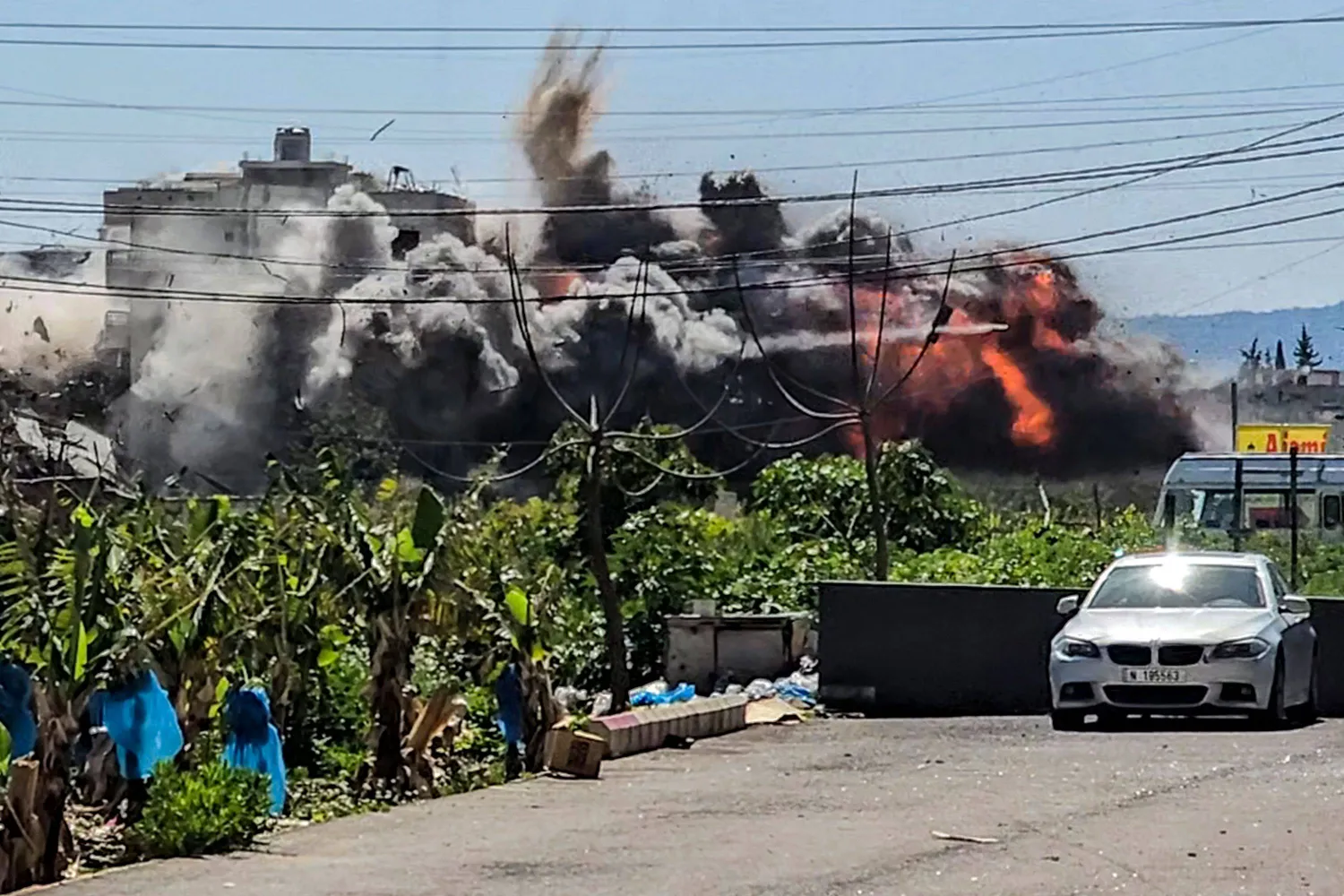
An explosion erupts following an Israeli airstrike on the village of Abbasiyeh in southern Lebanon on March 10, 2026 -  (Photo by KAWNAT HAJU / AFP)
An explosion erupts following an Israeli airstrike on the village of Abbasiyeh in southern Lebanon on March 10, 2026 - (Photo by KAWNAT HAJU / AFP)
TT

UN: Almost 700,000 Displaced, 84 Children Killed after Israeli Strikes on Lebanon

An explosion erupts following an Israeli airstrike on the village of Abbasiyeh in southern Lebanon on March 10, 2026 -  (Photo by KAWNAT HAJU / AFP)
An explosion erupts following an Israeli airstrike on the village of Abbasiyeh in southern Lebanon on March 10, 2026 - (Photo by KAWNAT HAJU / AFP)

The humanitarian crisis in Lebanon has deepened amid the wider Middle East war, with 84 children killed and more than 667,000 people displaced, two UN agencies said on Tuesday, as lives are upended on a massive scale across the country.

A total of 486 people have been killed in the war so far and 1,313 injured, of which 259 are children, according to the World Health Organization.

"This is only seven-days conflict, and we are already seeing that almost 100 children that have lost their lives," said Abdinasir Abubakar, WHO representative in Lebanon.

"One reason why we have a high number of children is that most of the attacks that we see actually is, it's urban centers, like in Beirut," he said, adding that Israel's airstrikes, which it says target Hezbollah infrastructure, are putting civilian lives at risk.

The current rate of displacement in Lebanon is outpacing levels seen during the 2023-24 war between Hezbollah and Israel, the UN Refugee Agency said on Tuesday. During that conflict, 886,000 people were internally displaced in Lebanon, while tens of thousands of Israelis were evacuated from northern towns near the Lebanese border.

ISRAEL ORDERS EVACUATION

Lebanon's sharp rise in displacement this week stems from large-scale evacuation orders issued by the Israeli army for southern Lebanon and Beirut's densely populated southern suburbs, which the UN human rights chief said on Friday raised serious concerns under international law.

The WHO warned that Lebanon's hospitals and frontline responders were under "extraordinary strain" trying to manage the rising number of patients.

Five hospitals are now out of service, four partially damaged, and 43 primary healthcare centers are closed - mostly in the south, which has been largely evacuated, Abubakar said.

"Many of the people fleeing were also fleeing back in 2024. We met many who then had their homes completely destroyed, family members killed and so on. So this means that people are not waiting to see what will happen next. They leave immediately," said Karolina Lindholm Billing, UNHCR representative in Lebanon.

Some 120,000 people are staying in government-designated shelters, while others are still looking for somewhere to stay, the UNHCR said, citing government figures.

"Many others are staying with relatives or friends or still searching for accommodation, and we see cars lined along the street with people sleeping in them and also on the sidewalks," Billing said.



Over 1.2 mn People in Lebanon to Face Acute Hunger due to War

UN forces operate in southern Lebanon, as seen from northern Israel, Wednesday, April 29, 2026. (AP Photo/Ariel Schalit)
TT

Over 1.2 mn People in Lebanon to Face Acute Hunger due to War

UN forces operate in southern Lebanon, as seen from northern Israel, Wednesday, April 29, 2026. (AP Photo/Ariel Schalit)

A UN-backed report said Wednesday that more than 1.2 million people in Lebanon were expected to face acute hunger due to the latest war between Israel and Hezbollah.

The figure was announced in a joint statement by the UN's Food and Agriculture Organization, the World Food Program and Lebanon's agriculture ministry.

Some "1.24 million people -- nearly one in four of the population analysed -- are expected to face food insecurity" at crisis levels or worse between April and August 2026, they said.

They were referring to analysis from the Integrated Food Security Phase Classification (IPC), a UN-backed group that monitors hunger and malnutrition.

This marks a "significant deterioration" from before the war erupted in March, "when an estimated 874,000 people, roughly 17 percent of the population, were experiencing acute food insecurity", the statement said.

"The deterioration is due to conflict, displacement and economic pressures," it added.

A ceasefire since April 17 has paused six weeks of war between Israel and Iran-backed militant group Hezbollah that has killed more than 2,500 people in Lebanon and displaced more than one million, according to the authorities.

Israeli forces are operating in south Lebanon near the border where residents have been warned not to return, and both sides have been trading fire despite the truce.

"Acute food insecurity is likely to deepen without sustained and timely humanitarian and livelihood support," the statement added.


Syria Says Australia Won't Repatriate Families from Camp for Those with Alleged Ties to ISIS Militants

A brick wall surrounds a tent camp housing people with alleged ties to ISIS militants at Roj Camp in eastern Syria, Friday, April 24, 2026. (AP)
TT

Syria Says Australia Won't Repatriate Families from Camp for Those with Alleged Ties to ISIS Militants

A brick wall surrounds a tent camp housing people with alleged ties to ISIS militants at Roj Camp in eastern Syria, Friday, April 24, 2026. (AP)

A group of Australian women and children who left a camp in Syria that houses people with alleged ties to ISIS group are stuck in the country because Australian authorities have refused to allow their return, Syrian officials said Wednesday.

Thirteen women and children from four families last week left Roj camp, a remote facility near the border with Iraq that houses relatives of suspected militants, on Friday and traveled to Syria's capital.

An official at the camp at the time said that the families were expected to remain in Damascus for around 72 hours and then be sent to Australia.

In response to an Associated Press inquiry about their status, Syria's information ministry said in a statement that after the families left the camp, the foreign ministry was informed that "the Australian government had refused to receive them.”

They were turned back from reaching Damascus International Airport, the information ministry's statement said.

“These families are still awaiting a solution, which can only be achieved through coordination with the relevant international parties.”

Australian Prime Minister Anthony Albanese said at a news conference on Wednesday that “we are providing no support for repatriation and no assistance for these people.”

Syria's information ministry said that the families, through a lawyer, had obtained passports that were delivered by an “individual” that it didn't identify while they were still in northeastern Syria in an area under the control of the Kurdish-led Syrian Democratic Forces, or SDF.

A Lebanese-Australian doctor, Jamal Rifi, previously told Australian media that he was helping to coordinate the repatriation effort. Rifi couldn't be reached for comment.

A previous attempt to return 34 women and children to Australia from the camp in February was turned back by Syrian authorities.

Former ISIS militants from multiple countries, along with their wives and children, were held in a network of camps and detention centers in northeast Syria after the militant group lost control of its territory in Syria in 2019. Though defeated, the group still has sleeper cells that carry out deadly attacks in Syria and Iraq.

The larger al-Hol camp has now been closed down, and thousands of suspected ISIS militants previously held in Syria were transferred to Iraq by the US military to stand trial there.

The moves came after fighting between government forces and the SDF in January. Government forces seized much of the territory formerly held by the SDF. Amid the chaos, many detainees fled al-Hol and some prisoners escaped from a detention center.

Australian governments have repatriated Australian women and children from Syrian detention camps on two occasions. Other Australians have also returned without government assistance.


Saudi Envoy Says Adherence to Taif Accord is Key to Any Settlement in Lebanon

Saudi Ambassador to Lebanon Walid Bukhari meets Grand Mufti Sheikh Abdul Latif Derian (X)
TT

Saudi Envoy Says Adherence to Taif Accord is Key to Any Settlement in Lebanon

Saudi Ambassador to Lebanon Walid Bukhari meets Grand Mufti Sheikh Abdul Latif Derian (X)

Saudi Ambassador to Lebanon Walid Bukhari said adherence to the 1989 Taif Agreement is the backbone to any settlement in Lebanon, alongside the need to reinforce civil peace and prioritize wisdom and reason.

Bukhari made the remarks during visits to Grand Mufti Sheikh Abdul Latif Derian, Deputy Head of the Higher Islamic Shiite Council Sheikh Ali al-Khatib and Druze spiritual leader Sheikh Sami Abi al-Muna.

During his meeting with Derian, Bukhari stressed Saudi Arabia’s commitment to Lebanon’s unity in facing current challenges, saying the Kingdom was pursuing diplomatic efforts to help Lebanon through its crisis and stood by the Lebanese state and its institutions in support of solutions that promote security, stability and prosperity.

Derian, for his part, praised Saudi Arabia’s role in the region, particularly in supporting Lebanon’s stability, security and unity under exceptional circumstances.

He said rebuilding the state was the only path to saving Lebanon by restoring its authority across all its territory, confining weapons to the Lebanese army and adhering to the Taif accord while strengthening national unity.

Derian also welcomed diplomatic efforts by President Joseph Aoun and Prime Minister Nawaf Salam, with the support of Arab and international partners, to halt the war in Lebanon and reach a settlement that ensures stability.

In a second stop, Bukhari met Ali al-Khatib at the Higher Islamic Shiite Council, where they reviewed developments in Lebanon and the region and prospects for the coming phase.

Bukhari voiced optimism about the future and stressed the need to strengthen civil peace in Lebanon, saying this had been a focus of recent Saudi efforts and expressing confidence in “people of wisdom and reason.”

He stressed that what is needed today is a path agreed by Lebanon’s three top leaders to safeguard civil peace, while praising the wisdom and experience of Parliament Speaker Nabih Berri at every critical juncture.

Bukhari said a return to the Taif accord was the main gateway to agreement on broad principles that protect every Lebanese component and avoid excluding any party, recalling late parliament speaker Hussein Husseini’s saying that “the alternative to Taif is implementing Taif.”

Khatib, for his part, praised Saudi Arabia’s role in strengthening civil peace in Lebanon and repeated that “we have no separate political project of our own.”

He said hopes rested on Saudi Arabia’s role in curbing Israeli and Western overreach, calling for cooperation among major Arab and Islamic states to forge a project capable of confronting the Zionist plan.

He added that the Arab and Islamic worlds needed a front to protect them and that Saudi Arabia was central to that effort, expressing hope such cooperation would lead to greater integration while preserving each state’s particularities.

Bukhari also met Abi al-Muna to discuss broader developments in light of continued military operations, efforts to stop the war, Saudi Arabia’s role in helping Lebanon overcome its difficult circumstances, the importance of preserving civil peace and national unity, and the outcome of the recent visit to Lebanon by Saudi Foreign Ministry adviser Yazid bin Farhan.