


Switzerland Closes Tehran Embassy but Maintains 'Open Line' between US, Iran

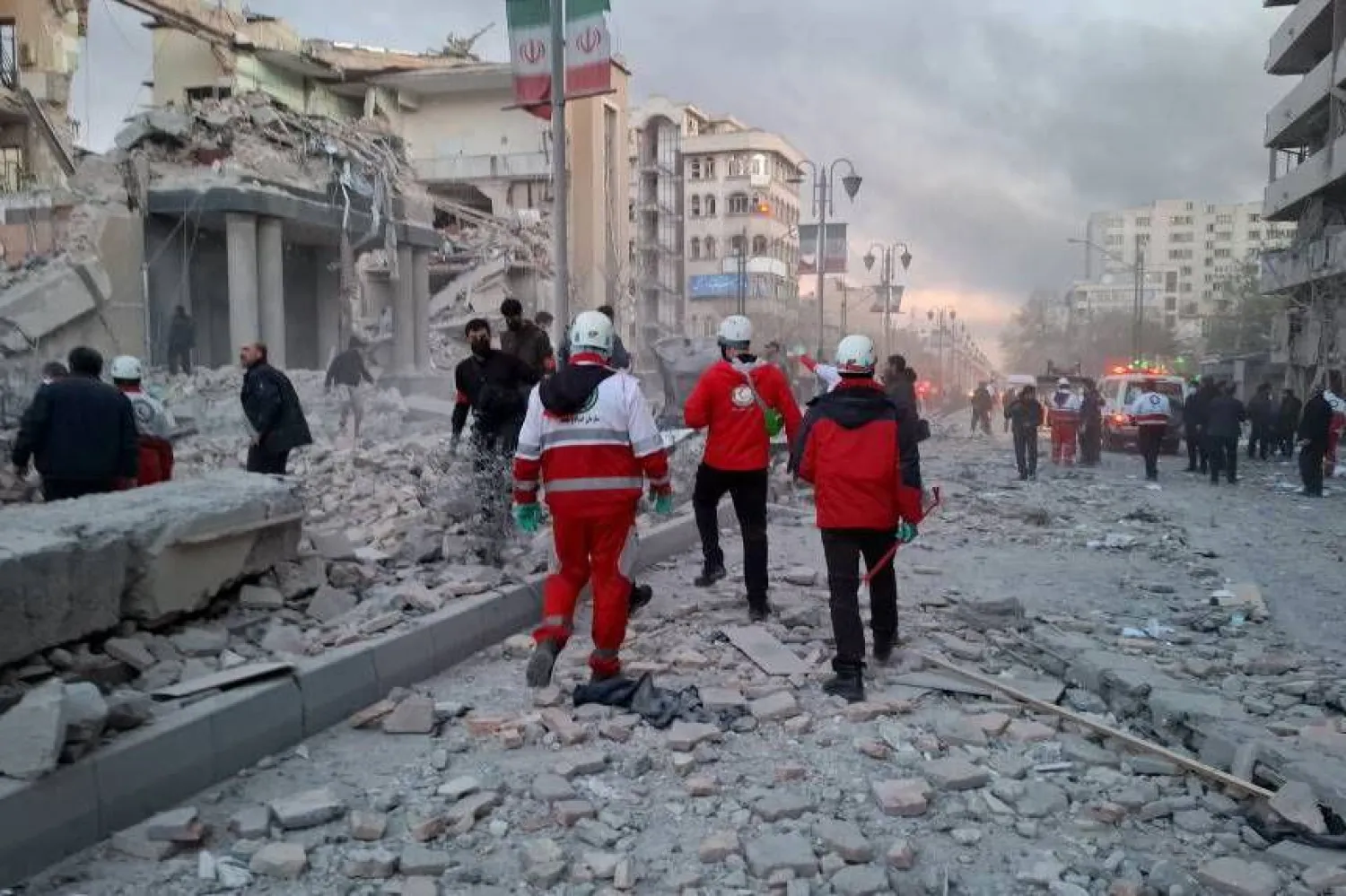
07 March 2026, Iran, Tehran: Members of the Iranian Red Crescent Society (IRCS) rescue teams work at the site of a building damaged in an airstrike in Iran, following the strikes launched by the United States and Israel on February 28, which killed Supreme Leader Ali Khamenei and senior military officials, prompting Iran to retaliate with strikes on Israel and Gulf states. Photo: IRCS via ZUMA Press Wire/dpa
TT

Switzerland Closes Tehran Embassy but Maintains 'Open Line' between US, Iran

07 March 2026, Iran, Tehran: Members of the Iranian Red Crescent Society (IRCS) rescue teams work at the site of a building damaged in an airstrike in Iran, following the strikes launched by the United States and Israel on February 28, which killed Supreme Leader Ali Khamenei and senior military officials, prompting Iran to retaliate with strikes on Israel and Gulf states. Photo: IRCS via ZUMA Press Wire/dpa

Switzerland said Wednesday it was temporarily closing its embassy in Tehran due to the Middle East war but maintaining an "open line" of communication between the United States and Iran.

For decades, neutral Switzerland has played a key role in maintaining basic diplomatic contacts between Iran and the United States, AFP said.

The foreign ministry in Bern said that in view of the war in the Middle East and the increasing security risk, it had "decided to temporarily close the Swiss embassy in Tehran".

Ambassador Olivier Bangerter and the remaining five other Swiss staff members left Iran by land earlier on Wednesday and will return to Tehran once the situation allows.

"As part of its good offices, Switzerland will continue to maintain an open line of communication between the United States and Iran, in consultation with the two countries," said the ministry statement.

Both the United States and Iran were informed of the temporary closure of the embassy and the departure of its Swiss staff.

"Switzerland will continue to be available to channel communications that the parties consider useful," the statement added.

"The protecting power mandate, under which Switzerland represents US interests in Iran, can be exercised independently of geographical location."

- The protecting power -

Renowned for its neutrality, Switzerland has been representing US interests in Iran since Washington broke off relations with Tehran after the 1980 hostage crisis, a year after the Iranian revolution.

In its role as the so-called protecting power, Switzerland has for decades allowed the two feuding nations to maintain a minimum of diplomatic and consular relations.

The Swiss embassy in Tehran handles all consular affairs between the United States and Iran, including passport requests, altering civil status and consular protection for US citizens in Iran.

Under the protecting power mandate, "Switzerland can either offer to act as a go-between on its own initiative or can fulfil this function at the request of the parties concerned, provided that all those involved agree," the foreign ministry says on its website.

The United States and Iran held a third round of indirect talks through Omani negotiators, on Iran's nuclear program, in the Swiss city of Geneva on February 26.

Two days later, the United States and Israel launched the first wave of attacks in a war that has seen Iran strike targets in multiple countries around the Gulf.

Switzerland has called for de-escalation and a return to diplomacy.


If Iran Refuses US Proposal, Israel Vows 'Even More Painful' Strikes

FILE PHOTO: A 3D-printed miniature model of Donald Trump and the US and Iran flags are seen in this illustration taken January 15, 2025. REUTERS/Dado Ruvic/Illustration/File Photo
TT

If Iran Refuses US Proposal, Israel Vows 'Even More Painful' Strikes

FILE PHOTO: A 3D-printed miniature model of Donald Trump and the US and Iran flags are seen in this illustration taken January 15, 2025. REUTERS/Dado Ruvic/Illustration/File Photo

Israel's defense minister warned Iran on Thursday against rejecting a US proposal focused on renouncing "nuclear armament" and vowed to stage "even more painful" strikes on new targets if it did so.

"Iran is standing at a historic crossroads: one path is renouncing the ways of terror and nuclear armament... in line with the US proposal, the other leads to an abyss," Israel Katz said, Reuters reported.

"If the Iranian regime chooses the second path, it will quickly discover there are even more painful targets than those we have already struck," he said.


Lula Says Trump Has 'No Right' to Threaten Countries

Brazilian President Luiz Inacio Lula da Silva (Photo by Evaristo Sa / AFP)
TT

Lula Says Trump Has 'No Right' to Threaten Countries

Brazilian President Luiz Inacio Lula da Silva (Photo by Evaristo Sa / AFP)

Brazilian President Luiz Inacio Lula da Silva criticized US President Donald Trump, saying the US leader has "no right" to threaten other nations, in an interview published in Spain on Thursday.

Lula's comments come after Trump this month warned that a "whole civilization will die" in Iran if the country did not open up the Strait of Hormuz.

"Trump has no right to wake up in the morning and threaten a country," Lula told the Spanish daily El Pais, recalling that the US Constitution divides authority over war and foreign policy between Congress and the president, AFP reported.

"It is essential that powerful leaders take greater responsibility in maintaining peace," the 80-year-old leftist president added.

Lula and Trump, 79, stand on opposite sides on issues including multilateralism, international trade and the fight against climate change.

Brasília-Washington relations remain strained, despite a meeting between the leaders last year that helped ease tensions and led to a reduction in trade tariffs.

Lula renewed calls for reform of the UN Security Council, including the removal of the veto held by five permanent members and the inclusion of more countries from Africa and Latin America.

"It is time to redefine the United Nations to give it credibility, otherwise Trump is right," he said, referring to the US president's criticism that the post-World War II international system is no longer effective.

Lula spoke to the newspaper ahead of a visit to Spain, where he is to meet Spanish Prime Minister Pedro Sanchez and attend a forum of progressive leaders.

Other attendees at the gathering in Barcelona on Saturday include Mexican President Claudia Sheinbaum and South African President Cyril Ramaphosa.


Danish Refugee Council Warns 4 Million More Face Displacement as Aid Drops

Some of the Sudanese civilian refugees and human rights activists hold placards with the wordings, 'KeepEyesOnSudan' outside a bus branded during a commemorative gathering dubbed 'Under the Neema (Tree)' to mark the third anniversary since the war in Sudan started, organized by the Amnesty International at the Freedom Corner in Nairobi, Kenya, 15 April 2026. EPA/DANIEL IRUNGU
TT

Danish Refugee Council Warns 4 Million More Face Displacement as Aid Drops

Some of the Sudanese civilian refugees and human rights activists hold placards with the wordings, 'KeepEyesOnSudan' outside a bus branded during a commemorative gathering dubbed 'Under the Neema (Tree)' to mark the third anniversary since the war in Sudan started, organized by the Amnesty International at the Freedom Corner in Nairobi, Kenya, 15 April 2026. EPA/DANIEL IRUNGU

Over 4 million people are set to be newly displaced around the world by the end of next year as donors step back from providing life-saving aid, the Danish Refugee Council said on Thursday.

There are already some 117 million people forcibly displaced worldwide as the number of conflicts has surged to around 130 - double ⁠the number reported ⁠earlier this century, according to the International Committee of the Red Cross.

"For families fleeing war with nothing but the clothes on their backs, there is little ⁠hope: the international safety net that once existed has gaping holes as humanitarian assistance shrinks," Reuters quoted Charlotte Slente, Secretary General of the DRC, as saying.

Sudan - where a war entered its fourth year this week and 13.5 million people are already displaced - will see the largest jump with an additional 670,000 people ⁠fleeing ⁠this year and next, the DRC said.

UN agencies are warning that they may have to cut off vital supplies of water and food to them in neighboring Chad because of a lack of funding.

The DRC's findings, supported by IBM, were based on key indicators on security, environment and other factors across 27 countries.
