

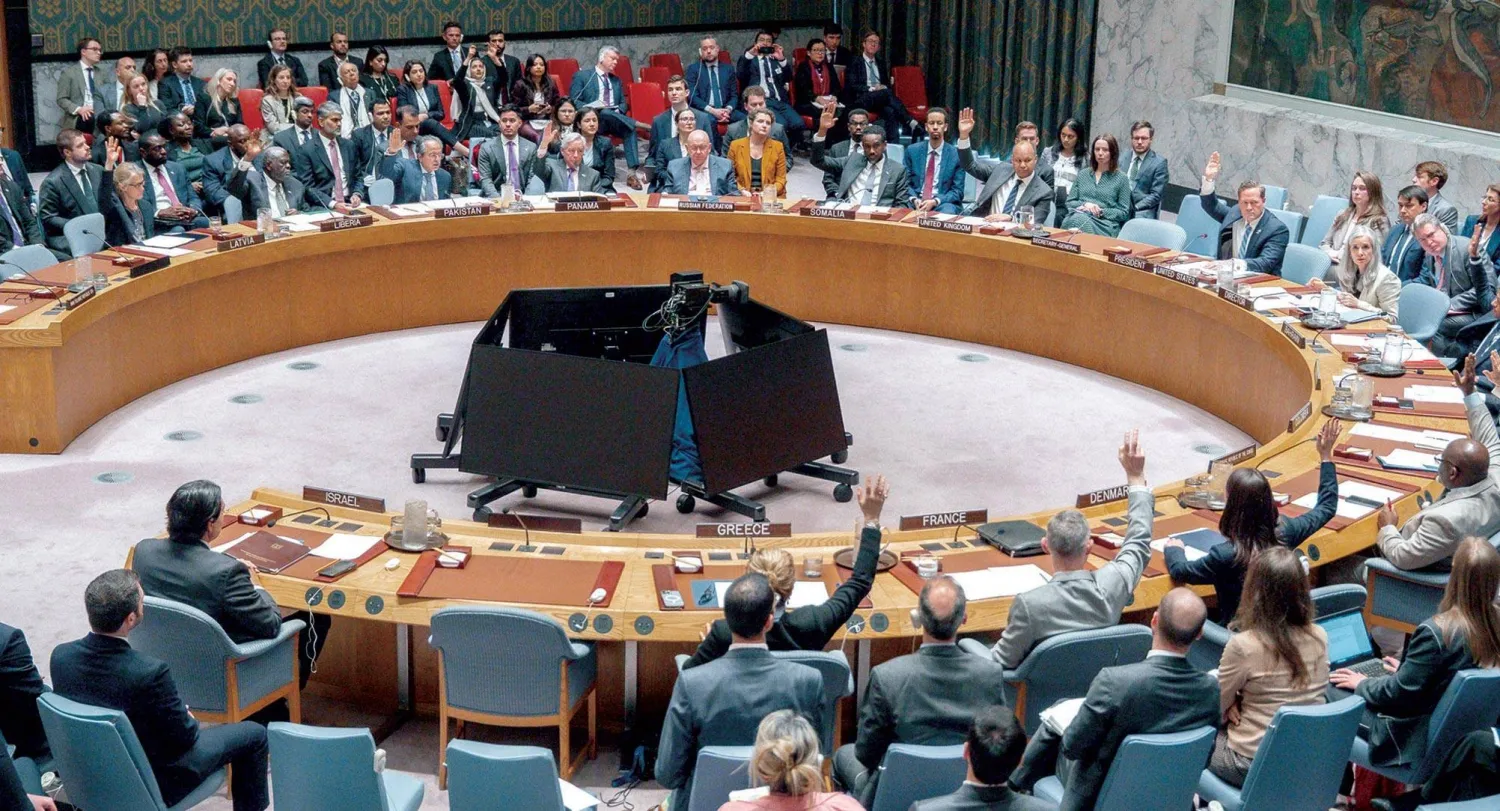

UN Security Council Condemns Iranian Attacks on the Gulf

The Security Council during its meeting on Wednesday (EPA)
TT

UN Security Council Condemns Iranian Attacks on the Gulf

The Security Council during its meeting on Wednesday (EPA)

In a resolution supported by 135 UN member states, the United Nations Security Council on Wednesday strongly condemned Iranian aggressions targeting Gulf states and Jordan, demanding that Tehran respects freedom of navigation in the Strait of Hormuz and the Bab al-Mandab in accordance with international laws.

On Wednesday, the 15-member Council adopted resolution 2817 by a vote of 13 in favor, including the US, France, UK, Denmark, Greece, Pakistan, Panama, Somalia, Bahrain, Columbia, the Republic of Congo, Latvia and Liberia, to none against, with 2 abstentions (China and Russia). The resolution was cosponsored by an extraordinary 135 other UN member states.

The resolution, drafted by Bahrain on behalf of the Gulf Cooperation Council (GCC) countries, reiterated its strong support for the territorial integrity, sovereignty and political independence of Bahrain, Kuwait, Oman, Qatar, Saudi Arabia, the United Arab Emirates and Jordan.

It condemned in the “strongest terms the egregious attacks” by Iran against the territories of the mentioned countries and determined that such acts constitute a breach of international law and are a serious threat to international peace and security.

The resolution condemned assaults on residential areas and civilian objects, and expressed solidarity with the countries that have come under attack and their people.

It also demanded immediate cessation of all attacks by Iran against the GCC countries and Jordan and that Tehran “immediately and unconditionally” cease from any provocation or threats to neighboring states, including the use of proxies.

The resolution called upon Iran to refrain immediately from any actions or threats and to comply fully with its obligations under international law, including international humanitarian law, particularly regarding the protection of civilians and civilian objects in armed conflict.

Additionally, it reaffirmed that the exercise of navigational rights and freedoms by merchant and commercial vessels, in accordance with international law, must be respected, particularly around critical maritime routes, and took note of the right of member states, in accordance with international law, to “defend their vessels from attacks and provocations, including those that undermine navigational rights and freedoms.”

The resolution condemned any actions or threats by Iran aimed at closing, obstructing, or otherwise interfering with international navigation through the Strait of Hormuz, or threatening maritime security in the Bab al-Mandab.

It warned that any attempt to impede lawful passage or freedom of navigation in these international waterways constitutes a serious threat to international peace.

After the vote, Bahrain’s ambassador to the UN, Jamal Alrowaiei, expressed his “deepest gratitude” on behalf of the GCC.

“The fact that 135 countries co-sponsored this resolution bears witness to a collective conscience of just how dangerous Iran’s attacks are against the GCC and Jordan,” Alrowaiei told the Security Council.



Saudi Arabia, Arab, Islamic Countries Hail UK Decision to Ban Imports from Illegal Israeli Settlements

This photograph taken from the E1 corridor, an area in the occupied West Bank shows vehicles driving along the highway near the Israeli settlement of Maale Adumim, on September 8, 2026. (AFP)
TT

Saudi Arabia, Arab, Islamic Countries Hail UK Decision to Ban Imports from Illegal Israeli Settlements

This photograph taken from the E1 corridor, an area in the occupied West Bank shows vehicles driving along the highway near the Israeli settlement of Maale Adumim, on September 8, 2026. (AFP)

Eight countries welcomed the decision by Britain to ban imports from illegal Israeli settlements in the West Bank and impose restrictions on some services, adding they hoped the ‌move would ‌mobilize other countries to ‌take ⁠similar action.

In a ⁠joint statement, the foreign ministers of Saudi Arabia, Egypt, Qatar, Jordan, the UAE, Türkiye, Pakistan and Indonesia welcomed the joint statement ‌by 12 countries ‌on the need for a two-state solution to the Palestinian-Israeli conflict.

The ministers "reiterate ‌their call for Israel to rescind all measures ⁠taken ⁠in connection with settlement activities and other measures aimed at altering the geographic and demographic character of the Occupied Palestinian Territory", the statement said.

The FMs welcomed the joint statement on the two-state solution issued by the foreign ministers of Canada, Denmark, Finland, France, Iceland, Ireland, Norway, Poland, Portugal, Spain, Sweden and the United Kingdom, confirming their intention to introduce national and/or support European restrictions on trade in goods with settlements that are illegal under international law, or to actively consider these and other measures in accordance with their respective national procedures.

The ministers considered the announced intentions to be in line with international law and relevant United Nations resolutions, including UN Security Council resolution 2334 (2016), and the Advisory Opinion of the International Court of Justice of July 19, 2024, including the obligation of all States not to recognize as legal the situation arising from Israel’s unlawful occupation and not to render aid or assistance in maintaining the situation created by Israel’s occupation.

The ministers underscored that Gaza is an integral part of the Occupied Palestinian Territory and call for the full and immediate implementation of President Donald Trump’s peace plan to end the conflict in the enclave, to ensure security and stability, address the humanitarian situation, facilitate reconstruction and recovery, and lay the foundations for lasting peace.

They stressed that the only viable path to achieving a just, lasting, and comprehensive peace is the implementation of the two-state solution, through the realization of an independent, sovereign, contiguous, and viable Palestinian State, based on the June 1967 lines, with East Jerusalem as its capital, in accordance with international law and the relevant UN resolutions.


Saudi Arabia Condemns Continued Iranian Attacks on Jordan

Jordanian air defenses intercept missiles launched from Iran, as seen from the Israeli side of the Jordan Valley, 09 September 2026. (EPA)
TT

Saudi Arabia Condemns Continued Iranian Attacks on Jordan

Jordanian air defenses intercept missiles launched from Iran, as seen from the Israeli side of the Jordan Valley, 09 September 2026. (EPA)

Saudi Arabia strongly condemned on Wednesday the continued, “unjustified, and blatant Iranian attacks on Jordan.”

A Foreign Ministry statement reiterated Saudi Arabia's solidarity with Jordan and its people regarding any measures taken in response to this aggression.

Saudi Arabia stressed that the Iranian attacks are “a flagrant violation of international law and the principles of good neighborliness.”

It underlined “the urgent need for an immediate end to Iran's attacks against Jordan and other countries in the region, as well as the need for serious and concerted efforts to achieve security and stability for the region's nations and peoples.”


Saudi Crown Prince Receives Princes, Scholars, Senior Officials, and Citizens

Prince Mohammed bin Salman bin Abdulaziz Al Saud, Crown Prince and Prime Minister, receives princes, scholars, ministers, and citizens at the Al-Salam Palace in Jeddah. (SPA)
TT

Saudi Crown Prince Receives Princes, Scholars, Senior Officials, and Citizens

Prince Mohammed bin Salman bin Abdulaziz Al Saud, Crown Prince and Prime Minister, receives princes, scholars, ministers, and citizens at the Al-Salam Palace in Jeddah. (SPA)

Prince Mohammed bin Salman bin Abdulaziz Al Saud, Crown Prince and Prime Minister, received princes, scholars, senior officials, and a number of citizens who came to greet him at the Al-Salam Palace in Jeddah on Tuesday.

The visitors included Minister of Interior Prince Abdulaziz bin Saud bin Naif bin Abdulaziz, Minister of Sports Prince Abdulaziz bin Turki Al-Faisal, and Minister of the National Guard Prince Abdullah bin Bandar bin Abdulaziz.