


Iran Defiant, US Vows Even Heavier Bombing

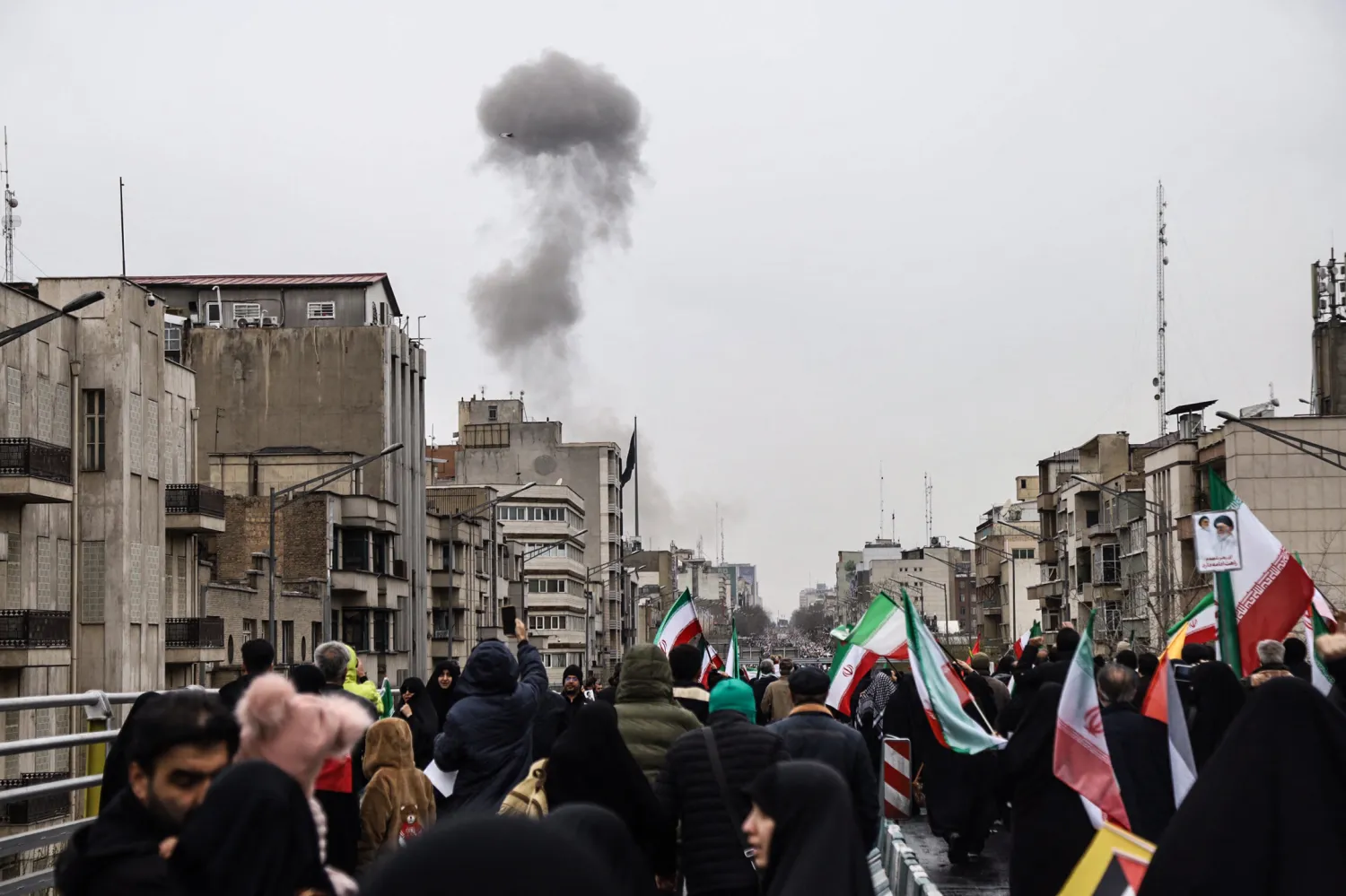
Black smoke rises following an airstrike, as Iranians take part in the Al-Quds (Jerusalem) Day rally, a commemoration in support of the Palestinian people on the last Friday of the Islamic holy month of Ramadan, in Tehran on March 13, 2026. (AFP)
TT

Iran Defiant, US Vows Even Heavier Bombing

Black smoke rises following an airstrike, as Iranians take part in the Al-Quds (Jerusalem) Day rally, a commemoration in support of the Palestinian people on the last Friday of the Islamic holy month of Ramadan, in Tehran on March 13, 2026. (AFP)

Iranian officials led a pro-government rally in Tehran as explosions rocked the city on Friday, while the United States vowed it would intensify strikes in the coming hours and days. 

The hardline stances and renewed strikes unleashed by Israel and Iran presaged no let-up in the conflict engulfing the Middle East and roiling the global energy market. 

AFP journalists in Tehran reported loud blasts over the city as Israel's military said it had carried out 7,600 strikes in Iran since the war started on February 28, with most targeting the country's missile program. 

US Defense Secretary Pete Hegseth told a news conference the US military would bombard Iran more heavily on Friday than any other day so far in the war. 

He also said Iran's new supreme leader, Mojtaba Khamenei, was "wounded and likely disfigured" in the attack that killed his father and predecessor Ali Khamenei at the start of the US-Israeli campaign. 

President Donald Trump said on social media that he viewed it "a great honor" to be killing Iran's rulers, calling them "deranged scumbags". 

He later said in an interview on Fox News Radio that the United States would be hitting Iran hard over the "over the next week". 

- Fresh strikes - 

While Mojtaba Khamanei has not appeared since being named supreme leader, other officials walked in the open in Tehran with pro-government demonstrators who waved flags and brandished banners reading "Death to America" and "Death to Israel". 

Iran's state media said at least one woman was killed when blasts hit an area near the demonstration. 

"These attacks are out of fear, out of desperation," said Ali Larijani, secretary of the Supreme National Security Council, who attended the rally to mark Quds Day, the last Friday of Ramadan and a day of support for the Palestinian cause. 

"It's clear that it (the enemy) has failed," said Larijani in a speech broadcast on state TV. 

President Masoud Pezeshkian and Foreign Minister Abbas Araghchi also attended the rally, while images on Iranian media showed the head of the judiciary being interviewed just as a blast occurred. 

Shortly afterwards, state television said Iran had launched a fresh salvo of missiles at Israel. Explosions were later heard on the outskirts of Tel Aviv, but Israeli paramedics reported no casualties. 

Earlier, a strike on the Israeli town of Zarzir wounded around 60 people, according to police, with AFP images showing burnt-out vehicles and craters in the ground. 

Iran also kept up launches of drone and missile strikes against neighboring states hosting US military assets. 

Saudi Arabia's defense ministry said on Friday its forces had intercepted dozens of drones, while an AFP journalist reported an explosion heard over Dubai that rattled buildings. 

Türkiye said NATO forces shot down a ballistic missile launched from Iran -- the third such interception in the war. 

- Oil worries - 

The conflict has sparked chaos in global markets and sent oil prices soaring. 

Iran's Revolutionary Guards have all but closed the Gulf's strategic Strait of Hormuz through which 20 percent of global oil supplies pass. 

Oil stayed at over $100 a barrel on Friday, leaving markets and governments everywhere skittish about the consequences of higher inflation. 

"Every day on the ship, I can see missile launches and hear explosions, making me feel like I was in danger," a sailor stuck on one of the ships unable to pass through the strait, Wang Shang, told AFP. 

The US government has said that the US Navy would likely not be able to escort ships through the strait until the end of the month. 

On Friday, the White House and Pentagon lashed out at CNN for a report suggesting that Washington had underestimated Iran's ability to disrupt oil traffic through the strait. 

"The Pentagon has been planning for Iran's desperate and reckless closure of the Strait of Hormuz for DECADES," White House press secretary Karoline Leavitt said on X. 

- Bread rationed - 

Within Iran, the Revolutionary Guards have warned of an even stronger response to any anti-government protests, after ones in January in which several thousand people were killed. 

Iranian authorities have maintained an internet blackout since the war started. 

Iranians speaking to AFP under cover of anonymity have described a grim picture of cities in ruins and cash running short. 

"Bread is now rationed. The population is extremely tense and outraged," one 30-year-old woman in Kermanshah, western Iran, told AFP. 

Another woman in the city said "countless" people from Tehran had come to seek refuge from the airstrikes, adding to demand for food and scarce medicine, with prices "nearly doubling". 

"As a result, locals face serious shortfalls... the situation is extremely tough," she said. 

The UN refugee agency has estimated that up to 3.2 million people have been displaced inside Iran since the war started. 

Iran's health ministry said on March 8 that more than 1,200 people have been killed, a figure AFP has not been able to verify independently. 

The US military has lost 13 personnel since the war started -- including all six members of a refueling aircraft that crashed in Iraq after an incident officials said was not caused by hostile fire. 

Pentagon chief Hegseth said the US and Israel have so far struck more than 15,000 targets. 

In another sign of the war's spread, President Emmanuel Macron announced the death of France's first soldier, in an attack in the Erbil region of Iraq. 

The conflict has also battered Lebanon, with authorities reporting at least 687 people killed by Israeli attacks. 

Israel's military said it has conducted 1,100 strikes in Lebanon, including 200 it said hit 200 "missile and launcher targets" and 35 command-and-control sites of the Iran-backed Hezbollah armed group. It said it had killed more than 380 members of Hezbollah. 

UN chief Antonio Guterres, at the start of a visit to Beirut, called on Israel and Hezbollah to "stop the war". 


Iran's Khamenei Says US, Israel Aim to Sow 'Division' after War Defeat

An Iranian man walks past a billboard carrying a picture of Iran' supreme leader Mojtaba Khamenei erected along a street in Tehran on May 28, 2026. (Photo by AFP)
TT

Iran's Khamenei Says US, Israel Aim to Sow 'Division' after War Defeat

An Iranian man walks past a billboard carrying a picture of Iran' supreme leader Mojtaba Khamenei erected along a street in Tehran on May 28, 2026. (Photo by AFP)

Iran's supreme leader on Thursday accused the US and Israel of trying to sow "division" among Iranians after suffering a "decisive blow" during the Middle East war.

In a written message, Mojtaba Khamenei said "the malicious enemy" was seeking to "plant the seeds of doubt, despair, fear, mistrust and division" among the public, reported AFP.

"In confronting these ill intentions, everyone must, through steadfastness, insight, preserving unity and cohesion... neutralize their sinister plot," his message said.


Ukraine Strike Kills 3 in Russian-occupied Crimea

A local woman, Olga, 35, and her daughter Natalia, 6, walk at the site of a Russian strike on a residential area in Kyiv, Ukraine, 02 June 2026, amid the Russian invasion. EPA/MAXYM MARUSENKO
TT

Ukraine Strike Kills 3 in Russian-occupied Crimea

A local woman, Olga, 35, and her daughter Natalia, 6, walk at the site of a Russian strike on a residential area in Kyiv, Ukraine, 02 June 2026, amid the Russian invasion. EPA/MAXYM MARUSENKO

A Ukrainian strike killed at least three people in Crimea, the region's Moscow-installed authorities said Thursday, a day after Kyiv targeted energy and military sites in Saint Petersburg where Russia was hosting an economic forum.

US Secretary of State Marco Rubio warned of a "real" risk of the Ukraine war escalating as Kyiv underlines its ability to strike deep inside Russian territory with the attacks.

Ukraine has described its strikes on Saint Petersburg as "fair" retaliation for a wave of Russian bombardment on its territory.

Sergey Aksyonov, the Moscow-installed head of the Crimea region, said early Thursday that preliminary reports showed a strike on non-residential buildings in Simferopol claimed three lives and wounded seven others, AFP said.

"Emergency services are currently at the scene," Aksyonov wrote on Telegram.

The strike came as 20,000 people from 130 countries were due at the three-day annual Saint Petersburg International Economic Forum (SPIEF) -- an event once dubbed "Russia's Davos".

President Vladimir Putin is to give a keynote address at the forum on Friday and Kremlin spokesman Dmitry Peskov vowed Russia would provide a "systemic" response to Ukraine's strikes on the city.

Black smoke from the strikes was visible from the conference venue as the first sessions started on Wednesday.

Valeria, a 32-year-old businesswoman from Moscow at the forum, told AFP she was used to the threat of attacks.

"We have been living under such attacks for many years now," she said.

- 'Real' escalation risk -

Ukrainian officials have said the Saint Petersburg attack on an oil terminal and the city's Kronstadt military base was meant to disrupt the conference.

"The Petersburg forum is opening with a nice plume of black smoke in the background after Ukrainian strikes," said Sergiy Sternenko, an adviser to the Ukrainian defense minister.

Ukrainian President Volodymyr Zelensky said his country was responding "accordingly" to Russian bombardment.

"It's just a matter of time before we can scale up the intensity of our responses," Zelensky said during a press conference in Kyiv with NATO chief Mark Rutte.

On Wednesday, a drone strike on a bus in Russian-occupied east Ukraine killed at least seven people, Moscow-installed officials said.

Two others were killed, one in the Bryansk region near the Ukraine border and another in the Russian-occupied Kharkiv region, they added.

Meanwhile, Russian attacks left at least 10 dead across Ukraine, local officials said.

Rubio said at a US Senate appropriations panel that Ukraine has "become increasingly effective at conducting long-range strikes deep into Russia".

It's "one of the things that reminds us of why it's important to try to bring this war to an end, if we can, because the risk of escalation is real, more real than it was two years ago," Rubio added.

Speaking earlier to the House Foreign Affairs Committee, Rubio lamented the lack of progress on ending the war, which began with Russia's full-scale invasion in February 2022.

"To this point, neither side has been willing to make concessions, particularly on the Russian side, necessary in order to bring peace about," he said.

"But we stand ready, and we've engaged and invested a tremendous amount of high-level time on that conflict over the last year," he added.

EU foreign affairs chief Kaja Kallas earlier told AFP that Ukraine's attacks had spooked the Kremlin.

"It clearly shows also panic on the Russian side -- why they are increasing the terrorist attacks that they're doing in Ukraine is because they don't know what to do with these things," Kallas said in an interview.

"Putin is losing money, men, and momentum, and that's why he's increasing attacks on civilians."


North Korea Unveils New Plant to Produce Fuel for Nuclear Weapons

This picture taken on June 3, 2026 and released by North Korea's official Korean Central News Agency (KCNA) on June 4, 2026 shows North Korean leader Kim Jong Un (front R) inspecting the newly-inaugurated nuclear materials production factory at an undisclosed location in North Korea. (Photo by KCNA VIA KNS / AFP)
TT

North Korea Unveils New Plant to Produce Fuel for Nuclear Weapons

This picture taken on June 3, 2026 and released by North Korea's official Korean Central News Agency (KCNA) on June 4, 2026 shows North Korean leader Kim Jong Un (front R) inspecting the newly-inaugurated nuclear materials production factory at an undisclosed location in North Korea. (Photo by KCNA VIA KNS / AFP)

North Korea on Thursday unveiled a new facility to produce nuclear bomb fuels, with leader Kim Jong Un announcing plans to bolster the country’s nuclear forces “at an exponential rate.”

Some experts still question whether North Korea has functioning nuclear missiles that can reach the US mainland. But the nuclear plant's disclosure implies that Kim is eager to cement his country's status as a nuclear power and has no intentions of placing his bomb program on a negotiating table.

After visiting the site on Wednesday, Kim said he and other top officials “confirmed the order of priority for implementing the ambitious future plan designed to beef up our state’s nuclear forces at an exponential rate,” according to the official Korean Central News Agency.

The site is likely a uranium enrichment plant KCNA said the facility used “more sophisticated technology” but didn’t provide further details like its location. South Korea’s Joint Chiefs of Staff assessed the site as a uranium enrichment plant and said it was closely coordinating with the United States to monitor North Korean nuclear activities.

KCNA photos showed Kim walking through narrow aisles lined with dense rows of silver tubes and pipes, in what appeared to be a centrifuge hall. Another image showed him speaking with senior officials in a meeting room, where a blurred graphic depicting a cone-shaped object was spread across a table. It wasn’t immediately clear whether the graphic showed a warhead design.

It's the third time that North Korea has disclosed a uranium enrichment site. In 2024, North Korea released photos of another covert uranium-enrichment plant. In 2010, North Korea showed one at its main Yongbyon nuclear complex to visiting American scholars.

Last September, South Korean Unification Minister Chung Dong-young said that North Korea was operating a total of four uranium enrichment facilities including the Yongbyon complex, and that they were running everyday.

During his plant visit, Kim said the urgency for bolstering up the country’s nuclear war deterrent, both in quality and quantity, has grown because of confrontations with “the most ferocious enemies,” an apparent reference to the US and South Korea.

According to The Associated Press, Kim said exercising “the position of a nuclear weapons state” is his country's “invariable” stand. He said North Korea’s nuclear materials production capacity has more than doubled compared with five years ago, a claim that cannot be verified independently.

Experts say Kim wants an international recognition as a nuclear state so that he could demand the lifting of UN economic sanctions. They say Kim would ultimately push for arms reductions talks with the US as a way to win concessions in return for a partial surrender of his nuclear capability.

President Donald Trump has repeatedly expressed his desire to resume diplomacy with Kim, but the North Korean leader responded the Americans must first drop its demand for North Korea to denuclearize as a precondition for talks.

Some question North Korea's nuclear program Since his first round of nuclear diplomacy collapsed in 2019, Kim has performed a provocative run of weapons tests and vowed repeatedly to “exponentially” expand the country’s nuclear arsenal.

This led to many experts believing North Korea now likely has nuclear missiles capable of striking the US mainland. But some still note North Korea hasn't proved it mastered last-remaining technological hurdles to obtain such missiles, including ensuring its warheads survive the conditions of atmospheric reentry. They say North Korea also need to perfect technologies to place multiple nuclear warheads on a single missile to defeat US missile shields.

A senior South Korean official told lawmakers in 2018 that North Korea was estimated to have manufactured between 20 and 60 nuclear weapons, but some experts now put the size of the North’s arsenal at more than 100 warheads.

In 2023, North Korea unveiled a type of battlefield nuclear warheads. Some analysts speculated the warhead’s unveiling might be a prelude to a nuclear test. But North Korea hasn't carried out a test, which would have been its seventh detonation overall and the first since September 2017.
