

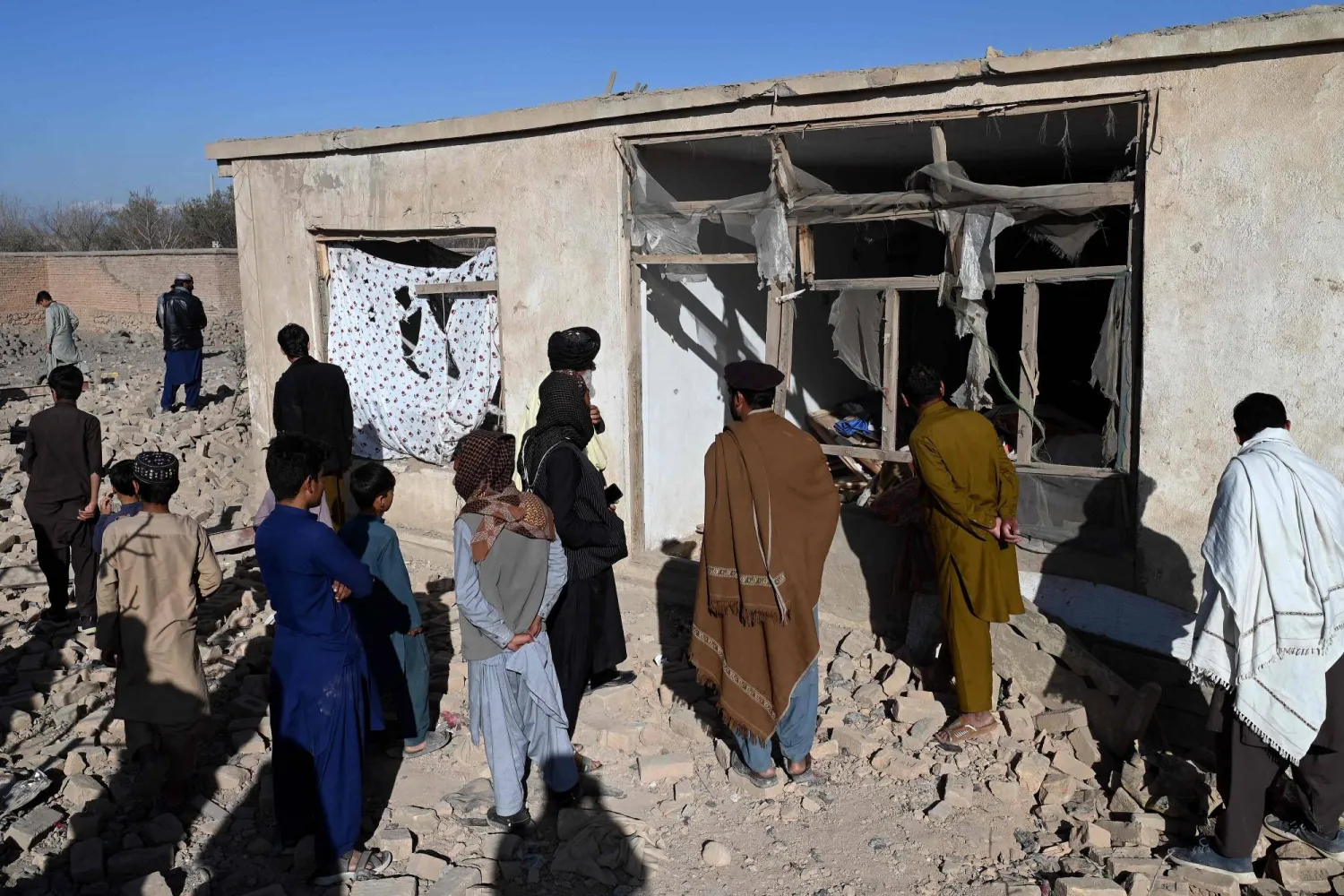

Afghanistan Accuses Pakistan of Targeting Homes in Airstrikes That Kill at Least 4 Civilians

Afghans inspect a damaged house at the site of an overnight Pakistan airstrike, at a residential area in Pol-e-Charkhi on the outskirts of Kabul on March 13, 2026. (AFP)
TT

Afghanistan Accuses Pakistan of Targeting Homes in Airstrikes That Kill at Least 4 Civilians

Afghans inspect a damaged house at the site of an overnight Pakistan airstrike, at a residential area in Pol-e-Charkhi on the outskirts of Kabul on March 13, 2026. (AFP)

Afghanistan’s Taliban government early Friday accused Pakistan’s military of targeting homes in overnight airstrikes in Kabul and the southern province of Kandahar, saying at least four civilians were killed as fighting between the neighbors entered its third week.

Government spokesman Zabihullah Mujahid said on X that Pakistan’s aircraft also struck fuel depots belonging to the private airline Kam Air near Kandahar airport. “This company supplies fuel to civilian airlines as well as to United Nations aircraft,” he said.

Pakistan’s military and government did not immediately comment.

Pakistan and Afghanistan have been targeting each other’s military installations since late February, when Kabul said it struck Pakistani posts in response to Pakistani attacks along the border. Pakistan’s military has said its operations targeted the Pakistani Taliban and their support networks along the border, which Afghanistan has never formally recognized.

Both sides have claimed to inflict heavy losses in what has become their deadliest fighting in years, a confrontation Islamabad has described as an “open war” with Afghanistan.

In his posts on X, Mujahid claimed that Pakistani strikes hit multiple civilian sites and uninhabited locations in Afghanistan’s Paktia and Paktika provinces, as well as other areas. He said the attacks “will not go unanswered.”

Kabul police spokesman Khalid Zadran said at least four civilians, including children, were killed in the city and 15 others were injured.

The total number of casualties around Afghanistan was unclear.

The latest Pakistani strikes came a day after China’s special envoy, Yue Xiaoyong, arrived in Islamabad and met with his Pakistani counterpart, Mohammad Sadiq, following a visit to Kabul where he met Afghan government officials.

Sadiq, Pakistan’s special envoy for Afghanistan, wrote on X the previous day that he and Yue “discussed threats posed by terrorist groups such as TTP and ETIM (East Turkestan Islamic Movement) to Pakistan and China respectively” and agreed on the need for collective efforts to ensure lasting peace and stability.

Repeated calls from the international community for restraint have had little effect.

Pakistan has previously said its strikes along the border and inside Afghanistan are aimed solely at Khawarij, a phrase Islamabad uses for the outlawed Pakistani Taliban, also known as Tehrik-e-Taliban Pakistan, or TTP. Islamabad frequently accuses Afghanistan’s Taliban government of harboring the group, a charge Kabul denies.

Since the Afghan Taliban returned to power in 2021, the TTP has intensified attacks inside Pakistan and along the border. Islamabad says its military operations will continue until Kabul takes verifiable steps to curb the TTP and other militants operating from its territory.

The current clashes also ended a ceasefire brokered by Qatar and Türkiye in October, when the two neighbors again came close to war. The truce, signed in Qatar, was followed by six days of talks in Istanbul that produced an agreement to extend the ceasefire and hold a third round of negotiations in November.



Iran Arrests Man Accused of Running Starlink Internet Network

 A man leaves a subway train past an image of the late Iranian Supreme Leader Ali Khamenei, in Tehran, Iran, Friday, March 13, 2026. (AP)
A man leaves a subway train past an image of the late Iranian Supreme Leader Ali Khamenei, in Tehran, Iran, Friday, March 13, 2026. (AP)
TT

Iran Arrests Man Accused of Running Starlink Internet Network

 A man leaves a subway train past an image of the late Iranian Supreme Leader Ali Khamenei, in Tehran, Iran, Friday, March 13, 2026. (AP)
A man leaves a subway train past an image of the late Iranian Supreme Leader Ali Khamenei, in Tehran, Iran, Friday, March 13, 2026. (AP)

Iranian authorities have arrested a man accused of leading a network that sold access to the internet via Starlink terminals, a technology that is banned in Iran, the ISNA news agency reported on Friday.

Iran has been digitally sealed off from the rest of the world by a complete internet blackout since the start of the Middle East war.

To get around those restrictions, some Iranians have turned to Starlink terminals from the US company SpaceX, which connect to the internet via satellites.

Doing so is a criminal offence in Iran punishable with prison time.

"A 37-year-old man, who had put in place a network in several provinces of the country to sell access to the unrestricted internet via Starlink, has been arrested" in Shiraz, ISNA reported, citing a deputy police commander for Fars province.

It did not say when the arrest took place.

Iranians were previously placed under an 18-day internet blackout in January, the longest so far, amid anti-government protests during which thousands were killed.

At the time, the authorities managed to disrupt the operation of Starlink terminals.

Under Iranian law, people found guilty of "the use, transportation, purchase or sale of electronic internet communication devices such as Starlink" used to access banned content can be jailed for up to two years in prison.


Middle East War ‘Benefits No One and Harms Many’, Merz

German Chancellor Friedrich Merz in Bardufoss in connection with Cold response 2026, in Bardufoss, Norway, 13 March 2026. (EPA)
TT

Middle East War ‘Benefits No One and Harms Many’, Merz

German Chancellor Friedrich Merz in Bardufoss in connection with Cold response 2026, in Bardufoss, Norway, 13 March 2026. (EPA)

German Chancellor Friedrich Merz said Friday that the Middle East war must end "as soon as possible" as the conflict "benefits no-one and harms many economically, including us".

Asked whether Europeans should make direct contact with Iran to ask for the Strait of Hormuz to be reopened, Merz said: "We are making every effort to end this war... all diplomatic channels are being used."

Speaking at a press conference in Norway alongside his Norwegian and Canadian counterparts Jonas Gahr Store and Mark Carney, Merz stressed that Germany shared the "important goals of the United States and Israel".

"Iran must not threaten Israel and other neighbors," Merz said, adding that Tehran's nuclear and ballistic missile programs must end and that the country "must stop supporting terrorism at home and beyond".

However, Merz added that "with each day of war, more questions arise than answers" and that "a convincing plan is needed" on conducting the war.

"We are witnessing a dangerous escalation. Iran is indiscriminately attacking states in the region, including close partners and allies of our own country, Germany," the chancellor said.

"The Strait of Hormuz has become impassable. We condemn this in the strongest possible terms.

"We have no interest in an endless war," Merz added. "We need a perspective for a peaceful order now."


Iran’s New Supreme Leader Wounded, Likely Disfigured, Hegseth Says

US Secretary of Defense Pete Hegseth speaks during a press conference at CENTCOM headquarters at MacDill Air Force Base in Tampa, Florida, USA, 05 March 2026. (EPA)
TT

Iran’s New Supreme Leader Wounded, Likely Disfigured, Hegseth Says

US Secretary of Defense Pete Hegseth speaks during a press conference at CENTCOM headquarters at MacDill Air Force Base in Tampa, Florida, USA, 05 March 2026. (EPA)

Iran's new Supreme Leader Mojtaba Khamenei is wounded and likely disfigured, US Defense Secretary Pete Hegseth said on Friday, questioning Khamenei's ability to govern after nearly two weeks of US and Israeli attacks on Iran.

No images have been released of Khamenei since an Israeli strike at the start of the war that killed much of his family, including his father and wife. His first comments came in a statement read out by a television presenter on Thursday. In the statement, he vowed to keep the Strait of Hormuz shut and called ‌on neighboring ‌countries to close US bases on their territory or risk Iran targeting ‌them.

"We ⁠know the new ⁠so-called not so supreme leader is wounded and likely disfigured. He put out a statement yesterday. A weak one, actually, but there was no voice and there was no video. It was a written statement," Hegseth told a briefing.

"Iran has plenty of cameras and plenty of voice recorders. Why a written statement? I think you know why. His father - dead. He's scared, he's injured, he's on the run and he lacks legitimacy."

An Iranian official told Reuters on Wednesday that the newly appointed supreme leader was lightly injured, but ⁠was continuing to operate, after state television described him as war-wounded.

Hegseth was joined ‌by General Dan Caine, the chairman of the Joint Chiefs ‌of Staff, at a briefing in which they emphasized US military strikes to knock out Iran's missile and ‌drone capabilities and its navy.

'NO QUARTER'

During the briefing, Hegseth said that the United States would show ‌no mercy in the war.

"We will keep pressing, keep pushing, keep advancing. No quarter, no mercy for our enemy," Hegseth said.

"No quarter" is the refusal to spare the life of someone who has expressed their intention to surrender - something prohibited by law.

"International humanitarian law prohibits the use of this procedure, that is, ordering that there shall ‌be no survivors, threatening the adversary therewith, or conducting hostilities on this basis," according to the International Committee of the Red Cross (ICRC).

Hegseth has moved to ⁠reshape the top ranks ⁠of the military justice system, replacing the judge advocates general for the Army, Navy and Air Force.

The United States has carried out strikes against more than 6,000 targets in Iran over the past 14 days. Almost two weeks of US-Israeli bombings have killed around 2,000 people in Iran.

A US official, speaking on the condition of anonymity, said the Pentagon was sending an additional warship, along with the Marines on board, to the Middle East. The Pentagon has previously said additional troops would be heading to the region.

But despite the US attacks on Iran, more Iranian drones were reported flying into Kuwait, Iraq, the UAE, Bahrain and Oman. Additionally, six US service members were killed on Friday when a US military refueling aircraft crashed in western Iraq, in an incident the US said involved another aircraft but was not the result of hostile or friendly fire.

Since the US and Israel started carrying out strikes against Iran on February 28, 11 US troops have been killed.