


Trump Threatens Iran Following New Wave of Attacks on Gulf States and Israel

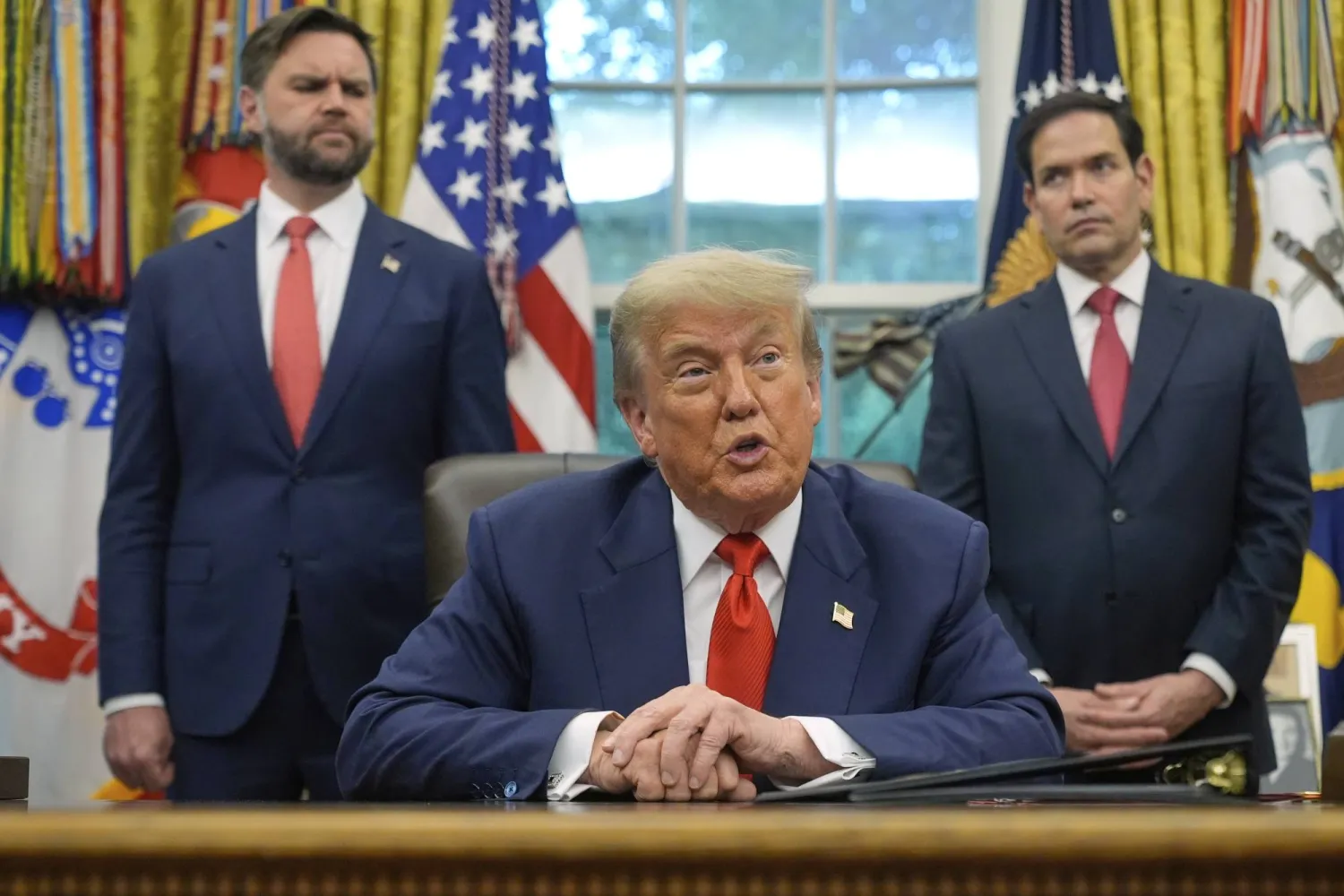
File photo: President Donald Trump speaks as he meets with Congo's Foreign Minister Therese Kayikwamba Wagner, and Rwanda's Foreign Minister Olivier Nduhungirehe, Friday, June 27, 2025, in the Oval Office at the White House in Washington, as Vice President JD Vance and Secretary of State Marco Rubio listen. (AP Photo/Manuel Balce Ceneta)
TT

Trump Threatens Iran Following New Wave of Attacks on Gulf States and Israel

File photo: President Donald Trump speaks as he meets with Congo's Foreign Minister Therese Kayikwamba Wagner, and Rwanda's Foreign Minister Olivier Nduhungirehe, Friday, June 27, 2025, in the Oval Office at the White House in Washington, as Vice President JD Vance and Secretary of State Marco Rubio listen. (AP Photo/Manuel Balce Ceneta)

Iran launched multiple attacks early Friday on Gulf Arab states, including dozens of drones at Saudi Arabia, following warnings from its new supreme leader about hosting American bases, and US President Donald Trump threatened major new retaliation.

“Watch what happens to these deranged scumbags today," Trump wrote in a social media post. “Iran’s Navy is gone, their Air Force is no longer, missiles, drones and everything else are being decimated, and their leaders have been wiped from the face of the earth.”

The comments came the day after Iran's Supreme Leader Mojtaba Khamenei vowed to “not refrain from avenging the blood” of Iranians killed, and warned Gulf Arab nations to shut US bases, saying the notion of American protection was “nothing more than a lie.”

Intense airstrikes landed around Iran’s capital, Tehran early Friday, just before rallies were to begin for the annual Quds Day event in support of the Palestinians. Israel said its air force had hit more than 200 targets in Iran over the past 24 hours, including missile launchers, defense systems and weapons production sites.

With growing global concerns about a possible energy crisis and no end to the war in sight, the price of Brent crude oil, the international standard, remained stubbornly over $100 per barrel as Iran kept its stranglehold on shipping through the Strait of Hormuz, the strategic waterway through which a fifth of the world's oil transits on its way from the Arabian Gulf to the open seas.

Brent prices have spiked as high as about $120 per barrel and are currently some 40% higher than when Israel and the United States attacked Iran on Feb. 28 to start the war.

Iran has been attacking ships that try to transit the strait, and Khamenei's comments — his first to the public since being named to replace his father, who was killed during the first day of the conflict — said Iran would continue to block the waterway.

In Iraq, recovery efforts were underway after an American KC-135 refueling plane went down, according to US Central Command. And a French soldier who was stationed in the north of the country was killed in an attack, the French president said Friday.

Iran launches new attacks on Gulf Arab countries

Iran has been attacking oil and other infrastructure around the Gulf region, and on Friday Saudi Arabia that it had downed nearly 50 drones sent in multiple waves throughout the early morning hours.

In Oman, two people were killed when two drones crashed in an industrial area in the region of Sohar, the Oman News Agency reported.

Sirens also sounded in Bahrain warning of incoming fire, and in Dubai black smoke billowed from an industrial area after a blaze authorities said was sparked by debris from an interception.

A building at the Dubai International Financial Center also sustained damage when hit with debris from what authorities described as a “successful interception.”

The DIFC is an economic free zone for banks, capital traders and wealth managers, home to exclusive restaurants and nightclubs for the city-state’s elite. Iran said earlier this week that it would target banks and financial institutions after an airstrike hit a bank in Tehran.

Nearly 60 people were wounded in northern Israel after Hezbollah said it had fired several rocket salvoes toward the area and at Israeli troops in southern Lebanon. Almost all the injuries were described as very minor.

One person was killed in southwestern Beirut in an Israeli strike, according to the Lebanese Health Ministry, and another attack hit an apartment in the capital, leaving it engulfed in flames. Following the attacks, the Israeli army said it had been targeting a member of Iran-linked Hezbollah.

In eastern Lebanon, a strike on an apartment wounded a local official with the Lebanese branch of the Muslim Brotherhood and killed his two sons, the state-run National News Agency reported. Israel for the past two years has targeted officials with the group, known as al-Jamaa al-Islamiya or the Islamic Group.

More than 600 people have been killed in Lebanon since the fighting began, the Health Ministry has reported and nearly 800,000 have been internally displaced, according to the UN refugee agency.

Iranian authorities say more than 1,300 people have been killed there, and Israel has reported 12 deaths. The US has lost at least seven soldiers while another eight have suffered severe injuries.

In his Friday morning post, Trump said that "we are totally destroying the terrorist regime of Iran, militarily, economically, and otherwise."

“They’ve been killing innocent people all over the world for 47 years, and now I, as the 47th President of the United States of America, am killing them,” Trump said. “What a great honor it is to do so!”

The US military said American forces have now struck more than 6,000 targets since the operation against Iran began, including more than 30 minelaying vessels.



Trump Urges other Nations to Send Ships to Secure Hormuz

FILE PHOTO: A map showing the Strait of Hormuz and Iran is seen in this illustration taken June 22, 2025. REUTERS/Dado Ruvic/Illustration/File Photo
TT

Trump Urges other Nations to Send Ships to Secure Hormuz

FILE PHOTO: A map showing the Strait of Hormuz and Iran is seen in this illustration taken June 22, 2025. REUTERS/Dado Ruvic/Illustration/File Photo

US President Donald Trump on Saturday urged other nations to send ships to help secure the Strait of Hormuz, the critical chokepoint for global oil supplies disrupted by the Mideast war.

Trump, who has said the United States will soon start escorting tankers through the strait, posted on Truth Social that "Many countries, especially those who are affected by Iran's attempted closure of the Hormuz Strait, will be sending War Ships, in conjunction with the United States of America, to keep the Strait open and safe."

The US president added: "Hopefully China, France, Japan, South Korea, the UK, and others, that are affected by this artificial constraint, will send Ships to the area."

Iranian strikes have all but halted maritime traffic in the strait, through which a fifth of global crude oil and liquefied natural gas normally pass. It is just 54 kilometers (34 miles) wide at its narrowest point.

With oil prices spiking, Trump was asked Friday when the US Navy would begin escorting tankers through the Strait of Hormuz. "It'll happen soon, very soon," he said.

In his post on Saturday, Trump asserted that Iran's military capability had been eliminated but he conceded that it was still able to attack the strait.

"We have already destroyed 100% of Iran's Military capability, but it's easy for them to send a drone or two, drop a mine, or deliver a close range missile somewhere along, or in, this Waterway, no matter how badly defeated they are," he wrote.

As he urged nations to send ships to the strait, he added that "the United States will be bombing the hell out of the shoreline, and continually shooting Iranian Boats and Ships out of the water. One way or the other, we will soon get the Hormuz Strait OPEN, SAFE, and FREE!"


Israeli Defense Minister Says War with Iran Entering 'Decisive Phase'

Smoke rises following an explosion during a protest marking the annual al-Quds Day (Jerusalem Day) on the last Friday of the holy month of Ramadan, amid the US-Israeli conflict with Iran, in Tehran, Iran, March 13, 2026. Elahe Asiabai/Fars News/WANA (West Asia News Agency) via REUTERS
TT

Israeli Defense Minister Says War with Iran Entering 'Decisive Phase'

Smoke rises following an explosion during a protest marking the annual al-Quds Day (Jerusalem Day) on the last Friday of the holy month of Ramadan, amid the US-Israeli conflict with Iran, in Tehran, Iran, March 13, 2026. Elahe Asiabai/Fars News/WANA (West Asia News Agency) via REUTERS

Israel said the war against Iran was entering its "decisive phase" on Saturday, as explosions rocked cities across the Middle East, with strikes on the US embassy in Baghdad and a major Emirati energy facility.

Washington's embassy in Iraq was hit by a drone, security sources told AFP, the second time it has been targeted since February 28, when the United States and Israel attacked Iran and plunged the Gulf into a conflict that has sent shockwaves through the global economy.

Millions have been displaced by waves of drone, missile and aerial bombing, while more than 1,200 people have reportedly been killed in Iran, with little sign of the conflict slowing as it entered its third week.

Oil prices have surged by 40 percent as Iran chokes off the vital Strait of Hormuz with threats to shipping and strikes on Gulf energy facilities.

Clouds of black smoke rose Saturday over Fujairah, home to a major Emirati oil storage and export terminal, shortly after Iran's military warned UAE civilians to avoid port areas.

President Donald Trump said Friday that US forces had struck Iran's Kharg Island, its biggest oil export hub, and "obliterated every MILITARY target", though sparing its energy facilities.

Iranian media confirmed the island's oil facilities were unaffected. Iran had threatened US-linked oil and energy firms would be "turned into a pile of ashes" if they were hit.

The strike could be a "turning point" with both sides escalating in a bid to force a surrender, said analyst Vali Nasr of John Hopkins University in a social media post. "The end will likely not be Iranian backing off but inflaming the Gulf."

Trump said the US Navy would start escorting tankers through the Strait of Hormuz "very soon", but governments around the world fear a prolonged blow to their economies.

Israel's Defense Minister Israel Katz said the strikes on Kharg showed the war was entering a "decisive phase", though he cautioned it would "continue as long as necessary".

Yet, despite facing superior US and Israeli firepower, Iran appears determined to fight on.

Blasts were heard by AFP journalists over Jerusalem on Saturday after the army detected missiles fired from Iran.

Iran has launched missile and drone attacks against at least 10 of its neighbors.

The Palestinian Islamist movement Hamas urged Iran to refrain from targeting Gulf neighbors.

Qatar said it intercepted two missiles over the capital's downtown area on Saturday and evacuated key areas after blasts were heard by AFP journalists in Doha.

Strikes continue in Iran, with heavy blasts shaking Tehran late Friday and local media reporting strikes in several provinces through Saturday.

Israel's army warned people in an industrial zone of Tabriz in northern Iran to evacuate, signalling an imminent attack.

Iran's health ministry says more than 1,200 people have been killed by US and Israeli attacks, numbers that could not be independently verified.

Up to 3.2 million people have been displaced inside Iran, according to the UN refugee agency.

Trump described Iran as "totally defeated" and in search of a deal he was unwilling to consider.

More than 15,000 targets in Iran have been hit by the US and Israel in two weeks, the Pentagon said.

A report this week said the first six days alone cost the US $11.3 billion and it has lost 13 military personnel.

US media raised the possibility of a ground invasion, with the New York Times and Wall Street Journal reporting the Pentagon had dispatched the Japan-based amphibious assault ship USS Tripoli to the region with some 2,500 Marines.

Iran's rulers appear intent on showing they will survive the war and maintain control, despite their supreme leader Ali Khamenei being killed on day one.

Khamenei's son Mojtaba Khamenei was named the new supreme leader, but has been absent from public view and is reportedly wounded.

Reza Pahlavi, the US-based son of Iran's last shah, said on social media Saturday that he was ready to lead a transition "as soon as the Islamic Republic falls".

But Iran's Revolutionary Guards have threatened a heavy crackdown on any anti-government protests. Thousands were killed in mass demonstrations in January, and a near-total internet blackout has been imposed since since the war began.


Iranian Official Says Kharg Oil Exports 'Normal', after US Strikes

A satellite image of Iran's Kharg Island (AFP)
TT

Iranian Official Says Kharg Oil Exports 'Normal', after US Strikes

A satellite image of Iran's Kharg Island (AFP)

Oil export operations from Iran's Kharg island in the Gulf were proceeding as normal Saturday after US strikes on the crude export hub which caused no casualties, a regional official said.

Activities of oil companies "at this export terminal are continuing as normal", said Ehsan Jahaniyan, deputy governor of Iran's southern Bushehr province, quoted by the IRNA news agency.

The Fars news agency, citing sources on the island, earlier reported there had been no damage to oil facilities after President Donald Trump said US strikes had destroyed only military targets, AFP reported.

Trump had threatened to target oil infrastructure on the island, a crucial hub for Iran, if Tehran continues to block the strategic Strait of Hormuz.

Iran has, in turn, threatened to target US-linked oil infrastructure.

Deputy governor Jahaniyan said that after the attacks "daily life and routine activities of the residents are also fully maintained."

The attack "did not cause any casualties among military personnel, company employees, or residents of Kharg island, he added.

According to Fars, the US operation "tried to damage the army's defenses, the Joshan naval base, the airport control tower and the helicopter hangar of the Iran Continental Shelf Oil Company."

Kharg Island, a scrubby stretch of land in the northern Gulf around 30 kilometres (19 miles) off the Iranian mainland, handles roughly 90 percent of Iran's crude exports.