


US Braces for Potential Iranian Retaliatory Operations within its Borders

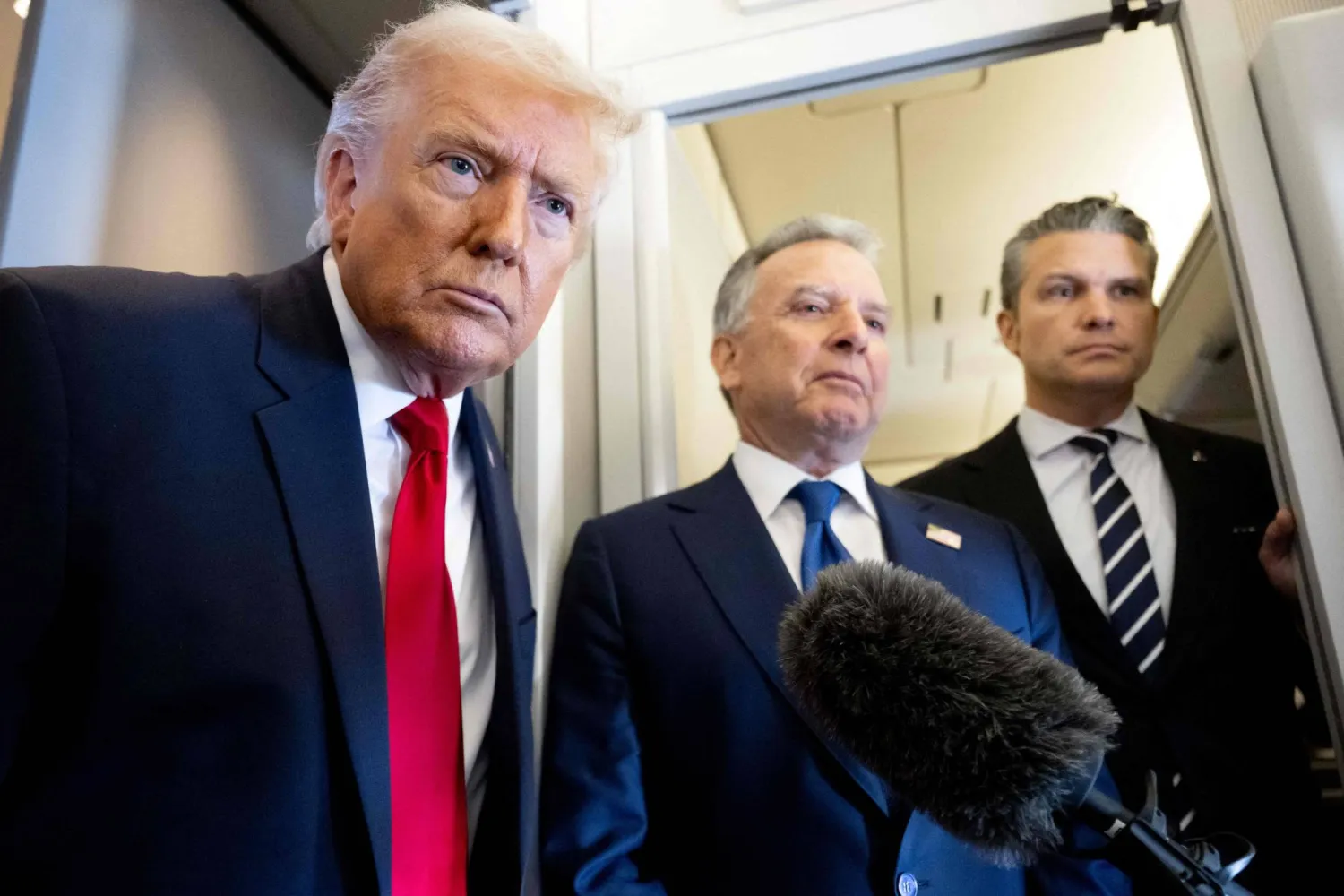
US President Donald Trump speaks with the media as Defense Secretary Pete Hegseth (R) and special envoy Steve Witkoff (C) look on aboard Air Force One during a flight from Dover, Delaware, to Miami, Florida, on March 7, 2026. (AFP)
TT

US Braces for Potential Iranian Retaliatory Operations within its Borders

US President Donald Trump speaks with the media as Defense Secretary Pete Hegseth (R) and special envoy Steve Witkoff (C) look on aboard Air Force One during a flight from Dover, Delaware, to Miami, Florida, on March 7, 2026. (AFP)

Fears have grown in the US that Tehran could activate “sleeper cells” or carry out unconventional retaliatory attacks on American soil as Washington and Tel Aviv continue their war against Iran.

President Donald Trump warned on Wednesday that his administration knows where the Iranian sleeper cells are and is monitoring all of their members. The statement appeared aimed both at reassuring the public and sending a warning to Iran.

Still, the tone contrasts with more cautious assessments from US security agencies, which say the threat remains potential rather than imminent or specific.

Security agencies on alert

Trump’s remarks followed earlier comments in which he said the situation was “under control” and that authorities were “watching everyone” of the suspected sleeper cells.

While the president sought to link the issue to immigration, security agencies have adopted a more measured approach. A US intelligence assessment issued after the killing of Iran’s Supreme Leader Ali Khamenei warned that Iran and its proxies could resort to selective attacks inside the United States, though large-scale assaults are considered less likely.

Officials see a higher probability of cyberattacks or smaller operations carried out by limited networks or sympathetic individuals.

The Department of Homeland Security has similarly assessed that Iran and its proxies could pose a threat through targeted attacks inside the United States.

Against that backdrop, Kash Patel, director of the Federal Bureau of Investigation, announced on Feb. 28 that the bureau had placed its counterterrorism and intelligence teams on “maximum alert.”

The move included mobilizing additional security resources and emphasizing that the FBI’s Joint Terrorism Task Forces nationwide are working around the clock to detect and disrupt potential threats. Such measures typically involve heightened surveillance of high-priority suspects, expanded use of confidential sources, reviews of technical intelligence tools and closer coordination between federal and local authorities.

Drone concerns in California

One development that drew attention in recent days was the disclosure of a confidential FBI bulletin circulated through the Los Angeles Joint Regional Intelligence Center before the outbreak of the war.

The notice warned that Iran might attempt to retaliate for US attacks by launching drones from ships at sea targeting California.

According to a security bulletin reviewed by Reuters, the FBI distributed the warning last month to law enforcement agencies, citing information collected in late February suggesting Iran could plan a surprise drone attack launched from a vessel offshore if Washington carried out strikes against it.

The bulletin, however, contained no specific information on timing or targets and described the scenario more as a potential ambition than a confirmed operational plan. It also said no further details were available regarding how such an attack might be carried out or who might be involved.

Details of the bulletin emerged publicly as the war, which began with US and Israeli strikes on Iran on Feb. 28, entered its twelfth day.

Vigilance but no imminent threat

California authorities sought to balance caution with reassurance. Governor Gavin Newsom said the state was aware of the warning and was coordinating closely with federal and local agencies while preparing for worst-case scenarios. He stressed that no credible or imminent threats had been identified.

Los Angeles Mayor Karen Bass and San Francisco Mayor Daniel Lurie delivered similar messages, saying no specific threat had been detected but that coordination with federal authorities was ongoing.

Local police departments across the state said they had been informed of a higher risk environment and urged residents to report suspicious activity.

Past incidents

Previous cases have heightened US concerns. In July 2021, the Justice Department revealed a plot linked to an Iranian intelligence network to kidnap journalist and activist Masih Alinejad from New York and forcibly take her to Iran.

In March 2025, a federal court convicted two leaders of an Eastern European organized crime network in a murder-for-hire scheme targeting Alinejad on behalf of actors linked to Iran’s Revolutionary Guard Corps.

They were sentenced in October that year to 25 years in prison each. Another defendant involved in surveilling Alinejad and planning her killing in New York was sentenced in January 2026 to 15 years in prison.



Iran Arrests Man Accused of Running Starlink Internet Network

 A man leaves a subway train past an image of the late Iranian Supreme Leader Ali Khamenei, in Tehran, Iran, Friday, March 13, 2026. (AP)
A man leaves a subway train past an image of the late Iranian Supreme Leader Ali Khamenei, in Tehran, Iran, Friday, March 13, 2026. (AP)
TT

Iran Arrests Man Accused of Running Starlink Internet Network

 A man leaves a subway train past an image of the late Iranian Supreme Leader Ali Khamenei, in Tehran, Iran, Friday, March 13, 2026. (AP)
A man leaves a subway train past an image of the late Iranian Supreme Leader Ali Khamenei, in Tehran, Iran, Friday, March 13, 2026. (AP)

Iranian authorities have arrested a man accused of leading a network that sold access to the internet via Starlink terminals, a technology that is banned in Iran, the ISNA news agency reported on Friday.

Iran has been digitally sealed off from the rest of the world by a complete internet blackout since the start of the Middle East war.

To get around those restrictions, some Iranians have turned to Starlink terminals from the US company SpaceX, which connect to the internet via satellites.

Doing so is a criminal offence in Iran punishable with prison time.

"A 37-year-old man, who had put in place a network in several provinces of the country to sell access to the unrestricted internet via Starlink, has been arrested" in Shiraz, ISNA reported, citing a deputy police commander for Fars province.

It did not say when the arrest took place.

Iranians were previously placed under an 18-day internet blackout in January, the longest so far, amid anti-government protests during which thousands were killed.

At the time, the authorities managed to disrupt the operation of Starlink terminals.

Under Iranian law, people found guilty of "the use, transportation, purchase or sale of electronic internet communication devices such as Starlink" used to access banned content can be jailed for up to two years in prison.


Middle East War ‘Benefits No One and Harms Many’, Merz

German Chancellor Friedrich Merz in Bardufoss in connection with Cold response 2026, in Bardufoss, Norway, 13 March 2026. (EPA)
TT

Middle East War ‘Benefits No One and Harms Many’, Merz

German Chancellor Friedrich Merz in Bardufoss in connection with Cold response 2026, in Bardufoss, Norway, 13 March 2026. (EPA)

German Chancellor Friedrich Merz said Friday that the Middle East war must end "as soon as possible" as the conflict "benefits no-one and harms many economically, including us".

Asked whether Europeans should make direct contact with Iran to ask for the Strait of Hormuz to be reopened, Merz said: "We are making every effort to end this war... all diplomatic channels are being used."

Speaking at a press conference in Norway alongside his Norwegian and Canadian counterparts Jonas Gahr Store and Mark Carney, Merz stressed that Germany shared the "important goals of the United States and Israel".

"Iran must not threaten Israel and other neighbors," Merz said, adding that Tehran's nuclear and ballistic missile programs must end and that the country "must stop supporting terrorism at home and beyond".

However, Merz added that "with each day of war, more questions arise than answers" and that "a convincing plan is needed" on conducting the war.

"We are witnessing a dangerous escalation. Iran is indiscriminately attacking states in the region, including close partners and allies of our own country, Germany," the chancellor said.

"The Strait of Hormuz has become impassable. We condemn this in the strongest possible terms.

"We have no interest in an endless war," Merz added. "We need a perspective for a peaceful order now."


Iran’s New Supreme Leader Wounded, Likely Disfigured, Hegseth Says

US Secretary of Defense Pete Hegseth speaks during a press conference at CENTCOM headquarters at MacDill Air Force Base in Tampa, Florida, USA, 05 March 2026. (EPA)
TT

Iran’s New Supreme Leader Wounded, Likely Disfigured, Hegseth Says

US Secretary of Defense Pete Hegseth speaks during a press conference at CENTCOM headquarters at MacDill Air Force Base in Tampa, Florida, USA, 05 March 2026. (EPA)

Iran's new Supreme Leader Mojtaba Khamenei is wounded and likely disfigured, US Defense Secretary Pete Hegseth said on Friday, questioning Khamenei's ability to govern after nearly two weeks of US and Israeli attacks on Iran.

No images have been released of Khamenei since an Israeli strike at the start of the war that killed much of his family, including his father and wife. His first comments came in a statement read out by a television presenter on Thursday. In the statement, he vowed to keep the Strait of Hormuz shut and called ‌on neighboring ‌countries to close US bases on their territory or risk Iran targeting ‌them.

"We ⁠know the new ⁠so-called not so supreme leader is wounded and likely disfigured. He put out a statement yesterday. A weak one, actually, but there was no voice and there was no video. It was a written statement," Hegseth told a briefing.

"Iran has plenty of cameras and plenty of voice recorders. Why a written statement? I think you know why. His father - dead. He's scared, he's injured, he's on the run and he lacks legitimacy."

An Iranian official told Reuters on Wednesday that the newly appointed supreme leader was lightly injured, but ⁠was continuing to operate, after state television described him as war-wounded.

Hegseth was joined ‌by General Dan Caine, the chairman of the Joint Chiefs ‌of Staff, at a briefing in which they emphasized US military strikes to knock out Iran's missile and ‌drone capabilities and its navy.

'NO QUARTER'

During the briefing, Hegseth said that the United States would show ‌no mercy in the war.

"We will keep pressing, keep pushing, keep advancing. No quarter, no mercy for our enemy," Hegseth said.

"No quarter" is the refusal to spare the life of someone who has expressed their intention to surrender - something prohibited by law.

"International humanitarian law prohibits the use of this procedure, that is, ordering that there shall ‌be no survivors, threatening the adversary therewith, or conducting hostilities on this basis," according to the International Committee of the Red Cross (ICRC).

Hegseth has moved to ⁠reshape the top ranks ⁠of the military justice system, replacing the judge advocates general for the Army, Navy and Air Force.

The United States has carried out strikes against more than 6,000 targets in Iran over the past 14 days. Almost two weeks of US-Israeli bombings have killed around 2,000 people in Iran.

A US official, speaking on the condition of anonymity, said the Pentagon was sending an additional warship, along with the Marines on board, to the Middle East. The Pentagon has previously said additional troops would be heading to the region.

But despite the US attacks on Iran, more Iranian drones were reported flying into Kuwait, Iraq, the UAE, Bahrain and Oman. Additionally, six US service members were killed on Friday when a US military refueling aircraft crashed in western Iraq, in an incident the US said involved another aircraft but was not the result of hostile or friendly fire.

Since the US and Israel started carrying out strikes against Iran on February 28, 11 US troops have been killed.