Dinosaur Fossils in Brazil Reveal New Giant Species

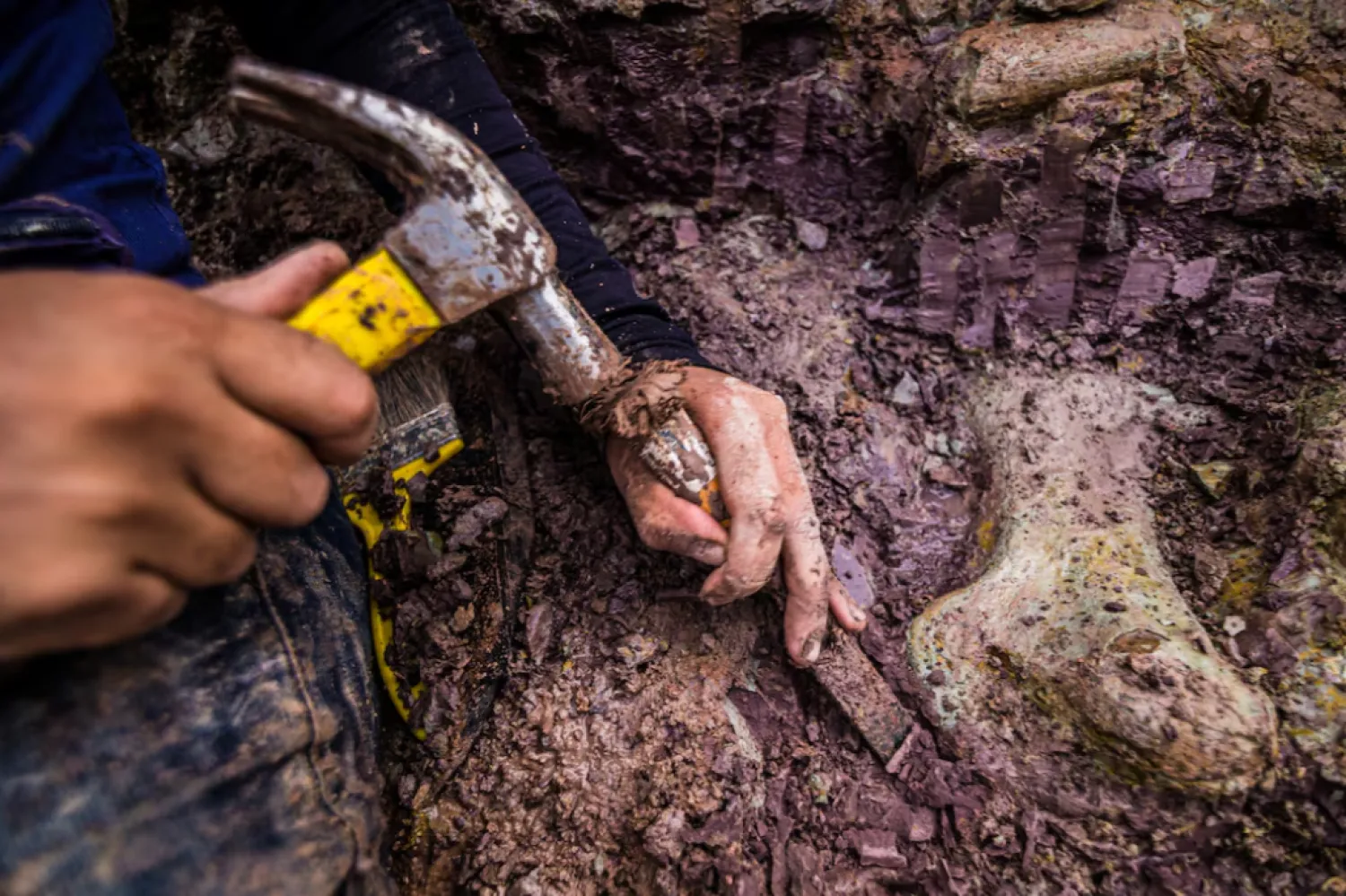
An employee works at the excavation site where dinosaur bones were found in Davinopolis, Maranhao state, Brazil, April 28, 2021. Giovani de Toledo Viecili/Handout via REUTERS
TT

Dinosaur Fossils in Brazil Reveal New Giant Species

An employee works at the excavation site where dinosaur bones were found in Davinopolis, Maranhao state, Brazil, April 28, 2021. Giovani de Toledo Viecili/Handout via REUTERS

Brazilian scientists have identified a new species of giant dinosaur with ties to a similar animal found in Spain, reinforcing knowledge that land routes once connected parts of South America, Africa and Europe about 120 million years ago.

Named Dasosaurus tocantinensis, the species is one of the biggest found in the South American country and was described this month in the Journal of Systematic Palaeontology, Reuters reported.

The fossils were uncovered in 2021 at a site hosting infrastructure works near Davinopolis, in Brazil's northeastern state of Maranhao, and the research was led by Elver Mayer of the Federal University of the Sao Francisco Valley.

The remains include a femur measuring about 1.5 meters (59 inches), which helped researchers estimate the animal stretched roughly 20 meters long.

"As the excavation progressed over the days, we began to see the evidence of that huge bone, which is the femur," said Leonardo Kerber, a paleontologist at the Federal University of Santa Maria (UFSM) who contributed to the research.

"This indicates it was a very large dinosaur. Today we know Dasosaurus is among the biggest dinosaurs ever found in Brazil," he noted.

According to UFSM, analysis indicated the species is the closest known relative of Garumbatitan morellensis, a dinosaur described in Spain.

Their lineage was European and may have dispersed into what is now South America roughly 130 million years ago, likely via northern Africa, before the Atlantic fully opened, the university said.

Dasosaurus tocantinensis's name combines references to the region where the dinosaur was found, including the Tocantins River, a major waterway whose eastern margins lie near the fossil site.


How Collecting DNA Samples in the Wild Could Transform Conservation

A golden monkey is seen in Volcanoes National Park in Kinigi, Rwanda, Thursday, March 19, 2026. (AP)
TT

How Collecting DNA Samples in the Wild Could Transform Conservation

A golden monkey is seen in Volcanoes National Park in Kinigi, Rwanda, Thursday, March 19, 2026. (AP)

A guide called out to endangered golden monkeys with grunts and clicks to signal he posed no threat, a familiar sound in the mist-covered forests of Rwanda ’s Volcanoes National Park.

Here in one of Africa's most well-known parks, steep ridges and dense vegetation often obscure even the largest mountain gorillas — also endangered — and scientists are turning to new technology to detect and protect them.

Known as environmental DNA, or eDNA, the technology allows researchers to identify species using genetic material like fur or feces left in soil and water. This reduces the impact of human interaction during wildlife surveys that can leave researchers groping through the mist.

The technology, more often used in marine conservation work, was introduced by the African Wildlife Foundation in partnership with the Rwandan government. It aims to develop a list of all species in the country. That will help protect biodiversity that is threatened by climate change and population growth.

“We selected eDNA as a new technology to bring solutions and to complement existing methods used in ecological monitoring,” said the foundation’s country manager for Rwanda, Patrick Nsabimana.

Biodiversity monitoring for decades has relied on camera traps, which operate when animals trigger their sensors, and ranger observations.

But that is a challenge in rugged terrain such as the Virunga mountains that are central to Volcanoes National Park, which covers part of Rwanda, Uganda and Congo. Insecurity in the border area also can limit ranger movement.

Nsabimana said eDNA is a cost-effective monitoring approach in large ecosystems such as Virunga. Samples are taken from locations like downstream ponds that are likely to have traces of animals on higher ground. Then they are tested.

“With one sample, you can detect multiple species, mammals, birds, amphibians and many others,” said Deogratias Tuyisingize, a Rwanda-based biodiversity researcher with the Dian Fossey Gorilla Fund that is also involved in the project.

He said a combination of traditional methods and new technology is needed to ensure all species are monitored. Because of steep ravines and mountainsides, “we are sure we were missing some species."

Meanwhile, having a better sense of where endangered species are could help in patrolling against poachers, people with the project said.

The ability to generate a broad snapshot of biodiversity is critical for conservation, especially as Rwanda expands some of its national parks by rehabilitating previously agricultural land.

“We can see how species are colonizing these sites over time,” Tuyisingize said.

That allows conservationists to measure success by the return of rare or threatened species, and offers early warnings of invasive species.

But the eDNA technology is not without limitations. It cannot reliably estimate how many animals are present in an ecosystem. DNA can linger long after a species has left.

Being able to process samples in Rwanda is also a challenge, as the project's initial ones had to be sent to Europe for analysis.

Joshua Newton, who conducted research on eDNA for Curtin University’s Trace and Environmental DNA Laboratory, said challenges also include having cold storage to preserve DNA samples and ensuring samples are not contaminated.

Data gaps are another issue. Africa has relatively limited genetic reference libraries, despite decades of conservation work on the continent, making it harder to match DNA samples to known species.

Most genetic reference libraries come from Europe and America, said James Munyawera, a lab specialist with the Dian Fossey Gorilla Fund.

Researchers are now building region-specific databases.

The project in Volcanoes National Park has also begun training residents of local communities, along with rangers, to participate in monitoring efforts by collecting samples.


‘He’s Tiny! It’s Blue!’: Scientists Find New Deep-Sea Octopus

An undated handout picture released on May 22, 2026 by the Charles Darwin Foundation shows a newly discovered blue pygmy octopus off the Galapagos Islands. (Charles Darwin Foundation / AFP)
TT

‘He’s Tiny! It’s Blue!’: Scientists Find New Deep-Sea Octopus

An undated handout picture released on May 22, 2026 by the Charles Darwin Foundation shows a newly discovered blue pygmy octopus off the Galapagos Islands. (Charles Darwin Foundation / AFP)

On the ocean floor near the Galapagos Islands, a submersible controlled by scientists came across a mysterious octopus as blue as the ocean and no bigger than a golf ball.

"He's tiny! It's blue!" one excited scientist was recorded as saying when she first caught sight of the cerulean cephalopod on footage transmitted from the sub.

The team from the Charles Darwin Foundation had just discovered a new species of octopus nearly 1,800 meters (5,900 feet) below the water's surface, according to research published on Monday.

"Right away, I knew it was something really special," said octopus expert Janet Voight, who was asked to identify the strange species.

At first the curator at the Field Museum of Natural History in Chicago had to make do with photos of the animal.

Then she received its preserved body in the mail.

"When it arrived, I was like 'Oh! My goodness! It's beautiful'," Voight told AFP.

She was immediately interested because the closest known octopus of that shape lives off the coast of Uruguay -- in a different ocean on the other side of South America.

Normally to describe a new octopus species, a specimen needs to be cut open so that its mouth, beak, teeth and other parts can be examined.

"We only had the one specimen, so I didn't want to take it apart," Voight said.

Instead, the team at the Field Museum used CT scans to take thousands of X-ray images, then compiled them to make a 3D model of the octopus, revealing its insides.

"There's nothing like spending the day looking at something no other human has ever seen," the Field Museum's X-ray lab head Stephanie Smith said in a statement.

- 'Deep purple' -

The new species, named Microeledone galapagensis, stands out for reasons other than its blue hue, which is believed to be the rarest color in nature.

The octopus appears to be the runt of the Megaleledonidae family, whose members are normally much larger and live in the Southern Ocean surrounding Antarctica.

"Its stubby little arms with only one row of suckers set it apart from most octopus we are familiar with," Voight said.

Even among "other species with short little arms and a single sucker row, its coloration and smooth skin on the back surface separate it", she added.

While the octopus is light blue on its back, underneath it is a "very deep purple", Voight said.

"We think this color pattern helps keep it safe. If the octopus grabs a prey item that emits light, that light may attract predators that might then eat the octopus," she explained.

"So the octopus puts its dark-colored web over the prey item, keeping itself safe."

Surprisingly, it is not uncommon to find new species of octopus in the deep sea -- particularly in areas that have not been well explored, which is a massive amount of the ocean floor.

"If you took all the land on Earth and pieced it together, you would not cover the Pacific Ocean," Voight pointed out.

She added that she had last seen a new octopus in 2023, off the coast of Costa Rica.

The first sighting of the new blue octopus was made in 2015 near Darwin Island, named after the English scientist whose visit to the Galapagos helped him form the theory of evolution.

Voight's research on the species was published in the journal Zootaxa.


Japanese Security Guard Finds Fame as Designer of Duct Tape Signs

Shuetsu Sato, a security guard whose handmade duct-tape signs have gained widespread recognition, poses with duct-tape signs which he made at a security company office where he works, in Tokyo, Japan, May 1, 2026. (Reuters)
TT

Japanese Security Guard Finds Fame as Designer of Duct Tape Signs

Shuetsu Sato, a security guard whose handmade duct-tape signs have gained widespread recognition, poses with duct-tape signs which he made at a security company office where he works, in Tokyo, Japan, May 1, 2026. (Reuters)

One of Japan's most in-demand graphic designers is neither hip nor an artist by training: he’s a septuagenarian security guard who works the graveyard shift at a train station in Tokyo.

Shuetsu Sato found his hidden passion when he was asked in 2004 to help travelers navigate the crowded, labyrinthine Shinjuku station as it underwent renovations.

His solution was to make signage out of duct tape, covering the station's walls with directions to the myriad train lines, exits and more. He ‌loved the work, ‌the result was effective, and the station master kept ‌asking ⁠for more.

"No one ⁠would think to ask a security guard to make signs or posters, so when someone requests one, I can't help but do my best," said the bespectacled 72-year-old, dressed in a bright-yellow jumpsuit uniform.

As more signs went up, discerning eyes noticed. Soon, Sato was getting requests from all over Japan, to make lettering for movie posters, a museum sign. He even got work ⁠from corporate giants such as Nintendo and Suntory.

Last year, he ‌won the Japan Sign Design Association's platinum ‌award for his unique typography - now known as "Shuetsu-tai" after his name - characterized by ‌rounded edges aimed at soothing commuters' irritation.

One of Sato's latest projects is ‌collaborating on a logo for Nike’s new brick-and-mortar store, which opened last month in the Shinjuku shopping district.

Shun Sasaki, a graphic designer hired by the sporting goods giant, said he immediately thought of Sato when he was asked to come up ‌with a logo that evoked Shinjuku.

"I was blown away by his cool, powerful lettering," Sasaki said. "He's overflowing with ⁠incredible passion - a ⁠strong desire to create."

For all his work's popularity, Sato - who sometimes gets so lost in making signs he forgets to eat or sleep - has never charged a set fee, leaving compensation up to his clients. He only asks for meals to be provided while he works and transportation costs, and the understanding that he will use only duct tape to create his designs.

"For Shinjuku, I think I got a certificate of appreciation from the station master, and a shampoo set," Sato said. Another station master he did signs for thanked him with new socks.

"I couldn't help but laugh at that ... But for me, it's just fun, and as long as it makes people happy, that's really all I need."