
Netanyahu Posts Video in Response to Iran Rumors That He Is Dead

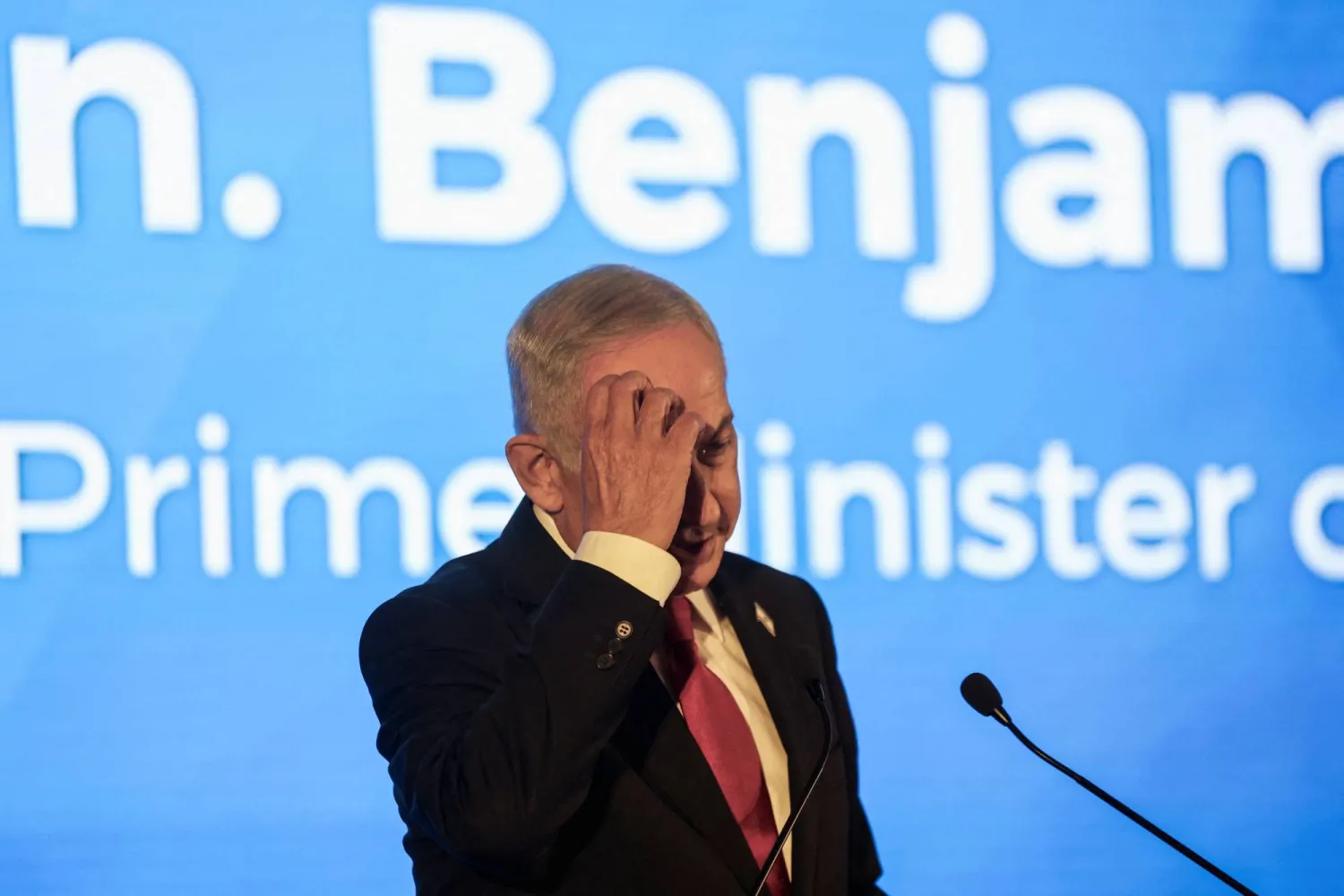
Israeli Prime Minister Benjamin Netanyahu at a press conference in Jerusalem (archive – Reuters)
TT

Netanyahu Posts Video in Response to Iran Rumors That He Is Dead

Israeli Prime Minister Benjamin Netanyahu at a press conference in Jerusalem (archive – Reuters)

Israeli Prime Minister Benjamin ‌Netanyahu posted a video of himself getting a cup of coffee and chatting with his aide on Sunday, after rumors that he was dead or injured were aired by Iranian state media and spread online in Iran. 

In the video, taken at a cafe in Jerusalem's outskirts and posted on Netanyahu's Telegram account, his aide asks him about the rumors. 

Netanyahu responds with a pun on the ‌word dead -- ‌which in Hebrew slang can be ‌used ⁠to describe "being crazy ⁠about" someone or something -- as he reaches for a cup of coffee. 

"I'm crazy about coffee. You know what? I’m crazy about my people," Netanyahu tells the aide. 

Reuters verified the video's location from file imagery of the cafe, which matched the ⁠interiors seen in the video. The date ‌was verified from multiple ‌videos and photos of Netanyahu's visit posted by the ‌cafe on Sunday. 

Iran's Revolutionary Guards vowed on Sunday to target Netanyahu as the war with Israel and the United States continues.  

"If this child-killing criminal is alive, we will continue to pursue and kill him with full force," said the Guards on their website Sepah News. 

Since the US and Israel ‌launched attacks on Iran on February 28, Netanyahu has visited at least two towns hit by Iranian missiles, a hospital, port and military bases, but there was little ‌to no media access, and videos were distributed by his office. 

Netanyahu, who rarely ⁠gives interviews ⁠to Israeli press or holds news conferences, convened his first press conference since the start of the war via a video link on Thursday, a similar format to the one he used in June during Israel's 12-day war with Iran. 

Emergency safety restrictions in Israel since the start of the war ban public gatherings and have kept most people at home or close to shelters and safe rooms, with schools shut across most of the country. 


Taiwan’s President Defends US Arms Purchases That Trump Called ‘Bargaining Chip’

20 May 2024, Taiwan, Taipei City: Taiwan's President Lai Ching-te is pictured during his inauguration speech. (dpa)
TT

Taiwan’s President Defends US Arms Purchases That Trump Called ‘Bargaining Chip’

20 May 2024, Taiwan, Taipei City: Taiwan's President Lai Ching-te is pictured during his inauguration speech. (dpa)

Taiwan’s president on Sunday stressed that arms purchases from the United States are “the most important deterrent” of regional conflict and instability, after President Donald Trump called into question continued US support of Taiwan following his visit to China.

US arms sales to Taiwan and security cooperation between the two sides are not only governed by law but also a catalyst for regional peace and stability, President Lai Ching-te said in a statement.

“We thank President Trump for his continued support for peace and stability across the Taiwan Strait since his first term, including the continuous increase in the scale and amount of arms sales to Taiwan,” he said.

His statement came days after Trump raised doubts over his willingness to continue to sell arms to Taiwan, the island democracy that China claims as its own breakaway province, to be retaken by force if necessary.

The US, like all countries that have formal ties with China, doesn’t recognize Taiwan as a country but has been the island’s strongest backer and arms supplier. Washington is bound by its own laws to provide Taiwan with the means to defend itself and sees all threats to the island as a matter of grave concern.

Trump rattles Taiwan with ‘bargaining chip’ comment

Trump already approved in December a record-breaking $11 billion arms package to Taiwan including missiles, drones, artillery systems and military software.

In an interview aired Friday on Fox News, just as Trump wrapped up a high-stakes visit to China, he said he has yet to greenlight a new $14 billion arms package to Taiwan and that it “depends on China.”

“It’s a very good negotiating chip for us frankly,” he said.

His comments raised concerns on the island, which the Taiwanese government has sought to disperse, noting that the US official policy on Taiwan has not changed.

“Taiwan will not provoke or escalate conflict, but it will also not relinquish its national sovereignty and dignity, or its democratic and free way of life, under pressure,” Lai said in his statement, calling China “the root cause of undermining regional peace and stability and attempting to change the status quo.”

US House Speaker Mike Johnson praised Lai's statement, saying “I thought that was a reasonable thing for the leader there to say.”

Johnson said on Fox News Sunday, “China cannot just go take over land, and we’re going to stand strong and resolute by that. I know the Congress will.”

US Trade Representative Jamieson Greer said on ABC's “This Week with George Stephanopoulos” on Sunday that the president is “considering how to move forward on” the arms sales to Taiwan, noting previous US presidents had paused sales in the past and Trump will need to weigh many factors.

“When the president makes a decision on national security, it’s really based on American security needs first though,” Greer said.

China has framed Taiwan as “the most important issue in China-US relations” during Chinese President Xi Jinping’s recent talks with Trump.

In one of his strongest statements to date, Xi on Thursday warned Trump of “clashes and even conflicts” if the issue of Taiwan was not handled properly.

China and Taiwan have been governed separately since 1949, when the Communist Party rose to power in Beijing following a civil war. Defeated Nationalist Party forces fled to Taiwan, which later transitioned from martial law to multiparty democracy.


North Korea’s Kim Calls to Make Border with South Korea an ‘Impregnable Fortress’

This picture taken on May 17, 2026 and released by North Korea's official Korean Central News Agency (KCNA) on May 18, 2026 shows North Korean leader Kim Jong Un (top C) speaking on key military issues during a meeting of commanding officers of the divisions and brigades of the entire army at the Party Central Committee headquarters in Pyongyang. (KCNA via KNS / AFP)
TT

North Korea’s Kim Calls to Make Border with South Korea an ‘Impregnable Fortress’

This picture taken on May 17, 2026 and released by North Korea's official Korean Central News Agency (KCNA) on May 18, 2026 shows North Korean leader Kim Jong Un (top C) speaking on key military issues during a meeting of commanding officers of the divisions and brigades of the entire army at the Party Central Committee headquarters in Pyongyang. (KCNA via KNS / AFP)

North Korean leader Kim Jong Un said plans to strengthen frontline units on the border with South Korea, as well as other major units, were key to "more thoroughly deterring war," state media KCNA reported on Monday.

Kim's comments on bolstering the military strength on the border to make it an "impregnable fortress" came at a meeting on Sunday of commanders of divisions ‌and brigades across ‌the army, KCNA said.

He called for ‌adjusting ⁠the training system ⁠and expanding practical drills to reflect changes in modern warfare and redefine operational concepts in North Korea's military, according to KCNA.

Kim stressed the need for vigilance against the "arch enemy," a term North Korea has used for South Korea.

The two Koreas are still technically at war after ⁠their 1950-53 conflict ended with an armistice rather ‌than a peace agreement.

South Korea's ‌Unification Ministry said on Monday it appeared to be Kim's ‌first reported meeting with division and brigade commanders since ‌he took power, adding that Seoul would continue to manage military tensions and seek to build trust.

South Korea's Joint Chiefs of Staff said on Monday that North Korean troops ‌had stepped up fortification work since March in areas near the land border between ⁠the two ⁠Koreas, including building walls.

Hong Min, a senior research fellow at the Korea Institute for National Unification in Seoul, said Kim's reference to fortifying the "southern border" suggested Pyongyang may also strengthen its military presence on its maritime boundaries with the South, such as the disputed Northern Limit Line (NLL).

Kim's references to modern warfare and redefining operations "in all spheres" likely reflected lessons Pyongyang has drawn from the war in Ukraine and Middle East conflicts, including the use of drones, precision strikes and electronic warfare, Hong said.


WHO Kicks off Annual Assembly Amid Hantavirus, Ebola Crises

 Delegates attend the 79th World Health Assembly of the World Health Organization (WHO) in Geneva, Switzerland, May 18, 2026. (Reuters)
Delegates attend the 79th World Health Assembly of the World Health Organization (WHO) in Geneva, Switzerland, May 18, 2026. (Reuters)
TT

WHO Kicks off Annual Assembly Amid Hantavirus, Ebola Crises

 Delegates attend the 79th World Health Assembly of the World Health Organization (WHO) in Geneva, Switzerland, May 18, 2026. (Reuters)
Delegates attend the 79th World Health Assembly of the World Health Organization (WHO) in Geneva, Switzerland, May 18, 2026. (Reuters)

World Health Organization member states gather for their annual meeting in Geneva Monday amid concern over deadly hantavirus and Ebola outbreaks and uncertainty over announced US and Argentinian withdrawals.

While the rare hantavirus outbreak on a cruise ship that has gripped global attention is not officially on the agenda, it is expected to feature prominently in the discussions, as is the fresh Ebola outbreak in the Democratic Republic of Congo.

A diplomatic source, who asked not to be identified, said it would be interesting to see how such outbreaks are used by WHO "to promote other things", including "to pressure (the United States and Argentina) not to go".

The meeting of the WHO's annual decision-making assembly, which runs through Saturday, comes after a difficult year for the organization. It has been weakened by the announced US withdrawal and by funding cuts that have forced it to slash its budget and staff numbers.

"We are stable now and moving forward," WHO chief Tedros Adhanom Ghebreyesus insisted at the end of April.

Diplomats and observers agreed.

The situation is "still fragile, but they've been successful in mobilizing most of the funds" required for the next two years, Surie Moon, co-director of the Global Health Centre at the Geneva Graduate Institute, told AFP.

And the hantavirus crisis provided "a clear illustration of why the world needs an effective, trusted, impartial, reliably-funded WHO", she added.

- US, Argentina withdrawals -

But significant divisions persist.

Continued disagreement between wealthy and developing nations has for instance blocked progress on the key missing piece of the WHO's landmark 2025 pandemic treaty, with negotiations now expected to be extended for another year.

It also remains unclear what, if anything, would be decided on the US and Argentinian announced withdrawals.

US President Donald Trump, on his first day back in office in January 2025, handed the WHO his country's one-year withdrawal notice, with Argentina soon following suit.

The WHO, whose constitution does not include a withdrawal clause, has not confirmed either withdrawal.

The United States reserved the right to withdraw when it joined the WHO in 1948 on condition of giving one year's notice and meeting its financial obligations in full for that fiscal year.

While the notice period has expired, Washington has still not paid its 2024 or 2025 dues, owing around $260 million.

When WHO's executive board met in January, Israel submitted a resolution to approve Argentina's withdrawal -- something countries are expected to discuss during the assembly -- but not a word was said about the US leaving.

Diplomats and observers indicated there was broad agreement that it would be better to maintain a grey zone around whether the US was effectively out.

"We hope that it will go past quietly on the US," a European diplomat said on condition of anonymity.

- Election campaign -

The assembly will take place as the process towards next year's election of a new WHO chief heats up.

No one has yet declared their candidacy, but announcements are possible this week ahead of the nomination deadline of September 24.

A number of sensitive resolutions are also on the table, including on Ukraine, the Palestinian territories and Iran, which could spark heated debate.

Much of this week's discussions will center on whether to launch a formal reform process for the so-called "global health architecture" -- a mishmash of organizations that do not always work together and often overlap.

"Among the issues to be explored are what is best done at the global and regional levels... and what is a national responsibility?" Helen Clark, co-chair of The Independent Panel for Pandemic Preparedness and Response and a former New Zealand prime minister, told AFP.

Canadian Health Minister Marjorie Michel told AFP that "this current crisis, with the departure of key players, also allows ... the WHO to re-examine its strategy with its members".

A key focus will be to ensure the process does not see "controversial" issues, such as climate and sexual and reproductive health rights, sacrificed in the context of dwindling international aid funding.

"The objective is to ensure better coordination among health actors, so that no activities or populations are left behind," said a diplomatic source, who asked not to be named.

But Thiru Balasubramaniam of the Knowledge Ecology International NGO, told AFP the WHO had already "scaled down some of their activities, including in terms of sexual and reproductive health".