


Hamas Official Said Killed by Israeli Strike in Lebanon

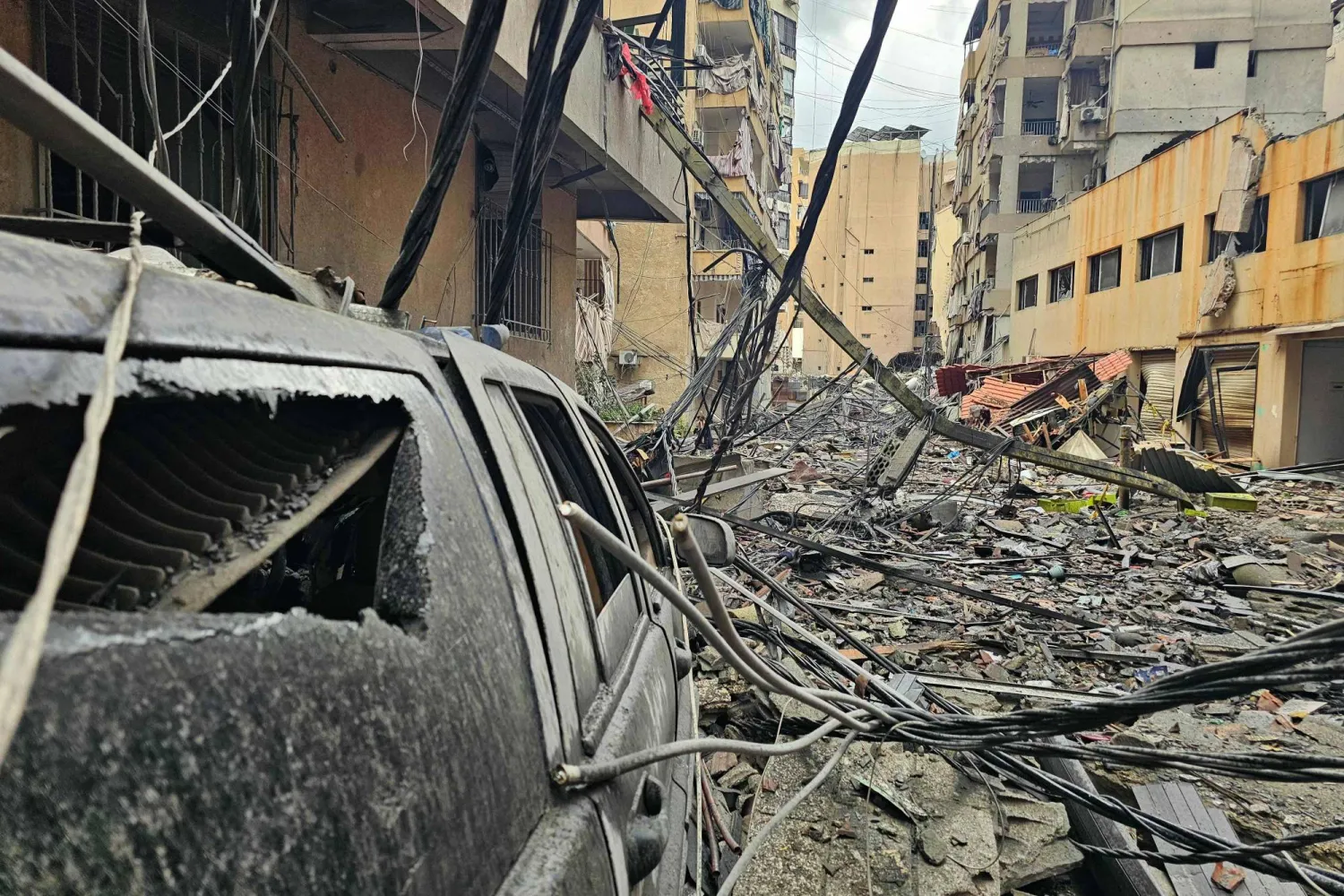
Debris is strewn along a street and vehicles after a residential apartment block was struck in an Israeli airstrike in Beirut's southern suburb of Haret Hreik on March 15, 2026. (AFP)
TT

Hamas Official Said Killed by Israeli Strike in Lebanon

Debris is strewn along a street and vehicles after a residential apartment block was struck in an Israeli airstrike in Beirut's southern suburb of Haret Hreik on March 15, 2026. (AFP)

A Hamas source said an Israeli strike on south Lebanon on Sunday killed an official from the Palestinian group as Hezbollah said it fired an "advanced missile" at an air base near Tel Aviv. 

Israel said no direct talks were planned with Lebanon to end the latest war which has been raging for two weeks. The statement came a day after a Lebanese official said Beirut was preparing a delegation to negotiate with Israel. 

Lebanon was dragged into the Middle East war on March 2 when Iran-backed Hezbollah attacked Israel in response to the killing of Iranian supreme leader Ali Khamenei in US-Israeli strikes, with Israel launching air raids on the neighboring country and troop incursions into border areas. 

Lebanese authorities said the death toll in Israeli attacks rose to 850, while more than 830,000 people have registered as displaced. 

Driving rain on Sunday piled more misery on displaced people, hundreds of whom have been sleeping rough or in tents near central Beirut's seafront. 

Coffee shop owner Nader, 42, displaced from Beirut's southern suburbs, said he had rebuilt his home after it was destroyed in 2024 during the previous Israel-Hezbollah conflict but "I am sure they have destroyed it again... but I haven't been able to check." 

"Here we have nothing and the situation is very bad with the heavy rains and wind -- it's very cold, lots of babies are sick and we can't protect them," he told AFP. 

- 'No' talks - 

The state-run National News Agency said Israel struck "an apartment in a residential building" in a northern district of the coastal city of Sidon, killing one person and causing a fire. 

An AFP correspondent saw damage to the third storey of an apartment building as the army cordoned off the area and rescue teams worked to extinguish the blaze and residents rushed into the street, some carrying belongings. 

The Hamas source, requesting anonymity, said the strike killed official Wissam Taha. 

Israel has repeatedly struck Hamas targets in Lebanon in recent years, including during previous hostilities between Israel and Hezbollah that erupted over the Gaza war, and after a 2024 ceasefire. 

Hezbollah claimed a series of attacks on sites in Israel and on Israeli troops in south Lebanon on Sunday, including one that it said targeted the Palmachim air base south of Tel Aviv, around 100 kilometers (60 miles) from the Lebanese-Israeli border, with "an advanced missile". 

The Israeli military said in a statement Sunday it continued to strike infrastructure used by Hezbollah throughout Lebanon. 

Lebanese President Joseph Aoun has proposed direct negotiations with Israel, but Israeli Foreign Minister Gideon Saar on Sunday responded "no" when asked whether Israel was set to hold such talks. 

- Debris - 

A Lebanese official had told AFP on Saturday that the country was preparing to form a delegation to negotiate with Israel but that there was no agenda, timing or location yet decided for any talks. 

French President Emmanuel Macron has said the Lebanese government was ready to engage in "direct talks" with Israel and he offered to host negotiations in Paris, warning that "everything must be done to prevent Lebanon from descending into chaos". 

The NNA reported Israeli strikes on various areas of the country's south and east, while Israel's military renewed an evacuation warning for Beirut's southern suburbs, which it has repeatedly struck in the past fortnight. 

An AFP photographer in south Beirut saw empty streets covered with debris and buildings flattened, with smoke still rising in the area after strikes in previous days. 

Southeast of Sidon, in the village of Al-Qatrani, three people were killed in an overnight Israeli strike, according to Lebanon's health ministry. 

The Israeli military said it hit "several Hezbollah launch sites" in Al-Qatrani, where it said the armed group was preparing to fire off missiles. 

It also said it had destroyed "command centers" belonging to Hezbollah's elite Radwan Force in Beirut. 

Meanwhile, the United Nations Interim Force in Lebanon said its peacekeepers were fired upon three times on Sunday "likely by non-state armed groups" in the country's south, two days after another position was hit by fire. 

"Today, UNIFIL peacekeepers were fired upon, likely by non-state armed groups, on three separate occasions while conducting patrols around their bases" in south Lebanon, the force said, adding that "two patrols returned fire in self-defense and after brief exchanges, the patrols resumed their planned activities. No peacekeeper was injured." 


UN Security Council Warns of 'Imminent Risk of Mass Atrocities' in Sudan

A child looks at Sudanese women lining up to receive aid at the Al-Afad camp for displaced people in the town of Al-Dabba, northern Sudan, on November 15, 2025. (Photo by Ebrahim HAMID / AFP)
TT

UN Security Council Warns of 'Imminent Risk of Mass Atrocities' in Sudan

A child looks at Sudanese women lining up to receive aid at the Al-Afad camp for displaced people in the town of Al-Dabba, northern Sudan, on November 15, 2025. (Photo by Ebrahim HAMID / AFP)

The United Nations Security Council said Saturday it is concerned over the "imminent risk of mass atrocities" in Sudan as it called on paramilitary forces encircling El-Obeid to back down.

The majority-Muslim southern city, in the Kordofan region, has been under siege for several months by the Rapid Support Forces (RSF), which has been at war with the regular army since April 2023.

"The members of the Security Council expressed concern at the imminent risk of mass atrocities and demanded the RSF immediately halt its assault on El-Obeid," the Security Council said in a statement.

"Council members called on the parties to the conflict to immediately halt the fighting."

The UN has voiced fears that there could be a repeat of the atrocities committed during the October 2025 assault on the city of El-Fasher, which it said bore "hallmarks of genocide."

The UN said Friday that Pekka Haavisto, the secretary-general's special envoy for Sudan, had called rebel paramilitary forces chief Mohamed Hamdan Daglo to urge him not to attack El-Obeid.

Haavisto "underscored the need to urgently de-escalate the situation in El-Obeid and avoid any actions that may further worsen the already dire humanitarian situation and put civilian lives further at risk," said Stephane Dujarric, spokesman for UN Secretary-General Antonio Guterres.

The official said aid workers were "preparing for the potential movements of large numbers of people" fleeing the city, and that "our humanitarian colleagues are doing the responsible thing, which is getting ready for the worst while hoping for the best."

Dujarric said Haavisto was also talking to countries with influence over the warring parties to encourage dialogue and prevent the assault.

The conflict in Sudan has killed tens of thousands of people and forced more than 11 million from their homes, creating what the UN describes as the world's largest displacement and hunger crises.


Dual Saudi Support Measures Bolster Yemen’s Stability and Protect Civilians

Officials sign a previous Saudi agreement to supply fuel for Yemen’s power stations (X). 
TT

Dual Saudi Support Measures Bolster Yemen’s Stability and Protect Civilians

Officials sign a previous Saudi agreement to supply fuel for Yemen’s power stations (X). 

Saudi Arabia’s latest support measures for Yemen have been welcomed by the country’s leadership after Riyadh announced a new budget support payment and extended the Masam Project for landmine clearance for another year. The parallel initiatives aim to ease Yemen’s economic and humanitarian challenges.

Rashad Al-Alimi, chairman of Yemen’s Presidential Leadership Council, expressed his gratitude on behalf of the council, the government, and the Yemeni people to King Salman bin Abdulaziz and Crown Prince and Prime Minister Mohammed bin Salman for directing the release of a new tranche of financial assistance for the state’s general budget.

The announcement was made by Saudi Ambassador to Yemen Mohammed Al Jaber, who also serves as general supervisor of the Saudi Development and Reconstruction Program for Yemen.

He said the Saudi leadership had approved a new payment of more than SAR 224 million ($60 million) to help finance the Yemeni government’s budget deficit and cover public-sector salaries.

Al Jaber said the funding would support government cash flows, provide foreign-currency liquidity, help stabilize the Yemeni rial, and strengthen the government’s ability to maintain essential services and improve living conditions.

Yemeni officials say Saudi budget support has played a critical role in recent years by helping the government meet key financial obligations, particularly public-sector wages and basic services, at a time of declining state revenues and the continuing impact of war.

The assistance is also viewed as an important tool for easing pressure on the national currency and enabling state institutions to continue operating in government-controlled areas despite persistent economic challenges.

Alongside the financial announcement, Al-Alimi welcomed Saudi Arabia’s decision to extend the Masam Project for clearing mines from Yemeni territory for an additional year.

He described the initiative as one of the most significant humanitarian programs protecting civilians from mines planted by the Houthi movement across large areas of the country.

Al-Alimi praised the project’s achievements since its launch, saying landmines remain among the most devastating legacies of Yemen’s conflict because of the deaths, injuries, and permanent disabilities they have caused among civilians.

He said the extension reflects Saudi Arabia’s continued humanitarian commitment to Yemen and represents a long-term investment in protecting Yemeni lives and securing war-affected communities.

The King Salman Humanitarian Aid and Relief Center (KSrelief) announced it had extended the Masam Project for another year at a cost of more than $52.5 million, continuing efforts to remove landmines and unexploded ordnance from Yemen.


The project is implemented through Saudi personnel and international expertise in cooperation with trained Yemeni teams. Activities include mine-clearance operations, public-awareness campaigns, and capacity-building programs designed to strengthen national expertise in the sector.

According to project figures, Masam has cleared more than 567,000 landmines, unexploded ordnance items, and other explosive remnants of war since its launch in mid-2018. The items recovered include anti-personnel and anti-tank mines planted in residential areas, farmland, roads, and civilian facilities.

Dr. Abdullah Al Rabeeah, adviser at the Saudi Royal Court and supervisor general of KSrelief, said the extension reflects Saudi Arabia’s humanitarian responsibility toward the Yemeni people and its commitment to eliminating threats posed by landmines.

He noted that indiscriminately planted mines, often concealed through various methods, have caused thousands of civilian casualties, left many victims permanently disabled, spread fear among local communities, and disrupted agriculture and development activities across wide areas.

Al Rabeeah said Masam has become a leading humanitarian model for addressing the dangers of landmines and war remnants by combining field-clearance operations with training and rehabilitation programs that will help Yemenis confront such threats in the future.

He also praised the Saudi leadership for its humanitarian and relief efforts in Yemen and elsewhere, stressing that the Kingdom’s support for the Yemeni people will continue through a range of development, relief, and humanitarian programs.


Israel Says It 'Eliminated' Two Hamas and Islamic Jihad Operatives Tied to Major Funding Network

TOPSHOT - A man sits atop a hill near destroyed and heavily-damaged buildings at the Nuseirat camp for Palestinian refugees in the central Gaza Strip on June 19, 2026. (Photo by Eyad Baba / AFP)
TT

Israel Says It 'Eliminated' Two Hamas and Islamic Jihad Operatives Tied to Major Funding Network

TOPSHOT - A man sits atop a hill near destroyed and heavily-damaged buildings at the Nuseirat camp for Palestinian refugees in the central Gaza Strip on June 19, 2026. (Photo by Eyad Baba / AFP)

The Israeli military said on Sunday that they "eliminated" Hussein Qadra and ‌Mohammed ‌Farra, operatives in ‌the ⁠military wings of ⁠Hamas and Islamic Jihad, Reuters said.

Qadra, who headed ⁠the ‌network with ‌Farra, acted ‌under ‌Hamas leadership and facilitated the transfer ‌of more than half a billion ⁠shekels ⁠to Hamas, according to an Israeli military X post.
