


Israeli Military Claims Brother of Man Who Attacked Michigan Synagogue Was Hezbollah Commander

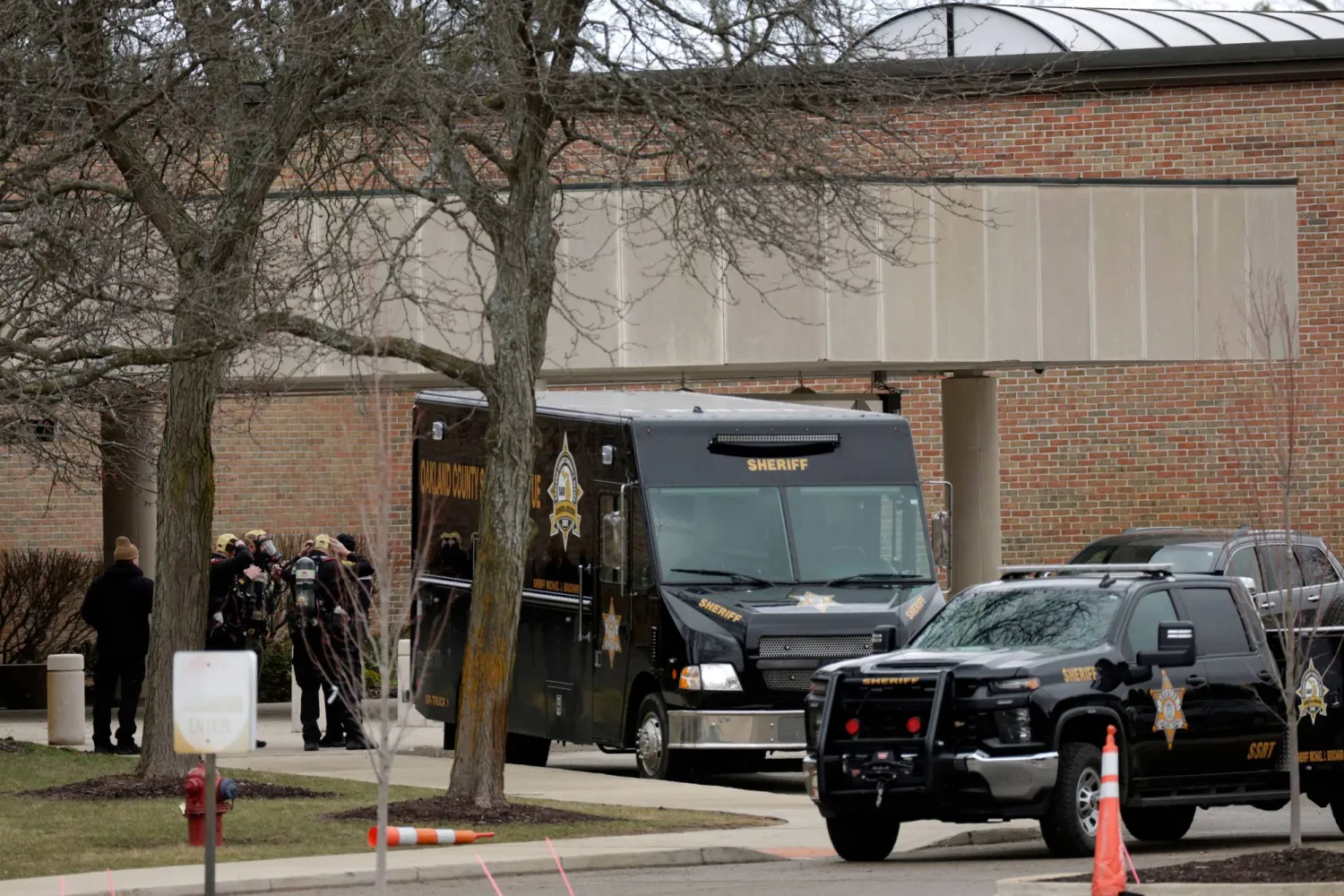
Oakland County Sheriff Deputies prepare to enter Temple Israel synagogue in West Bloomfield, Michigan, on March 13, 2026, after a person drove a vehicle into the synagogue a day earlier. (AFP)
TT

Israeli Military Claims Brother of Man Who Attacked Michigan Synagogue Was Hezbollah Commander

Oakland County Sheriff Deputies prepare to enter Temple Israel synagogue in West Bloomfield, Michigan, on March 13, 2026, after a person drove a vehicle into the synagogue a day earlier. (AFP)

The brother of a man who attacked a Michigan synagogue last week, who was killed earlier this month in an Israeli airstrike, was a Hezbollah commander, Israel’s military claimed Sunday.

Ibrahim Ghazali was killed in Lebanon along with three other of the attacker’s relatives on March 5 — a week before authorities allege Ayman Mohamad Ghazali drove his car into a major synagogue outside Detroit and killed himself after security fired at him.

The FBI's Detroit office, which is investigating the attack, declined to comment on the claims by Israel's military about Ibrahim Ghazali.

“Out of respect for the ongoing investigation, we will continue to refrain from commenting on its substance,” FBI spokesman Jordan Hall said in an email Sunday.

The AP was not immediately able to verify the claim that Ibrahim Ghazali was a militant.

The Israeli military alleges Ibrahim Ghazali was a Hezbollah commander who managed weapons for a unit that fired rockets at Israel.

A Lebanese official, who requested anonymity because he could not publicly discuss details of the airstrike, has confirmed Ibrahim Ghazali’s death, telling the AP that Ghazali’s children, Ali and Fatima, and brother, Kassim, were also killed in the strike that hit their home just after sunset.

Authorities have said that Ayman Ghazali, 41, carried out the synagogue attack after learning that four of his family members were killed in the Israeli strike.

Israel has stepped up attacks on the Iranian-backed Hezbollah party in Lebanon as the war with Iran has spread violence across the Middle East.

On Thursday, Ayman Ghazali waited in his car outside Temple Israel, near Detroit, for about two hours with a rifle, commercial grade fireworks and jugs of liquid believed to be gasoline, before crashing into the building full of dozens of children, according to authorities.

He started firing his gun through the windshield, exchanging fire with an armed security guard. Ghazali fatally shot himself after he got stuck in his vehicle and the engine caught fire, said Jennifer Runyan, the special agent in charge of the FBI’s Detroit field office. No staffers or children inside the synagogue were hurt, likely due to beefed up security in recent months.

The FBI, which is leading the investigation, described the attack on one of the nation’s largest Reform synagogues as an act of violence targeting the Jewish community, but said that they didn’t have enough evidence yet to call it an act of terror.

Ghazali came to the US in 2011 on an immediate relative visa as the spouse of a US citizen and was granted US citizenship in 2016, according to the Department of Homeland Security.

He lived in a single-story brick home in the Detroit suburb of Dearborn Heights about 38 miles (61 kilometers) south of the synagogue.

The attack on the Michigan synagogue took place on the same day as a former Army National Guard member who served years in prison for attempting to aid the ISIS opened fire on a classroom at Old Dominion University in Virginia, killing one person and wounding two others.



Europeans Seek Clarity About Trump’s Iran War Aims Before Agreeing to His Warship Demands

European Union High Representative for Foreign Affairs and Security Policy Kaja Kallas arrives ahead of a Foreign Affairs Council meeting at the Council of the European Union in Brussels, Belgium, 16 March 2026. (EPA)
TT

Europeans Seek Clarity About Trump’s Iran War Aims Before Agreeing to His Warship Demands

European Union High Representative for Foreign Affairs and Security Policy Kaja Kallas arrives ahead of a Foreign Affairs Council meeting at the Council of the European Union in Brussels, Belgium, 16 March 2026. (EPA)

European countries on Monday sought more details about US President Donald Trump's plans for the war on Iran and warned that NATO must not become involved it, as they weighed whether to agree to his call to send warships to help shore up security in the Gulf.

The cool response to Trump’s demand reflects wide caution about the US-Israeli war among allies kept in the dark before, and largely since, it was launched on Feb. 28.

Trump has asked partners, including France, China, Japan, South Korea and Britain, to help secure the Strait of Hormuz for global shipping. He said the United States was talking to “about seven” countries, but he wouldn’t say which ones and gave no indication of when such a coalition might be formed.

UK Prime Minister Keir Starmer insisted Britain “will not be drawn into the wider war,” and said British troops should only be sent into action that is legal and has “a proper thought-through plan.” But his country is considering other forms of help in conjunction with allies.

In an interview with the Financial Times, Trump also warned that “if there’s no response or if it’s a negative response, I think it will be very bad for the future of NATO.”

German Chancellor Friedrich Merz said that “NATO is a defensive alliance, not an interventionist one. And that is precisely why NATO has no business being involved here.” He said he hopes that NATO allies “will treat one another with the necessary respect within the alliance.”

Merz agreed that “this Iranian regime must come to an end,” but he said that "based on all the experience we have gained in previous years and decades, bombing it into submission is, in all likelihood, not the right approach.”

EU debates Trump's demand

Many are keen to know when the war will end.

At a meeting in Brussels, where European Union foreign ministers gathered to discuss Trump's demand, German Foreign Minister Johann Wadephul said it's important for the US and Israel to define “when they consider the military aims of their deployment to have been reached.”

“We need more clarity here,” Wadephul told reporters.

Estonian Foreign Minister Margus Tsahkna also said that US allies in Europe want to understand Trump’s “strategic goals. What will be the plan?”

Polish Foreign Minister Radek Sikorski invited the Trump administration to go through the proper channels.

“If there is a request via NATO, we will of course out of respect and sympathy for our American allies consider it very carefully,” he said. Sikorski made a reference to Article 4 of NATO's founding treaty, which allies can invoke if they believe their territory or security is under threat.

Acting in Europe's interests

Still, EU foreign policy chief Kaja Kallas said that “it is in our interest to keep the Strait of Hormuz open."

Kallas had urged the 27 member countries to expand the EU's Operation Aspides naval mission to protect shipping in the Red Sea up into the Persian Gulf. But after chairing the meeting, she said there had been “no appetite” to boost its mandate.

But Kallas said the EU would closely monitor threats to maritime security also in the Red Sea, where Aspides operates with three warships. “The risk that the Houthis get involved is real. So we must remain vigilant,” she said.

Yemen’s Iran-backed Houthi militants have so far remained on the sidelines of the war even as it has spread across the Middle East, raising questions about why, and perhaps when, the battle-hardened militants might join the fight.

It was not immediately clear whether some European countries might go it alone and form a “coalition of the willing” to provide military support on an ad hoc basis.

The war in Iran has driven up energy prices worldwide, with Brent crude up more than 40%. The conflict has also disrupted the wider global supply chain beyond oil, affecting things like pharmaceuticals from India, semiconductors from Asia and oil-derived products like fertilizers that come from the Middle East.

Cargo ships are stuck in the Gulf or making a much longer detour around the southern tip of Africa. Planes carrying air cargo out of the Middle East are grounded. And the longer the war drags on, the more likely that there will be shortages and price increases on a wide range of goods.

France has said it is working with countries — French President Emmanuel Macron mentioned partners in Europe, India and Asia — on a possible mission to escort ships through the strait but has stressed it must be when “the circumstances permit,” when fighting has subsided.

French senior officials, speaking anonymously on ongoing talks, said the Netherlands, Italy and Greece had shown interest and that Spain might be involved in some way.

Starmer said Britain is discussing with the US and allies in Europe and the Gulf the possibility of using its mine-hunting drones already in the region.


Trump on Iran: We Don’t Know Their Leaders

US President Donald Trump speaks during a meeting with trustees of the John F. Kennedy Center for Performing Arts in the East Room of the White House in Washington, DC, USA, 16 March 2026. (EPA)
TT

Trump on Iran: We Don’t Know Their Leaders

US President Donald Trump speaks during a meeting with trustees of the John F. Kennedy Center for Performing Arts in the East Room of the White House in Washington, DC, USA, 16 March 2026. (EPA)

President Donald Trump said on Monday that he believes Iran wants to make a deal to end the US-Israeli conflict with Tehran but that it is unclear who is actually leading Iran.

"We don't know who their leader is. We ‌have people ‌wanting to negotiate. We have ‌no ⁠idea who they ⁠are," Trump told reporters during a White House event.

After Iran's supreme leader, Ali Khamenei, was killed in the initial strikes of the war, Tehran announced his ⁠son, Mojtaba Khamenei, had been ‌named as ‌his successor.

Pentagon chief Pete Hegseth said ‌last week the new leader ‌was believed to have been wounded in a strike. He has not been seen publicly.

"A lot of people ‌are saying that he's badly disfigured. They're saying that he lost ⁠his ⁠leg ... and he's been hurt very badly. Other people are saying he's dead," Trump said.

Oman has attempted multiple times to open a line of communication between the United States and Iran, but the White House made it clear it is not interested at this juncture, Reuters reported on Saturday.


Middle East War ‘Not a Matter for NATO’, Says Germany’s Merz

 German Chancellor Friedrich Merz, attends a joint press conference with the Prime Minister of the Netherlands, Rob Jetten after their meeting at the chancellery in Berlin, Germany, Monday, March 16, 2026. (AP)
German Chancellor Friedrich Merz, attends a joint press conference with the Prime Minister of the Netherlands, Rob Jetten after their meeting at the chancellery in Berlin, Germany, Monday, March 16, 2026. (AP)
TT

Middle East War ‘Not a Matter for NATO’, Says Germany’s Merz

 German Chancellor Friedrich Merz, attends a joint press conference with the Prime Minister of the Netherlands, Rob Jetten after their meeting at the chancellery in Berlin, Germany, Monday, March 16, 2026. (AP)
German Chancellor Friedrich Merz, attends a joint press conference with the Prime Minister of the Netherlands, Rob Jetten after their meeting at the chancellery in Berlin, Germany, Monday, March 16, 2026. (AP)

Chancellor Friedrich Merz on Monday said the war in the Middle East started by US-Israeli strikes on Iran was "not a matter for NATO" and Germany would not be taking part in it.

"It has been clear at all times that this war is not a matter for NATO," Merz said, adding that the US and Israel "did not consult us prior to this war".

"There was never a joint decision on whether to intervene. That is why the question of how Germany might contribute militarily does not arise. We will not do so," Merz said at a press conference alongside his Dutch counterpart Rob Jetten.

US President Donald Trump on Sunday called for nations including South Korea, France, China and Britain to help ensure safe passage in the Strait of Hormuz, which Iran has declared closed to US and US-allied traffic.

He later upped the pressure on NATO allies, telling the Financial Times newspaper that the alliance faced a "very bad" future if its members did not do their bit to reopen the strait.

Merz ruled out Germany sending ships to the Strait of Hormuz.

"For as long as the war continues, we will not be involved in ensuring free passage in the Strait of Hormuz by military means," he said.

Merz's spokesman Stefan Kornelius earlier also said the war had "nothing to do with NATO".

"NATO is an alliance for the defense of territory" and "the mandate to deploy NATO is lacking", Kornelius told a regular press briefing.

At a separate briefing on Monday, Defense Minister Boris Pistorius said Germany wanted all those involved to prevent "further military escalation".

"There will be no military participation" from Germany but Berlin is prepared to support diplomatic efforts to "to ensure safe passage through the Strait of Hormuz", he said.

"We have a situation which we did not provoke... This war started without any consultations," Pistorius added.

Germany's main responsibility is "for the eastern flank and the high north", he said, and "we stay committed to that but we can't be anywhere in the world".

"What does Donald Trump expect from a handful of European frigates in the Strait of Hormuz that the mighty US navy cannot manage alone? This is the question I find myself asking," Pistorius said.