

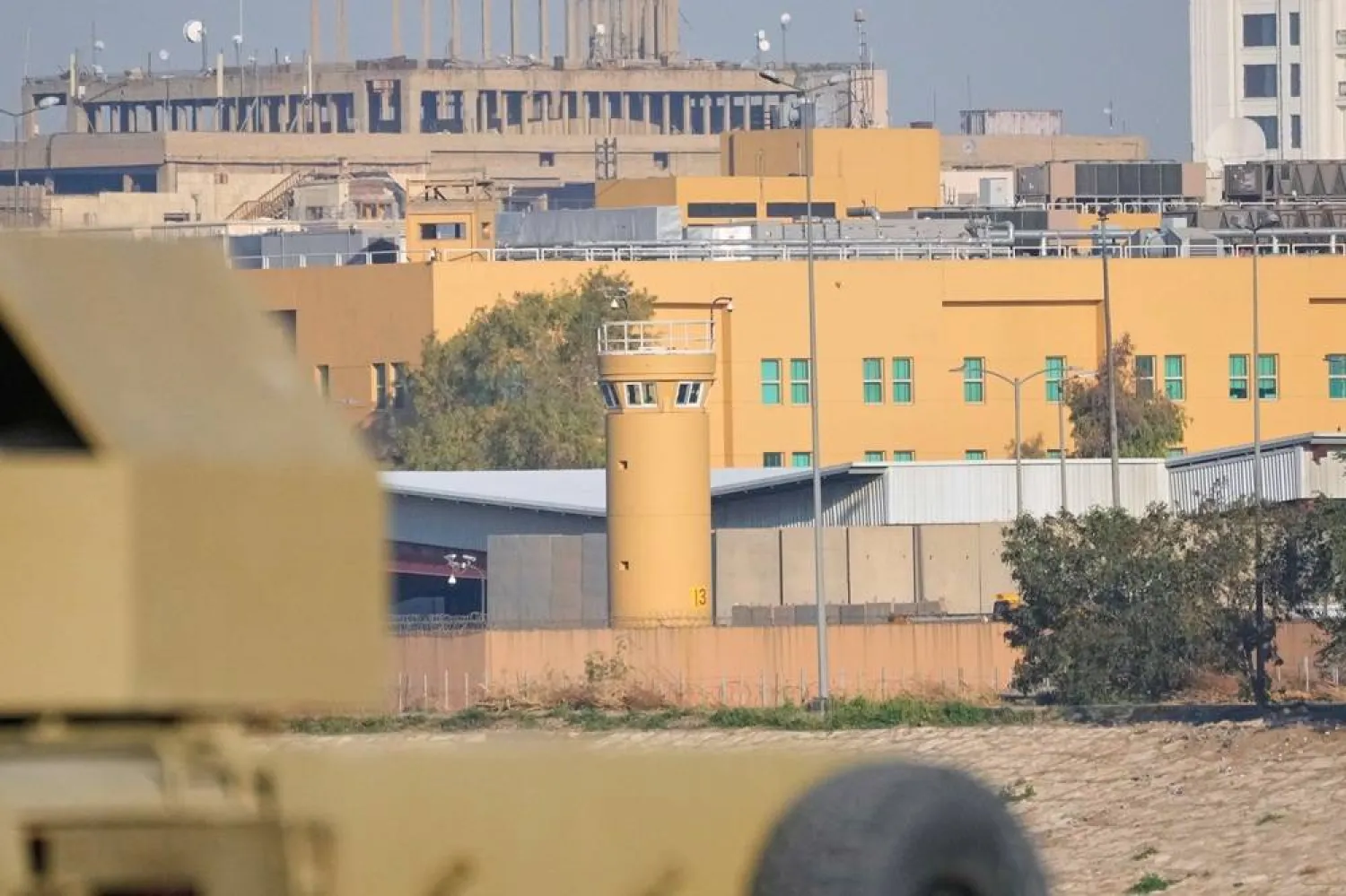

Drone, Rocket Attack Targets US Embassy in Baghdad

 The US Embassy is seen across the Tigris River in Baghdad, Tuesday, March 17, 2026. (AP)
The US Embassy is seen across the Tigris River in Baghdad, Tuesday, March 17, 2026. (AP)
TT

Drone, Rocket Attack Targets US Embassy in Baghdad

 The US Embassy is seen across the Tigris River in Baghdad, Tuesday, March 17, 2026. (AP)
The US Embassy is seen across the Tigris River in Baghdad, Tuesday, March 17, 2026. (AP)

A drone and rocket attack targeted the US embassy in Baghdad early Tuesday, while a strike killed four people at a house reportedly hosting Iranian advisors, security officials said, pulling Iraq deeper into the Middle East war.

An AFP journalist reported seeing black smoke rising after an explosion in the embassy complex, as well as air defenses intercepting another drone.

The strikes came hours after air defenses thwarted a rocket attack at the embassy and a drone sparked a fire at a luxury hotel frequented by foreign diplomats in Baghdad's fortified Green Zone.

Iraq was drawn into the Middle East war after having long been a proxy battleground between the United States and Iran, with strikes targeting Iran-backed groups that have claimed daily attacks on US interests in Iraq and across the region.

Meanwhile, a strike on a house in Baghdad killed four people early Tuesday, with initial reports suggesting that two of the dead were "Iranian advisors" to Tehran-backed groups, a security source told AFP.

Another source from an Iran-backed faction confirmed that four people were killed in the strike on a house hosting Iranian advisors in al-Jadiriyah neighborhood.

The attacks came shortly after the powerful Tehran-backed Kataib Hezbollah group announced that its senior security commander Abu Ali al-Askari had been killed, without providing details on the circumstances of his death.

Iraq's interior ministry initially said that a "projectile" fell on the roof of the luxury al-Rasheed Hotel in Baghdad's heavily fortified Green Zone, before clarifying that it was a drone. It did not specify whether the building itself was the target.

"The incident caused no casualties or material damage," it added.

A street leading to the hotel, which hosts diplomatic missions including the US embassy, was blocked by a large security deployment, with firefighters and ambulances present, according to an AFP correspondent.

Witnesses saw a fire break out on the roof of the hotel.

Shortly after the hotel incident, a loud blast was heard in Baghdad, as air defenses were seen intercepting an attack over the US embassy, an AFP journalist said.

A security official told AFP "air defenses thwarted an attack with four rockets" on the embassy.

Prime Minister Mohammed Shia al-Sudani, head of the armed forces, denounced the attacks -- including a strike on a southern oil field -- calling them threats to his country's "security and stability".

He promised security services would "hunt down the perpetrators of these acts and bring them to justice immediately", according to a statement from his spokesman, Sabah al-Numan.

"These criminal acts have serious repercussions for our country and undermine the government's efforts toward reconstruction and prosperity."

- Fighters killed, oil attack -

Kataib Hezbollah announced Monday "the martyrdom of Haj Abu Ali al-Askari", without providing any details on how and when he was killed.

A security official told AFP that "Abu Ali al-Askari is Abu Ali al-Amiri, the commander who was killed in a strike on Baghdad on Saturday".

Kataib Hezbollah referred to Askari as the group's security chief. He was also the spokesperson in charge of issuing all key statements in the group's name.

Drone and rocket attacks have also targeted oil fields and facilities.

Earlier Monday, two drones targeted the southern Majnoon oil field -- which had already paused production -- with the oil ministry spokesperson saying that one of the drones had hit a telecommunications tower.

A security official said a second drone had targeted the offices of a US firm, operating at the site.

In a separate incident in the west, eight Iraqi fighters from a former paramilitary coalition were also killed in strikes near the country's border with Syria.

The fighters belonged to the Popular Mobilization Forces (PMF), which are now part of Iraq's regular army.

In a statement, the PMF confirmed the attack, saying they were killed “while performing their duty in protecting the nation’s territory and sovereignty.” 

“It was the latest attack on our heroic security forces in recent days,” it added. 

“They attacks will only make us more determined and driven to perform our duty in defending Iraq and consolidating its sovereignty,” it stressed. 

PM Sudani has sacked a number of senior intelligence officers in Baghdad and Nineveh in an attempt to curb attacks inside Iraq, whether those carried out by Washington and Tel Aviv against the PMF and its affiliated armed factions, or by the factions against Baghdad airport and other civilian locations in Iraq and the Iraqi Kurdistan Region. 

Military sources said the majority of attacks against Kurdistan are being launched from Nineveh or Kirkuk. Iran has also been firing at the region. 

There is a growing conviction in the country that Sudani’s caretaker government will be incapable of preventing the attacks on Iraq despite the statements of condemnation and the various probes that have been launched into them. 


Lebanese President Pins Hopes on Rome Talks to Secure Israeli Withdrawal

Aoun receives former UN Special Coordinator for the Middle East Peace Process Sigrid Kaag and a delegation from the University of Balamand. (Lebanese Presidency)
TT

Lebanese President Pins Hopes on Rome Talks to Secure Israeli Withdrawal

Aoun receives former UN Special Coordinator for the Middle East Peace Process Sigrid Kaag and a delegation from the University of Balamand. (Lebanese Presidency)

Hours before the sixth round of Lebanese-Israeli negotiations in Rome on Tuesday, Lebanese President Joseph Aoun hoped that the two-day talks will produce tangible progress on the ground, starting with an Israeli withdrawal from Lebanese territory and the deployment of the Lebanese Army to areas vacated by Israeli forces.

The Lebanese delegation heads into the talks seeking to move from the framework agreement with Israel to the implementation phase, while Hezbollah has intensified its criticism of both the government and the accord, saying it undermines Lebanon’s sovereignty and targets the party itself.

Lebanon is pressing for the prompt launch of the “pilot zones” outlined in the agreement. Sources familiar with the negotiations told Asharq Al-Awsat that US-led efforts, through a delegation that arrived in Beirut from Israel on Saturday, to initiate an Israeli withdrawal from pilot areas remain active and should not be considered stalled.

“We are still awaiting signs that such a step can be achieved before Tuesday’s talks in Rome,” the sources said, adding that contacts are continuing until the last minute in hopes of securing an Israeli withdrawal from one or two villages before negotiations begin.

Two weeks ago, Prime Minister Nawaf Salam said that Israel would withdraw from Western Zawtar, Eastern Zawtar, and several other villages.

Ministerial sources said the Lebanese delegation includes Ambassador Simon Karam, Ambassador Nada Mouawad, and retired Brig. Gen. Ziad Haykal, a member of Aoun’s advisory team.

US Ambassador to Lebanon Michel Issa will not attend.

The talks will focus on mechanisms for implementing the framework agreement, establishing a timetable for an Israeli withdrawal, and launching the pilot zones through the deployment of the Lebanese Army as a prelude to reconstruction.

The framework agreement sets out broad principles for resolving the situation in southern Lebanon, including an Israeli withdrawal, the deployment of the Lebanese Army, and reconstruction. However, it does not include a binding implementation timetable, one of the main points of contention.

During meetings on Monday, Aoun said national unity was Lebanon’s “strongest weapon” and urged political leaders to “speak with one Lebanese voice,” stressing that loyalty should be to the nation rather than personal interests.

He vowed not to compromise on southern Lebanon or the country’s rights, saying the framework agreement calls for a full Israeli withdrawal from Lebanese territory and includes an Israeli commitment that it has no territorial ambitions in Lebanon.

Aoun argued that war had failed to bring security or stability and said diplomacy aims to achieve objectives broadly supported by Lebanese citizens, foremost among them an Israeli withdrawal, the return of displaced residents, the release of detainees and the remains of the dead, and the launch of reconstruction.

He said he would discuss ways to pressure Israel to implement the framework agreement during his upcoming meeting with US President Donald Trump in Washington.

As preparations for the Rome talks continued, Hezbollah stepped up its attacks on the Lebanese government and the framework agreement, arguing that it fails to safeguard Lebanon’s sovereignty, links ending the occupation to the issue of the group’s weapons, and grants Israel political gains it failed to achieve during the war.

MP Ali Al-Moqdad, a member of Hezbollah’s parliamentary bloc, called for the agreement to be abandoned, describing it as “an agreement of humiliation and disgrace” that betrays the sacrifices of those killed, wounded, and displaced.


Jordan Shoots Down 4 Rockets Fired by Iran as Sirens Sound in Bahrain

A view of Amman, Jordan. (Petra file)
TT

Jordan Shoots Down 4 Rockets Fired by Iran as Sirens Sound in Bahrain

A view of Amman, Jordan. (Petra file)

The Jordanian military announced on Tuesday that air defenses shot down four rockets fired from Iran. No injuries or material damage was reported.

Iran has intensified its attacks on US allies in the region in retaliation to the latest American strikes against it.

Meanwhile, sirens sounded in Bahrain three times as Iran targeted the country.

In Jordan, an official military source said the armed forces intercepted and downed four missiles that had entered the kingdom’s airspace at dawn, saying they were fired by Iran.

The interception was carried out with high efficiency in line with procedures to protect the kingdom's sovereignty and security and safety of its people.

The source stressed that any attempt to violate the kingdom’s sovereignty or its airspace will be met with “complete firmness within the reliable rules of engagement” to safeguard the national interest.

“The armed forces will not be lenient in taking all necessary measures to protect the nation and defend its security and stability,” it declared.

Iran’s Revolutionary Guards Corps (IRGC) said it targeted a “US air base” in Jordan with ballistic missiles.

Jordan had last Thursday intercepted eight rockets fired by Iran. The IRGC also claimed the attack was targeting an American military base.

Jordan has repeatedly said it does not host foreign bases on its territories. Any foreign troops in the country are deployed at Jordanian bases as part of joint agreements and training programs.

In April, Jordan said it had been targeted by 281 rockets and drones fired by Iran during the US-Israel war against Tehran that started on February 28. It said that it had intercepted 261 of the attacks, which had resulted in 30 injuries.


Al-Hijri Renews Call for Sweida’s ‘Independence’ from Syria

Sheikh Hikmat al-Hijri, flanked by supporters from the so-called National Guard. (Suwayda24)
TT

Al-Hijri Renews Call for Sweida’s ‘Independence’ from Syria

Sheikh Hikmat al-Hijri, flanked by supporters from the so-called National Guard. (Suwayda24)

The spiritual leader of Syria’s Druze community, Sheikh Hikmat al-Hijri, renewed calls Monday for what he described as Sweida’s “independence,” saying the southern province could eventually become “an autonomous entity under another state’s protection or join another state.”

His remarks coincided with the first anniversary of the July 2025 clashes in Sweida.

A local source in Sweida opposed to al-Hijri’s policies rejected the proposal, telling Asharq Al-Awsat that residents “have no state but Syria, despite the country’s current hardships.”

The source added that neither Israel nor Jordan supports such a move, noting that Israeli officials have publicly stated they do not back Sweida’s secession and that “the overwhelming majority of residents will not abandon their Syrian identity.”

Areas under al-Hijri’s influence have hosted gatherings in recent days to commemorate last July’s clashes, which killed hundreds of Bedouin residents, Druze faction fighters, civilians, and members of the army and security forces.

The source said the events reflected widespread grief, as most families had suffered deaths, injuries, or displacement, stressing that the commemorations were intended to honor the victims rather than press for secession.

On Sunday, al-Hijri met representatives of the Shahba Operations Room, affiliated with the so-called National Guard, in the town of Qanawat.

In widely circulated video footage, he said the goal was “the independence of Bashan State,” adding that this could take the form of an independent state, a region under another country’s protection, or union with another state, “whichever best serves the interests of the people of the region.”

He also thanked Israel, saying it had stood by Sweida and citing its geographic proximity.

The Sweida Governorate issued a statement marking the anniversary, describing the July events as a tragedy that left lasting scars on the province and on Syrians as a whole.

Maysaa al-Abdallah, a resident of Sweida, told Asharq Al-Awsat that many families remain displaced a year later, with 135 people still missing and civilians still detained at Adra Prison near Damascus.

She also said that, of roughly 14,000 middle- and high-school students eligible to sit for national exams, only a very small number had been able to do so.

While most residents still identify as Syrian and Arab, she argued that “government policies are pushing many to reject that identity.”
