


Israel Launches New Strikes on Tehran and Lebanon as Iran Hits Back and Fires on Gulf Neighbors

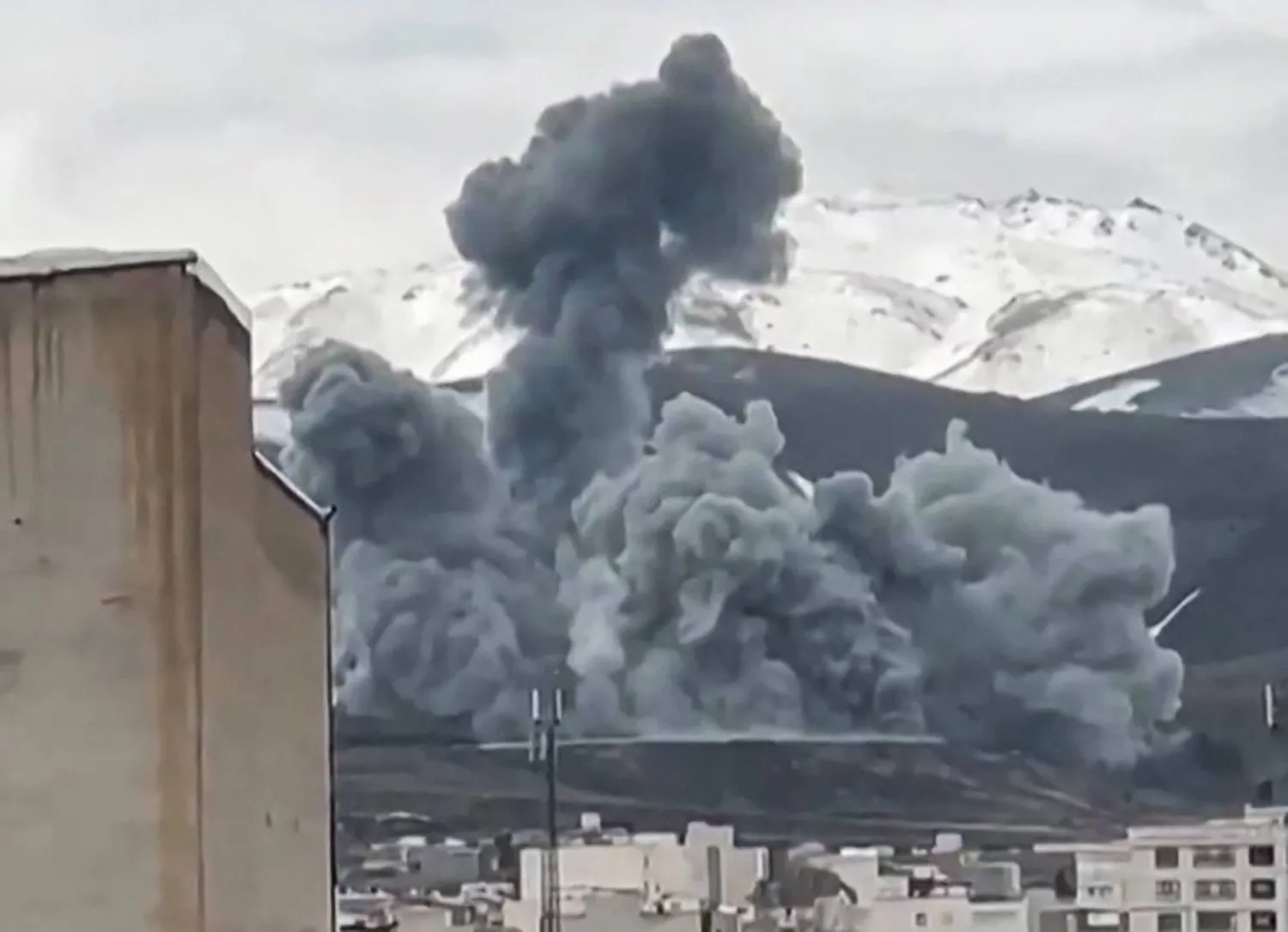
This video grab taken from UGC images posted on social media and verified by AFPTV staff on March 16, 2026, show smoke rising from the side of a mountain in Hamedan, in Hamedan Province, western Iran. (Photo by UGC / AFP)
TT

Israel Launches New Strikes on Tehran and Lebanon as Iran Hits Back and Fires on Gulf Neighbors

This video grab taken from UGC images posted on social media and verified by AFPTV staff on March 16, 2026, show smoke rising from the side of a mountain in Hamedan, in Hamedan Province, western Iran. (Photo by UGC / AFP)

Residents of Dubai and Doha, Qatar, awoke to the sound of explosions Tuesday as air defenses worked to intercept new waves of incoming Iranian fire, and Israel launched new strikes on Iran and Lebanon, as the war in the Middle East showed no signs of abating.

Dubai, a major transit hub for international travel, briefly shut its airspace as the military said it was “responding to incoming missile and drone threats” around the city, The Associated Press said.

The Israeli military said early Tuesday it had begun a “wide-scale wave of strikes” across Iran’s capital and was also stepping up strikes on Iran-backed Hezbollah militants in Lebanon. Israel also reported two incoming salvos before dawn from Iran at Tel Aviv and elsewhere, and said Hezbollah targeted Israel's north.

Iranian strikes pressure neighbors and oil markets

Iran kept up the pressure on the energy infrastructure of its Gulf Arab neighbors, hitting an oil facility in Fujairah, a UAE emirate on the country’s east coast with the Gulf of Oman that has been repeatedly targeted. State-run WAM news reported that no one had been injured in the blast from the drone strike.

Iran's attacks on Gulf nations and its stranglehold on the Strait of Hormuz, through which a fifth of the world's oil is transported, has given rise to increasing concerns of a global energy crisis. Early Tuesday it hit a tanker anchored off the coast of Fujairah, one of about 20 vessels hit since Israel and the United States started the war with an attack on Iran on Feb. 28.

With Washington under increasing pressure over rising oil prices, Brent crude, the international standard, remained over $100 a barrel, up more than 40% since the war started.

US President Donald Trump said he had demanded that roughly a half-dozen countries send warships to keep the Strait of Hormuz open. But his appeals brought no immediate commitments, with many saying they are hesitant to get involved in a war with no defined exit plan and skeptical that they could do more than the US Navy.

UAE briefly closes airspace as Iran launches new attacks on Gulf neighbors

The UAE shut down its airspace early Tuesday as its military reported it was “responding to missile and drone threats from Iran." The closure was soon lifted, and not long after the sounds of explosions could be heard as the military worked to intercept incoming fire.

The snap announcement on its airspace showed the balancing act Emirati authorities face in trying to keep their long-haul carriers, Emirates and Etihad, flying as Iranian attacks continue to target the country.

Saudi Arabia’s Defense Ministry reported intercepting a dozen drones Tuesday morning over the country’s vast Eastern Province, home to oil infrastructure.

In Qatar, the sounds of explosions boomed over the capital early in the day as defenses worked to intercept incoming fire. Qatar's Defense Ministry said later that it had successfully thwarted a missile attack on the city, though a fire broke out in an industrial area from a downed projectile.

Attacks from Iran-linked proxy forces continued in Iraq, as the US Embassy in Baghdad was hit with shrapnel from drones that had been intercepted.

The embassy's air defenses were able to shoot down all four drones targeting the facility, according to two Iraqi security officials, speaking on condition of anonymity to discuss intelligence matters.

A separate strike targeted a house in the heavily fortified Presidential Compound in Baghdad’s al-Jadriya area, the officials said. It wasn’t clear who carried out either attack but Iran-allied militias have regularly been attacking American targets inside Iraq since the conflict began.

Israel launches new attacks on Tehran and steps up strikes on Beirut

The Israeli military early Tuesday said it had launched new attacks across Tehran in addition to the Lebanese capital targeting Hezbollah militants.

More than 1,300 people have been killed in Iran since the start of the conflict, according to the Iranian Red Crescent.

Israel’s strikes have also displaced more than 1 million Lebanese — or roughly 20% of the population — according to the Lebanese government, which says some 850 people have been killed.

Some Israeli troops have pushed into southern Lebanon, and there are fears Israel is preparing a large-scale invasion.

The military's chief of staff, Lt. Gen. Eyal Zamir, said Monday on a visit to the northern border that Israel's army is “determined to deepen the operation until all of our objectives are achieved” and that the military's Northern Command is being reinforced with additional soldiers.

Israel reported two Iranian salvos early Tuesday fired toward Tel Aviv and an area south of the Sea of Galilee. More launches from Lebanon were also reported.

In Israel, 12 people have been killed by Iranian missile fire. At least 13 US military members have been killed.

Trump seeks allies' help to police the Strait of Hormuz

The virtual shutdown of the Strait of Hormuz is unnerving the world economy, driving up energy prices, threatening food shortages in poor countries, destabilizing fragile states and complicating efforts by central banks to drive down prices for consumers.

There have been a handful of ships getting through, primarily Iranian but also from other countries including India and Türkiye, and Iranian Foreign Minister Abbas Araghchi said: “from our perspective it is open” — just not for the United States, Israel and its allies.

Underscoring the danger of even getting close to the strait, a tanker anchored off the eastern coast of the United Arab Emirates was hit by a projectile early Tuesday morning.

The United Kingdom Maritime Trade Operations center, run by the British military, reported the attack, saying the vessel was in the Gulf of Oman off Fujairah. It said the tanker sustained “minor structural damage” and no one was hurt.

On Monday, Trump said “numerous countries” have told him “they’re on the way” to help police the Strait of Hormuz but there was no sign of that actually happening.

Europeans have been critical of the US and Israel for failing to provide clarity on their objectives in the war and have suggested that they are more interested in a diplomatic solution than getting dragged into the conflict.

Japan and Australia said Monday they had not been asked to help protect the strait and had no current plans to do so, and Italy's Foreign Minister Antonio Tajani said his country favors strengthening anti-piracy and defensive missions in the Red Sea, but not expanding their role in the Strait of Hormuz.

British Prime Minister Keir Starmer said his country might deploy mine-hunting drones already in the region, but “will not be drawn into the wider war.”



Starmer Tells Zelensky ‘Focus Must Remain on Ukraine’ amid Iran War

 Britain's Prime Minister Keir Starmer meets with Ukrainian President Volodymyr Zelenskyy at 10 Downing Street in London, Tuesday, March 17, 2026.(Suzanne Plunkett, Pool Photo via AP)
Britain's Prime Minister Keir Starmer meets with Ukrainian President Volodymyr Zelenskyy at 10 Downing Street in London, Tuesday, March 17, 2026.(Suzanne Plunkett, Pool Photo via AP)
TT

Starmer Tells Zelensky ‘Focus Must Remain on Ukraine’ amid Iran War

 Britain's Prime Minister Keir Starmer meets with Ukrainian President Volodymyr Zelenskyy at 10 Downing Street in London, Tuesday, March 17, 2026.(Suzanne Plunkett, Pool Photo via AP)
Britain's Prime Minister Keir Starmer meets with Ukrainian President Volodymyr Zelenskyy at 10 Downing Street in London, Tuesday, March 17, 2026.(Suzanne Plunkett, Pool Photo via AP)

UK Prime Minister Keir Starmer told Ukrainian President Volodymyr Zelensky in London on Tuesday that "the focus must remain on Ukraine" despite the US-Israeli war with Iran.

Starmer welcomed Zelensky to his official Downing Street residence for talks after the Ukraine leader met King Charles III at Buckingham Palace.

"I think it's really important that we are clear that the focus must remain on Ukraine," said Starmer.

"There's obviously a conflict in Iran going on, in the Middle East, but we can't lose focus on what's going on in Ukraine and the need for our support," he added.

Washington has partly rolled back sanctions against Moscow to cool oil prices sent soaring by the Middle East war, which appears to have scuttled US-led talks on ending Russia's four-year invasion.

Tuesday's meeting came after Downing Street had earlier announced that Britain and Ukraine are set to sign a defense partnership aimed at addressing the threat of low-cost drones.

Zelensky's visit in London -- ahead of a trip to Spain on Wednesday -- comes as his European allies have vowed to keep up support for Kyiv in the conflict with Russia.

"Our resolve is unbreakable," said Starmer, reiterating the UK's long-standing backing of Ukraine.

Earlier, Zelensky and King Charles shook hands during a private audience at Buckingham Palace.

"I thank His Majesty and the entire Royal Family for their unwavering support and solidarity with Ukraine," Zelensky wrote on X.

The Ukrainian leader was later due to meet NATO chief Mark Rutte in London, his spokesman said.

He was also expected to address members of the UK parliament.


Middle East War Could Trigger ‘Permanent’ Refugee Crisis, Warns Türkiye

Türkiye’s Foreign Minister Hakan Fidan speaks during an interview with The Associated Press, in Ankara, Türkiye, Saturday, March 14, 2026. (AP)
TT

Middle East War Could Trigger ‘Permanent’ Refugee Crisis, Warns Türkiye

Türkiye’s Foreign Minister Hakan Fidan speaks during an interview with The Associated Press, in Ankara, Türkiye, Saturday, March 14, 2026. (AP)

If the Middle East war spreads, it could create a "permanent" refugee crisis, Türkiye’s top diplomat warned Tuesday as Lebanon said Israel's bombardment had displaced over a million people.

"If the war... spreads, there is a possibility this will turn into a permanent refugee crisis with refugees seeking shelter outside the borders of their countries," Foreign Minister Hakan Fidan told a joint news conference with his Canadian counterpart Anita Anand.

"This needs to stop as soon as possible."

Lebanon was dragged into the Middle East war on March 2 when Iran-backed Hezbollah attacked Israel in response to the killing of Iranian supreme leader Ali Khamenei during the US-Israeli strikes on Iran.

Since then, more than one million people have registered as displaced, the Lebanese authorities said on Monday -- representing more than a sixth of its entire population.

The news came as Israel's military said it had launched a limited ground operation against Hezbollah in southern Lebanon.

"The humanitarian situation is deeply concerning in Lebanon and has the potential to worsen if there is a ground offensive there," Anand told the news conference.

Fidan said the war "could lead to permanent damage.. between countries of the region" pointing to the conflict "spreading across Lebanon, and things also becoming much more complicated in Iraq."

He said Türkiye had been "working very hard diplomatically since the outbreak of the war to prevent these crises from escalating", saying he would travel to several countries in the region on Wednesday.

Anand said Canada appreciated Türkiye’s diplomatic efforts and its "role as an interlocutor in the current Middle East conflict" while also expressing its resolute opposition to Iran's "reprehensible" strikes on regional nations.

"Canada absolutely condemns those retaliatory strikes.. Those retaliatory strikes must stop, whether they are in Doha or even against this very country," she said.


US Does ‘Not Need’ Help from Allies on Iran, Trump Says

An F/A-18F Super Hornet launches from the flight deck of the US Navy Nimitz-class aircraft carrier USS Abraham Lincoln during the Operation Epic Fury attack on Iran from an undisclosed location March 6, 2026. (US Navy/Handout via Reuters)
TT

US Does ‘Not Need’ Help from Allies on Iran, Trump Says

An F/A-18F Super Hornet launches from the flight deck of the US Navy Nimitz-class aircraft carrier USS Abraham Lincoln during the Operation Epic Fury attack on Iran from an undisclosed location March 6, 2026. (US Navy/Handout via Reuters)

President Donald Trump said Tuesday that US forces "no longer need" military help in the Iran war, after his calls for assistance from allies to reopen the Strait of Hormuz to oil traffic were largely rebuffed.

The American president has spent recent days griping about how world powers have so far declined to send warships to escort tankers through the narrow waterway in and out of the Gulf and key to the transit of crude.

With the war in its third week, Trump has repeatedly stressed that US and Israeli air strikes have decimated Iran's leadership, military facilities, and weapons manufacturing capacity.

"The United States has been informed by most of our NATO 'Allies' that they don't want to get involved with our Military Operation against the Terrorist Regime of Iran, in the Middle East," Trump posted on his Truth Social platform.

"Because of the fact that we have had such Military Success, we no longer 'need,' or desire, the NATO Countries' assistance -- WE NEVER DID! Likewise, Japan, Australia, or South Korea," Trump said, adding: "WE DO NOT NEED THE HELP OF ANYONE!"

Speaking of allies who have rejected his call for assistance, the 79-year-old Republican said he is "not surprised by their action, however, because I always considered NATO, where we spend Hundreds of Billions of Dollars per year protecting these same Countries, to be a one way street."

The US-Israeli war on Iran has expanded dramatically across the Middle East, with Iran targeting the energy facilities of its crude-producing neighbors.

Tehran has also attacked and threatened tankers transiting the Strait of Hormuz, all but closing the vital waterway through which one fifth of global crude oil passes.

French President Emmanuel Macron insisted Tuesday that his country would not participate in operations to open the Strait of Hormuz given the current context of air strikes and other military dangers, but once the situation becomes "calmer" it could participate in an "escort system" alongside other nations.

Britain has also waved off Washington's request for assistance. But Trump on Monday suggested Paris and London would lend a hand to the United States in the operation, and said several other countries -- without naming them -- had responded favorably to his call.