


Budapest’s Vintage Freight Trams Celebrate 100 Years in Service

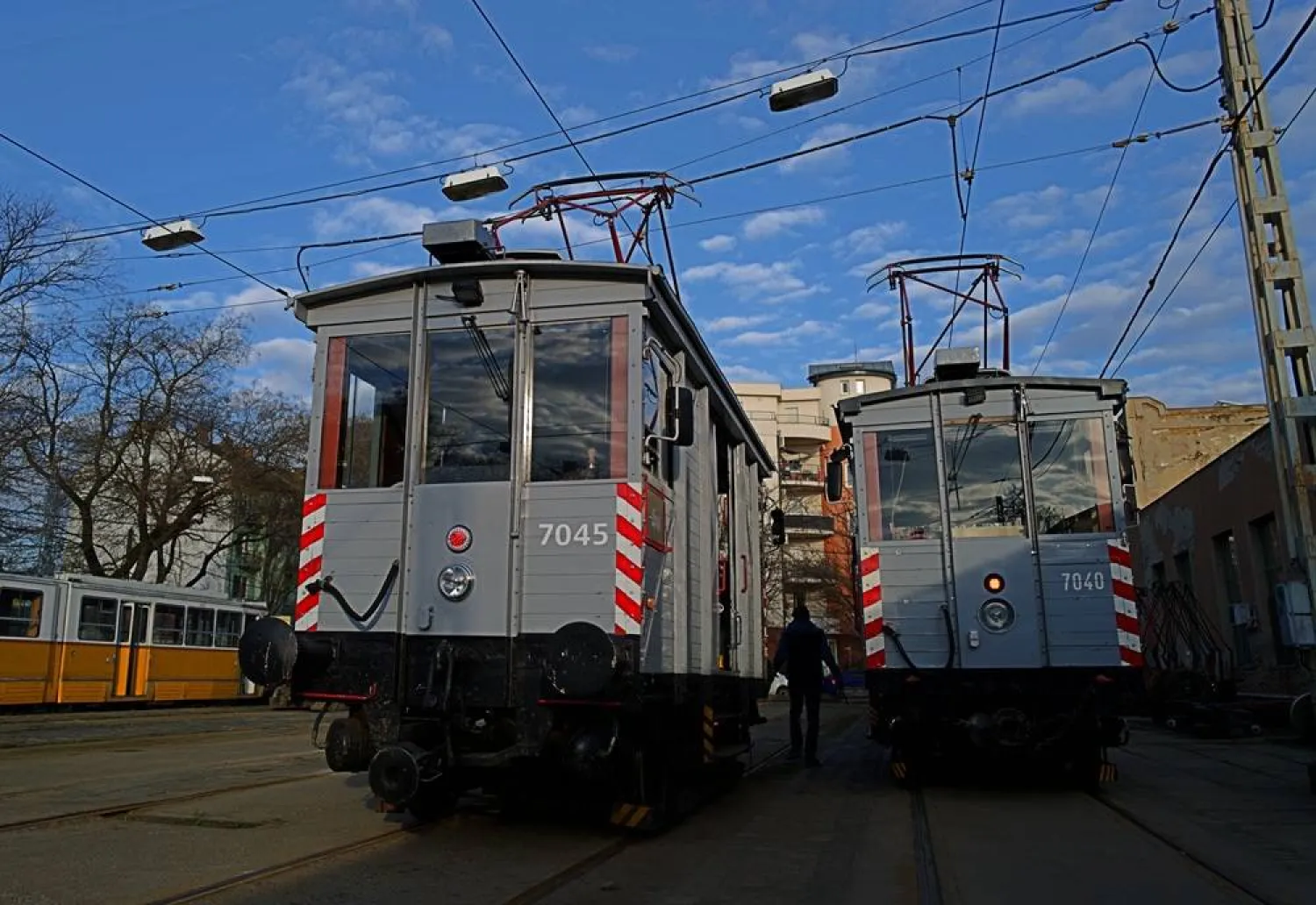
 Two century-old freight trams are parked in the Kelenfold tram depot in Budapest, Hungary on Thursday, March 12, 2026. (AP)
Two century-old freight trams are parked in the Kelenfold tram depot in Budapest, Hungary on Thursday, March 12, 2026. (AP)
TT

Budapest’s Vintage Freight Trams Celebrate 100 Years in Service

 Two century-old freight trams are parked in the Kelenfold tram depot in Budapest, Hungary on Thursday, March 12, 2026. (AP)
Two century-old freight trams are parked in the Kelenfold tram depot in Budapest, Hungary on Thursday, March 12, 2026. (AP)

With the toot of a horn, the ring of a bell and the hiss of air brakes, an unusual rail vehicle pulls out of a depot in Budapest to serve the Hungarian capital's public transit system, a job it has done for a century.

The so-called freight trams, known as mukis, run on electricity provided by overhead wires and travel on Budapest's vast tram rail network, one of the busiest in the world. But unlike the hundreds of iconic yellow trams in the passenger fleet, they don’t carry commuters.

Acquired by the city in 1926, the wood-sided trams were initially products of necessity: They brought goods and raw materials to and from Budapest's factories after much of the local freight infrastructure had been destroyed during World War I.

"Engineers at the time designed an electric drive system mainly using parts from vehicles damaged in the war, as well as parts from vehicles that had already been designated for scrapping," said Ádám Zadravecz, the head of tram vehicle development and technology at Budapest's public transit company BKV.

"Their primary purpose was freight transport, but after World War II, these vehicles were also used for removal of the war ruins," he said.

Over time, the mukis' function changed as Hungary recovered. In the 1960s, some of the original 40 trams were equipped with a snowplow, enabling them to clear the city's tram tracks in winter, as they do today.

They also perform nighttime maintenance runs, and transport broken-down trams into depots for repairs.

Various parts on the trams were gradually replaced, resulting in a mishmash of components. By 2018, the mukis were due for a more comprehensive refurbishment.

"When they were manufactured in the 1920s, they were extremely simple, extremely puritanical devices," said Nándor Meixner, head of vehicle maintenance at Budapest's Ferencváros depot. "During the refurbishment, we strove to make our colleagues’ work easier. That is why, for example, a seat was added to the vehicle, so that the driver can at least sit down."

Another addition: The trams were equipped with heating in the cabin.

Despite the changes over the last 100 years, Zadravecz said the trams' overall nature remained the same.

"Their maintenance costs is almost zero because these trams are very easy to maintain. Compared to the complex electronics of today’s vehicles, there is very little in them that can break down," he said. "People say that it can be repaired with a hammer and a file, and that’s absolutely true."

Driving them requires special training, however, as well as what Meixner called a certain "feel" for the vehicle.

"It is not enough to just drive, to know the signs and instructions, you also need to know the vehicle itself," he said.

Of the original fleet of 40 mukis, only six have survived the last 100 years in Budapest, with three in active use.

"The value of these vehicles lies precisely in their simplicity, in the pure fact that they exist and are available to us," Zadravecz said.


Fetching Votes: In Paris Mayor’s Race, Dogs Dominate Campaigns

People walk dogs on a pedestrian crossing in Paris, France, March 6, 2026. (Reuters)
TT

Fetching Votes: In Paris Mayor’s Race, Dogs Dominate Campaigns

People walk dogs on a pedestrian crossing in Paris, France, March 6, 2026. (Reuters)

Paris will choose a new mayor on Sunday, with one unlikely issue dominating campaigns alongside all the partisan acrimony - dogs.

Candidates from socialists to conservatives have set out policies to deal with an issue which voters have regularly ranked among their top concerns, a lack of space for the capital's estimated 100,000 canines.

"Paris isn't exactly a very dog-friendly capital," said Vincent Danna, founder of the Monceau Dog Club, a group of around 1,000 owners who have campaigned for more open spaces for their pets.

"It can indeed be a decisive factor in municipal elections. I think the candidates have understood that well."

Rachida ‌Dati, the conservative ‌candidate backed by President Emmanuel Macron, has filmed herself ‌with ⁠dogs on the ⁠campaign trail and told Reuters she would create new parks where owners can take their dogs for walks, or even let them run free.

"We're going to develop dog parks specifically to create these shared spaces. And not just for the sake of shared spaces, but so people can bring their pets along freely, without being bothered or judged. That's the idea," Dati ⁠said.

Socialist Emmanuel Gregoire, who led the first round of voting ‌last Sunday, has also committed to ‌expanding outdoor spaces for pets.

"The main goal is to have outdoor spaces where ‌animals can live as comfortably as possible," Gregoire told Reuters.

Sophia Chikirou, from ‌the hard-left LFI party who came third in the first round, has proposed letting owners take their dogs on all forms of public transport.

Pets have long played a role in French political life. Every president since Charles de Gaulle has ‌owned at least one dog. Far-right leader Marine Le Pen studied to get a cat-breeding diploma in 2021.

An Ifop ⁠poll in ⁠February showed 58% of French voters saw animal welfare as a priority issue in their municipality. So far, activists have taken the lead.

Following pressure from the Monceau Dog Club, the park of the same name has let dogs run free in a dedicated area in the first trial of its kind in the capital.

Still, not everyone is convinced dogs will make a difference in the second and final round of voting this weekend.

"If you ask me whether a dog plan is going to sway my vote one way or the other, I would say no. Because I think there are perhaps more important things," local resident Marie-Christine Alary said.

"But I do think it's a very good thing."


Fans of Niche Japanese Crisps Brand Panic After Oil Shortage Halts Production

A shopper checks food items at a supermarket in Tokyo, Japan January 20, 2023. (Reuters)
TT

Fans of Niche Japanese Crisps Brand Panic After Oil Shortage Halts Production

A shopper checks food items at a supermarket in Tokyo, Japan January 20, 2023. (Reuters)

Die-hard fans of ‌a niche Japanese crisps brand took to the internet on Tuesday to lament a production halt the snack maker Yamayoshi Seika blamed on a shortage of cooking oil caused by the conflict in the Middle East.

The US and Israel's war on Iran and the resulting effective closure of the vital Strait of Hormuz have fuelled fears of a knock-on impact on prices in ‌Japan. But news ‌of the crisps brand's suspension is ‌among ⁠the first tangible ⁠fallout for consumers.

Once the news spread, Yamayoshi Seika's "Wasabeef" became the third-most trending buzzword in Japan on social media platform X, with the company name trailing not far behind.

"I never expected the closure of the Strait of Hormuz to result in ⁠the production stoppage of Wasabeef," ‌user @JoshuaGboyega5 posted on X. "I ‌can't imagine life without Wasabeef!"

CEO Satoshi Kada said Yamayoshi ‌Seika's heavy oil wholesaler had warned him in ‌early March of an expected price hike of 20% to 30% and soon after said it could no longer send any supplies.

"We had no choice but ‌to stop the factory," he told Reuters, adding that he did not know ⁠when ⁠production could resume.

Yamayoshi Seika, which was established in 1953, calls Wasabeef a "national brand" characterized by a flavor blending wasabi and savory beef essence. The company has monthly sales of about 400 million to 500 million yen ($2.5 million to $3 million), Kada said.

Japan, which depends on the Middle East for around 95% of its crude oil supplies, this week began releasing about 80 million barrels of oil from its strategic reserves to mitigate disruptions.


Shigeaki Mori, Hiroshima Atomic Bomb Survivor Embraced by Obama, Dies at 88

US President Barack Obama (L) hugs atomic bomb survivor Shigeaki Mori as he visits Hiroshima Peace Memorial Park in Hiroshima, Japan May 27, 2016. (Reuters)
TT

Shigeaki Mori, Hiroshima Atomic Bomb Survivor Embraced by Obama, Dies at 88

US President Barack Obama (L) hugs atomic bomb survivor Shigeaki Mori as he visits Hiroshima Peace Memorial Park in Hiroshima, Japan May 27, 2016. (Reuters)

Shigeaki ‌Mori, the survivor of the Hiroshima atomic bombing whom former US President Barack Obama embraced during a historic visit to the city in 2016, has died at 88, Jiji Press reported on Tuesday.

The image of Obama's arms wrapped around a tearful Mori at the Hiroshima Peace Memorial ‌Park became ‌a defining moment of that ‌visit - ⁠the first ever ⁠by a sitting US president.

Mori was eight years old when the US dropped the atomic bomb on Hiroshima, flattening the city on August 6, 1945 and knocking him ⁠unconscious with the force ‌of its ‌blast.

Thirty years later, Mori embarked on a ‌multi-decade quest to find victims who ‌were cremated at his school playground. His work also identified 12 Americans who died in the bombing.

He died in ‌a hospital in Hiroshima on March 14, Jiji reported.

Many nuclear ⁠bomb ⁠survivors - known as "hibakusha" in Japanese - despite their advanced age and dwindling numbers have tried to keep alive the legacies of Hiroshima and Nagasaki, the only two cities to ever suffer a nuclear attack.

The cities have counted some 550,000 deaths from the attacks to date, including from illnesses related to acute radiation exposure.