


Northern Arabia Archaeological Site Reveals 13,500-Year-Old Human Settlement

The study documented human settlement at the site dating back about 13,500 years. (Saudi Ministry of Culture)
TT

Northern Arabia Archaeological Site Reveals 13,500-Year-Old Human Settlement

The study documented human settlement at the site dating back about 13,500 years. (Saudi Ministry of Culture)

The Saudi Heritage Commission, one of 11 sector-specific commissions under the Ministry of Culture, announced findings documenting archaeological evidence of early human settlement in northern Arabia. The scientific study presenting the evidence has been published in the journal Nature.

The findings, presented in the scientific study titled “The Natufian Epipalaeolithic and Pre-Pottery Neolithic in the desert of northern Arabia,” are based on advanced excavation and scientific analysis conducted at the Sahout site, an archaeological site located on the southern edge of the Nefud Desert between the Arnan and Al-Misma mountains.

The site occupies a strategic geographic position linking internal desert environments with settlement networks connected to the Levant, making it a key location for understanding early human movement and dispersal in the region during the late Ice Age and the beginning of the Holocene.

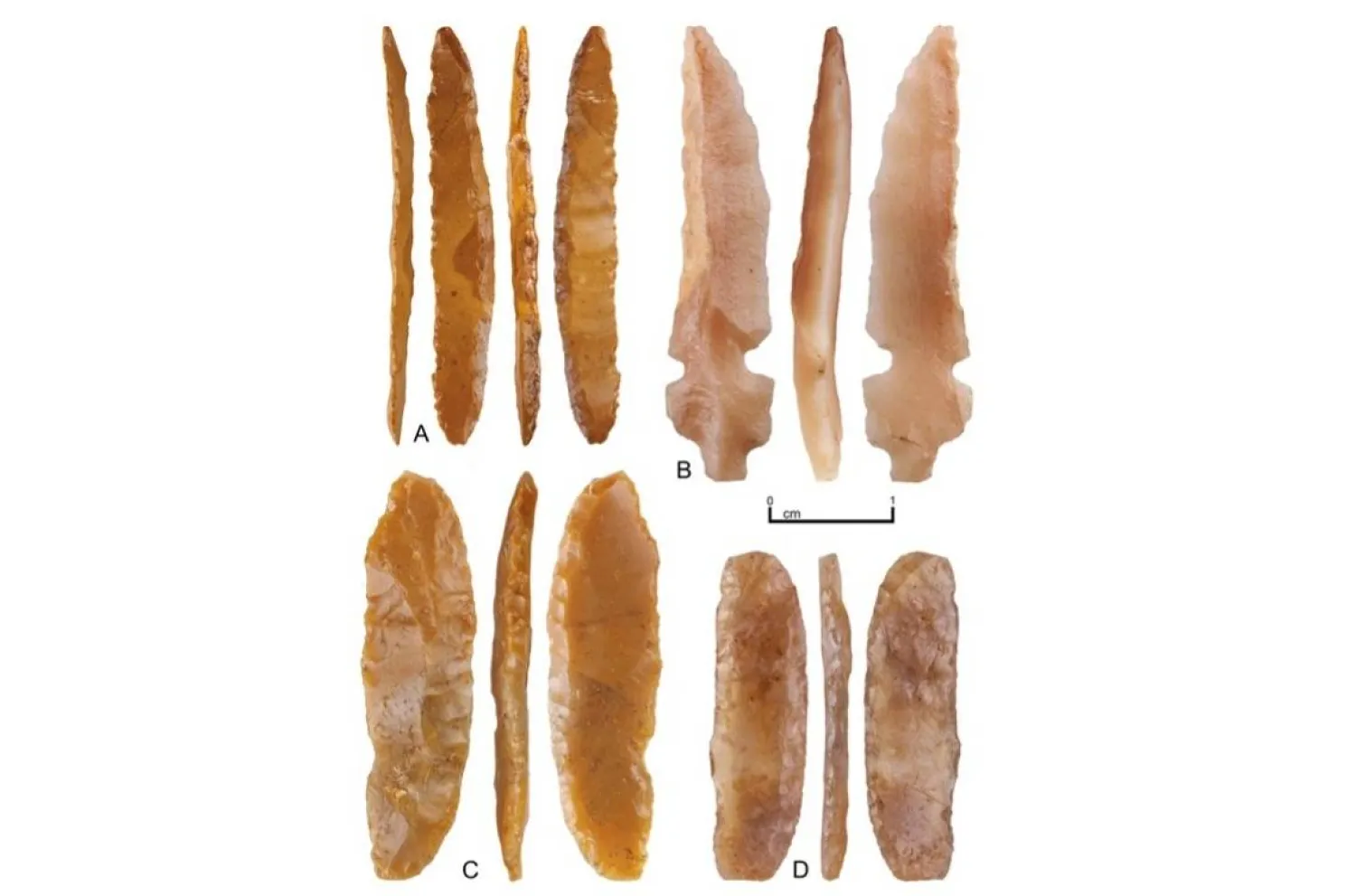
The study documented human settlement at the site dating back about 13,500 years. Stratified excavations uncovered distinctive stone tools, most notably Helwan bladelets - small, finely crafted stone implements used as arrowheads or as components of hunting tools.

These artifacts are important archaeological indicators associated with the Natufian culture. Their discovery at the Sahout site confirms the presence of human communities possessing advanced technical skills and the ability to adapt to desert environments. It also reflects the connection of the Arabian Peninsula to broader cultural networks extending to the Fertile Crescent during this early period.

The discovery also revealed a later settlement phase dating between approximately 10,300 and 8,700 years ago, characterized by greater settlement density and technological development in stone industries. Archaeologists discovered Abu Salem points, a type of finely crafted arrowhead used in hunting.

These findings provide important evidence of advanced human societies with sophisticated technological skills, reflecting a high level of organization and environmental knowledge during the Pre-Pottery Neolithic period and confirming the presence of developed human settlement in northern Arabia during that time.

Geochemical analyses of the obsidian used to manufacture the stone tools showed that the material originated from Jabal Al-Abyad in the Khaybar region, about 190 km south of the site. This indicates the existence of extensive communication and exchange networks, demonstrating that early communities were capable of traveling long distances to obtain resources from distant areas and highlighting advanced levels of cultural and technological interaction among populations in the region.

The study documented a direct link between human settlement and rock art at the site. Carving tools were found within dated archaeological layers alongside artistic elements depicting life-size camels and human figures.

These discoveries provide a precise chronological framework for the development of artistic expression in northern Arabia, confirming that artistic production was an integral part of the cultural life of the communities inhabiting the area during these early periods.

The findings reaffirm the Kingdom’s commitment to cultural preservation, historical understanding, and knowledge development.



As Iran Diplomacy Picks Up, Rubio Tours Taj Mahal

United States Secretary of State Marco Rubio poses with his wife, Jeanette Rubio, during their visit to the Taj Mahal in Agra, India, Monday, May 25, 2026. Pool via Reuters
TT

As Iran Diplomacy Picks Up, Rubio Tours Taj Mahal

United States Secretary of State Marco Rubio poses with his wife, Jeanette Rubio, during their visit to the Taj Mahal in Agra, India, Monday, May 25, 2026. Pool via Reuters

As diplomacy intensifies on ending the Iran war, top US diplomat Marco Rubio was spending Monday not in negotiations but at India's world-famous monument to love, the Taj Mahal.

Rubio, on his first-ever visit to India, flew to Agra and spent 45 minutes at the Taj Mahal with his wife Jeanette, who usually shuns the spotlight.

"It's one of the wonders of the world," Rubio said of the Taj Mahal.

"I think it's important to show respect to the culture of the countries that you visit."

Under a blazing sun in 40C heat, Rubio removed the tie from his navy-blue suit, put his arm around Jeanette, who wore a flowing dress with elegant heels.

The couple posed for pictures on the bench from where Princess Diana was photographed alone in an iconic 1992 shot.

The US ambassador to India, Sergio Gor, a high-octane former aide to President Donald Trump, smiled and eagerly joined some of the couple's pictures.

The normally teeming street leading to the Taj Mahal were cleared for Rubio, with other tourists kept 100 meters away from him -- although it was only a partial shutdown unlike when Vice President JD Vance visited.

Rubio was not entirely away from Iranian influence at the Taj Mahal, whose domes and four-way charbagh gardens are heavily influenced by Persian architecture.

The Taj Mahal was built in the 17th century on orders of Mughal emperor Shah Jahan as a mausoleum for his beloved wife Mumtaz Mahal who died in childbirth.

The excursion is unusual for Rubio, who in nearly a year and a half on the job has preferred short, business-like trips and rarely done events outside of government meetings.

Rubio said he was taking advantage of a one-day break in his schedule before a meeting in New Delhi on Tuesday of the Quad -- Australia, India, Japan and the United States.

He will also visit the palace-filled city of Jaipur on Monday to tour the Amber Fort.

Rubio is visiting four cities over four days in India as he seeks to revive ties with a country successive US administrations saw as a like-minded partner in a world dominated by China's rise.

Trump has shaken up that approach since returning to office, temporarily imposing high tariffs, warming to both China and India's historic adversary Pakistan, curbing visas used by Indian professionals and reposting insulting language about Indian immigrants.

Trump, in remarks Sunday by speakerphone to a celebration in New Delhi for the 250th anniversary of US independence, insisted he was on board with the relationship, telling the crowd, "we've never been closer to India, and India can count on me 100 percent".


French Artist Begins Giant ‘Cave’ Art Inflation Over Paris’ Oldest Bridge

People walk along the Seine river next to "The Pont Neuf Cave," an inflated art installation by French street artist JR, on Paris' oldest bridge, the Pont Neuf, Thursday, May 21, 2026, which will be open to the public from June 6-28. (AP Photo/Michel Euler)
TT

French Artist Begins Giant ‘Cave’ Art Inflation Over Paris’ Oldest Bridge

People walk along the Seine river next to "The Pont Neuf Cave," an inflated art installation by French street artist JR, on Paris' oldest bridge, the Pont Neuf, Thursday, May 21, 2026, which will be open to the public from June 6-28. (AP Photo/Michel Euler)

The oldest bridge in Paris has begun to vanish this week, as the artist JR — who is known as the “French Banksy” — began inflating a giant “cave” over the Pont Neuf.

The monumental, rocky illusion is swallowing the 17th-century landmark, which has carried Parisians across the Seine for more than 400 years. By Thursday, it looked as if a prehistoric cliff had risen in the heart of the city.

The inflation process, which was carried out overnight — after being delayed by bad weather — is the most dramatic stage yet of a project more than a year in the making.

One of the most ambitious public artworks Paris has seen in decades, which has been funded by the sale of JR’s work and a handful of corporate partners, does not open to the public until June 6.

“We’re about to leave something pretty incredible in the middle of Paris,” JR told The Associated Press earlier this year at his studio in the city’s east, wearing his trademark hat and shades.

The transformation of the bridge has been documented by the AP since March with time-lapse cameras, including one fixed on a rooftop terrace high above the river, watching the bridge slowly disappear day by day.

From the outside, the installation looks like a rocky mass that “literally” breaks the landscape, said JR, who is famous for pasting enormous photographs on buildings, walls and rooftops around the world. This time he wanted Parisians to do something unusual on their busiest bridge: stop.

Visitors will be able to walk for free through a long, dark tunnel that lets in no daylight and where, according to JR, people “will lose track of time.”

The numbers are startling. The structure is 120 meters (393 feet) long and 18 meters (59 feet) tall — which is as high as a six-story building.

Yet it is built almost entirely from air — 80 fabric arches filled with 20,000 cubic meters of it — and weighs only about five tons. The fabric was hand stitched by 25 artisans in a village in Brittany.

Nothing digs into the historic stone.

Cut the air and the cliff would sink like a held breath — a collapse JR’s engineers spent weeks rehearsing in a hangar at Orly airport to be sure that if the power ever failed, the rock would come down gently.

The artwork, called La Caverne du Pont Neuf, is a tribute to a Parisian artistic legend.

In 1985, artist Christo and his wife, Jeanne-Claude, wrapped the same bridge in pale golden fabric — 13 kilometers of rope, a decade of arguing with city hall, three million visitors in two weeks. The act helped invent the idea of monumental art in modern cities.

A square beside the bridge now carries their names.

“It’s pretty hard to go after them,” JR said.

His idea, he said, is to bring “mineral and nature” back to the heart of the city. He is not covering the bridge but undressing it — sending the dressed stone back to the limestone quarries from which Paris itself was cut.

The cave is also a warning. JR built it as a nod to Plato’s allegory, in which prisoners mistake shadows on a wall for the real world.

“What are our caves today? Our phones,” he said. “Because we believe that our algorithm on social media is the reality.”

Then he walks straight into the contradiction: to enter his cave about screens, visitors raise their phones.

The tech company Snap has built an augmented-reality layer that shows what the eye cannot.
The sound is a low, mineral hum from Thomas Bangalter, formerly of Daft Punk — who was 10 the year Christo wrapped the bridge.

The cave will be open around the clock from June 6-28, closing the bridge to traffic and visible from the quays, from passing boats, even from the top of the Eiffel Tower.

It will coincide with Paris Fashion Week, World Music Day and the all-night Nuit Blanche arts festival.

When it comes down, the fabric will be reused or recycled. Air, JR likes to say, leaves no scar.
Then, like the golden wrapping 40 years before, the cave will be gone — and the Pont Neuf, older than the republic and older than the revolution, will reappear exactly as it was.


Winston Churchill's 'Playful' Paintings Go on Show in London

The 'Winston Churchill: The Painter' exhibition opens on Saturday at the Wallace Collection in London. Justin TALLIS / AFP
TT

Winston Churchill's 'Playful' Paintings Go on Show in London

The 'Winston Churchill: The Painter' exhibition opens on Saturday at the Wallace Collection in London. Justin TALLIS / AFP

As Britain's wartime leader, Winston Churchill was known for his stirring speeches, but a new London exhibition explores another side to his creativity -- as a passionate and prolific artist.

The exhibition opening Saturday at the Wallace Collection will be the most significant display of the statesman's paintings for more than 60 years, including over 50 canvases, many of them rarely seen in public.

Churchill first tried painting during World War I after he resigned from the government over the 1915 failed Dardanelles naval attack.

This was a "very difficult time in his life" when "he suddenly finds himself with all this unwanted leisure time", Lucy Davis, co-curator of the exhibition, told AFP.

"And he discovered painting as a way of releasing the stress, the anguish that the situation had caused him."

The museum presents a chronological survey starting with his first paintings, created with advice from renowned artist John Lavery, then canvases painted in the 1920s at Chartwell, the country house where Churchill lived with his family.

Largely self-taught while associating with well-known painters, Churchill quickly became interested in landscape painting and drew inspiration from holidays in the south of France to create brightly colored canvases dominated by blues and ochre.

- 'Loved the light' -

Churchill "saw painting as a spur to travel" and "just loved the light and warmth and atmosphere, which he captures so beautifully", said Davis.

A whole room is dedicated to canvases inspired by trips to Morocco, including "The Tower of the Koutoubia Mosque", the only painting that Churchill did during World War II. A gift to US President Franklin D. Roosevelt, the painting recently belonged to Hollywood star Angelina Jolie.

The exhibition ends with the postwar period when Churchill, defeated in a general election, began painting again and continued until his death in 1965, with some of his works going on display at the Royal Academy.

Churchill had previously shown paintings at various galleries, but always under an assumed name.

As a statesman, Churchill went down in history for his wartime leadership, but as an artist, he had little interest in depicting current world events, the curator stressed.

"He was a wartime leader. He was known for these very stirring wartime speeches. But in these paintings, you really see his joie de vivre, his witty side, his playful side."

One painting at the exhibition is an exception: "The Beach At Walmer", painted in 1938 as fears grew of imminent war.

It shows a sandy beach in southern England with bathers paddling. But in the foreground, a black cannon points at the sea, suggesting a looming threat.