


US Does ‘Not Need’ Help from Allies on Iran, Trump Says

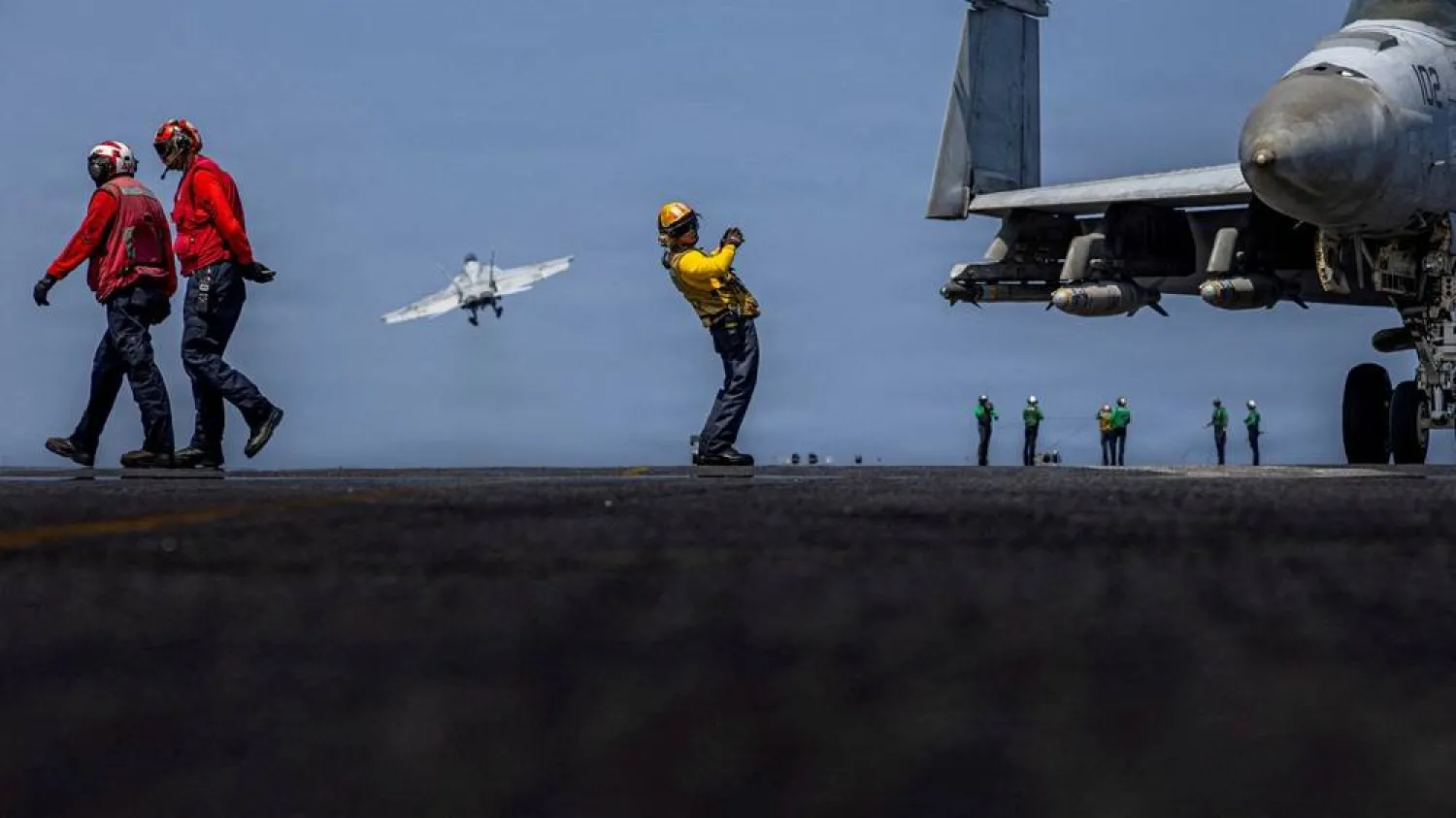
An F/A-18F Super Hornet launches from the flight deck of the US Navy Nimitz-class aircraft carrier USS Abraham Lincoln during the Operation Epic Fury attack on Iran from an undisclosed location March 6, 2026. (US Navy/Handout via Reuters)
TT

US Does ‘Not Need’ Help from Allies on Iran, Trump Says

An F/A-18F Super Hornet launches from the flight deck of the US Navy Nimitz-class aircraft carrier USS Abraham Lincoln during the Operation Epic Fury attack on Iran from an undisclosed location March 6, 2026. (US Navy/Handout via Reuters)

President Donald Trump said Tuesday that US forces "no longer need" military help in the Iran war, after his calls for assistance from allies to reopen the Strait of Hormuz to oil traffic were largely rebuffed.

The American president has spent recent days griping about how world powers have so far declined to send warships to escort tankers through the narrow waterway in and out of the Gulf and key to the transit of crude.

With the war in its third week, Trump has repeatedly stressed that US and Israeli air strikes have decimated Iran's leadership, military facilities, and weapons manufacturing capacity.

"The United States has been informed by most of our NATO 'Allies' that they don't want to get involved with our Military Operation against the Terrorist Regime of Iran, in the Middle East," Trump posted on his Truth Social platform.

"Because of the fact that we have had such Military Success, we no longer 'need,' or desire, the NATO Countries' assistance -- WE NEVER DID! Likewise, Japan, Australia, or South Korea," Trump said, adding: "WE DO NOT NEED THE HELP OF ANYONE!"

Speaking of allies who have rejected his call for assistance, the 79-year-old Republican said he is "not surprised by their action, however, because I always considered NATO, where we spend Hundreds of Billions of Dollars per year protecting these same Countries, to be a one way street."

The US-Israeli war on Iran has expanded dramatically across the Middle East, with Iran targeting the energy facilities of its crude-producing neighbors.

Tehran has also attacked and threatened tankers transiting the Strait of Hormuz, all but closing the vital waterway through which one fifth of global crude oil passes.

French President Emmanuel Macron insisted Tuesday that his country would not participate in operations to open the Strait of Hormuz given the current context of air strikes and other military dangers, but once the situation becomes "calmer" it could participate in an "escort system" alongside other nations.

Britain has also waved off Washington's request for assistance. But Trump on Monday suggested Paris and London would lend a hand to the United States in the operation, and said several other countries -- without naming them -- had responded favorably to his call.



Starmer Tells Zelensky ‘Focus Must Remain on Ukraine’ amid Iran War

 Britain's Prime Minister Keir Starmer meets with Ukrainian President Volodymyr Zelenskyy at 10 Downing Street in London, Tuesday, March 17, 2026.(Suzanne Plunkett, Pool Photo via AP)
Britain's Prime Minister Keir Starmer meets with Ukrainian President Volodymyr Zelenskyy at 10 Downing Street in London, Tuesday, March 17, 2026.(Suzanne Plunkett, Pool Photo via AP)
TT

Starmer Tells Zelensky ‘Focus Must Remain on Ukraine’ amid Iran War

 Britain's Prime Minister Keir Starmer meets with Ukrainian President Volodymyr Zelenskyy at 10 Downing Street in London, Tuesday, March 17, 2026.(Suzanne Plunkett, Pool Photo via AP)
Britain's Prime Minister Keir Starmer meets with Ukrainian President Volodymyr Zelenskyy at 10 Downing Street in London, Tuesday, March 17, 2026.(Suzanne Plunkett, Pool Photo via AP)

UK Prime Minister Keir Starmer told Ukrainian President Volodymyr Zelensky in London on Tuesday that "the focus must remain on Ukraine" despite the US-Israeli war with Iran.

Starmer welcomed Zelensky to his official Downing Street residence for talks after the Ukraine leader met King Charles III at Buckingham Palace.

"I think it's really important that we are clear that the focus must remain on Ukraine," said Starmer.

"There's obviously a conflict in Iran going on, in the Middle East, but we can't lose focus on what's going on in Ukraine and the need for our support," he added.

Washington has partly rolled back sanctions against Moscow to cool oil prices sent soaring by the Middle East war, which appears to have scuttled US-led talks on ending Russia's four-year invasion.

Tuesday's meeting came after Downing Street had earlier announced that Britain and Ukraine are set to sign a defense partnership aimed at addressing the threat of low-cost drones.

Zelensky's visit in London -- ahead of a trip to Spain on Wednesday -- comes as his European allies have vowed to keep up support for Kyiv in the conflict with Russia.

"Our resolve is unbreakable," said Starmer, reiterating the UK's long-standing backing of Ukraine.

Earlier, Zelensky and King Charles shook hands during a private audience at Buckingham Palace.

"I thank His Majesty and the entire Royal Family for their unwavering support and solidarity with Ukraine," Zelensky wrote on X.

The Ukrainian leader was later due to meet NATO chief Mark Rutte in London, his spokesman said.

He was also expected to address members of the UK parliament.


Middle East War Could Trigger ‘Permanent’ Refugee Crisis, Warns Türkiye

Türkiye’s Foreign Minister Hakan Fidan speaks during an interview with The Associated Press, in Ankara, Türkiye, Saturday, March 14, 2026. (AP)
TT

Middle East War Could Trigger ‘Permanent’ Refugee Crisis, Warns Türkiye

Türkiye’s Foreign Minister Hakan Fidan speaks during an interview with The Associated Press, in Ankara, Türkiye, Saturday, March 14, 2026. (AP)

If the Middle East war spreads, it could create a "permanent" refugee crisis, Türkiye’s top diplomat warned Tuesday as Lebanon said Israel's bombardment had displaced over a million people.

"If the war... spreads, there is a possibility this will turn into a permanent refugee crisis with refugees seeking shelter outside the borders of their countries," Foreign Minister Hakan Fidan told a joint news conference with his Canadian counterpart Anita Anand.

"This needs to stop as soon as possible."

Lebanon was dragged into the Middle East war on March 2 when Iran-backed Hezbollah attacked Israel in response to the killing of Iranian supreme leader Ali Khamenei during the US-Israeli strikes on Iran.

Since then, more than one million people have registered as displaced, the Lebanese authorities said on Monday -- representing more than a sixth of its entire population.

The news came as Israel's military said it had launched a limited ground operation against Hezbollah in southern Lebanon.

"The humanitarian situation is deeply concerning in Lebanon and has the potential to worsen if there is a ground offensive there," Anand told the news conference.

Fidan said the war "could lead to permanent damage.. between countries of the region" pointing to the conflict "spreading across Lebanon, and things also becoming much more complicated in Iraq."

He said Türkiye had been "working very hard diplomatically since the outbreak of the war to prevent these crises from escalating", saying he would travel to several countries in the region on Wednesday.

Anand said Canada appreciated Türkiye’s diplomatic efforts and its "role as an interlocutor in the current Middle East conflict" while also expressing its resolute opposition to Iran's "reprehensible" strikes on regional nations.

"Canada absolutely condemns those retaliatory strikes.. Those retaliatory strikes must stop, whether they are in Doha or even against this very country," she said.


45 Million More Face Hunger Threat from Extended Middle East War, Says UN

 A displaced stands by tents, which have plastic sheeting to protect against rain, following an escalation between Hezbollah and Israel, amid the US-Israeli conflict with Iran, in Beirut, Lebanon, March 17, 2026. (Reuters)
A displaced stands by tents, which have plastic sheeting to protect against rain, following an escalation between Hezbollah and Israel, amid the US-Israeli conflict with Iran, in Beirut, Lebanon, March 17, 2026. (Reuters)
TT

45 Million More Face Hunger Threat from Extended Middle East War, Says UN

 A displaced stands by tents, which have plastic sheeting to protect against rain, following an escalation between Hezbollah and Israel, amid the US-Israeli conflict with Iran, in Beirut, Lebanon, March 17, 2026. (Reuters)
A displaced stands by tents, which have plastic sheeting to protect against rain, following an escalation between Hezbollah and Israel, amid the US-Israeli conflict with Iran, in Beirut, Lebanon, March 17, 2026. (Reuters)

An extra 45 million people could face acute hunger if the Middle East war rages on beyond June, swelling the number worldwide to a "terrible" high, the United Nations warned Tuesday.

The war, now in its third week, and its shockwaves on food and fuel costs could price families out of staple foods far beyond the region, the UN's World Food Program said.

"The escalating humanitarian fallout from the conflict in the Middle East is growing more concerning by the day," warned WFP deputy executive director Carl Skau.

"Our analysis projects that if the Middle East conflict continues through June," and oil prices remain above $100 a barrel, "an additional 45 million people could be pushed into acute hunger by price rises," he told a Geneva press conference.

"This would take global hunger levels to an all-time record, and it's a terrible, terrible prospect," he said, with nearly 320 million people -- already a huge number -- currently acutely food insecure.

"Really it is again taking this to a whole other level," said Skau.

"The consequences are falling on the world's most vulnerable people who are already living in dire conditions. They do not have the margins to cope with a new jump in living costs."

Skau called for countries to make more humanitarian resources available.

- 'Stretched to the limit' -

The United States and Israel launched their war on Iran on February 28, with Tehran in turn striking targets in Israel and Gulf nations. Lebanon was drawn into the conflict when Iran-backed Hezbollah attacked Israel.

WFP is providing hot meals and bread to tens of thousands of people in Lebanon and is seeking $77 million for its operations in the country over the next three months.

Skau said the agency was already facing a "perfect storm" before the war erupted.

"Hunger has never been as severe as now," he declared.

The nearly 320 million people in acute food insecurity marks a three-fold increase in five years, driven by extreme weather events, conflict and pockets of famine.

Meanwhile, WFP faced a 40-percent cut in its resources last year, as international funding dried up.

"We are basically stretched to the limit", said Skau, and the Middle East is making WFP's operations "much, much more expensive".

He said WFP's operating costs had surged -- notably through soaring fuel prices and longer supply chain routes -- with shipping costs up 18 percent and trucks running on pricier fuel.

The disruption to fertilizer exports through the Strait of Hormuz comes just as sub-Saharan Africa heads into a planting season and poses a "major risk" to countries like Somalia and Kenya, he said.

"In Somalia we have clear indications that we're heading into a famine: we have two consecutive droughts," he said, but WFP is struggling to assist around 700,000 people in the country and "we just don't have the funding".

The agency has cut life-saving food rations for people in famine conditions in Sudan and is now only able to support one in four acutely malnourished children in Afghanistan, "which is now the world's worst malnutrition crisis", said Skau.

"People are dying in Afghanistan due to the lack of assistance."