


Israel Targets Islamic Jihad Leaders in Iran: What We Know

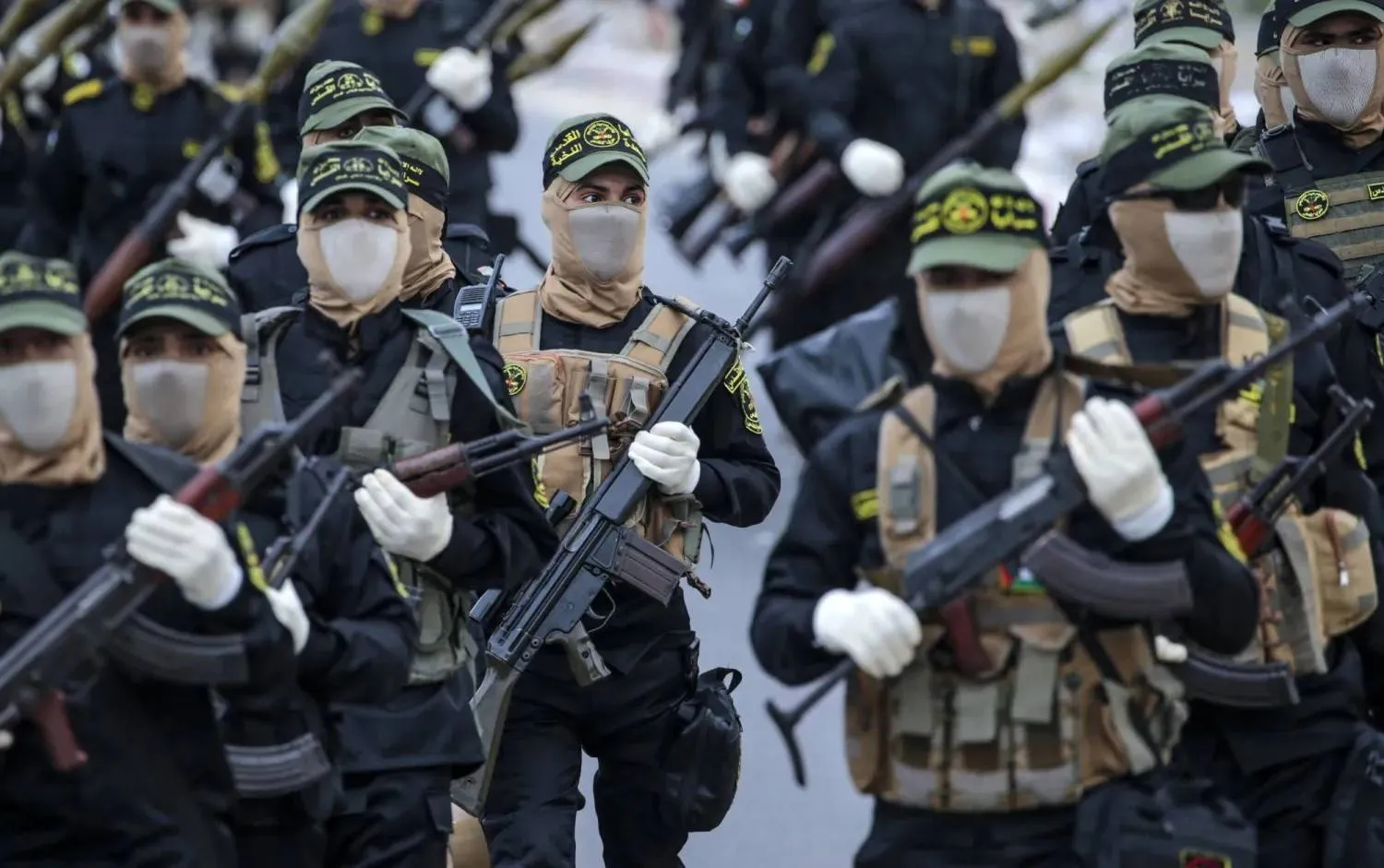
A group of Al-Quds Brigades fighters in Gaza, October 2023 (EPA)
TT

Israel Targets Islamic Jihad Leaders in Iran: What We Know

A group of Al-Quds Brigades fighters in Gaza, October 2023 (EPA)

Israel’s Chief of Staff Eyal Zamir said on Tuesday that Palestinian figures linked to Iran had been killed “inside a safe house they had taken refuge in,” while Israeli military correspondents, citing sources, said the targets were two senior leaders in the Palestinian Islamic Jihad.

The sources identified them as the group’s deputy leader, Mohammad al-Hindi, and the head of its armed wing, the Al-Quds Brigades, Akram al-Ajouri.

Islamic Jihad is the largest faction financially and logistically linked to Iran.

Reports differed on whether both men were targeted or only one of them.

Israel’s Channel 12 said the strike targeted al-Ajouri and several of his aides in the Iranian city of Qom, while Channel 14 reported that al-Hindi was also targeted.

According to Channel 14, the attack, which it said took place four days ago, hit Islamic Jihad leaders in a fortified underground location, with dozens of bombs dropped to ensure the site was destroyed and those inside killed.

Islamic Jihad had not commented on the Israeli reports by midday Tuesday and maintained silence.

However, a source familiar with the group told Asharq Al-Awsat that it was “unlikely that al-Hindi was at the site of the attack or in Iran in general.”

The source said al-Hindi’s movements are kept secret due to repeated targeting attempts, adding that, according to the latest confirmed information within the group’s leadership, he had been in another country, not Iran, days earlier.

Several Islamic Jihad sources said al-Hindi’s visits to Tehran had already been limited even before Oct. 7, 2023, and had declined significantly since then.

Who is Mohammad al-Hindi?

For years, al-Hindi, born in 1955, has been on Israel’s wanted list. Israel attempted to assassinate him several times while he was in Gaza, though such attempts declined after he left the enclave in 2014. He has since been based mainly in Türkiye, traveling to other countries.

Al-Hindi was third in the group’s leadership before Ziyad al-Nakhalah became secretary-general in 2018, following the deterioration of the health of his predecessor Ramadan Shallah, who died in 2020.

Following those changes, al-Hindi became the group’s number two. He is known for his close ties to Hamas and played a key role in improving relations between the two movements. He also built important ties with figures in Türkiye and the Muslim Brotherhood.

Al-Hindi is credited with making the group more open over the past decade to relations with other movements and states, including Qatar, given its role in mediations on the Palestinian cause, as well as building ties with Egyptian officials handling the matter.

Before leaving Gaza, he also supported Egyptian intelligence efforts to contain armed clashes between Fatah and Hamas during the 2006 to 2007 split, leveraging his strong ties with both movements.

Who is Akram al-Ajouri?

Al-Ajouri, believed to be in his sixties, is one of the most influential figures in Islamic Jihad, not only operationally, through his role in arming the Al-Quds Brigades in Gaza, but also through his strong ties with leaders of Hezbollah and, previously, with the government of former Syrian president Bashar al-Assad.

Sources in the group say al-Ajouri is of particular importance to Iran’s Islamic Revolutionary Guards due to his role in executing missions and planning military operations, including weapons transfers to Gaza and other areas, as well as forming multiple militant cells in the West Bank.

He oversees the group’s military portfolio and has long managed its armed wing, including weapons procurement in Gaza and the West Bank, as well as efforts to build up its military presence in Lebanon and Syria.

He has also pushed fighters in both countries to take part in operations launched from Lebanon and to support Hezbollah since Oct. 8, 2023.

Al-Ajouri has survived several assassination attempts, including two in Syria. He escaped one in 2014, while another in 2019 targeted his home, killing his son and others. At the time, estimates suggested he was in Lebanon, where he also survived at least one assassination attempt.

A source in Islamic Jihad said contact with al-Ajouri had been lost since the start of the US-Israeli war against Iran, while another senior source said al-Ajouri had recently communicated electronically with some levels of the group, possibly through intermediaries, adding that “no one knows his location.”

Sources say al-Ajouri had been preparing to leave Lebanon shortly before the war on Iran, but several Arab and Islamic capitals refused to receive him despite efforts by al-Nakhalah. Some countries rejected him due to legal cases filed against him in local courts, while others declined for security reasons. Sources suggested he may be in Iran.

More than a week ago, Israel killed Adham al-Othman, a close associate of al-Ajouri, in a strike on a Hezbollah safe apartment in Beirut’s southern suburbs.



Pakistan and Afghanistan Announce Eid ‘Pause’ in Hostilities

 A part of a drug rehabilitation center destroyed in what the Taliban said was a Pakistani air strike burns, in Kabul, Afghanistan, March 18, 2026. (Reuters)
A part of a drug rehabilitation center destroyed in what the Taliban said was a Pakistani air strike burns, in Kabul, Afghanistan, March 18, 2026. (Reuters)
TT

Pakistan and Afghanistan Announce Eid ‘Pause’ in Hostilities

 A part of a drug rehabilitation center destroyed in what the Taliban said was a Pakistani air strike burns, in Kabul, Afghanistan, March 18, 2026. (Reuters)
A part of a drug rehabilitation center destroyed in what the Taliban said was a Pakistani air strike burns, in Kabul, Afghanistan, March 18, 2026. (Reuters)

Pakistan and Afghanistan on Wednesday announced a halt in fighting during celebrations for the end of Ramadan, after the deadliest strike in their escalating conflict killed hundreds in Kabul earlier this week.

The governments in Islamabad and Kabul said in separate statements that Saudi Arabia, Qatar and Türkiye had requested a pause in fighting over Eid al-Fitr and both agreed.

Cross-border attacks have intensified since last month and Pakistan accuses the Taliban authorities of shielding extremists behind attacks on its territory. Afghanistan denies doing so.

On Monday night, Pakistani jets struck a drug rehabilitation center in the Afghan capital, prompting fresh calls for an immediate end to attacks and talks to end the bloodshed.

Pakistan's information minister, Attaullah Tarar, said the government agreed to a halt to its operations from Thursday to Monday "in good faith and in keeping with the Islamic norms".

Taliban government spokesman Zabiullah Mujahid said defending Afghanistan was "a national and religious obligation" and they would respond to any aggression or threat.

Tarar said: "In case of any cross-border attack, drone attack or any terrorist incident inside Pakistan, (operations) shall immediately resume with renewed intensity."

- Mass funeral -

The Taliban authorities have said that around 400 people were killed and more than 200 wounded in Monday's strike and a mass funeral was held for some of the victims on Wednesday.

Afghan Red Crescent Society volunteers carried dozens of simple wooden coffins from a fleet of ambulances to a mass grave in Kabul, dug in the rocky ground of a rainswept hillside by giant excavators.

At the graveside, Interior Minister Sirajuddin Haqqani said they were innocent victims targeted by "criminals", days before the end of the Muslim holy month.

"We will take revenge," he added and warned those behind Monday night's bombing: "We are not weak and helpless. You will see the consequences of your crimes."

But Haqqani, who until last year had a $10-million US bounty on his head, also suggested that talks were the government's preferred option to halt the fighting.

"We do not want war but the situation has come to this," he said. "So, we are trying to solve the problems through diplomacy."

Interior ministry spokesman Abdul Mateen Qani said the ceremony was for identified victims. Some had been sent back to their home provinces for burial.

Identification of other victims was still ongoing, he added.

Health ministry spokesperson Sharafat Zaman told AFP that 50 coffins had been brought to the Kabul site on Wednesday.

- Identification -

Obtaining immediate independent confirmation of exact death tolls is difficult in Afghanistan and Pakistan, with attacks often in hard-to-reach places and with conflicting information.

AFP journalists at the scene on Monday evening and Tuesday morning saw at least 95 bodies extracted from the rubble at the devastated center.

Jacopo Caridi, the Afghanistan country director for the Norwegian Refugee Council, a humanitarian NGO, said they also had teams on the ground.

"From what we saw and what we discussed with the others involved in the (emergency) response, we can say that there were hundreds of killed and wounded," he told AFP.

Recovery of bodies has proven difficult because of the debris and collapsed structures, and Caridi described the scene as "shocking", which would make identification more difficult.

"I saw a finger in one place, a foot in another place, a hand in one location. It was really horrific," said Caridi.

- Mediation stalled -

Afghanistan and Pakistan have faced calls for an immediate end to the conflict, with the overall civilian death toll mounting and concern about those displaced.

The UN said before Monday's strike that at least 76 Afghan civilians had been killed in the fighting since February 26, and that more than 115,000 people had been forced from their homes.

Mediation efforts, however, have so far proved fruitless.

China has sent a special envoy to mediate and pledged to play a "constructive role in de-escalating tensions".

Russia's special representative for Afghanistan, Zamir Kabulov, said Moscow "will be ready" to help broker talks if both sides request it.

"So far, this has not happened," he told pro-Kremlin outlet Izvestia.


NATO Allies in Talks on 'Best Way' to Re-open Hormuz Strait

FILE PHOTO: A map showing the Strait of Hormuz is seen in this illustration taken June 22, 2025. REUTERS/Dado Ruvic/Illustration/File Photo/File Photo
TT

NATO Allies in Talks on 'Best Way' to Re-open Hormuz Strait

FILE PHOTO: A map showing the Strait of Hormuz is seen in this illustration taken June 22, 2025. REUTERS/Dado Ruvic/Illustration/File Photo/File Photo

NATO chief Mark Rutte said Wednesday that allies of the military alliance were in discussions on the "best way" to open the Strait of Hormuz, through which a large chunk of the world's oil supply normally passes, AFP reported.

"I have been in contact with many allies. We all agree, of course, that strait has to open up again. And what I know is that allies are working together, discussing how to do that, what is the best way to do it," Rutte told a news conference during a visit to a NATO exercise in northern Norway.

US President Donald Trump has urged other global powers to send warships to escort convoys of tankers through the Strait of Hormuz, a vital waterway for the world's oil and liquefied natural gas supplies.


Iran President Confirms 'Assassination' of Intelligence Minister

US and Iran flags are seen in this illustration taken June 18, 2025. REUTERS/Dado Ruvic/Illustration/File Photo
TT

Iran President Confirms 'Assassination' of Intelligence Minister

US and Iran flags are seen in this illustration taken June 18, 2025. REUTERS/Dado Ruvic/Illustration/File Photo

Iran's President Masoud Pezeshkian confirmed on Wednesday that Intelligence Minister Esmail Khatib had been killed in the war with the US and Israel, blasting a "cowardly assassination".

In a post on X, Pezeshkian did not say who had carried out the attack but earlier Israel's defence minister announced that Khatib had been "eliminated, AFP reported.

"The cowardly assassination of my dear colleagues Esmail Khatib, Ali Larijani and Aziz Nasirzadeh, along with some of their family members and accompanying team, has left us in mourning," he said, referring to Iran's recently killed security chief and defense minister.

Israel’s defense minister said Wednesday that the military killed Iranian Intelligence Minister Esmail Khatib. Khatib’s killing follows Israel killing top Iranian security official Ali Larijani and the head of the paramilitary Revolutionary Guard’s all-volunteer Basij force.

Also on Wednesday, Iran launched strikes toward Israel and neighboring Gulf countries, with explosions heard in the United Arab Emirates and Qatar and interceptions reported in Saudi Arabia.