
Iran Attacks Wipe Out 17% of Qatar’s LNG Capacity for Up to Five Years

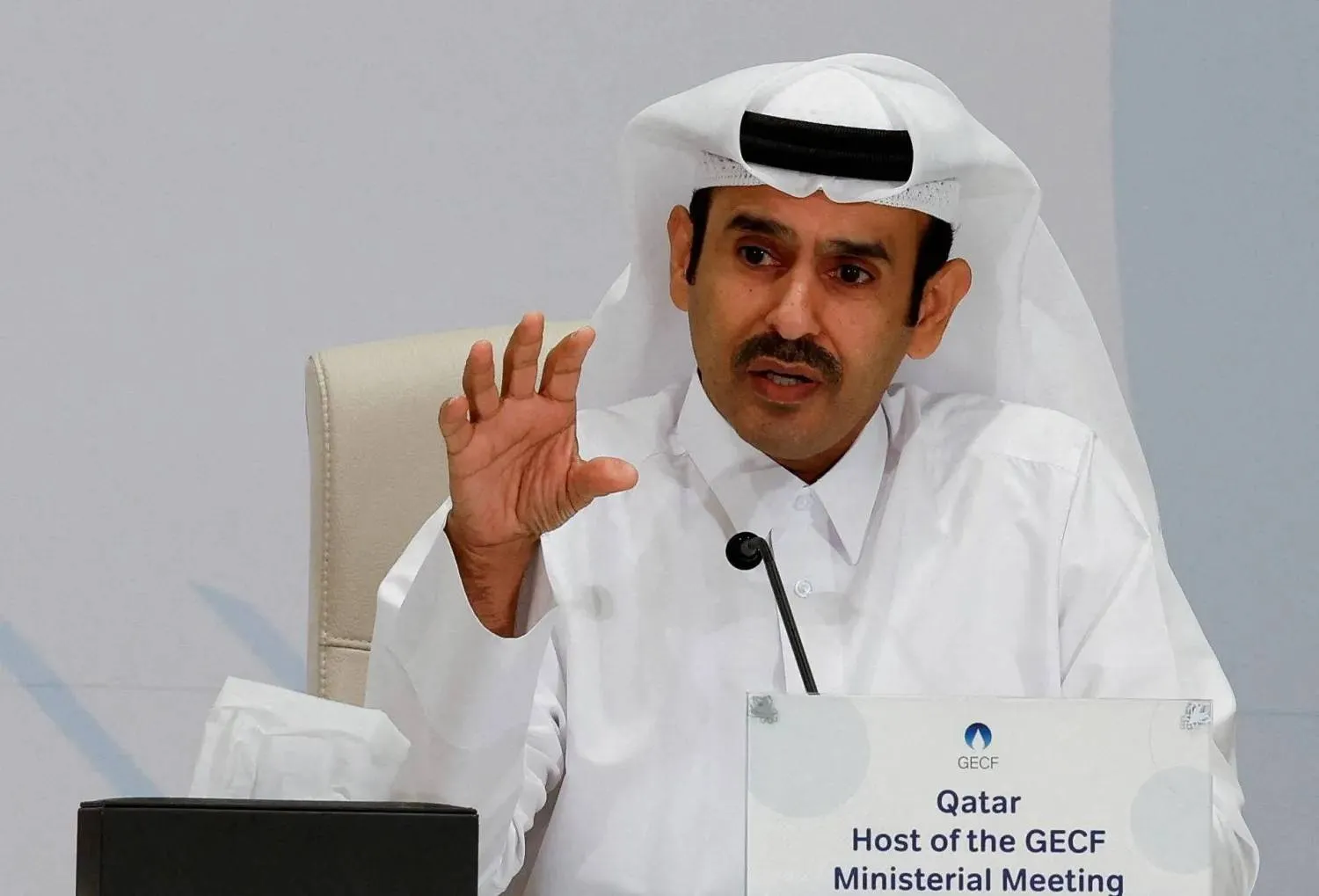
QatarEnergy's CEO and state minister for energy affairs, Saad al-Kaabi (File/Reuters) 
TT

Iran Attacks Wipe Out 17% of Qatar’s LNG Capacity for Up to Five Years

QatarEnergy's CEO and state minister for energy affairs, Saad al-Kaabi (File/Reuters) 

Iranian attacks ‌have knocked out 17% of Qatar's liquefied natural gas (LNG) export capacity, causing an estimated $20 billion in lost annual revenue and threatening supplies to Europe and Asia, QatarEnergy's CEO and state minister for energy affairs told Reuters on Thursday.

Saad al-Kaabi said two of Qatar's 14 LNG trains and one of its two gas-to-liquids (GTL) facilities were damaged in the unprecedented strikes. The repairs will sideline 12.8 million tons per year of LNG for three to five years, he said in an interview.

“I never in my wildest dreams would have thought that Qatar would be - Qatar and the region - ⁠in such an attack, especially from a brotherly Muslim country in the month of Ramadan, attacking us in this way,” Kaabi said.

Hours earlier Iran had aimed a series of attacks at Gulf oil and gas facilities after Israeli attacks on its own gas infrastructure.

State-owned QatarEnergy will have to declare force majeure on long-term contracts for up to five years for LNG supplies bound for Italy, Belgium, South Korea, and China due to the two damaged trains, Kaabi said.

“I mean, these are long-term contracts that we have to declare force majeure. We already declared, but that was a shorter term. Now it's whatever the period is,” he said.

ExxonMobil Impact and Byproducts

QatarEnergy had declared force majeure on its entire output of LNG, after earlier attacks on its Ras Laffan production hub, which came under fire again on Wednesday.

“For production to restart, first we need hostilities to cease,” he said.

US oil major ExxonMobil is a partner in ‌the damaged ⁠LNG facilities, while Shell is a partner in the damaged GTL facility, which will take up to a year to repair.

Texas-based ExxonMobil holds a 34% stake in LNG train S4 and a 30% stake in train S6, Kaabi said.

Train S4 impacts supplies to Italy's Edison and EDFT in Belgium, while Train S6 impacts South Korea's KOGAS, EDFT and Shell in China.

The scale of the damage from the attacks has set the region back 10 to 20 years, he said.

“And of course, this is a safe ⁠haven for a lot of people, to have a safe place to stay and so on. And that image, I think, has been shaken.”

The fallout extends well beyond LNG. Qatar's exports of condensate will drop by around 24%, while liquefied petroleum gas (LPG) will fall 13%. Helium output will fall 14%, and naphtha and sulphur will both drop ⁠by 6%.

Those losses have implications ranging from LPG used in restaurants in India to South Korea's chipmakers which use helium.

The damaged units cost approximately $26 billion to build, Kaabi said.

No work is currently taking place on Qatar's massive North Field expansion project, which could be delayed for more than a year, he ⁠said.

“If Israel attacked Iran, it's between Iran and Israel. It has nothing to do with us and the region,” he said.

“And so now, in addition to that, I'm saying that everybody in the world, whether it's Israel, whether it's the US, whether it's any other country, everybody should stay away from oil and gas facilities.”

The Ras Laffan Industrial City covers an area of 295 sq. km, roughly one-third the size of New York City.

In addition to LNG processing, it also houses other gas-related facilities, including a gas-to-liquids plant, LNG storage facilities, condensate splitting units, and an oil refinery.

In 2025, the Ras Laffan LNG facility accounted for approximately 19% of global LNG exports, according to ship-tracking data compiled by Bloomberg.

Its shipments also represented more than a fifth of total gas consumption in India, Taiwan, and Pakistan, according to Energy Institute data.


IEA Proposes Building Iraq-Türkiye Pipeline to Bypass Hormuz

A general view of oil tanks at Türkiye's Mediterranean port of Ceyhan, February 19, 2014. (Reuters)
TT

IEA Proposes Building Iraq-Türkiye Pipeline to Bypass Hormuz

A general view of oil tanks at Türkiye's Mediterranean port of Ceyhan, February 19, 2014. (Reuters)

International Energy Agency Executive Director Fatih Birol proposed building a new oil pipeline linking Iraq’s Basra oil fields and Türkiye’s Mediterranean oil terminal in Ceyhan to bypass the Strait of Hormuz, according to Turkish newspaper Hürriyet.

“I believe a Basra-Ceyhan pipeline could be extremely attractive and a very important project for both Iraq and Türkiye, as well as for regional supply security, especially from Europe’s perspective,” Birol said in an interview with the newspaper.

“I also believe the financing issue can be overcome. Now is exactly the right time.”

He said, “The vase has been broken once, and it is very difficult to fix,” referring to the Strait of Hormuz.

A new oil pipeline “is a necessity for Iraq and an opportunity for Türkiye. It is also a major opportunity for Europe in terms of supply security. I think this should be considered a strategic project,” Birol added.

The war on Iran has disrupted shipping through the Strait of Hormuz, the strategic choke point through which 20% of the world’s oil supply flows, bringing global economic pain in the form of higher prices for gasoline, fertilizer and other staples.

Iraq and Türkiye share the Kirkuk-Ceyhan pipeline, a strategic corridor for transporting crude oil from northern Iraq to the Turkish port of Ceyhan, which began operation in 1976.

Iraq is seeking to rehabilitate the pipeline to overcome export problems, proposing to establish a new line from Basra to Ceyhan as a safe alternative to the Strait of Hormuz and to boost European energy security. On Sunday, Birol suggested building the new line.


Taiwan Business Group Urges Beijing, Taipei to Keep Politics Out of Trade

A person looks at a stock market graph inside the Taiwan Stock Exchange in Taipei, Taiwan, 20 April 2026. (EPA)
TT

Taiwan Business Group Urges Beijing, Taipei to Keep Politics Out of Trade

A person looks at a stock market graph inside the Taiwan Stock Exchange in Taipei, Taiwan, 20 April 2026. (EPA)

The head of one of Taiwan's top business groups said on Monday both Beijing and Taipei should leave politics out of resuming normal trade and tourism exchanges, after China unveiled new incentives for the island.

China, which views democratically-governed Taiwan as its own territory, announced measures this month which include easing tourism curbs and food imports, but said they had to be based on "opposing Taiwan independence".

China refuses to talk to Taiwan President Lai ‌Ching-te saying he ‌is a "separatist", and has stepped up political and economic ‌pressure ⁠in recent years, ⁠targeting tourism and imports of food, as well as holding regular war drills.

"As soon as there is an opening up, it should be as much as possible be systematic and normalized to maintain the long-term stability of business and trade exchanges," said Paul Hsu, chairman of the General Chamber of Commerce.

Flanked by representatives of the tourist and food sectors, he ⁠urged China to ensure stability in trade ties ‌rather than sudden stops and starts, in ‌comments to reporters in Taipei.

No matter which political party runs a city ‌or county, China should offer equal treatment, especially in southern Taiwan, ‌Hsu added, referring to a stronghold of Lai's Democratic Progressive Party.

China's Taiwan Affairs Office did not immediately respond to a request for comment.

China's new steps came at the end of a visit to Beijing by Taiwan opposition leader Cheng Li-wun, ‌which she described as a journey of peace, on which she met President Xi Jinping.

Taiwan's government should ⁠also "proactively face" China's offers ⁠of opening up, Hsu's group, which represents more than a million companies, said in a statement accompanying the remarks.

Group members' votes would go to whoever was good for Taiwan industry, Hsu said, adding that he was representing non-partisan industry voices.

"As long as you put forth good policies, we will offer support. But if you stand against us, I'm sorry, I can't support you. We have a vote - we are a democratic society."

Taiwan will hold key local elections in November, with the next presidential vote scheduled for early 2028.

On Sunday, Taiwan's China-policy making Mainland Affairs Council said the government would address the "reasonable demands" of industry, but warned it not to "become tools manipulated and exploited by the Chinese communists".


Oil Prices and Stocks Climb as US-Iran Standoff Keeps Strait of Hormuz in Limbo

 Tankers and gas carriers anchored in the Strait of Hormuz, Saturday, April 18, 2026. (AP)
Tankers and gas carriers anchored in the Strait of Hormuz, Saturday, April 18, 2026. (AP)
TT

Oil Prices and Stocks Climb as US-Iran Standoff Keeps Strait of Hormuz in Limbo

 Tankers and gas carriers anchored in the Strait of Hormuz, Saturday, April 18, 2026. (AP)
Tankers and gas carriers anchored in the Strait of Hormuz, Saturday, April 18, 2026. (AP)

Oil prices climbed more than 5% while Asian shares also advanced Monday as a standoff between Iran and the US prevented tankers from using the Strait of Hormuz.

The Gulf waterway was closed again after Iran reversed a decision to reopen the strait and President Donald Trump said a US Navy blockade of Iranian ports remains in effect.

US benchmark crude gained 5.6% to $87.20 a barrel, while Brent crude, the international standard, was up 5.3% at $95.16 a barrel.

Despite renewed doubts about how soon ships will again transport the vast amounts oil the world gets from the Middle East, share prices were mostly higher in Asia.

In Tokyo, the Nikkei 225 gained 1% to 59,045.45, while South Korea's Kospi was up 1.1% at 6,260.92.

Hong Kong's Hang Seng added 0.8% to 26,373.71 and the Shanghai Composite index advanced 0.6% to 4,075.08.

Australia's S&P/ASX 200 was nearly unchanged at 8,943.90.

In Taiwan, the Taiex jumped 1.4%.

“The problem for markets is not the absence of hope; it is the overpricing of it,” Stephen Innes of SPI Asset Management said in a commentary. “The latest move higher in equities has started to feel less like conviction and more like momentum feeding on itself.”

On Friday, oil prices had dropped back to where they were in the early days of the Iran war, and US stocks raced to a fresh record after Iran said the strait was open again for commercial tankers carrying crude from the Gulf to customers worldwide.

A freer flow of oil could relieve pressure on prices for gasoline and all kinds of other products that get moved by vehicles. It could even ultimately help people pay less on credit-card interest and mortgage bills.

The S&P 500 leaped 1.2% to an all-time high of 7,126.06, closing out a third straight week of big gains, its longest streak since Halloween.

The Dow Jones Industrial Average surged 1.8% to 49,447.43. The Nasdaq composite climbed 1.5% to 24,468.48.

The US stock market has jumped more than 12% since hitting a bottom in late March on hopes the United States and Iran can avoid a worst-case scenario for the global economy despite their war.

The price for a barrel of benchmark US crude had plunged 9.4% after Iran’s foreign minister, Abbas Araghchi, posted on X that passage for all commercial vessels through the strait “is declared completely open” as a ceasefire appears to be holding in Lebanon.

Brent crude fell 9.1%.

After Araghchi's announcement, Trump said on his social media network that the US Navy’s blockade of Iranian ports remained “in full force” pending a deal on the war, though he also suggested that “should go very quickly in that most of the points are already negotiated.”

President Donald Trump said Sunday that the US had seized an Iranian-flagged cargo ship that tried to get around a naval blockade. Iran’s joint military command said Tehran would respond soon and called the US seizure an act of piracy.

A fragile, two-week ceasefire between the US and Iran is set to expire Wednesday, while escalating tensions in the Strait of Hormuz raises questions over new talks to end the war.

Since the war began, market sentiment has swung between optimism and gloom over when the fighting will end and what costs the world economy will endure. A strong start to the earnings reporting season for big US companies has helped support stocks.

In other dealings early Monday, the US dollar rose to 158.90 Japanese yen from 158.79 yen. The euro climbed to $1.1757 from $1.1742.