

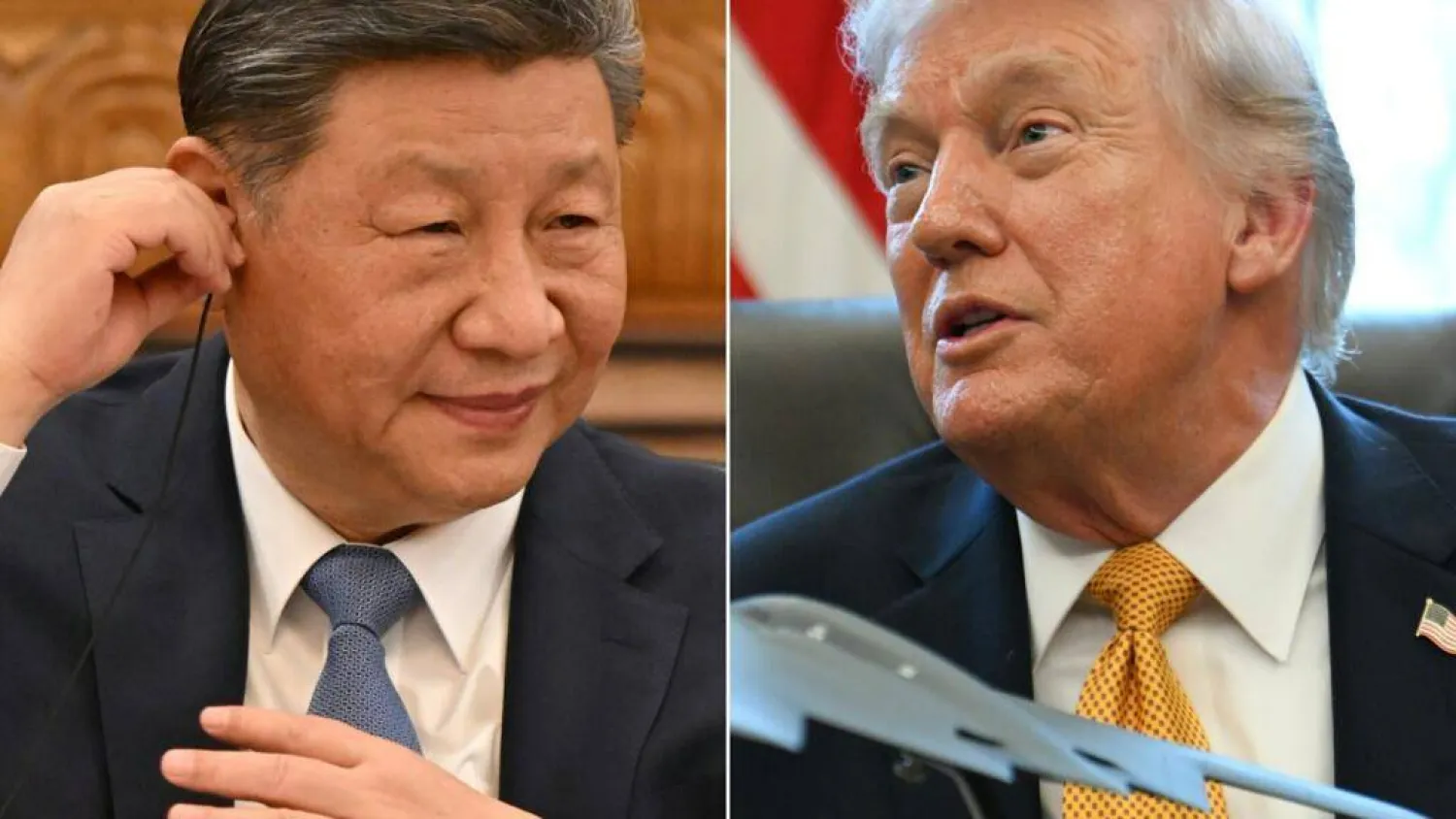

Trump's Mideast Muddle Could Play into Xi's Hands at Planned Summit

US President Donald Trump and China's President Xi Jinping are expected to meet to discuss formalizing a truce on tariffs they shook hands on at a meeting in South Korea in October. ADEK BERRY, ANNABELLE GORDON / AFP
TT

Trump's Mideast Muddle Could Play into Xi's Hands at Planned Summit

US President Donald Trump and China's President Xi Jinping are expected to meet to discuss formalizing a truce on tariffs they shook hands on at a meeting in South Korea in October. ADEK BERRY, ANNABELLE GORDON / AFP

China will be in a stronger position to extract concessions from Donald Trump when the US president finally visits Beijing after becoming entangled in his Middle East war, analysts say.

Trump had been due in the Chinese capital at the end of this month for talks with President Xi Jinping, but has delayed his trip by several weeks to deal with the fallout from the war.

His decision last month to join Israel in strikes on Iran has plunged the Middle East into violence, pushed energy prices to years-long highs and seeded fears of global supply shortages due to Iran's effective closure of the Strait of Hormuz.

With Trump struggling to define how the intervention will end and traditional allies reluctant to back him, the US leader may come to China needing a diplomatic win.

"A show of US force that was meant to intimidate Beijing has instead served to puncture the illusion of US omnipotence," said Ali Wyne, a senior adviser focusing on US-China ties at the International Crisis Group think tank.

"Unable to reopen the Strait of Hormuz alone, Washington now needs its principal strategic competitor to help it manage a crisis of its own making," Wyne said.

Trump said on Tuesday he expects to travel to China in "five or six weeks".

The prospective summit would aim to formalize a truce on tariffs that Trump and Xi shook hands on at a meeting in South Korea in October.

But Trump's weakened position could help Beijing argue for deeper tariff cuts and limit Washington's ability to push for change on other trade issues like access to critical minerals.

New leverage

Top Chinese and American trade officials held what they called "constructive" talks in Paris last weekend that were seen as setting the stage for a Xi-Trump summit.

Any chances of major breakthroughs on trade "seem limited", according to Dan Wang, a director on Eurasia Group's China team, with bilateral trust low after years of disputes over trade, technology and rights.

New US trade investigations into excess industrial capacity in 60 economies including China have also drawn Beijing's ire.

The Chinese leader will benefit from more strategic leverage over Trump as the war drags on -- at least in the near term, analysts told AFP.

Beijing has so far ignored Trump's call for help in reopening the Strait of Hormuz, a vital artery for global oil and gas shipments.

Nor has it relaxed its tight control on exports of rare earths, an industry that China dominates and provides certain critical minerals needed in US weaponry.

US military demand for certain "heavy" rare earths far exceed commercial needs, Jason Bedford, visiting senior research scholar at the National University of Singapore's East Asian Institute, told AFP.

They are used for equipment including drones, jet fighters, missile guidance systems and radar, said Bedford.

While the size of US military stockpiles is a "closely guarded secret", he said, "in theory, (China) could certainly disable new weapons production".

The absence of announcements on Hormuz or rare earths suggests "no concrete results were made during the trade talks" in Paris, said Wang of Eurasia Group.

Xi and Trump "have other chances to meet this year", but "the prospects of getting breakthroughs beyond lower tariffs seem limited", she told AFP.

'Not reliable'

China could also calibrate its actions to make Trump's domestic position shakier at a time when a majority of Americans already oppose military action in the Middle East.

Trump and his negotiators "want China to buy US agricultural products, which is important to the midterm elections for the Republicans", said Wu Xinbo, director of the Center for American Studies at Shanghai's Fudan University.

"If you cannot stabilize relations with China, you have to face some big challenges," Wu said.

Any Xi-Trump summit is unlikely to succeed in changing either side's broader geostrategic aims.

On Thursday, the Trump administration announced that it is considering easing certain sanctions targeting Iranian oil to curb rising prices -- a move experts say could benefit China.

China is believed to be the main buyer of sanctioned Iranian oil, making it Tehran's "main economic lifeline", Henry Tugendhat, a China expert at the Washington Institute for Near East Policy, said at a forum on Wednesday.

Beijing also has "no incentive" to stop selling weapons to Iran as long as the United States continues to provide arms to self-ruled Taiwan, Tugendhat said.

On the streets of Beijing this week, locals were circumspect about a visit from the US president.

"Trump's personality is that he changes every day," a 50-year-old IT worker surnamed Huang told AFP.

"Even if he comes, he may have reached agreements with you, but he will change his mind," he said.

"He is not reliable."

Still, Trump's willingness to come to Beijing is a positive sign for 32-year-old finance worker Yang, who said: "I think the United States still hopes to maintain a positive and friendly attitude towards China."



‘Ending Soon’: Netanyahu Shifts Iran War Goals

 Israeli Prime Minister Benjamin Netanyahu speaks at a press conference (Reuters)
Israeli Prime Minister Benjamin Netanyahu speaks at a press conference (Reuters)
TT

‘Ending Soon’: Netanyahu Shifts Iran War Goals

 Israeli Prime Minister Benjamin Netanyahu speaks at a press conference (Reuters)
Israeli Prime Minister Benjamin Netanyahu speaks at a press conference (Reuters)

Israeli Prime Minister Benjamin Netanyahu is gradually scaling back his sweeping ambition to end the war with Iran by toppling its regime, bringing his rhetoric closer to that of US President Donald Trump.

Netanyahu now speaks of “achieving tremendous gains” through three objectives: curbing Iran’s nuclear program, halting its ballistic missile program, and creating conditions that would allow the Iranian people to take control of their own future.

He acknowledged that overthrowing the Iranian regime from the air is not possible, drawing criticism from Israeli opposition leader Yair Lapid, who accused him of manipulating public sentiment.

Lapid noted that, only weeks ago, Netanyahu had pledged to completely destroy the nuclear project, the missile industry, and the ability to repair damage, topple the regime, and eliminate Lebanon’s Hezbollah.

“The question is not what Iran can do today, but what it will be able to do tomorrow, at the end of the war or in a year,” Lapid wrote in a post on X.

Netanyahu held a press conference late Thursday into Friday, his second since the start of the Israeli-US war on Iran, addressing international audiences in English and Israelis in Hebrew.

His appearance seemed aimed at responding to debate in the United States and its echoes in Israel, particularly accusations that he had drawn Trump into the war and was now pushing to expand and prolong it.

War paradoxes

As Netanyahu spoke of dismantling Iran’s nuclear and missile capabilities, Iranian missiles were falling on Jerusalem, oil refineries in Haifa, as well as Ashdod and the Galilee.

The prevailing impression in Israel is that Netanyahu convened the conference to counter accusations that he had succeeded in drawing Trump into a war with Iran, similar to the 2018 US withdrawal from the nuclear deal.

While Netanyahu may see such accusations as flattering, portraying him as influential in shaping international policy, many in Israel are concerned about their implications for future relations between Tel Aviv and Washington.

Many believe Israel’s critics in Washington, whose numbers are growing and whose rhetoric is sharpening, even within the Republican Party, are using this narrative to fuel hostility toward Israel and antisemitism.

Israel’s strike on Iran’s South Pars gas field and joint Iranian-Qatari energy facilities has also triggered a crisis in Gulf countries, particularly since such an operation could hardly have taken place without US knowledge.

The strike has raised questions about Washington’s conduct and its potentially hostile implications. While the United States denied prior knowledge, semi-official Israeli sources said the attack was carried out in full coordination with the Americans through a joint war command room.

Netanyahu appeared to defend Trump on both issues.

Netanyahu forcefully rejected claims Thursday that he misled President Trump into a potential conflict with Iran, calling the notion “fake news” and insisting the president made his own decisions based on American interests.

“Does anyone really think that someone can tell President Trump what to do? Come on,” Netanyahu said at a press conference on Thursday, adding that Trump “always makes his decisions based on what he thinks is good for America.”

“I misled no one, and I didn’t have to convince President Trump about the need to prevent Iran from developing its nuclear program, putting it underground, and being able to launch nuclear-tipped missiles at the United States. He understood that,” he added.

Addressing American journalists, Netanyahu cast speculation around how Iran would behave if it acquired nuclear weapons after decades of slogans such as ‘Israel is the lesser Satan and America the greater Satan,’ ‘Death to America’ and ‘Death to Israel.’

He then reiterated his accusations against Iran on its overt goal of erasing Western civilization. He said Iran tried to assassinate Trump twice and now it is engaging in blackmail.

On the second issue, Netanyahu said Israel had “acted alone” in striking the South Pars facility before President Trump requested a halt to any further attacks. Netanyahu then said Israel was complying with his request.

His remarks came shortly before Trump confirmed that he had asked the Israeli prime minister not to strike Iran’s energy facilities, and that he agreed.

Who will topple Iran’s regime?

Responding to further questions, Netanyahu said Iran’s Supreme Leader Ali Khamenei, who was killed at the start of the war, had ordered the resumption of missile and nuclear programs and their burial deep underground.

He added that Israel was targeting the industries enabling the production of such programs, rather than remaining missiles.

After 20 days of war, Netanyahu said he can confirm that Iran has no capability to enrich uranium or produce ballistic missiles.

He added that it was “too early to predict” whether the Iranian people would take advantage of the conditions Israel is trying to create and take to the streets, though he expressed hope that they would, stressing that “it is entirely up to them.”

Netanyahu said he sees “cracks” within Iran’s leadership and on the ground, adding that Israel is working to deepen these divisions.

With the war entering its 20th day, Israel is seeking to intensify these fractures, he said, noting that he does not know exactly who is currently leading the country.

Netanyahu said that what Israel is seeing in Iran is significant tension among rivals for power, avoidance of confrontation, and abandonment of responsibility by many officials, as well as chaos in governance and contradictions in decision-making.

Israel will continue efforts to deepen these divisions “as quickly as possible,” not only within the top leadership but also on the ground, he added.


Pregnant Syrian Mum, 5 Kids Die in Container Fire in Türkiye

A crossing at the Syrian-Turkish borders. (AFP)
TT

Pregnant Syrian Mum, 5 Kids Die in Container Fire in Türkiye

A crossing at the Syrian-Turkish borders. (AFP)

A pregnant Syrian woman and her five young children died when a fire ripped through containers housing agricultural workers near the southwestern Antalya resort, the governor and media reports said Friday.

DHA news agency said the 27-year-old mother was seven months pregnant, with her husband fighting for his life after the blaze.

The tragedy occurred as Türkiye began celebrating the three-day Bayram holiday to mark the end of the Muslim fasting month of Ramadan.

Antalya Governor Hulusi Sahin said the fire ripped through several containers where greenhouse workers were living in Kepez district, just north of Antalya.

"Three containers caught fire, and we lost a mother and five children aged between four and nine," he told reporters standing in front of the charred remains of a container and a burned-out car.

Five others were injured in the blaze, one of whom had sustained "life-threatening injuries", he said.

DHA said the fire broke out in the northern Gaziler neighborhood at around 1:30 am (2230 GMT on Thursday), with local leader Suleyman Kaplan saying the victims were from a family of Syrian agricultural workers.

"A fire broke out in the middle of the night in a container where Syrians were staying. Unfortunately, five children and their pregnant mother died. The children's father was also injured and is in intensive care," he told DHA.

Anadolu said four of the injured -- one of whom was a two-year-old -- had the same family names as the victims, while the fifth was the business owner.

Although the cause was not immediately clear, Sahin said it appeared someone had been having a barbecue on a burner outside the containers.

"It seems they went to bed without extinguishing it. But for now, we cannot definitively say that's why it happened," he added.

Investigators were looking into the cause of the blaze and had arrested three people, he said.

Kaplan said he and other neighborhood leaders had repeatedly asked the authorities to set up a fire station in the area.

"As a community, we've asked for a fire engine because the fire station is so far away and it takes the fire brigade too long to arrive," he said.

"We urgently need a fire station."


UK FM Warns Iran against 'Directly' Targeting British Bases

UK and Iran flags are seen in this illustration taken June 18, 2025. REUTERS/Dado
TT

UK FM Warns Iran against 'Directly' Targeting British Bases

UK and Iran flags are seen in this illustration taken June 18, 2025. REUTERS/Dado

Britain's Foreign Minister Yvette Cooper warned her Iranian counterpart in a phone call "against targeting UK bases, territory or interests directly", a foreign office statement said Friday, AFP reported.

The statement was response to one issued by Iran's foreign ministry in which it said Foreign Minister Abbas Araghchi told Cooper in the call on Thursday that any US use of British bases would be seen as "participation in aggression" against the Islamic republic.

Cooper told Araghchi "the defensive UK operations in the region were a response to the Iranian aggression against Gulf partners", the UK foreign office said, adding: "She made clear that the UK wants to see a swift resolution to this conflict."