


Spain to Spend 5 bn Euros to Ease Middle East War Fallout

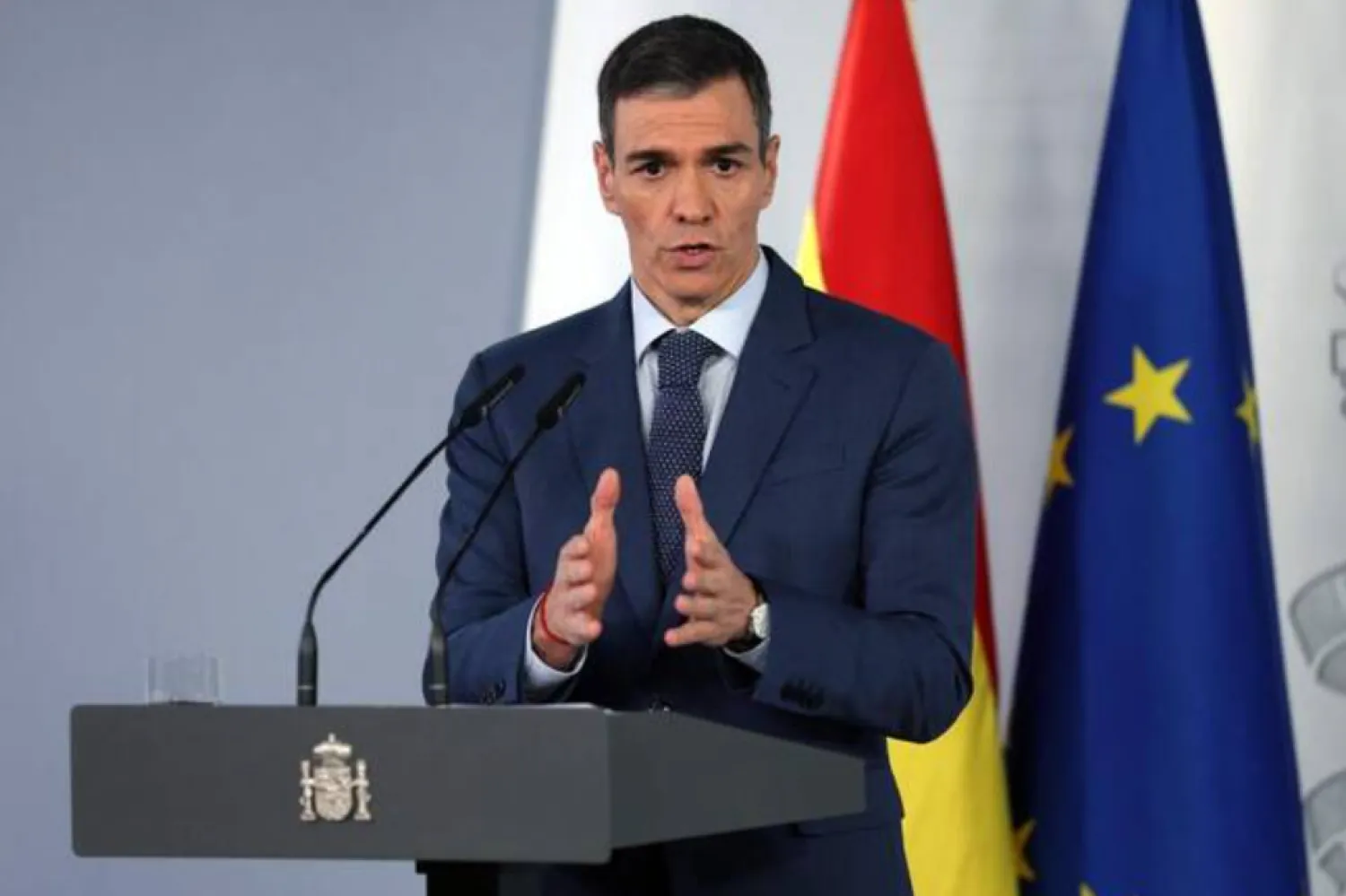
Spain’s Prime Minister Pedro Sanchez gives a press conference following an extraordinary cabinet meeting about the energy crisis, at the Moncloa Palace in Madrid on Mar. 20, 2026 via AFP
TT

Spain to Spend 5 bn Euros to Ease Middle East War Fallout

Spain’s Prime Minister Pedro Sanchez gives a press conference following an extraordinary cabinet meeting about the energy crisis, at the Moncloa Palace in Madrid on Mar. 20, 2026 via AFP

Spanish Prime Minister Pedro Sanchez announced Friday a sweeping package worth five billion euros ($5.8 billion) aimed at cushioning the economic impact of the Middle East war, including a "drastic reduction" in energy-related taxes.

Speaking after an emergency cabinet meeting, the Socialist leader said the 80-measure package was necessary to shield households and key sectors from surging costs.

"Extraordinary situations require extraordinary responses," Sanchez said, calling it the "largest social and economic shield" being implemented in the European Union.

"Clearly, these measures will not prevent the effects of this illegal war from reaching Spain, but they will at least mitigate their impact and make them somewhat more bearable."

The package, set to take effect Saturday following publication in the official gazette, includes cuts to value-added tax on gas and fuel expected to reduce pump prices by as much as 30 euro cents per litre, or roughly 20 euros per tank for the average car.

Sanchez also said the government would cap the maximum price of butane and propane.

The government will also slash electricity taxes by 60 percent, suspend a production tax and reduce the value-added tax on electricity to 10 percent from 21 percent.

Additional support includes a direct subsidy of 0.20 euros per litre of fuel for transport operators, farmers, ranchers and fishermen, along with equivalent aid for fertilizer purchases.

Sanchez also announced a decree introducing a "temporary freeze" on rents in Spain, which like other European nations is grappling with a housing crisis as rents skyrocket.

This measure still requires approval from parliament, where the government lacks a majority.

It was included under pressure from Sanchez's junior coalition partners, the far-left Sumar party.

"I am extremely angry about the situation the world is in, which certain decisions and governments are pushing us into," Sanchez said, repeating his opposition to the war being waged by the United States and Israel against Iran.

"Spaniards will have to bear a cost of five billion euros -- money that could have been spent on scholarships, healthcare or social services."

Sanchez defiantly refused to let US troops use its bases to attack Iran at the start of the conflict, a move that drew sharp criticism from US President Donald Trump.

He said Spain was the "best prepared" country to face the crisis thanks to its higher reliance on renewable energy.

Renewable power makes up around 55 percent of Spain's energy mix, while the country imports most of its crude oil from the Americas and Africa.

The EU's fourth-largest economy has in recent years registered growth rates far higher than its peers, notably thanks to domestic consumption, tourism and exports.



Riyadh Air Adds Malaga, Kuala Lumpur to International Network

Riyadh Air Adds Malaga, Kuala Lumpur to International Network
TT

Riyadh Air Adds Malaga, Kuala Lumpur to International Network

Riyadh Air Adds Malaga, Kuala Lumpur to International Network

Riyadh Air, Saudi Arabia's new national carrier and a subsidiary of the Public Investment Fund, announced on Tuesday the addition of two new destinations to its growing network, launching ticket sales for flights linking Riyadh with Malaga and Kuala Lumpur.

With the addition of the two destinations, the new national carrier is preparing to operate flights to eight destinations from Riyadh by August. The network will include London, Cairo, Dubai, Jeddah, Madrid, Manchester, Malaga, and Kuala Lumpur, as the airline prepares to receive its sixth aircraft.

Riyadh Air offers passengers a range of options combining seasonal tourism and year-round services. The airline will launch seasonal nonstop flights to Malaga, Spain, from July 14 through September 8.

Three days later, on July 17, it will inaugurate its nonstop route between Riyadh and Madrid.

The Madrid route holds strategic importance for both business and tourism sectors, in addition to its sporting significance, as it links the two capitals and enhances the partnership with Atletico Madrid and its Riyadh Air Metropolitano Stadium.

Meanwhile, passengers heading to Asia will benefit from year-round scheduled flights to Kuala Lumpur, Malaysia, beginning July 30.

Passengers can book tickets through the Riyadh Air mobile application, the airline's official website, or authorized travel partners.


Cyprus, Energy Giants Declare Gas Fields Commercially Viable

Representatives of ExxonMobil and QatarEnergy sign an agreement with Cyprus declaring gas in two offshore fields marketable, paving the way for further development of offshore gas reserves in the eastern Mediterranean, at the Presidential Palace in Nicosia, Cyprus June 30, 2026. (Reuters)
TT

Cyprus, Energy Giants Declare Gas Fields Commercially Viable

Representatives of ExxonMobil and QatarEnergy sign an agreement with Cyprus declaring gas in two offshore fields marketable, paving the way for further development of offshore gas reserves in the eastern Mediterranean, at the Presidential Palace in Nicosia, Cyprus June 30, 2026. (Reuters)

Cyprus, ExxonMobil and QatarEnergy on Tuesday declared natural gas fields discovered off the Mediterranean island nation to be commercially viable, with a 2033 target for production to commence.

The declaration of commercial discovery, signed in Nicosia, moves the Glaucus and Pegasus gas discoveries from the exploration phase to project development, strengthening Cyprus's ambitions to become an eastern Mediterranean energy hub.

"This has been the culmination of eight years of work since we were awarded the blocks in 2017, discovery in 2019, second discovery last year," John Ardill, ExxonMobil's vice president for exploration and new ventures, said.

"This declaration of commerciality takes us from looking for energy to developing energy," Ardill said. "It is a very historic point."

Cypriot President Nikos Christodoulides described the agreement as "a milestone of strategic importance".

Ardill said the company expected to take a final investment decision in 2029, with production starting in 2033.

He added that ExxonMobil would resume drilling later this year as part of the Pegasus appraisal program, while expanding exploration into Blocks 4 and 10A of the Cypriot exclusive economic zone (EEZ).

"The concept of a European energy hub is realized when the molecules start flowing, and that's what we are here to initiate today," Ardill said.

Ardill said the leading development option is a subsea pipeline linking the Cypriot fields to existing liquefied natural gas infrastructure in Egypt, pointing to established bilateral agreements and infrastructure.

An onshore LNG terminal in Cyprus would require substantially larger gas reserves than those identified so far.

Tuesday's declaration follows years of appraisal drilling and technical studies confirming the fields are commercially exploitable.

Energy Minister Michael Damianos said Cyprus expected to launch a new offshore licensing round within the next two years.

The island nation has sought to position its offshore gas as a strategic source of energy security for Europe following Russia's invasion of Ukraine.

It has been 15 years since Nicosia's first commercial natural gas find, dubbed the Aphrodite field.

Cyprus has delineated its EEZ into 13 offshore exploration blocks licensed to international energy companies, including ExxonMobil, QatarEnergy, Eni, TotalEnergies and Chevron.


Iraq's SOMO Offers Big Discounts for Term Basrah Oil in July

FILE PHOTO: A gas flare burns in the distance at the Rumaila oil field, amid nationwide output cuts following the closure of the Strait of Hormuz, in Basra, Iraq, March 4, 2026. REUTERS/Essam Al-Sudani/File Photo
TT

Iraq's SOMO Offers Big Discounts for Term Basrah Oil in July

FILE PHOTO: A gas flare burns in the distance at the Rumaila oil field, amid nationwide output cuts following the closure of the Strait of Hormuz, in Basra, Iraq, March 4, 2026. REUTERS/Essam Al-Sudani/File Photo

Iraq's SOMO has offered wide discounts to its official selling prices to encourage term buyers to lift Basrah crude from its terminal inside the Middle East Gulf in July, according to trade sources and a document reviewed by Reuters.

The discounts for Basrah Medium crude ranged from $14 to $16 a barrel while those for Basrah Heavy crude were between $16.80 and $18.80 a barrel, depending on the loading period. Discounts are wider for cargoes ⁠loading between July 1 ⁠and 5 and they become narrower for cargoes loading July 6-10 and July 11-31.

Buyers are requested to submit their nominations for quantity within a day from receiving the letter, Reuters quoted SOMO as saying.

The discounts are meant as compensation for buyers who have to pay high chartering ⁠costs for ships to enter the Strait of Hormuz to fetch the oil, a trade source said.

The daily time charter rate for a Very Large Crude Carrier to load 2 million barrels of crude from the Middle East to China has climbed to about $300,000 from about $220,000 on February 27, before the US and Israel launched strikes on Iran, but has dropped from a peak of about $600,000 in March, LSEG data shows.

The wide discounts for ⁠Basrah ⁠crude may entice buyers, but the question remains if the Strait of Hormuz is passable, two other people said.

Last week, SOMO issued a tender to sell July-loading crude but it failed to attract buying interest as traders had difficulties in booking tankers to enter the Gulf, another source said.

Other Middle East producers are pushing ahead with oil loadings, but shipping in the strait has slowed following fresh ship attacks and renewed strikes between the US and Iran in recent days.