

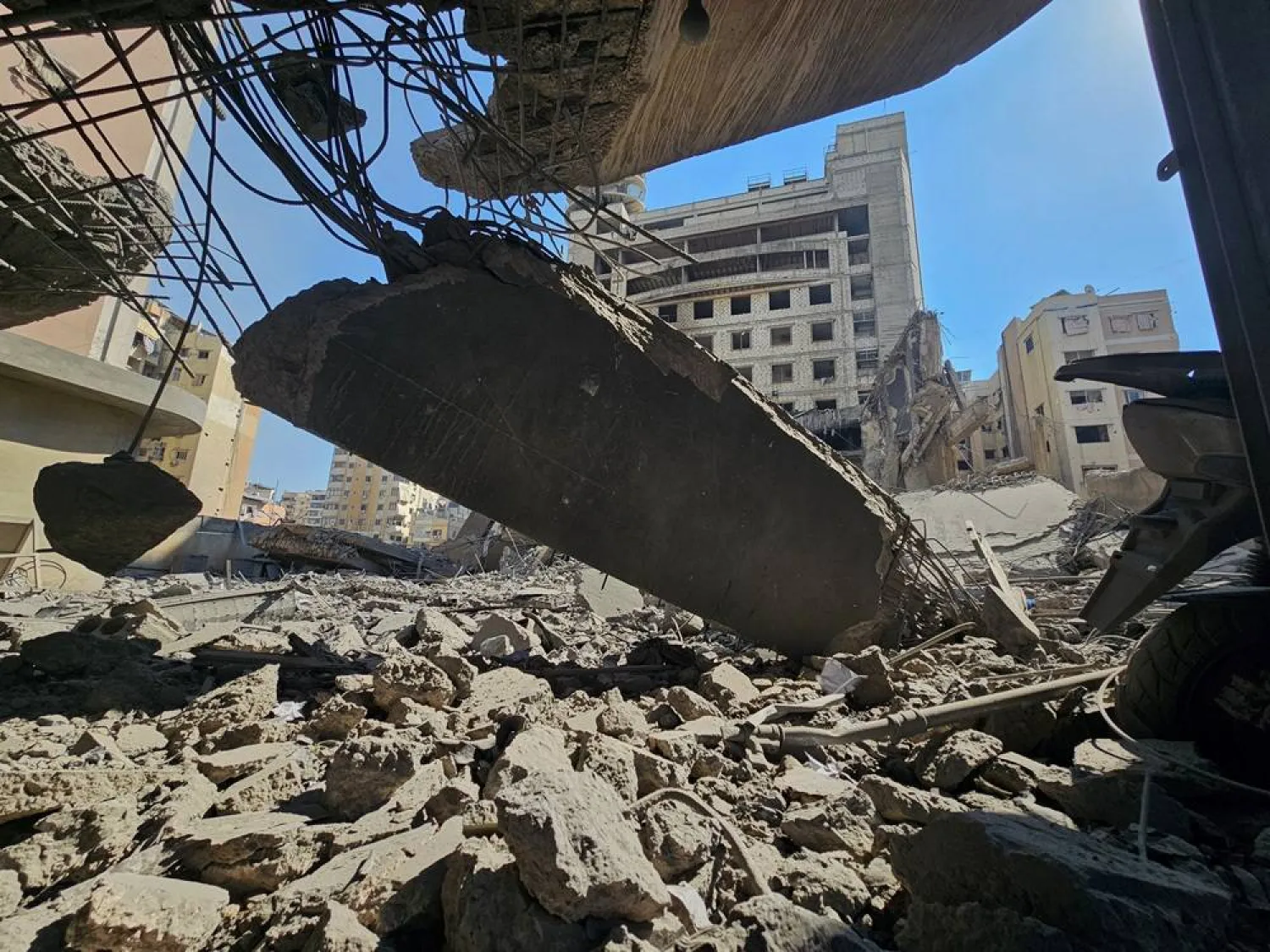

Israel Says Targeting Hezbollah in Beirut as South Lebanon Struck

Debris cover the site of Hezbollah's Al-Manar TV headquarters after it was hit in an Israeli airstrike on Dahieh, a southern suburb of Beirut, Lebanon, Tuesday, March 3, 2026. (AP)
TT

Israel Says Targeting Hezbollah in Beirut as South Lebanon Struck

Debris cover the site of Hezbollah's Al-Manar TV headquarters after it was hit in an Israeli airstrike on Dahieh, a southern suburb of Beirut, Lebanon, Tuesday, March 3, 2026. (AP)

The Israeli military said it launched a wave of strikes on Beirut claiming to target the Iran-backed group Hezbollah early Saturday, while Lebanese state media reported strikes in the country's south.

Lebanon was pulled into the Middle East war when Hezbollah began firing rockets into Israel on March 2 to avenge the killing of Iran's supreme leader Ali Khamenei.

Israel has since launched strikes across Lebanon and sent ground troops into the country's south.

In a brief statement on Saturday, the Israeli military said its forces were "currently striking Hezbollah terrorist organization targets in Beirut".

A military spokesman earlier issued a warning to residents of Beirut's southern suburbs, a Hezbollah stronghold, to evacuate ahead of strikes.

Lebanon's official National News Agency (NNA) reported strikes on two neighborhoods in the area, without immediately saying what had been hit or whether there were any casualties.

In southern Lebanon, close to the border, the NNA said an Israeli airstrike hit a house in the town of Ghandouriyeh, killing at least one person and wounding two others.

The agency reported more strikes overnight and in the early morning on several areas of southern Lebanon, as well as an "extensive combing operation" carried out by Israeli troops in the area of Khiam town.

Hezbollah also said its fighters had targeted Israeli troops in six villages in southern Lebanon.

The group said it had also launched rockets across the border, where air raid sirens were activated, according to the Israeli military's Home Front Command.

The US ambassador to Lebanon, Michel Issa, gave his backing on Friday to a truce initiative proposed by Lebanese President Joseph Aoun, telling reporters that "matters are not resolved without talking".

He said, however, he believed Israel "has decided not to stop" striking Lebanon yet.

"That means Lebanon has to decide whether it can meet the Israelis in this case," the ambassador added.

Lebanon's health ministry says the war has killed more than 1,000 people in Lebanon and displaced more than one million more.

Two Israeli soldiers have been killed in southern Lebanon, according to the military.


Libya, US Hold Talks on Money Laundering, Terror Financing

Libya central bank governor (left) with US assistant secretary of state (central bank)
TT

Libya, US Hold Talks on Money Laundering, Terror Financing

Libya central bank governor (left) with US assistant secretary of state (central bank)

Anti-money laundering measures dominated talks in Washington between governor of the Central Bank of Libya Naji Issa and US officials, as prosecutors pursue corruption cases.

The central bank said Issa outlined efforts to strengthen anti-money laundering and counterterrorism financing systems, expand electronic payments, and introduce unconventional monetary tools in line with international standards, steps it said have boosted confidence among global financial institutions.

Late on Wednesday, the bank said Issa and his delegation met several officials, including Robert B. Thomson, Visa's vice chairman, in talks aimed at expanding electronic payment services and advancing financial inclusion in Libya, while tightening oversight of financial transactions in line with international standards.

Libya ranks among the world’s five most corrupt countries, according to recent estimates by Transparency International. The country fell to 177th out of 182 states in the 2025 Corruption Perceptions Index.

The central bank said Issa also attended a meeting of finance ministers and central bank governors from the Middle East, North Africa and Pakistan group, MENAP, with IMF Managing Director Kristalina Georgieva, on the sidelines of the 2026 Spring Meetings of the IMF and World Bank in Washington.

Discussions focused on slowing global growth, inflationary pressures, and challenges tied to commodity and energy prices.

The bank added that it received an official invitation from the US State Department and held a high-level meeting in Washington with Kyle Liston, a US State Department official. It quoted him as praising the governor and the bank’s board, calling their efforts “a model to be emulated in financial management despite compelling circumstances.”

Separately, Libya’s Anti-Financial Crimes, Money Laundering and Terrorism Financing Agency said it dismantled a local network and arrested five bank employees over embezzlement and manipulation of a customer account.

Investigators said the suspects abused their positions to load international cards with $12,000 and carry out transfers worth 63,000 dinars without the account holder’s knowledge, placing his name on suspicion lists. The official exchange rate is 6.33 dinars to the dollar.

The public prosecutor said electronic tracking and financial analysis linked the case to a wider network that used data from more than 200,000 people in an organized money-laundering scheme. The suspects were referred to the anti-corruption prosecution, and authorities said strict oversight would be enforced to protect the economy.

In a related ruling, the Tripoli Court of Appeal sentenced a former director of international marketing at the National Oil Corporation to 10 years in prison, fined him more than $1.825 billion, and permanently stripped him of his civil rights, after convicting him of serious violations in oil marketing and fuel supply.

The attorney general’s office said the case stems from charges that the official failed to collect payments for crude oil and petroleum products sold between 2010 and 2017, and approved contracts in 2013 to supply gasoline that did not meet Libyan standards.


Tension, Veiled Threats Mark al-Hayya’s Meeting with US Official in Cairo

People mourn next to the bodies of Palestinian brothers Abdel Malek and Abdel Sattar Al-Attar, who were killed in an Israeli strike, according to medics, during their funeral, at Al-Shifa Hospital in Gaza City, April 16, 2026. REUTERS/Dawoud Abu Alkas
TT

Tension, Veiled Threats Mark al-Hayya’s Meeting with US Official in Cairo

People mourn next to the bodies of Palestinian brothers Abdel Malek and Abdel Sattar Al-Attar, who were killed in an Israeli strike, according to medics, during their funeral, at Al-Shifa Hospital in Gaza City, April 16, 2026. REUTERS/Dawoud Abu Alkas

Cairo is seeing renewed diplomatic momentum on Gaza, with mediators working to narrow gaps between Hamas and Israel, alongside the United States and Nickolay Mladenov, the high representative for Gaza at the Board of Peace.

A meeting in Cairo on Tuesday brought together Hamas chief negotiator Khalil al-Hayya and US diplomat Aryeh Lightstone, now a senior adviser to the Board of Peace.

A Hamas source said the meeting was not pre-arranged. It was meant to include only al-Hayya and Mladenov before Lightstone joined unexpectedly, along with US General Jasper Jeffers, who left shortly after. Egyptian mediators pushed for the talks.

The meeting was the first between Hamas and a US official since the Gaza ceasefire took effect on Oct. 10, 2025.

Negotiations remain stalled. Hamas and other factions insist Israel must first meet its first-phase commitments, especially humanitarian measures and aid entry, before any further steps. Israel and the United States are pressing for an immediate shift to phase two, centered on disarmament.

Sources said mediators are trying to break the deadlock with a parallel approach, completing the remaining first-phase steps while opening talks on the second, with implementation tied to Israel’s full compliance. One source said proposals call for gradual, conditional progress on disarmament.

Tense exchanges

Four Hamas sources and one from another Palestinian faction said the meeting was tense at times.

A senior Hamas source said the US official used strong language, accusing Hamas of delaying disarmament and demanding a full handover of weapons within 24 hours.

The source said al-Hayya praised US President Donald Trump's efforts to halt the war but did not respond directly. Some Hamas delegates left Cairo for consultations, while al-Hayya stayed at Egypt’s request to review a revised mediation proposal.

Sources said both Mladenov and the US side sought a fully signed commitment from Hamas and Gaza factions to disarm under a Board of Peace plan, before completing the humanitarian phase, and without clear timelines or guarantees for Israel.

Hamas conditions

Hamas and allied factions outlined five key demands.

They called for full implementation of phase one as a test of Israel’s intent. They also demanded that Gaza’s administrative committee be allowed to operate and meet urgent civilian needs.

They urged the dismantling of armed groups set up by Israel. They also called for the deployment of international forces east of the “yellow line” to replace Israeli troops, with a timetable for withdrawal to Gaza’s eastern border.

They further demanded the launch of a comprehensive political process on the Palestinian issue.

A Hamas official said the 90-minute meeting was generally positive but failed to bridge gaps. He cited periods of tension and what he described as implicit threats from Lightstone and Mladenov of a return to war if factions refused to fully disarm.

He said the two officials conveyed what they described as Israeli approval to meet first-phase commitments, including curbing violations and expanding aid, but only if disarmament came first, a condition al-Hayya rejected.

No breakthrough

Sources said talks are at a standstill, with no clear progress, as Israel ties first-phase implementation to disarmament.

Three Hamas sources abroad, including one in Cairo, said the delegation remains firm, and Israel must fully implement phase one before any move to phase two.

They said Mladenov recently returned from Israel with assurances that it would improve humanitarian conditions and honor phase one if Hamas agreed to disarm. One source said the approach seeks to sidestep Israel’s obligations.

The sources pointed to unfulfilled promises to restore crossings to pre-war levels after the Iran war, which began in late February. Aid deliveries fluctuated this week.

About 323 trucks entered on Monday, falling to around 280 the next day and dropping further on Wednesday, despite mediator assurances that crossings would improve to about 600 trucks daily, as outlined in the ceasefire.

One source said Israel, the United States, and the Board of Peace, represented by Mladenov, are trying to link disarmament only to aid entry, without commitments on reconstruction or other obligations.


Trump Says Israel, Lebanon Agree to 10-day Ceasefire

This photograph taken from the southern Lebanese area of Marjeyoun shows smoke rising from the site of an Israeli strike that targeted the village of Kfar Tibnit on April 16, 2026. (Photo by AFP)
TT

Trump Says Israel, Lebanon Agree to 10-day Ceasefire

This photograph taken from the southern Lebanese area of Marjeyoun shows smoke rising from the site of an Israeli strike that targeted the village of Kfar Tibnit on April 16, 2026. (Photo by AFP)

US President Donald Trump announced that Israel and Lebanon have agreed to a 10-day ceasefire starting on Thursday.

Trump said the truce followed "excellent" conversations with Israeli Prime Minister Benjamin Netanyahu and Lebanese President Joseph Aoun, taking place two days after Israel and Lebanon held peace talks in Washington.

"These two Leaders have agreed that in order to achieve PEACE between their Countries, they will formally begin a 10 Day CEASEFIRE at 5 P.M. EST," Trump said on his Truth Social network.

Trump said he had directed US Vice President JD Vance, Secretary of State Marco Rubio, and top US military officer Dan Caine to work with the two countries "to achieve a Lasting PEACE."

"It has been my Honor to solve 9 Wars across the World, and this will be my 10th, so let's, GET IT DONE!" said Trump, who launched the war on Iran alongside Israel on February 28.

Hezbollah then pulled Lebanon into the Middle East war, firing rockets at Israel in support of its backer Tehran.

Since then, Israeli strikes on Lebanon have killed more than 2,000 people and displaced more than one million, and Israeli ground forces have invaded the country's south.

Trump said late Wednesday that Aoun and Netanyahu were due to speak on Thursday, but the Lebanese president rejected the US request for the direct phone call with the Israeli PM, an official source told AFP.
