


Matisse’s Last Years Cut Out -- But Not Pasted -- At Paris Expo

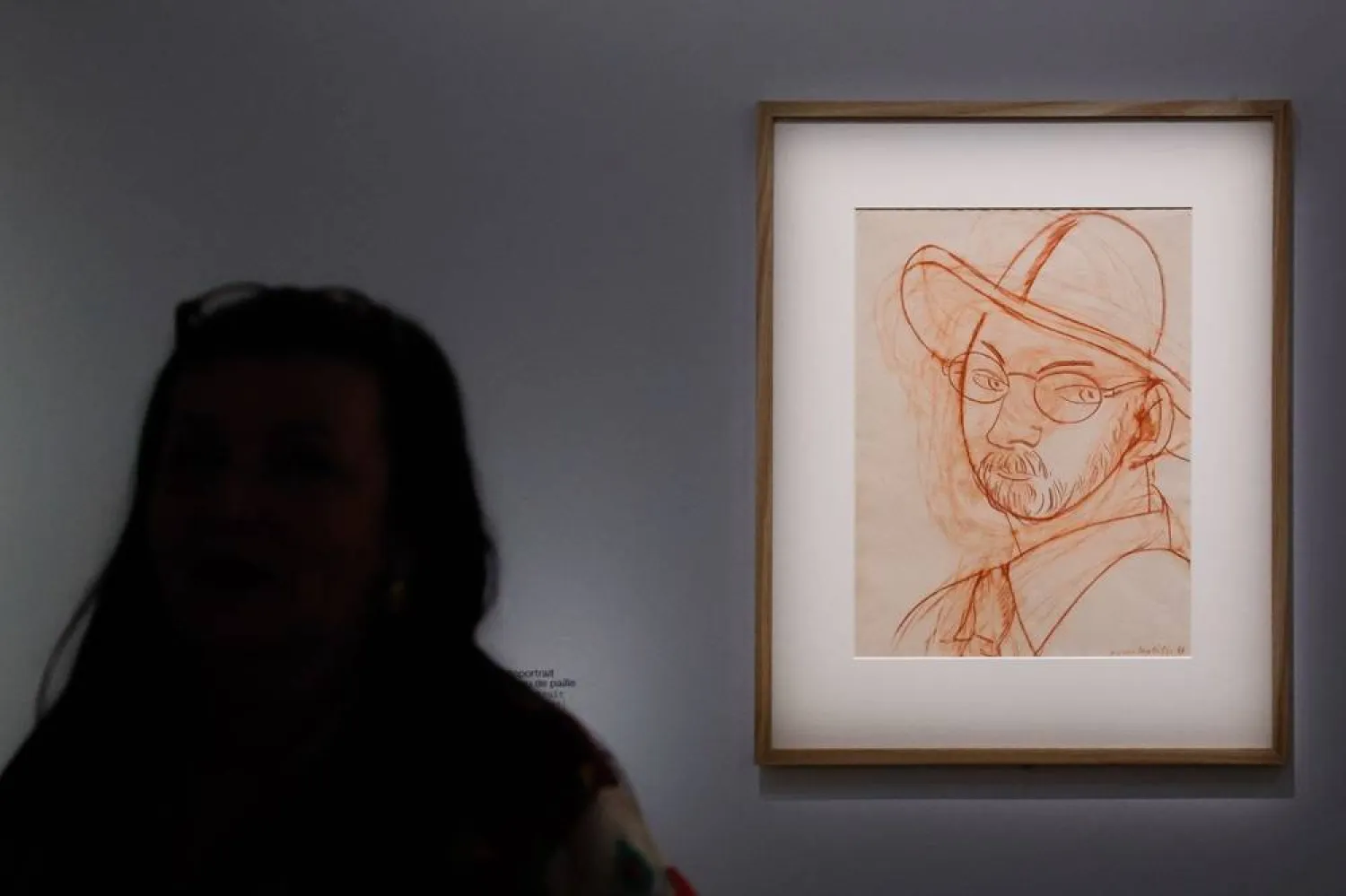
Artwork entitled "Autoportrait au chapeau de paille" by French artist Henri Matisse on display during the exhibition "Matisse 1941-1954" at the Grand Palais in Paris, France, 19 March 2026. (EPA)
TT

Matisse’s Last Years Cut Out -- But Not Pasted -- At Paris Expo

Artwork entitled "Autoportrait au chapeau de paille" by French artist Henri Matisse on display during the exhibition "Matisse 1941-1954" at the Grand Palais in Paris, France, 19 March 2026. (EPA)

The final years of Henri Matisse's artistic life, marked by the Nazi occupation of France and a brush with death and surgery, will light up a twilight retrospective opening next week.

From Tuesday, the Grand Palais in Paris will see a reunion of seminal series by the late French master, such as "Blue Nudes", "Jazz" or the monumental "La Gerbe" (The Sheaf), revealing the ageing painter's prolific work ethic despite his health woes.

The exhibition brings together 320 works, from media as varied as paintings, sketches, gouache cut-outs, textiles and stained glass, all drafted by the artist in the run-up to his death in 1954 at the age of 84.

Titled "Matisse 1941-1954", it chronicles a time when the Nazis considered Matisse a "degenerate" artist, during which he confessed to a friend that he came within a "whisker of death" after going under the surgeon's knife in 1941.

"At that time, he was therefore an elderly man, partially disabled and struggling to stand upright," said Claudine Grammont, the curator of the exhibition and a former director of the Matisse Museum in Nice.

Yet despite those woes, Matisse was about to embark on "the most prolific moment of his career", Grammont added.

"It's truly his apotheosis, meaning that the artist reaches a state of nonchalance, of detachment... in short, a moment of grace."

Grammont, who also heads the graphic art department at the French capital's famed Pompidou museum, bristles at the long-standing accusation that Matisse abandoned the art of painting for cut-outs in his old age.

"It has often been said, wrongly, that during this period Matisse stopped painting and did nothing but cut-out gouaches.

"Well, no: Matisse painted 75 paintings between 1941 and 1954."

Nonetheless, Matisse's supposed dotage was marked by an outbreak of inspiration.

"In 1950 alone, 40 works were produced. That's a lot for an 80-year-old man," Grammont said.

- 'Intimacy' -

Visitors will have until July 26 to catch the late Matisse's essential works, including the best part of his ornamentation for the Vence Chapel in southeastern France and its dozen paintings.

It also brings together four of his now-ubiquitous "Blue Nudes", which have become a modern cultural touchstone, visible on tourist-shop T-shirts and the walls of student bedsits alike, even despite criticism of the artist's supposed colonialism from his time in Tahiti.

Matisse would often work on pieces such as 1953's "La Gerbe", with its splash of vividly colored spiky cut-outs, at night, "because he was an insomniac", Grammont said.

For the curator, Matisse significantly altered his method in his final years, developing "a new iconographic vocabulary" through the cut-out to give his art a monumental scope.

Hence an exhibition on two floors, with spacious rooms capable of housing these large gouache cut-outs once pinned to the walls of his studio.

"What we wanted to recreate in the exhibition is this intimacy within the atelier," Grammont said.

"It's about being able to enter Matisse's studio and find yourself face to face with the artworks."


Gold, Gems and Renoirs: France’s Museums Grapple with a Wave of Smash-and-Grab Thefts

 The entrance of the Renoir Museum is pictured after thieves stole four valuable Renoir paintings, in Cagnes-sur-Mer, Tuesday, Sept. 8, 2026. (AP)
The entrance of the Renoir Museum is pictured after thieves stole four valuable Renoir paintings, in Cagnes-sur-Mer, Tuesday, Sept. 8, 2026. (AP)
TT

Gold, Gems and Renoirs: France’s Museums Grapple with a Wave of Smash-and-Grab Thefts

 The entrance of the Renoir Museum is pictured after thieves stole four valuable Renoir paintings, in Cagnes-sur-Mer, Tuesday, Sept. 8, 2026. (AP)
The entrance of the Renoir Museum is pictured after thieves stole four valuable Renoir paintings, in Cagnes-sur-Mer, Tuesday, Sept. 8, 2026. (AP)

At a museum in eastern France, two men disguised with wigs used a sledgehammer and a hammer to smash a display case and make off with a 2,500-year-old gold necklace. The heist took under four minutes.

In a smash-and-grab at another French museum, three masked robbers stole 27 pieces of jewelry valued at more than 4.5 million euros (US$5.2 million), busting through two doors to break in.

Those thefts took place in July. This week, thieves sliced through a fence and climbed through the window of a museum on the French Riviera and fled with two paintings by Pierre-Auguste Renoir. They abandoned two other artworks by the Impressionist master as they made their escape.

The rash of the robberies, coming on the heels of last year's stunning jewel heist in France's most famous and most visited museum, the Louvre, show how the country is both blessed and cursed by its troves of treasure accumulated over centuries of conquest, creativity and having money to spend on art.

France's passion for paintings, sculptures, ancient artifacts and other valuables and curios is a source of national pride and identity. Thousands of museums that house collections big and small help transmit France's love of culture and history from one generation to the next. The biggest also draw millions of tourists who pump money into the French economy.

But keeping all that wealth safe is costly and difficult. Criminals see museums as soft targets. The brazen and agonizing theft of 88 million euros ($102 million) worth of crown jewels from display cases in the Louvre's Apollo gallery served as a wake-up call. But it was only the most shocking example of broader threats to museums, and not just in France.

“When the jewels of a French king disappear, to be melted down because of the price of gold, it is tragic. It breaks everyone’s heart,” said Guillaume Poitrinal, president of a foundation that funds the renovation and protection of French cultural sites, the Fondation du patrimoine.

“We need to make it more difficult to steal works of art and objects that are part of France’s cultural heritage and belong to all French people. That is absolutely essential. And to achieve that, we need to invest,” he said in an interview with The Associated Press.

The Renoir heist took just minutes

Before dawn Tuesday, two robbers made off with “Portrait of Madame Colonna Romano” and “Young Woman at the Well.” They dropped “Portrait of Madame Pichon” and “Coco Reading” as they fled through the garden of the Renoir Museum in Cagnes-sur-Mer.

They cut through a fence with an electric knife or saw and entered the museum through the ground floor, said Bryan Masson, mayor of the town between Cannes and Nice on the Mediterranean coast.

The heist took under three minutes. Masson estimated the artworks' value at 9 million euros ($10.5 million). Offloading well-known, stolen art is impossible through legitimate channels, so the paintings could prove to be worth little or nothing for the thieves.

European police agency Europol says museum heists are becoming more violent, with sledgehammers, axes, crowbars and even explosives used for break-ins and to smash display cases.

Thieves also are increasingly targeting museum items with gold and other precious metals that can be melted down and with gemstones that can be removed and sold, the agency said in a report in August. Criminals believe “museum security measures are less robust than those in jewelry stores,” it said.

The ancient necklace stolen July 24 from the museum in Châtillon-sur-Seine, eastern France, was crafted from nearly half a kilo (a pound) of gold.

A record 10 burglaries targeted French and other European museums this summer, according to Jean-Christophe Castelain, director of Le Journal des Arts, a bimonthly revue of the art world.

“Eight of those 10 involved jewelry, coins or antique objects that can easily be melted down,” he said.

A distraught museum director shares her pain

The Lalique Museum in Wingen-sur-Moder, further east near France's border with Germany, has not reopened since the July 5 theft of jewelry there from six display cases busted open with sledgehammers and hammers. The public museum celebrates 19th-century jeweler and glassmaker René Lalique and his successors.

The pain is still raw for its director, Véronique Brumm Schaich. Her voice cracked with emotion during an interview. The museum is seeking 200,000 euros ($233,000) for security upgrades.

“Robbers’ tactics are evolving,” she said. “The recent examples show that we are not the only ones who need to go further in our efforts.”

Because of government budget squeezes, it's not yet clear how much funding will come from public coffers, she said. The museum is also collecting private donations, because “these are things that are extremely expensive,” she said.

“These are difficult times,” she said. “A burglary never comes at a good time, but this one came at an especially bad time.”

Some of the funding that the Fondation du patrimoine provides, including for museums, comes from a national lottery. To help boost museum revenues, the foundation is also launching a pass that will grant subscribers access to 500 museums, monuments and châteaux.

“France is a country where we love passing the buck,” said Poitrinal, the foundation president. “People say it is the state’s responsibility or the city’s responsibility. I say it's quite simple: it is everyone’s responsibility.”


Saudi Arabia’s Red Sea Museum Opens Submissions for Sea Art Fair

The community initiative encourages participants to transform recycled or repurposed materials into artworks
TT

Saudi Arabia’s Red Sea Museum Opens Submissions for Sea Art Fair

The community initiative encourages participants to transform recycled or repurposed materials into artworks

The Red Sea Museum in Historic Jeddah has announced an open call for submissions for its upcoming Sea Art Fair, inviting children, families, emerging artists, and creatives of all ages to participate.

The community initiative encourages participants to transform recycled or repurposed materials into artworks reflecting the Red Sea's marine life, coastal heritage, and local narratives. No prior professional artistic experience is required.

Submissions remain open until October 1. Following an evaluation period from October 5 to 20, selected works will be announced on October 25, with final pieces due by October 30.

The exhibition will take place from November 12 to 14 at the museum's historic Bab Al-Bunt building, advancing its mission to celebrate Red Sea culture and heritage through artistic expression and community engagement.


New Riyadh Exhibition Draws Inspiration from Travels of Ibn Battuta

The Saudi flag. Asharq Al-Awsat
TT

New Riyadh Exhibition Draws Inspiration from Travels of Ibn Battuta

The Saudi flag. Asharq Al-Awsat

The Misk Art Institute has announced the launch of its art exhibition "Along the Way," opening on September 16 at Prince Faisal bin Fahd Arts Hall in Riyadh and running through March 31, 2027.

The exhibition features 34 artists from Saudi Arabia and around the world, alongside a rare collection of historical manuscripts.

Drawing inspiration from the travels of Ibn Battuta, the exhibition explores travel as a transformative journey of knowledge and self-discovery, examining themes of maps, wayfinding, memory, and humanity's connection to nature through paintings, sculptures, installation art, and photography.

The exhibition also displays rare historical manuscripts, including the Book of Fixed Stars by Al-Sufi and Nuzhat al-Qulub by Al-Qazwini, which contains a circular world map, alongside an engraved brass astronomical disc from Persia, reflecting Islamic civilization's contributions to navigation and astronomy.
