


Israel Bombs Central Tehran; Trump Gives Iran 48 Hours to Open Strait of Hormuz

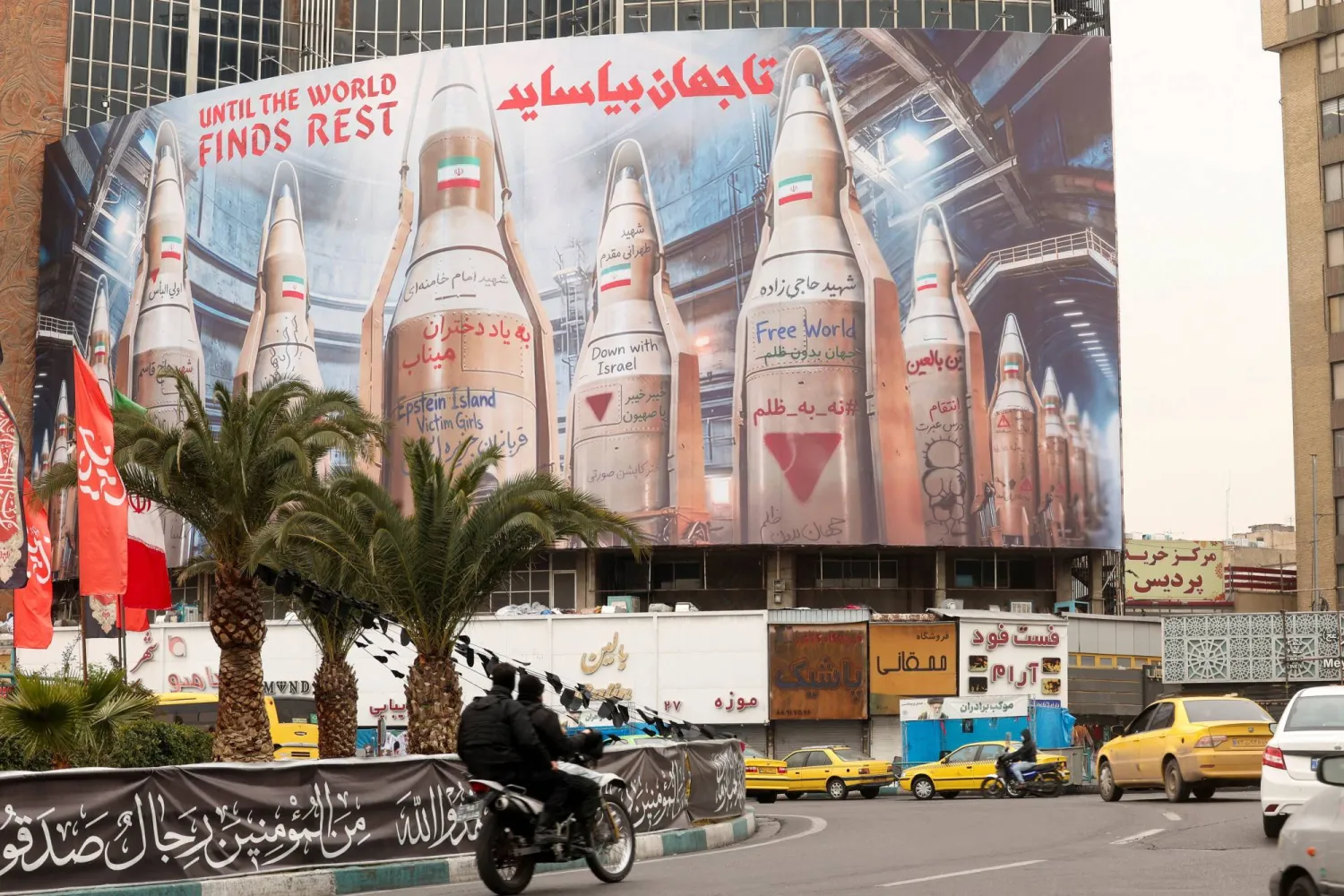
People on motorcycles ride past a large billboard with images of Iranian missiles, amid the US-Israeli conflict with Iran, in Tehran, Iran, March 15, 2026. REUTERS/Alaa Al-Marjani
TT

Israel Bombs Central Tehran; Trump Gives Iran 48 Hours to Open Strait of Hormuz

People on motorcycles ride past a large billboard with images of Iranian missiles, amid the US-Israeli conflict with Iran, in Tehran, Iran, March 15, 2026. REUTERS/Alaa Al-Marjani

President Donald Trump warned the US will “obliterate” power plants in Iran if the Iranian Republic doesn’t fully open the Strait of Hormuz within 48 hours, while Iranian missiles struck two communities not far from Israel’s main nuclear research center late Saturday, leaving buildings shattered and dozens injured in the attacks.

The developments signaled the war was moving in a dangerous new direction at the start of its fourth week, The Associated Press said.

Trump, who issued the ultimatum in a social media post while he spent the weekend at his Florida home, said he’s giving Iran 48 hours to open the vital waterway or face a new round of attacks. He said the US would destroy “various POWER PLANTS, STARTING WITH THE BIGGEST ONE FIRST!”

Iran warned early Sunday that any strike on its energy facilities would prompt attacks on US and Israeli energy and infrastructure assets in the region, according to a statement citing an Iranian military spokesperson carried by state media and semiofficial outlets.

The Strait of Hormuz, which connects the Arabian Gulf to the rest of the globe’s oceans, is a critical pathway for the world’s flow of oil. Attacks on commercial ships and threats of further strikes have stopped nearly all tankers from carrying oil, gas and other goods through the passage, leading to cuts in output from some of the world’s largest oil producers, because their crude has nowhere to go.

Iran strikes area near Israeli nuclear site

Israel’s military said it was not able to intercept missiles that hit the southern cities of Dimona and Arad, the largest near the center in Israel’s sparsely populated Negev desert. It was the first time Iranian missiles penetrated Israel’s air defense systems in the area around the nuclear site.

“If the Israeli regime is unable to intercept missiles in the heavily protected Dimona area, it is, operationally, a sign of entering a new phase of the battle,” Iran’s Parliament Speaker Mohammad Bagher Ghalibaf said on X before word of the Arad strike spread.

Rescue workers said the direct hit in Arad caused widespread damage across at least 10 apartment buildings, three of them badly damaged and in danger of collapsing. At least 64 people were taken to hospitals.

Dimona is about 20 kilometers (12 miles) west of the nuclear research center and Arad around 35 kilometers (22 miles) north.

Israel is believed to be the only Middle East nation with nuclear weapons, though its leaders refuse to confirm or deny their existence. The UN nuclear watchdog said on X it had not received reports of damage to the Israeli center or abnormal radiation levels.

The Iranian strikes in Israel came after Tehran’s main nuclear enrichment site at Natanz was hit earlier in the day.

Israel denies responsibility for attack on Natanz

Israel earlier Saturday denied responsibility for the strike on Natanz, nearly 220 kilometers (135 miles) southeast of Tehran. The Iranian judiciary’s official news agency, Mizan, said there was no leakage.

The International Atomic Energy Agency has said the bulk of Iran’s estimated 970 pounds (440 kilograms) of enriched uranium is elsewhere, beneath the rubble at its Isfahan facility. It said on X it was looking into the strike.

The Pentagon declined to comment on the strike on Natanz, which was also hit in the first week of the war and in the 12-day war last June. Russian Foreign Ministry spokesperson Maria Zakharova said such strikes posed a “real risk of catastrophic disaster throughout the Middle East.”

The US and Israel have offered shifting rationales for the war, from hoping to foment an uprising that topples Iran’s leadership to eliminating its nuclear and missile programs and its support for armed proxies. There have been no signs of an uprising, while internet restrictions limit information from Iran.

The war’s effects are felt far beyond the Middle East, raising food and fuel prices.


London Police Probe Attack on Jewish Ambulances as Hate Crime

Firefighters work at the scene after four ambulances were set on fire, in northwest London, Britain, March 23, 2026. REUTERS/Hannah McKay
TT

London Police Probe Attack on Jewish Ambulances as Hate Crime

Firefighters work at the scene after four ambulances were set on fire, in northwest London, Britain, March 23, 2026. REUTERS/Hannah McKay

London's police said they are investigating an "arson attack" as an antisemitic hate crime after volunteer ambulances run by a Jewish organization were set on fire on Monday.

The London Fire Brigade said it was alerted to vehicles on fire at Highfield Court in Golders Green at 1:40 am.

Firefighters called to the scene found that multiple cylinders on the vehicles had exploded, breaking windows in an adjacent block.

London's Metropolitan Police said the burnt vehicles were four Hatzalah ambulances belonging to the Jewish Community Ambulance service, AFP reported.

"Officers remain on scene and the arson attack is being treated as an antisemitic hate crime," police said in a statement.

No injuries have been reported and all the fires have been put out, police added.

"We know this incident will cause a great deal of community concern and officers remain on scene to carry out urgent enquiries," superintendent Sarah Jackson said.

"We are in the process of examining CCTV and are aware of online footage. We believe we are looking for three suspects at this early stage," she said, adding that no arrest has been made.

Nearby houses were evacuated as a precaution and road closures remained in place.

London Fire Brigade said the cause of the fire is under investigation.


Israel Launches New Wave of Attacks on Tehran

A motorist rides past the dummy models of Iranian missiles installed along the roadside at the Valiasr Square, in Tehran on March 22, 2026. (AFP)
TT

Israel Launches New Wave of Attacks on Tehran

A motorist rides past the dummy models of Iranian missiles installed along the roadside at the Valiasr Square, in Tehran on March 22, 2026. (AFP)

Israel launched a new wave of attacks early Monday against Tehran and a top American commander told Iranians to remain in shelters for the foreseeable future, while Iran renewed strikes on its Gulf neighbors.

As Iran continues its stranglehold on the Strait of Hormuz, US President Donald Trump gave a 48-hour deadline for Tehran to open the strategic waterway to all ships, saying that otherwise the United States would “obliterate” Iran’s power plants. Trump posted the threat to social media early Sunday in Middle East time zones.

Iran’s paramilitary Revolutionary Guard said Monday that if the US did that, Iran would respond by hitting power plants in all areas that supply electricity to American bases, “as well as the economic, industrial and energy infrastructures in which Americans have shares.”

“Do not doubt that we will do this,” the Guard said in a statement read on Iranian state television.

As Israel hit the Iranian capital, the military said it had “begun a wide-scale wave of strikes” on infrastructure targets in Tehran without immediately elaborating.

United States Central Command chief Adm. Brad Cooper claimed in an interview aired Monday that Iran was launching missiles and drones from populated areas, and suggested those areas would be targeted.

“You need to stay inside for right now,” Cooper told Iranian civilians in the interview with the Farsi-language satellite network Iran International aired early Monday.

“There will be a clear signal at some point, as the president has indicated, for you to be able to come out.”

Air defenses in the United Arab Emirates intercepted a ballistic missile near the Al Dhafra Air Base in Abu Dhabi, and one person on the ground was injured when hit with shrapnel.

Warning sirens sounded in Bahrain and Kuwait, while Saudi Arabia’s Defense Ministry said it had intercepted a missile targeting Riyadh, and had destroyed drones over the Kingdom’s Eastern Region.

Oil prices up more than 50% since start of the war

Oil prices remained stubbornly high in early trading, with the price of Brent crude, the international standard at around $112 a barrel, up nearly 55% since Israel and the US started the war on Feb. 28 by attacking Iran.

The war has also caused wild fluctuations in global stock markets as traders grow increasingly concerned about a world energy crisis and other issues.

In addition to targeting Israel and American bases, Iran has been hitting the energy infrastructure of its Gulf Arab neighbors.

It also has a tight grip on shipping through the Strait of Hormuz, which leads from the Gulf toward the open ocean and through which a fifth of the world’s oil is shipped, along with other important commodities.

A trickle of ships has been getting through the strait and Iran insists it remains open — just not to the US, Israel or their allies. On Sunday, Iranian Foreign Minister Abbas Araghchi blamed the US for the problem facing everyone, saying that the attack on Iran made insurance companies shut down shipping through the strait for fear of having to pay large claims if tankers were damaged or destroyed.

Iran has said it will completely close the critical waterway if Trump follows through with the threat to attack Iranian power plants.

Iranian parliament speaker Mohammad Bagher Qalibaf also said Iran would then consider vital infrastructure across the region legitimate targets.

US commander says campaign against Iran is “ahead or on plan” In his first one-on-one interview since the war started, Adm. Cooper said the campaign against Iran is “ahead or on plan” and that the US and Israel were targeting infrastructure and manufacturing facilities to destroy Iran’s capabilities to rebuild its military.

“It’s not just about the threat today,” he said. “We’re eliminating the threat of the future, both in terms of the drones, the missiles as well as the navy.”

He suggested Iran could bring a quick end to the war if it stopped firing back, though did not say whether that would prompt Israel and the US to relent before all infrastructure targets have been destroyed.

“They could stop this war right now, absolutely, if they chose to do so,” he said of Iran. “They need to stop putting the wonderful Iranian people at risk by firing missiles and drones from inside populated areas. ... They need to stop immediately attacking civilians throughout the Middle East region.”

Iran’s death toll in the war has surpassed 1,500, its health ministry has said. In Israel, 15 people have been killed by Iranian strikes. More than a dozen civilians in the occupied West Bank and Gulf Arab states have been killed in strikes.

In Lebanon, authorities say Israeli strikes targeting Iran-linked Hezbollah have killed more than 1,000 people and displaced more than 1 million. Meanwhile, Hezbollah has fired hundreds of rockets into Israel.


Officials: Torrential Rains in Kenya Kill 81 in March

Officials: Torrential Rains in Kenya Kill 81 in March
TT

Officials: Torrential Rains in Kenya Kill 81 in March

Officials: Torrential Rains in Kenya Kill 81 in March

Torrential storms that have triggered flash floods in Kenya have killed at least 81 people this month, authorities said Sunday, as rain continued to pound much of the country.

"The cumulative number of fatalities has unfortunately risen to 81," national police spokesman Muchiri Nyaga said in a statement.

"Additionally, flash floods have swept through several areas, displacing approximately 2,690 families and causing widespread destruction of infrastructure and property."

The capital Nairobi is the hardest-hit region, with 37 people killed, he said.

On Friday night, authorities called on residents to evacuate several slum neighborhoods downstream from the Nairobi dam, warning of an imminent risk of flooding as rising water levels threatened to breach the dam embankment, according to local media.

The dam has held so far.

Two people drowned overnight in floods in the town of Kiambu, just outside the capital, police told AFP.

Two also died as landslides hit the western village of Kasaka, burying numerous homes, reported private broadcaster Citizen TV.

The rain is forecast to continue until Tuesday.

Authorities called for "extreme caution".

The March rains have repeatedly turned Nairobi streets to raging rivers, flooding thousands of homes and businesses.

Critics have called for the resignation of Nairobi Governor Johnson Sakaja, who had vowed to improve the capital's drainage and road infrastructure when he took office in 2022.

Scientists say human-caused climate change is increasing the probability, length and severity of extreme weather events.

Studies indicate east Africa has been hit by more extreme rains and droughts over the past two decades.
