


Fighting in South Lebanon Reaches Close Combat Stage

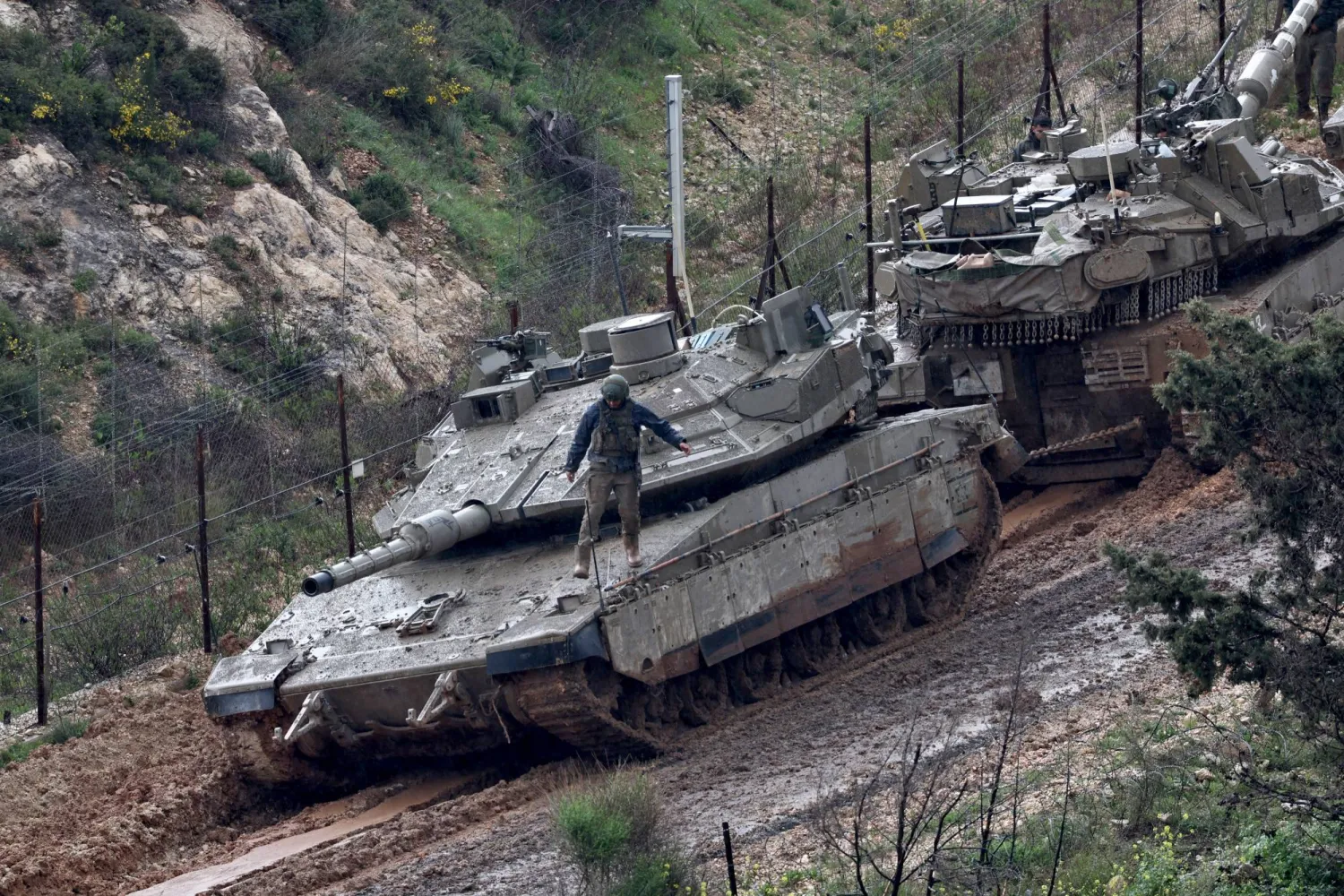
Israeli tanks are deployed along the northern Israeli border with Lebanon, 21 March 2026. EPA/ATEF SAFADI
TT

Fighting in South Lebanon Reaches Close Combat Stage

Israeli tanks are deployed along the northern Israeli border with Lebanon, 21 March 2026. EPA/ATEF SAFADI

Israeli advances in the border town of Khiam and the coastal village of Naqoura triggered fierce clashes with Hezbollah, which said its fighters battled Israeli forces for four hours in central Khiam, as sustained Israeli shelling pounded the surrounding areas and one-way attack drones entered the fight.

The Israeli push toward the outskirts of Bint Jbeil and the Litani River from the Maroun al-Ras and Taybeh axes slowed, with fighting shifting to Khiam, where Israeli forces are seeking full control after advancing on the western axis facing the Marjayoun plain, the third stage of an offensive toward northern Khiam.

The battle for Khiam

Battlefield sources in Marjayoun told Asharq Al-Awsat that fighting erupted with light and medium machine guns, in one of the rare instances in which such intense clashes have been heard so clearly in the area. Explosions were followed by thick smoke rising over central and western Khiam.

Clashes focused on the Jallahiya neighborhood, one of the last high ground positions in northwestern Khiam and a key link between the city’s center and its eastern and western sectors. Israeli tanks had reached the area days earlier before withdrawing, in what observers described as a probing move to test Hezbollah’s defenses.

The latest incursion followed four days of airstrikes targeting northern and eastern neighborhoods, alongside relentless artillery fire, paving the way for the advance.

Hezbollah said its fighters engaged Israeli forces at close range in Khiam using light and medium weapons and rocket-propelled grenades, with clashes lasting four hours. The group’s media described the fighting as direct contact with enemy forces. It also said the heaviest battles took place in Jallahiya and the city’s eastern quarter.

Rocket fire was reported to target Israeli troop concentrations near the Khiam detention center and the eastern quarter, as well as strikes on the Hadabat al-Ajl site north of Kfar Yuval and two other gatherings in Metula.

A powerful Israeli blast later shook Khiam, shattering shop windows in the nearby town of Qlayaa.

The battle for Naqoura

On the Naqoura coastal axis in southwestern Lebanon, clashes broke out for the first time since the war began on March 2, as Israeli forces advanced from two directions.

One push came from the seafront, an area local sources described as militarily exposed. The other came from the east, expanding from the Labouneh heights and the outskirts of Alma al-Shaab, which Israel pressed Lebanon to fully evacuate last week.

Sources said the advance was relatively easy due to the area’s uninhabited nature, extensive destruction from previous fighting, and subsequent clearing operations by the Lebanese army and UN peacekeepers under the mechanism.

A large stretch between the sea and Alma al-Shaab now functions as a security zone, hosting the main headquarters of the UN peacekeeping force.

They said the first line of defense has shifted to populated parts of Naqoura, where fighting erupted on Saturday. While Israel’s military has not announced operations there, Hezbollah media said its fighters were confronting Israeli attempts to advance toward the town.

Local media reported clashes on Naqoura’s outskirts from the directions of Alma al-Shaab and Labouneh.

Hezbollah said it targeted Israeli soldiers east of Naqoura with rocket barrages and artillery, and that its fighters clashed with a force attempting to infiltrate from the Tabbasin area toward the municipal building using light and medium weapons.

Sustained bombardment

Israeli strikes hit Beirut’s southern suburbs before dawn on Saturday after a two-day lull, following a broad evacuation warning. Two buildings were targeted in Burj al-Barajneh and Ghobeiry.

Israeli bombardment continued across southern Lebanon, hitting the outskirts of Ghandooriyeh, Tayri, Bint Jbeil, Deir Seryan, Mansouri, Jabal al-Rayhan, Shaaitiyeh, areas between Bazouriyeh and Burj al-Shamali, and Haniyeh and Hamoul east of Naqoura. A house in Zawtar al-Sharqiya was also destroyed.

Artillery fire struck Naqoura, Hamoul, Khiam, Taybeh, Markaba, Houla, Shaqra, Burj Qalaouiyeh, Ghandooriyeh, and the Qleileh plain south of Tyre.

Before dawn, Israeli warplanes carried out a heavy strike on a house in Kafra in the Bint Jbeil district, Lebanon’s state news agency said.



Sharaa Receives Kurdish Delegation for Eid, Nowruz: Cultural Diversity Source of Syria’s Strength

A group photo during Syrian President Ahmed al-Sharaa’s reception in Damascus of a Kurdish delegation marking Eid al-Fitr and Nowruz. (Syrian Presidency)
TT

Sharaa Receives Kurdish Delegation for Eid, Nowruz: Cultural Diversity Source of Syria’s Strength

A group photo during Syrian President Ahmed al-Sharaa’s reception in Damascus of a Kurdish delegation marking Eid al-Fitr and Nowruz. (Syrian Presidency)

Syrian President Ahmed al-Sharaa received in Damascus on Saturday a Kurdish delegation on the occasion of Eid al-Fitr and Nowruz. The event was attended by the governors of Aleppo, Raqqa and Hasakeh, as well as a presidential envoy overseeing the implementation of a January 29 agreement with the Kurdish-led Syrian Democratic Forces (SDF).

Sharaa said Nowruz was a “national holiday” reflecting the identity of Syria’s Kurdish community, while stressing that “the Syrian people are one.”

He said guaranteeing Kurdish rights was a fundamental principle and described Syria’s cultural diversity as a source of strength, according to state news agency SANA.

Participants welcomed a 2026 presidential decree granting rights to Kurds, stressing the importance of national unity, partnership and restricting weapons to state control.

It was the first time Nowruz has been celebrated as an official national holiday in Syria.

Kurdish academic and independent politician Farid Saadoun told Asharq Al-Awsat that Sharaa announced plans to allocate up to $1 billion to rebuild infrastructure in northern Syria.

The meeting, coordinated by authorities in Hasakeh, lasted about 90 minutes and included between 50 and 60 Kurdish figures, including representatives of the Kurdish National Council, independents, academics and civil society figures.

Saadoun said the delegation represented Kurds from across Syria, including Kobani, Afrin and Damascus, but noted that the Democratic Union Party (PYD) did not attend despite being invited.

He described the meeting as “historic,” saying it was the first time a Syrian president had received a Kurdish delegation to exchange greetings for Eid and Nowruz.

According to Saadoun, Sharaa said Syria was entering a “new phase,” declaring that “the past has ended” and calling on Syrians to unite to rebuild the country.

He emphasized Kurdish rights to “dignity, freedom and participation” after years of marginalization under the previous government, adding that Kurds would have a role in state institutions.

Sharaa said the government would focus on rebuilding infrastructure in the north, improving education and reinstating dismissed public employees.

On the January 29 agreement with the SDF, Saadoun said the president reaffirmed his commitment to its implementation, aimed at stabilizing the country and restoring services.

“We are moving steadily toward integration and delivering services to the people,” Sharaa was quoted as saying.

Mahmoud Khalil, deputy head of internal security in Hasakeh, said he attended the event alongside local officials. He said discussions also covered detainees and the return of displaced people to Afrin and Ras al-Ain.

Khalil said a special committee had been formed on Sharaa’s instructions to follow up on these issues and support stability efforts.


Opposition to Beirut Displacement Center Rises over Security, Sectarian Concerns

The site of a displacement shelter under construction in the Karantina area near Beirut port (Asharq Al-Awsat)
TT

Opposition to Beirut Displacement Center Rises over Security, Sectarian Concerns

The site of a displacement shelter under construction in the Karantina area near Beirut port (Asharq Al-Awsat)

Security and sectarian concerns are fueling opposition in Lebanon to plans for a displacement center in central Beirut, as ongoing conflict between Israel and Hezbollah drives new waves of displaced people.

Prime Minister Nawaf Salam has called for tighter security measures, amid growing political and public debate over establishing shelters for those displaced, most recently in the Karantina area near Beirut port.

At a security meeting at the Grand Serail, Salam stressed “the need to intensify security measures across Lebanon, particularly in Beirut, to safeguard citizens and their property,” citing developments in the south and the resulting displacement and security challenges.

A government decision to set up the displacement center in Karantina has triggered controversy, with several lawmakers urging it be scrapped on security and political grounds.

Although about 70 percent of the facility had been completed shortly after work began, informed sources said construction has been temporarily halted pending further review, without ruling out cancelling the project altogether. Funding is provided by international organizations and civil society groups.

Sources said the dispute reflects both political and sectarian sensitivities, while acknowledging that some concerns are legitimate. They added that security forces and the Lebanese Red Cross would oversee the center, with detailed registries of residents to ensure control.

The facility is intended to house around 800 people, particularly families unwilling to relocate to northern Lebanon or Mount Lebanon, preferring to remain in Beirut near their homes.

The suspension followed criticism from several political figures. MP Nicolas Sehnaoui of the Free Patriotic Movement described the project as “wrong in every sense,” calling for alternative solutions.

Lebanese Forces MP Razi Hage warned against turning the Karantina-port area into “a security and social hotspot under the pretext of a displacement center,” adding that temporary measures often become permanent.

For his part, Independent MP Waddah Sadek warned Beirut risked fragmenting into “security zones” and areas lacking oversight, while MP Fouad Makhzoumi urged the government to reconsider plans for large shelters in Karantina and Martyrs’ Square.

“While we fully recognize the humanitarian dimension, we respectfully urge reconsideration,” he said, warning of security and organizational repercussions.

The debate comes after Israeli strikes targeted areas previously considered relatively safe. Israel said it had targeted members of Hezbollah and Iran’s Revolutionary Guards in Aramoun in Mount Lebanon and areas near central Beirut.

The strikes have heightened concerns among residents in host communities, complicating efforts to respond to the growing displacement crisis.


Hamas Moves to Freeze Leadership Vote amid Regional Turmoil

Palestinians wave Hamas flags during the reception of released Palestinian prisoners in Ramallah, in the occupied West Bank, November 2023 (AFP) 
TT

Hamas Moves to Freeze Leadership Vote amid Regional Turmoil

Palestinians wave Hamas flags during the reception of released Palestinian prisoners in Ramallah, in the occupied West Bank, November 2023 (AFP) 

Hamas is moving toward freezing its leadership election process as the US-Israeli war against Iran reshapes the region’s political and security landscape, senior sources in and outside Gaza said.

The Palestinian militant group had been preparing to elect a new head of its political bureau, but multiple sources told Asharq Al-Awsat that a “near-final” decision has emerged to suspend the vote due to mounting complications.

For about 18 months, Hamas has been run by a “leadership council.” In recent weeks, efforts intensified to appoint a new leader to serve the remainder of the current political bureau’s term, extended to 2026. Broader internal elections had been expected later this year or early next year.

Four well-informed sources said current regional conditions, particularly with leading candidates based abroad, have pushed the movement toward delaying the process.

The race has focused on Khaled Meshaal, Hamas’ political chief abroad, and Khalil al-Hayya, a Gaza-based senior figure who leads ceasefire negotiations. Both are members of the leadership council chaired by Mohammed Darwish, head of the group’s Shura Council. Other members include Zaher Jabarin and Nizar Awadallah.

Sources said al-Hayya is believed to have backing from Hamas figures in Gaza and its armed wing, the Ezzedine al-Qassam Brigades, while Meshaal enjoys stronger support in the West Bank and among members abroad.

Two sources - one in Gaza and one outside - said a decision could be taken within days to cancel the current vote and instead hold full political bureau elections at the end of the year.

“The region is undergoing major security and political changes,” one source outside Gaza said. “Field conditions require postponement, and there is growing support for holding a single comprehensive election.”

After the killing of Hamas leader Ismail Haniyeh in Tehran in July 2024, the group appointed Yahya Sinwar as his successor. Following Sinwar’s death in clashes in Rafah in October 2024, Hamas shifted to collective leadership under the council.

A source in Gaza said time constraints were also a factor. “We are approaching April, and there is little time left before the end of the extended term. There is near consensus to cancel elections for now,” the source underlined.

He added that regional developments could significantly affect the Palestinian cause, while Hamas is focusing on diplomatic efforts linked to Gaza’s future.

However, not all Hamas officials support freezing the process. A source outside Gaza said the issue “has not been settled,” describing any delay as temporary.

A senior Hamas figure abroad said much of the election process had already been completed. “It is not logical to cancel after such progress,” he explained.

War impact

The war has also stirred internal tensions within Hamas over Iran’s strikes on Gulf countries.

Hamas, which maintains close ties with Tehran, initially faced pressure after its armed wing praised the Iranian attacks. The group later called on Iran to halt the strikes following criticism.

Sources said Qatar has taken measures in recent days against some Hamas figures over statements supporting Iran.