


Musk Launches 'Terafab' Project to Make Own AI Chips

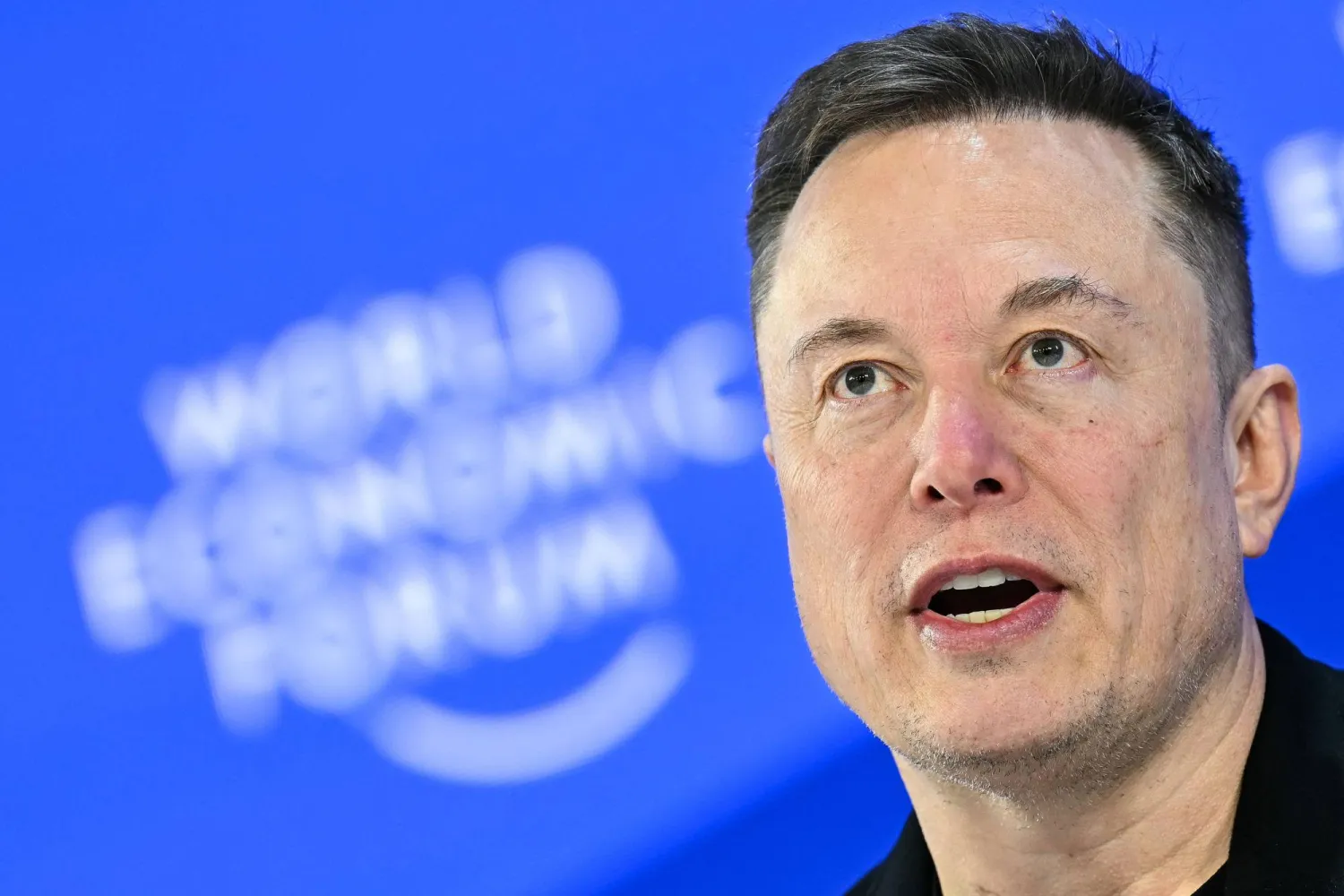
(FILES) CEO of SpaceX and Tesla, South African-Canadian-US businessman Elon Musk speaks during the World Economic Forum (WEF) annual meeting in Davos on January 22, 2026. (Photo by Fabrice COFFRINI / AFP)
TT

Musk Launches 'Terafab' Project to Make Own AI Chips

(FILES) CEO of SpaceX and Tesla, South African-Canadian-US businessman Elon Musk speaks during the World Economic Forum (WEF) annual meeting in Davos on January 22, 2026. (Photo by Fabrice COFFRINI / AFP)

Elon Musk announced Saturday a plan to make chips for artificial intelligence, robotics and data centers in space, in the latest bold project by the world's richest person.

The "Terafab", a manufacturing facility based near Austin, Texas, will aim to produce one terawatt of computing power per year, Musk said.

A terawatt is equivalent to one trillion watts. That is slightly less than the total power generation capacity of the United States, according to an industry group.

Musk said the project would be run jointly by his electric-vehicle firm Tesla and his rocket company SpaceX.

He did not disclose the initial investment. Previous US media reports have put the figure between $20 billion and $25 billion, AFP said.

Musk, who has no prior experience in semiconductors, said the Terafab was necessary because Tesla and SpaceX's demand for computing power was expected to far exceed that of global chip suppliers.

"We're very grateful to our existing supply chain, to Samsung, TSMC, Micron, and others... but there's a maximum rate at which they're comfortable expanding," Musk said.

"That rate is much less than we would like... and we need the chips, so we're going to build the Terafab."

An "advanced technology fab" in Austin will have the facilities to design, manufacture, test and improve each chip, Musk said.

Eventually, the project aims to make chips to support 100 to 200 gigawatts of computing power on Earth, and a terawatt in space.

Musk did not give a timeline for the Terafab's output, and has previously promised grand results from other projects on compressed time scales.

He said the Terafab would ultimately help humanity become a "galactic civilization" capable of harnessing the resources of other planets and stars.



US Accuses Chinese AI Firms of ‘Malicious’ Copying of AI Technology

A DeepSeek AI sign is seen at a building where the Chinese start-up's office is located in Beijing, China, February 19, 2025. (Reuters)
TT

US Accuses Chinese AI Firms of ‘Malicious’ Copying of AI Technology

A DeepSeek AI sign is seen at a building where the Chinese start-up's office is located in Beijing, China, February 19, 2025. (Reuters)

The US government on Tuesday accused Chinese artificial intelligence companies of maliciously copying technology from American AI firms, potentially complicating relations ahead of a planned meeting between leaders of the world's two biggest economies later this month.

The Chinese companies copied US AI labs’ intellectual property through a technique known as distillation, according to a statement from US law enforcement and intelligence officials. Distillation is the process of training smaller AI models using output from larger, more expensive ones as part of an effort ‌to lower the ‌costs of training a new AI tool.

US ‌officials ⁠accused six Chinese ⁠companies, including DeepSeek, Moonshot AI and Alibaba, of tapping variants of American-made AI models to train their AI products more quickly.

The companies did so "likely with Chinese government awareness," according to the statement from US officials, who added that the Chinese companies targeted AI models from Anthropic, OpenAI, Alphabet's Google and SpaceX.

"China-based AI companies are engaging in aggressive, malicious and ⁠targeted distillation activities at an industrial scale," the officials ‌said.

US officials made the allegations ‌as the administration of President Donald Trump prepares for Chinese President Xi Jinping's visit ‌to the US in late September. The US and China are ‌also gearing up to discuss AI safety risks during a dialogue planned for mid-September, Reuters previously reported.

In response, Chinese foreign ministry spokesperson Mao Ning said on Wednesday that China's AI advances were the result of "achieving high-level ‌science and technological self-reliance."

"We hope the US will earnestly implement the important consensus reached by the leaders ⁠of both ⁠countries and refrain from making false accusations and smearing China," Mao said.

"As major powers in artificial intelligence, China and the US should strengthen cooperation."

The US made a similar accusation in April ahead of Trump's visit to Beijing.

The Tuesday statement alleged that the distillation not only reduces research and development costs for Chinese AI firms, but also enhances China's “military and cyberattack capabilities that could be used against the US and our allies.”

Reuters reported on July 31 that Chinese military researchers have used outputs from leading US AI models to train domestic Chinese AI systems and advance China's defense capabilities.


OpenAI Says Working with Samsung on Next-Generation Chips, Deepening Cooperation

The logo of Samsung is seen on a building during the Mobile World Congress in Barcelona, Spain February 25, 2018. (Reuters)
TT

OpenAI Says Working with Samsung on Next-Generation Chips, Deepening Cooperation

The logo of Samsung is seen on a building during the Mobile World Congress in Barcelona, Spain February 25, 2018. (Reuters)

OpenAI is deepening cooperation with Samsung Electronics as the ChatGPT maker develops its own chips, expanding ties with the South Korean technology giant across semiconductors and enterprise AI services.

"One of the areas where we have made the most progress and gained the most recognition with Samsung Electronics is our joint production and research on the next-generation chips we are developing," Harrison Kim, General Manager of OpenAI Korea, said at a press ‌conference in Seoul ‌on Wednesday, without elaborating.

Kim also said Samsung Electronics was "one ‌of ⁠the largest-scale deployments of ⁠ChatGPT globally," saying the company's employees in Korea and overseas use ChatGPT for work across research and development, marketing and sales.

Samsung Electronics said in a statement that it could not confirm information related to customers.

In June, OpenAI unveiled its first custom artificial intelligence chip designed with Broadcom. OpenAI's engineers designed the chip, called Jalapeno, together with Broadcom for a task known as AI inference, the ⁠process of crunching data to answer queries in applications ‌such as ChatGPT.

OpenAI at that time said that ‌Taiwan's TSMC would manufacture the chips.

Last year, Samsung Electronics and SK Hynix signed letters ‌of intent to supply memory chips for OpenAI's Stargate data center project.

Kim ‌said demand for memory chips would continue to grow as more advanced chips were needed to enable faster and more complex computing, making cooperation with South Korean semiconductor suppliers a priority for OpenAI's local office.

The cooperation comes as Samsung broadens its ‌use of generative AI. The company said in June that workers in its Device eXperience division, which oversees mobile ⁠phones, televisions and home ⁠appliances, would be allowed to use ChatGPT, Google's Gemini and Anthropic's Claude internally.

OpenAI said the number of ChatGPT Enterprise users at South Korean companies and institutions had surged about 28-fold as of the end of August from a year earlier, as businesses broadened their use of artificial intelligence from individual tasks to company-wide operations.

Companies were increasingly using AI across functions including legal, sales, finance, marketing and operations, OpenAI said. The company declined to provide absolute user numbers.

South Korea had the largest number of paying ChatGPT subscribers outside the United States as of late last year, according to OpenAI.

OpenAI expects adoption to accelerate following the September 4 launch of GPT-6 Astra, its latest model, which it said offered improved performance in computer use, professional work, science, coding and cybersecurity.


Communications Minister Discusses Strengthening Saudi Arabia’s AI Partnerships in Silicon Valley

Minister of Communications and Information Technology Abdullah Alswaha's meetings are part of Saudi Arabia’s efforts to expand its international partnerships and attract high-value investments in AI and advanced technologies. (SPA)
TT

Communications Minister Discusses Strengthening Saudi Arabia’s AI Partnerships in Silicon Valley

Minister of Communications and Information Technology Abdullah Alswaha's meetings are part of Saudi Arabia’s efforts to expand its international partnerships and attract high-value investments in AI and advanced technologies. (SPA)

Saudi Minister of Communications and Information Technology Abdullah Alswaha held a series of meetings with leaders of global technology and investment companies during the first day of his visit to Silicon Valley in California, reported the Saudi Press Agency on Wednesday.

The meetings focused on strengthening investments and partnerships in artificial intelligence (AI), computing capabilities, and deep technologies, as well as supporting the growth of Saudi startups and their expansion into global markets.

Alswaha met with Co-Founder and General Partner at Andreessen Horowitz Ben Horowitz to discuss expanding the firm’s investments in the Kingdom and in Saudi startups. The meeting also addressed connecting companies within its investment portfolio with HUMAIN’s computing capabilities to support their expansion in the Kingdom and the region, while enabling Saudi companies to access global markets.

He met with Partner at Sequoia Capital Alfred Lin to discuss increasing the firm’s investments in Saudi AI and deep-tech companies, connecting companies within its investment portfolio with HUMAIN’s computing capabilities, and supporting the growth and global expansion of Saudi companies.

In the field of advanced technologies, Alswaha met with CEO and Co-Founder of TenX Semi Dr. Suk Hwan Lim to discuss the use of AI agents in chip design and verification, accelerating development cycles, and applying autonomous design technologies to support the development of advanced semiconductor design capabilities in the Kingdom.

These meetings are part of Saudi Arabia’s efforts to expand its international partnerships and attract high-value investments in AI and advanced technologies, while supporting the growth and global expansion of Saudi startups, reinforcing the Kingdom’s position and boosting the competitiveness of its digital economy globally.