


Indonesia Says No to $1bn Fee for Trump's 'Board of Peace' Seat

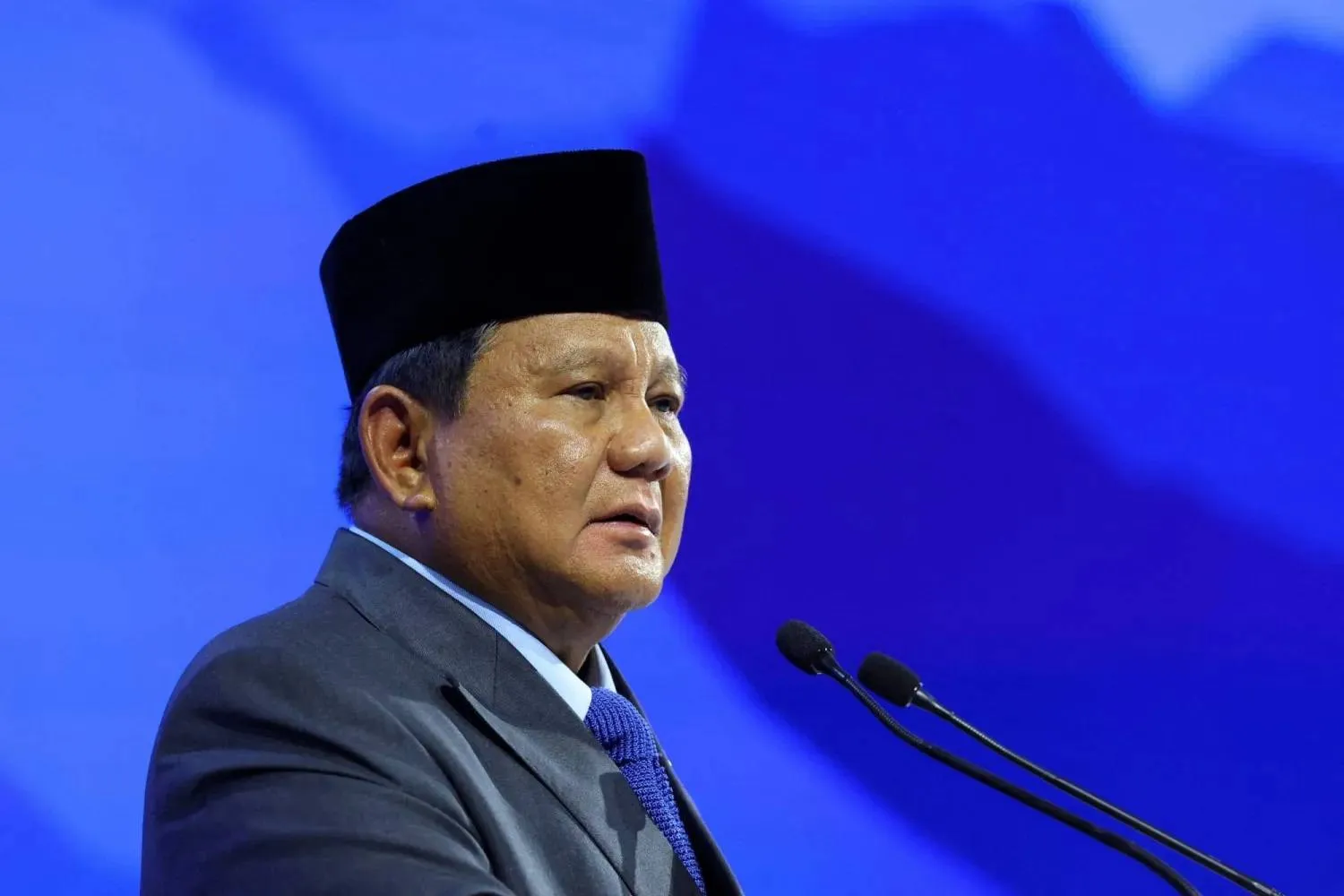
Indonesia's President Prabowo Subianto attends the 56th annual World Economic Forum (WEF) meeting in Davos, Switzerland, January 22, 2026. (Reuters)
TT

Indonesia Says No to $1bn Fee for Trump's 'Board of Peace' Seat

Indonesia's President Prabowo Subianto attends the 56th annual World Economic Forum (WEF) meeting in Davos, Switzerland, January 22, 2026. (Reuters)

Indonesia's president, under fire at home for signing up to US counterpart Donald Trump's so-called "Board of Peace", has insisted his country would not pay the $1 billion joining fee for permanent membership.

Jakarta had only committed peacekeeping troops for the initiative, Prabowo Subianto said in a statement published on the presidential YouTube channel Sunday, AFP reported.

The "Board of Peace" came together after the Trump administration, teaming up with Qatar and Egypt, negotiated a ceasefire in October to halt two years of devastating war in Gaza.

Countries that want to be permanent members must pay $1 billion -- sparking criticism the board could become a "pay-to-play" version of the UN Security Council.

Prabowo, a former general, has come under criticism from Indonesian Muslim groups for joining the board and pledging to send 8,000 peacekeeping troops to Gaza.

Prabowo attended the inaugural meeting of the "Board of Peace" in Washington last month.

But he later said he would withdraw from the board if it does not bring benefits to Palestinians or align with Indonesia's national interests.

"We never said that we wanted to contribute $1 billion," Prabowo said in statements broadcast on his YouTube channel Sunday.

He said he did not make any financial commitments "at all".

Prabowo signed a tariff deal with the US last month, but insisted Sunday that Indonesia could withdraw from any agreement if its conditions or execution threatens the national interest.

Talks with Washington about any peacekeeping mission to Gaza have been put "on hold", according to state news agency Antara, citing Foreign Ministry spokesman Vahd Nabyl Achmad Mulachela.



Sudan's RSF Denies Reports of Abu Lulu's Release

This handout picture released by the Sudanese Rapid Support Forces (RSF) on October 30, 2025, shows RSF members reportedly detaining a fighter known as Abu Lulu (L) in al-Fashir in war-torn Sudan's western Darfur region. (RSF / AFP)
TT

Sudan's RSF Denies Reports of Abu Lulu's Release

This handout picture released by the Sudanese Rapid Support Forces (RSF) on October 30, 2025, shows RSF members reportedly detaining a fighter known as Abu Lulu (L) in al-Fashir in war-torn Sudan's western Darfur region. (RSF / AFP)

Sudan’s paramilitary Rapid Support Forces (RSF) denied on Tuesday reports about the release of RSF Brigadier General al-Fateh Abdullah Idris, known as Abu Lulu, who was arrested late last year following global outrage over videos of him executing unarmed people in al-Fashir.

In a statement, the RSF “categorically” denied the reports, slamming them as “baseless” and being part of a “campaigns of incitement.”

Two sources – a Sudanese intelligence official and a commander with the RSF – said they personally saw Abu Lulu on the battlefield in Kordofan in March, said a Reuters report on Monday.

The RSF stressed that Abu Lulu and a number of individuals, accused of violations against civilians in al-Fashir, have been detained since their arrest in October.

“They remain in prison and have never left,” it added.

RSF officers had pleaded for Abu Lulu to be returned to the field to boost the morale of forces engulfed in heavy fighting there, a Chadian military officer told Reuters.

Reuters spoke with 13 sources who said they knew of Abu Lulu’s release. They include three RSF commanders, an RSF officer, a relative of Abu Lulu, a Chadian military officer close to RSF command and seven other sources with contacts in RSF leadership or access to intelligence on RSF field operations.

The RSF-led coalition government, in response to questions from Reuters, issued a statement on Monday denying the group had released Abu Lulu.

A special court will try him and others accused of violations during the al-Fashir offensive, according to the statement from Ahmed Tugud Lisan, spokesman for the RSF-led Tasis government.

The RSF imprisoned Abu Lulu in late October 2025, a few days after its bloody takeover of al-Fashir, a large city in North Darfur.

Multiple videos had surfaced of him executing unarmed people during the offensive. His actions earned him the nickname “the butcher of al-Fashir,” a moniker noted by the UN Security Council when sanctioning him on February 24 for human rights abuses.

The three-year civil war between the Sudanese army and the RSF is a brutal power struggle to control the country and its financial resources. It has created what aid groups say is the world's largest humanitarian ‌crisis.


Blank Ballots Impede Vote for New Hamas Leader

Hamas leaders, from right: Rawhi Mushtaha, Saleh al-Arouri and Ismail Haniyeh, all of whom were assassinated, Khaled Meshaal and Khalil al-Hayya. Hamas media)
TT

Blank Ballots Impede Vote for New Hamas Leader

Hamas leaders, from right: Rawhi Mushtaha, Saleh al-Arouri and Ismail Haniyeh, all of whom were assassinated, Khaled Meshaal and Khalil al-Hayya. Hamas media)

While many were waiting to learn who would become the new head of Hamas’s political bureau, the movement issued a rare and surprising statement last Saturday saying the result could not be decided in the first round and that a second would be held.

Asharq Al-Awsat asked Hamas sources inside and outside Gaza why the process of electing a new leader had stalled.

Speaking separately, they cited several factors, including “blank ballots” cast by some voters to show they were not backing either of the two contenders, Khalil al-Hayya, head of Hamas’s office in Gaza, and Khaled Meshaal, his counterpart abroad.

Hamas is facing its worst crisis since it was founded in 1987. Israeli strikes that began after the October 7, 2023, attack have hit its various wings and leaderships.

Israel assassinated its political bureau chief Ismail Haniyeh in Tehran in July 2024. He was succeeded by Yahya al-Sinwar in Gaza in October of the same year.

For about a year and a half, a “leadership council” has been running Hamas’s affairs. At the start of this year, a new push began to elect a chief to lead the movement for the remaining period of the current political bureau’s term. The term had been due to end in 2025 but was extended by one year, pending general elections at the end of this year or the beginning of next year.

Two options

Three Hamas sources, including two outside Gaza, told Asharq Al-Awsat that since the result was not decided in favor of either al-Hayya or Meshaal, the movement’s internal regulations offer “two options: either the candidate with fewer votes withdraws in favor of the one with more, or a second round is held within 20 days of the first.”

The vote to elect the head of the political bureau is conducted through the 71-member Shura Council.

The two sources outside Gaza said many voters submitted blank votes, meaning they did not name any candidate. This prevented either contender from winning the first round.

Both sources, who are senior leaders in the movement, said this was “the first time” they had seen such a situation in a vote for the head of the bureau.

One source said the situation suggested “dissatisfaction with the two competing figures, and perhaps a protest against the movement’s policies and an attempt to push toward a younger leadership.”

The other source said: “This is not necessarily a protest against the contenders, as much as it indicates that there is real rejection of some policies on several files, or a desire to postpone the idea of electing an interim chief, wait until comprehensive elections are held, and keep the current leadership council in place.”

Hard-fought contest

Assessments inside and outside Hamas suggest that the competition between al-Hayya and Meshaal reflects diverging trends between two camps within the movement.

Al-Hayya is believed to be closer to support from the Qassam Brigades, Hamas’s military wing, and to advocates of closer ties with Iran.

Meshaal is seen as representing a current that is more independent from tying the movement’s path to Tehran, as reflected in his dispute over the events of the Syrian revolution and in distancing the movement from involvement in it.

One source outside Gaza described the election as a very tight contest between Meshaal and al-Hayya, saying Hamas’s leadership in Gaza had controlled the movement’s most important files over the past two election cycles.

The source inside Gaza said only that “decisions within the movement are made by consensus, regardless of the standing or historical role of whoever leads Hamas.”

Previous elections

In previous years, elections for the head of Hamas’s political bureau were held as part of broader elections for the entire bureau and its various bodies.

In the last comprehensive elections, held in 2021, Haniyeh secured the leadership of the political bureau for a second term. His closest rivals were Saleh al-Arouri and Mohammed Nazzal, respectively.

In his first term as head of the movement in 2017, Haniyeh ran for the leadership with relative ease after Meshaal, who led Hamas’s political bureau between 2013 and 2017, was unable to run.

In the last election, held in Gaza, there was a fierce contest between Sinwar and Nizar Awadallah. It was heading for a second round before Awadallah withdrew in favor of Sinwar.


Israeli Strikes on Southern Lebanon Kill 19, Including Children and Women

Smoke rises from the site of an Israeli airstrike that targeted the village of Deir Qanoun al-Nahr in southern Lebanon on May 19, 2026. (AFP)
TT

Israeli Strikes on Southern Lebanon Kill 19, Including Children and Women

Smoke rises from the site of an Israeli airstrike that targeted the village of Deir Qanoun al-Nahr in southern Lebanon on May 19, 2026. (AFP)

Israeli airstrikes on southern Lebanon on Tuesday killed at least 19 people, including four women and three children, Lebanon’s Health Ministry said, the latest in near-daily attacks from both sides that have not stopped despite the fragile, US-brokered ceasefire in the Israel-Hezbollah war.

Israel’s military did not immediately comment on the casualties or specific incidents, but said that between Monday afternoon and Tuesday afternoon, it had targeted more than 25 sites of Hezbollah infrastructure in southern Lebanon.

The Israel-Hezbollah latest fighting began on March 2 with the Lebanese militant Hezbollah group firing rockets at Israel, two days after the United States and Israel attacked Iran.

In Beirut, the government said a single strike on the village of Deir Qanoun al-Nahr in the coastal Tyre province killed 10 people, including three children and three women. Three were wounded, including a child.

The ministry provided no further details about the strike, but state-run National News Agency said it destroyed a house, leaving several people under the rubble. Their bodies were pulled out later in the day.

According to the ministry, another airstrike — this one on the southern city of Nabatieh — killed four people and wounded 10 others, including two women. A third strike in the nearby village of Kfar Sir killed five people, including one woman.

The latest deaths came a day after the death toll in the latest round of fighting between Israel and Hezbollah surpassed 3,000, and two days after the US-brokered truce that has been in place since April 17, was extended for 45 days.

Israel has since invaded southern Lebanon and bombarded its capital, Beirut, and other areas, saying it is targeting Hezbollah infrastructure. Hezbollah has resisted pressure to disarm, including by the Lebanese government.

More than a million people have been displaced in Lebanon by the fighting, with some sheltering in tents along roads and the Mediterranean Sea in Beirut.

Israel, meanwhile, has struggled to halt frequent Hezbollah drone attacks targeting its troops on Lebanese soil and northern Israeli border towns.

Israel's military said one of its soldiers was killed on Tuesday in battle in southern Lebanon, raising the Israeli troops' death toll to 21 since the latest conflict started.