

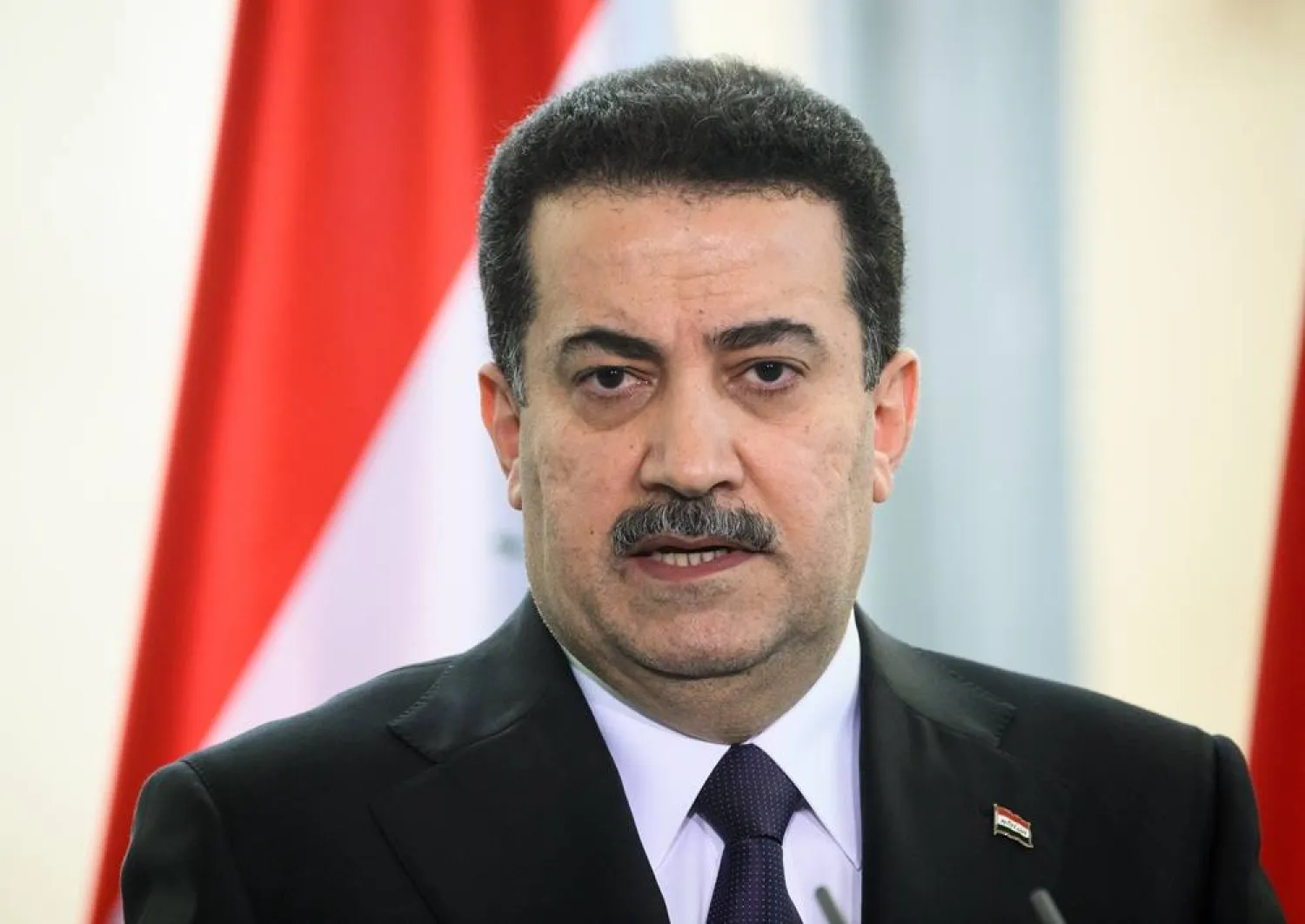

Iraqi PM Says Accelerating Withdrawal of Anti-ISIS Coalition Forces

13 January 2023, Berlin: Iraqi Prime Minister Mohammed Shia al-Sudani speaks during a press conference. (dpa)
TT

Iraqi PM Says Accelerating Withdrawal of Anti-ISIS Coalition Forces

13 January 2023, Berlin: Iraqi Prime Minister Mohammed Shia al-Sudani speaks during a press conference. (dpa)

Iraqi Prime Minister Mohammed Shia al-Sudani said he would accelerate the dismantling of a US-led international anti-ISIS coalition, in an interview with an Italian newspaper published Monday.

The prime minister's comments come as the country finds itself unwillingly drawn into the conflict in the Middle East, which began with Israeli and US strikes on Iran on February 28.

Pro-Iran armed groups have claimed responsibility for near-daily attacks on US interests in Iraq and across the region, while strikes have also targeted these groups.

The end of the international anti-ISIS coalition's mission was initially planned for September 2026 in Iraq, with the drawdown launching in 2024.

The end of the mission was intended to pave the way for bilateral security partnerships with member countries of the alliance, formed in 2014 to fight the extremist ISIS group.

"With our allies we have now decided to bring forward the end of the international coalition, which was supposed to continue until September 2026," Sudani told Italian newspaper Corriere Della Sera.

"Once there are no more foreign military contingents on Iraqi soil, it will be easier to break up the armed factions," he said, referring to pro-Iran groups in the country.

The presence of foreign troops -- particularly American advisers -- is a long-running point of contention between the government and the pro-Iran armed factions.

Baghdad has demanded a monopoly on weapons and called for the dismantling of the groups' arsenals, which the factions justify by pointing to the presence of foreign soldiers.

Both the government and the coalition insist the coalition deploys military advisers -- who provide expertise and support, aiming to prevent a resurgence of ISIS -- to Iraq at the invitation of the authorities.

These advisers are currently only deployed in northern Iraqi Kurdistan and were scheduled to remain there until September 2026.

In January, the first phase of the coalition withdrawal agreement was completed, with personnel leaving the Iraqi military bases.

The coalition is also in the process of withdrawing from neighboring Syria, where it also deployed, having recently handed over its bases to Syrian government forces.



Report: Russian Military Flotilla Bound for Libya Turns Around After Warship Sunk on November 22

A Libyan Navy vessel is docked at the military port, a day after the port was targeted in a drone attack that destroyed a Russian ship, in Benghazi, Libya, November 23, 2026. (Reuters)
TT

Report: Russian Military Flotilla Bound for Libya Turns Around After Warship Sunk on November 22

A Libyan Navy vessel is docked at the military port, a day after the port was targeted in a drone attack that destroyed a Russian ship, in Benghazi, Libya, November 23, 2026. (Reuters)

A convoy of Russian ships carrying military vehicles bound for Libya has turned around in the Mediterranean after Ukrainian maritime drones sank a Russian naval corvette in Benghazi port on November 22, three people from military and security services told Reuters on Friday.

The convoy's diversion, which has not been previously reported, shows how Russia is acting to protect its naval assets following a Ukrainian sea drone attack that sank a Russian warship in Libya some 2,000 km (1,240 miles) from the battlefield in Ukraine.

The convoy, which was escorted by a Russian navy frigate, Golovko, turned around near the Strait of Sicily on the same day as ‌the attack in ‌Benghazi, a European military official, who had been tracking the convoy, ‌said.

The ⁠strait is a ⁠waypoint before the North African coast.

A Ukrainian military intelligence official and a Middle East security official - both familiar with the convoy - confirmed that the flotilla had turned from heading to Libya.

Russia's defense ministry did not immediately respond to a request for comment sent outside office hours.

While Russia and Ukraine have repeatedly attacked each other's military and commercial shipping in the Black Sea, attacks elsewhere have been rarer.

The convoy, which set off from Kaliningrad on November 5, was last tracked ‌on November 25 near Algeria and it was unclear where it would now head, the European official said. The Middle Eastern source said the vessels had paused their voyages in the Mediterranean.

Libya's eastern-based government said the corvette that was attacked on November 22, the Merkury, had been docked at the Benghazi ‌naval base, which was confirmed by Ukrainian President Volodymyr Zelenskiy as being targeted.

The Merkury had been accompanying a cargo ship bringing military vehicles into ⁠Libya after beginning loading ⁠on October 13, as did the convoy which has turned, the European military source said.

Some of the vessels in the convoy had previously been used in what was known as the "Syria Express", auxiliary commercial ships deployed to supply former Syrian President Bashar al-Assad with military equipment during the country's civil war, a Western maritime security source said about the ships which had diverted course.


Israeli Strike Kills Two Doctors Without Borders Staff in Gaza

Food stuff spills onto the road as Palestinians inspect the remains of a bus that was transporting food rations to displaced people after it was targeted by the Israeli army, killing three people, in Al-Sina'a Street in the Tel Al-Hawa area, west of Gaza City on November 21, 2026. (AFP)
TT

Israeli Strike Kills Two Doctors Without Borders Staff in Gaza

Food stuff spills onto the road as Palestinians inspect the remains of a bus that was transporting food rations to displaced people after it was targeted by the Israeli army, killing three people, in Al-Sina'a Street in the Tel Al-Hawa area, west of Gaza City on November 21, 2026. (AFP)

Doctors Without Borders (MSF) said Saturday an Israeli strike killed two staff members at a clinic in Gaza, with the Israeli army labeling the pair as Hamas "terrorists".

The Israeli army identified the men, who worked as security guards at the clinic, as Hamas artillery cell commander Moaz Yousef Alitsbach and Ahmed Sufyan Muhammad Ali Abu.

MSF said it was "devastated" by the killings and denounced "a direct hit" on the organization.

"Our premises were clearly marked with MSF logos, and their location had been communicated to and was known by the Israeli military," it wrote on X.

World Health Organization chief Tedros Adhanom Ghebreyesus slammed the attack.

"Attacks on health facilities, health workers and humanitarian personnel in #Gaza are outrageous and unacceptable," he posted on X.

The Israeli military denied targeting a hospital or damaging medical infrastructure.

"This is another example of the Hamas terrorist organization embedding itself within international organizations," it posted on Telegram.


Lebanon Fears Israel May Impose Maritime Buffer Zone in Southern Waters

Smoke rises from Israeli strikes on the border town of Naqoura, as seen from the southern Lebanese city of Tyre in April. (AFP file photo)
TT

Lebanon Fears Israel May Impose Maritime Buffer Zone in Southern Waters

Smoke rises from Israeli strikes on the border town of Naqoura, as seen from the southern Lebanese city of Tyre in April. (AFP file photo)

Israeli military warnings to Lebanese fishermen to stay clear of its naval forces and military vessels have fueled fears that Israel is seeking to extend its planned maritime buffer zone into parts of Lebanon’s territorial waters off the southern coast.

Israeli accusations

The Israeli military accused Hezbollah of using civilian fishing boats as cover for intelligence operations, citing information it said it had obtained during interrogations of military operatives active near the maritime border.

It said Hezbollah was sending operatives aboard fishing boats to approach Israeli forces in what it called the “maritime security zone in southern Lebanon” to photograph naval forces and gather intelligence.

The military urged Lebanese residents and fishermen operating in the area to “exercise extreme caution, refrain from entering areas where Israeli forces are deployed or operating, and stay away from military vessels operating in the area.”

A maritime ‘Yellow Line’

Maj. Gen. Abdul Rahman Shehaitly said the warnings could be laying the groundwork for Israel to propose a buffer zone in Lebanese waters during upcoming talks, mirroring the arrangements it seeks to enforce along the “Yellow Line” on land while retaining the right to patrol the area.

“Israel has long advocated establishing a buffer zone off-limits to everyone while retaining the right to patrol it,” Shehaitly told Asharq Al-Awsat. “It appears intent on establishing a similar zone at sea, modeled on the area it has demarcated with the Yellow Line on land, while retaining the right to conduct naval patrols.”

“All this is laying the groundwork for raising the issue in upcoming talks, with Israel proposing arrangements for the yellow zone on land and similar measures at sea within Lebanese waters,” he added.

Shehaitly suggested the maritime buffer zone could stretch along the coast between Mansouri and Naqoura, citing repeated Israeli strikes in the area.

Three-kilometer security zone

Retired Brig. Gen. Bassam Yassin also said the warnings could herald the establishment of a maritime buffer zone off Lebanon’s southern coast, adjacent to areas Israel occupies on land, without amounting to a naval blockade.

“The Israelis are warning fishermen against approaching areas occupied by their forces, from Naqoura to the outskirts of Bayyada, on the pretext of possible espionage,” Yassin told Asharq Al-Awsat.

“They are also warning them to stay away from military vessels, potentially making fishermen targets on suspicion of conducting reconnaissance for Hezbollah.”

Yassin said that when Israeli forces take up positions along the coast, they seek to establish a security perimeter extending some three kilometers out to sea, barring access to their forces and the areas they occupy.

“They may eventually draw a line at sea and prohibit anyone from crossing it,” he added.

Buffer zone, not a blockade

Yassin drew a distinction between a maritime buffer zone and a naval blockade.

“A naval blockade is different. It would require Israeli military boats to deploy along the entire Lebanese coast, intercept ships bound for Lebanese ports, inspect them and carry out checks. What we are discussing now is the possibility of a maritime buffer zone,” he said.

Yassin stressed that Israel had yet to establish such a zone and was, for now, only issuing warnings against approaching its forces.

“It could establish a maritime buffer zone off its coastal military positions, extending some three kilometers out to sea and barring fishermen, swimmers and others from entering,” he said.

“I believe it could stretch from Naqoura to Bayyada, covering about 12 kilometers, with a possible northward extension toward Qoleileh, bringing it to 15 kilometers.”

Yassin noted that the coastline between Naqoura and Bayyada was already inaccessible, but Israel could draw a line at sea off its coastal military positions, extending toward Qoleileh to create a maritime buffer zone.