


Oil Prices Ease and Stocks Jump after Trump Says Iran is Talking with the US, Despite Iran's Denials

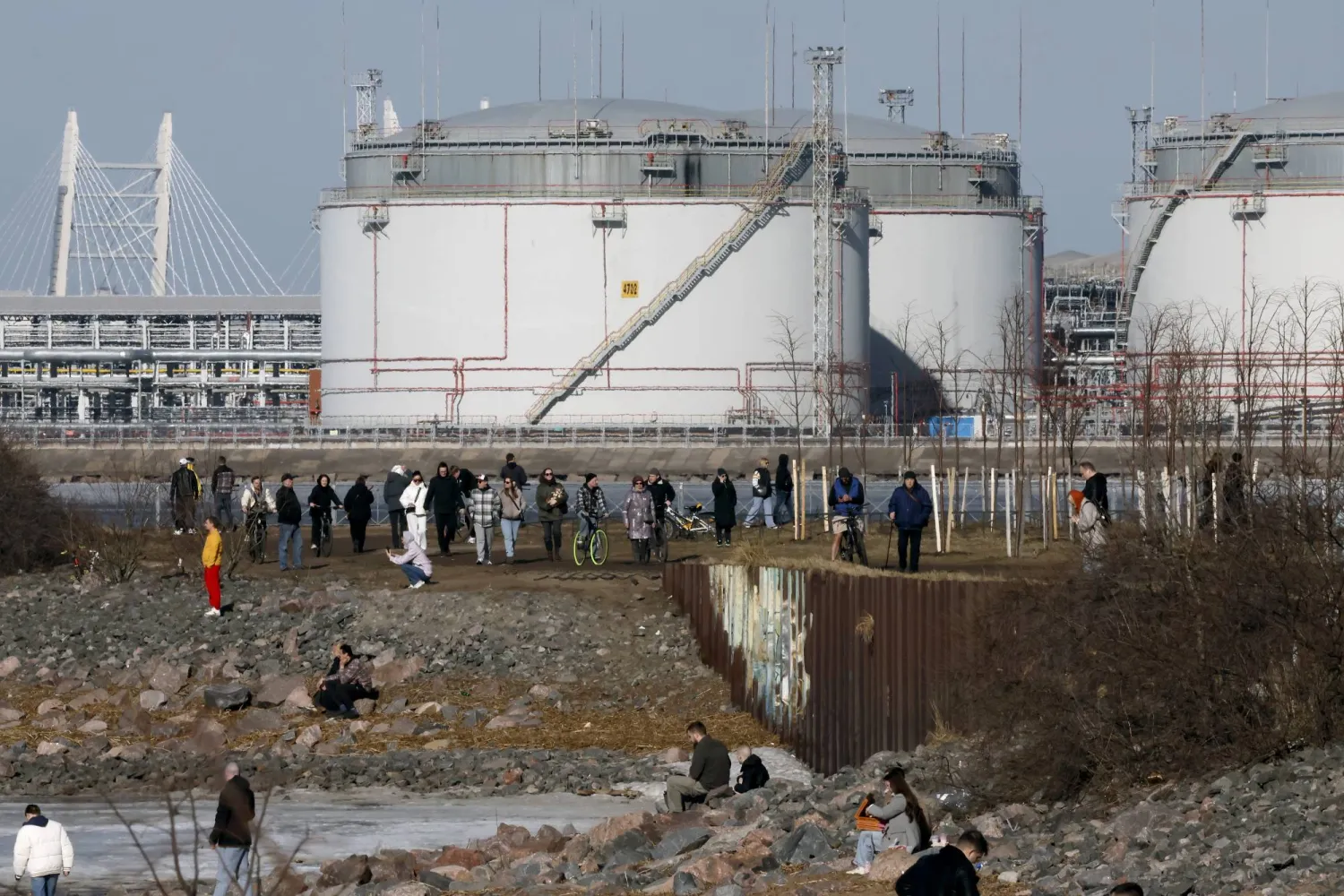
epa12841568 People walk on the shore of the Gulf of Finland with the St. Petersburg Oil Terminal in the background on a sunny day in St. Petersburg, Russia, 22 March 2026. Temperatures in St. Petersburg, Russia's second largest city, reached eleven degrees Celsius.  EPA/ANATOLY MALTSEV
epa12841568 People walk on the shore of the Gulf of Finland with the St. Petersburg Oil Terminal in the background on a sunny day in St. Petersburg, Russia, 22 March 2026. Temperatures in St. Petersburg, Russia's second largest city, reached eleven degrees Celsius. EPA/ANATOLY MALTSEV
TT

Oil Prices Ease and Stocks Jump after Trump Says Iran is Talking with the US, Despite Iran's Denials

epa12841568 People walk on the shore of the Gulf of Finland with the St. Petersburg Oil Terminal in the background on a sunny day in St. Petersburg, Russia, 22 March 2026. Temperatures in St. Petersburg, Russia's second largest city, reached eleven degrees Celsius.  EPA/ANATOLY MALTSEV
epa12841568 People walk on the shore of the Gulf of Finland with the St. Petersburg Oil Terminal in the background on a sunny day in St. Petersburg, Russia, 22 March 2026. Temperatures in St. Petersburg, Russia's second largest city, reached eleven degrees Celsius. EPA/ANATOLY MALTSEV

Relief is ripping through financial markets Monday after President Donald Trump said the United States has talked with Iran about a possible end to their war. Oil prices are easing, and stock prices are jumping on Wall Street following severe losses elsewhere in the world before Trump’s announcement.

The price for a barrel of Brent crude fell 8% to $103.23, down from nearly $120 last week, after Trump said on his social media network that the United States and Iran held productive talks the last two days “regarding a complete and total resolution of our hostilities in the Middle East.”

The S&P 500 leaped 1.3% toward its best day since well before the war began following the step down in tensions, even though Iran denied there were any negotiations, The AP news reported.

Over the weekend, Trump had threatened to obliterate Iran’s power plants if it doesn’t open up the Strait of Hormuz within 48 hours. The strait has become a sore point for Trump because its near-closure by Iran has prevented oil tankers from leaving the Arabian Gulf to supply customers around the world.

Trump said Monday that he is postponing attacks on Iranian power plants for five days to allow talks to continue. Still, caution remains, and the optimism in financial markets was measured. Shortly after Trump’s announcement — hours before his original deadline was set to expire — Iranian state television declared that the American leader had backed down “following Iran’s firm warning.” And a state-owned newspaper said Iran’s Foreign Ministry denied that any negotiations have taken place with the US.

The price of Brent crude fell as low as $96 immediately after Trump’s announcement of the postponement, but it quickly recovered a chunk of that loss. Benchmark US crude had a similar reaction, immediately falling toward $84 per barrel before paring its loss and reaching $90.85.

Financial markets have gone through vicious swings up and down since the war began because of uncertainty about how long it may last. The fear is that the war could keep so much oil and natural gas from the Arabian Gulf off global markets that it sends a debilitating wave of inflation crashing through the global economy.

That in turn could keep the Federal Reserve and other central banks from resuming their cuts to interest rates, which would give the global economy and prices for investments a boost.

Still, the overriding reaction in financial markets on Monday was one of relief. The Dow Jones Industrial Average was up 654 points, or 1.4%, as of 9:35 a.m. Eastern time, and the Nasdaq composite was 1.6% higher.

In Europe, stock indexes immediately flipped from losses to gains following Trump’s announcement and then held onto them. France’s CAC 40 jumped 1.3%, and Germany’s DAX returned 1.8%.

That compares with sharp drops for Asian stock indexes, which finished trading before Trump made his announcement. South Korea’s Kospi careened 6.5% lower, Japan’s Nikkei 225 dropped 3.5% and Hong Kong’s Hang Seng fell 3.5%.

Treasury yields also eased in the bond market following Trump’s announcement. But like oil prices, they nevertheless remain well above where they were before the war began.

The yield on the 10-year Treasury fell to 4.38% from 4.39% late Friday. But it remains solidly above its 3.97% level from just before the war.



Musk Says SpaceX Could Bring $1 Trillion in Revenue by 2030

Founder, CEO, Chairman, and Chief Engineer of SpaceX, Elon Musk, speaks via videolink on the day of SpaceX's initial public offering (IPO) at the Nasdaq MarketSite in New York City, US, June 12, 2026. REUTERS/Brendan McDermid
TT

Musk Says SpaceX Could Bring $1 Trillion in Revenue by 2030

Founder, CEO, Chairman, and Chief Engineer of SpaceX, Elon Musk, speaks via videolink on the day of SpaceX's initial public offering (IPO) at the Nasdaq MarketSite in New York City, US, June 12, 2026. REUTERS/Brendan McDermid

Elon ‌Musk said on Sunday that his rocket company, SpaceX, could bring in $1 trillion in revenue by 2030, making the statement two days after the company went public, valuing it at over $2 trillion.

"And I would be surprised if revenue ‌is not greater ‌than $1T in 2031," he ‌wrote ⁠on his social ⁠media platform X, replying to journalist and financial commentator Jon Erlichman.

SpaceX on Friday became the sixth-largest US firm, cementing Musk's status as the ⁠world's first trillionaire.

However, the ‌company ‌still makes far less money than similarly ‌valued tech giants like ‌Broadcom and Amazon.com.

In 2025, SpaceX's revenue jumped to $18.67 billion from $14.02 billion a year earlier, but the ‌company swung to a net loss of $4.94 billion from ⁠a ⁠profit of $791 million.

Some Wall Street analysts are cautious about the company's growth.

Goldman had estimated that SpaceX's revenue would exceed $470 billion in 2030, while Morgan Stanley projected it would reach nearly $330 billion, according to a Wall Street Journal report from earlier this month.


Fitch Affirms China's Credit Rating at 'A'

 A woman walks past murals at a shopping center in Beijing on June 13, 2026. (AFP)
A woman walks past murals at a shopping center in Beijing on June 13, 2026. (AFP)
TT

Fitch Affirms China's Credit Rating at 'A'

 A woman walks past murals at a shopping center in Beijing on June 13, 2026. (AFP)
A woman walks past murals at a shopping center in Beijing on June 13, 2026. (AFP)

Global ratings agency Fitch on Monday affirmed China's long-term sovereign rating at "A" with a stable outlook, citing its large and diversified ‌economy, which supports ‌prospects for solid ‌GDP ⁠growth and the ⁠country's important role in global trade.

China, which faced high US tariff uncertainty last year, should see some relaxation after US President ⁠Donald Trump's visit, Fitch said, ‌even ‌as it warned of weak ‌household confidence weighing on goods ‌consumption.

Data from last month showed China's official manufacturing purchasing managers' index dropping to 50 from ‌50.3 in April, its lowest reading in three months ⁠as ⁠demand weakened. A level below 50 typically signals contraction.

"The energy price shock may pose a challenge, but large crude oil inventories, substantial refining capacity and diversified energy sources should cushion risks," the ratings agency said.


Saudi Arabia's Inflation Edges Up to 1.8% in May

People shopping in a market in Saudi Arabia (SPA)
TT

Saudi Arabia's Inflation Edges Up to 1.8% in May

People shopping in a market in Saudi Arabia (SPA)

Saudi Arabia’s consumer price index (CPI) rose 1.8% year-on-year in May 2026, compared with the same month a year earlier, according to official data released on Sunday.

The General Authority for Statistics said the annual increase was driven mainly by a 3.7% rise in housing, water, electricity, gas and other fuels costs, supported by a 4.7% increase in actual housing rents.

Higher prices in several other categories also contributed to the increase. Restaurant and hotel prices rose 1.7%, while transport costs increased 1.5%.

Prices in the personal care and miscellaneous goods and services category climbed 5.6%, largely due to a 20.0% jump in jewelry and watches prices.

The overall rise in inflation was partly offset by a 0.5% annual decline in furniture and household equipment prices, the statistics authority said.

Slight Monthly Price Changes

On a monthly basis, Saudi Arabia’s consumer price index edged up 0.2% in May from April. The increase was driven primarily by a 0.6% rise in transport prices, largely due to a 1.9% increase in passenger transport services.

Food and beverage prices rose 0.1% month-on-month, while housing and water costs increased 0.2%.

Meanwhile, prices in the personal care and miscellaneous goods and services category fell 0.2%, as did furniture and household equipment prices. Clothing and footwear prices also declined 0.1% from the previous month.

Housing and Transport Lead Inflation Drivers

The housing, water, electricity, gas and other fuels remained the largest contributor to annual inflation in May, accounting for 0.7 percentage points.

The personal care and miscellaneous goods and services category was the second-largest contributor, adding 0.3 percentage points to the annual inflation rate.

Transport and food and beverages each contributed 0.2 percentage points, while the remaining 0.3 percentage points came from other components of the consumer basket, according to the authority.