


Iran’s True Casualty Figures Unknown as Internet Blackout Hampers Monitors

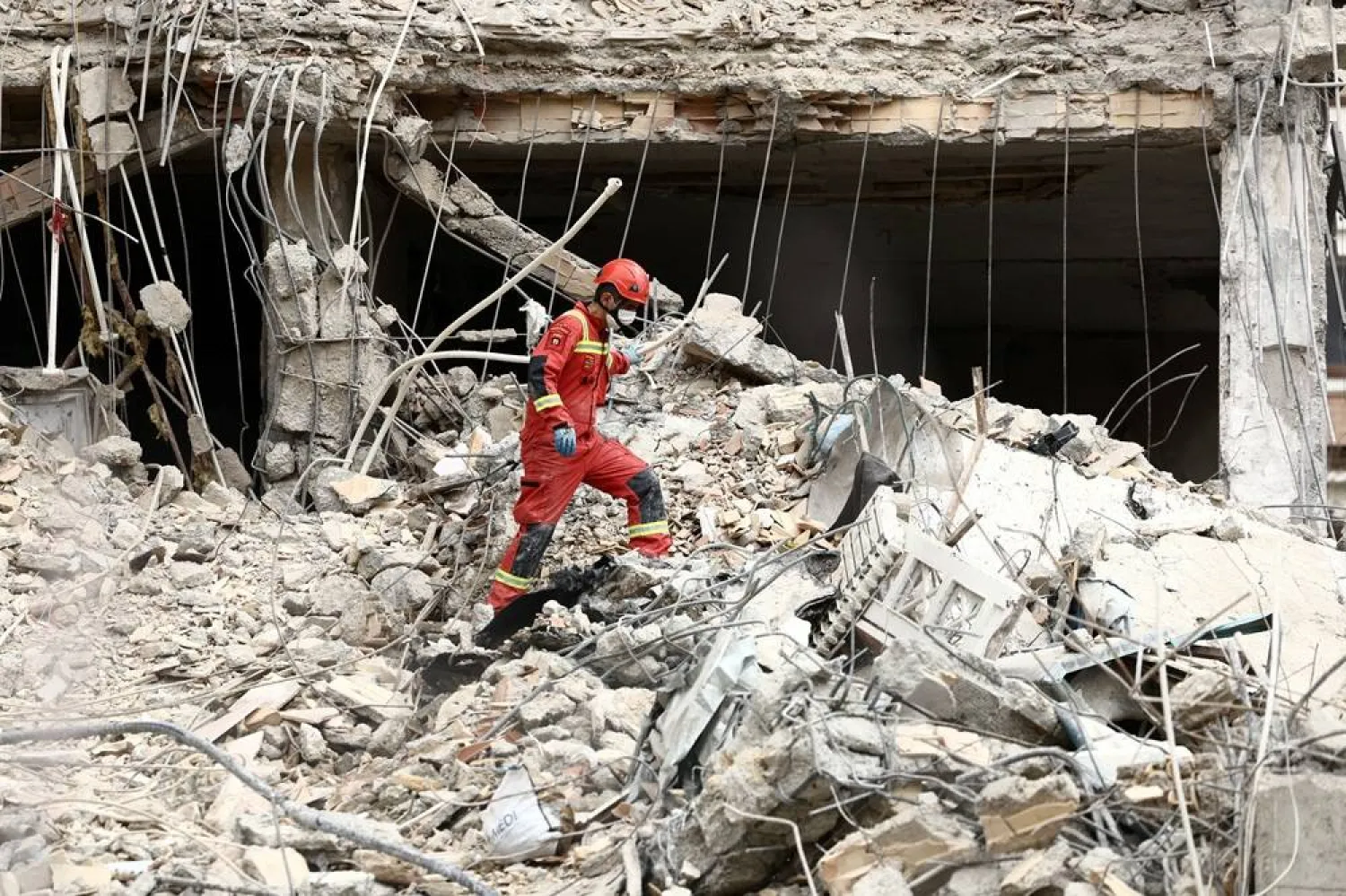
Emergency personnel work at the site of a strike on a residential building, amid the US-Israeli conflict with Iran, in Tehran, Iran, March 23, 2026. Majid Asgaripour/WANA (West Asia News Agency) via Reuters
TT

Iran’s True Casualty Figures Unknown as Internet Blackout Hampers Monitors

Emergency personnel work at the site of a strike on a residential building, amid the US-Israeli conflict with Iran, in Tehran, Iran, March 23, 2026. Majid Asgaripour/WANA (West Asia News Agency) via Reuters

Iran has not updated its official death toll figures for weeks, while human rights groups outside the country are struggling with chronic communication problems, meaning the number of people killed during the war remains largely unknown.

The last time Iran's health ministry gave a full update about casualties was on March 8, the ninth day of the conflict, when it said around 1,200 civilians had been killed in US and Israeli airstrikes across the country.

Overseas human rights groups have long been considered one of the most reliable sources of information about life inside the heavily censored country.

But with Iran's connections to the global internet cut off and phone lines down, they are struggling to reach their networks of contacts who are their eyes and ears on the ground.

The US-based Human Rights Activists News Agency (HRANA), which played an important role corroborating deaths during anti-government protests in January, estimates the civilian death toll at 1,407 people, including 214 children.

"I would say it's an absolute, absolute minimum, and that's simply because we don't have the capacity to be everywhere at one time, understanding the full extent of what's happening," HRANA deputy director Skylar Thompson told AFP.

"With the scale and the speed at which places are being targeted across the country, it's impossible to document it at the same pace," she added.

The Iranian Red Crescent is not providing casualty estimates, but its latest figures indicate 61,555 homes, 19,000 businesses, 275 medical centers, and nearly 500 schools have been damaged.

AFP journalists have been able to confirm that many civilian buildings in Tehran have been damaged, including apartment blocks caught in the blast wave of nearby missile or bomb strikes, but not beyond the city.

Reporters are unable to travel around the country without official authorization.

- Connection problems -

Distrust of Iran's official figures is high among human rights groups, particularly after the bloody crackdown on anti-government protests in January.

Although Iran acknowledged around 3,000 deaths, mostly among security forces, researchers and campaigners outside Iran estimated that anywhere from 7,000 to 35,000 people were killed in the indiscriminate shooting.

"The Islamic republic has a history of not publishing or not collecting data," Awyar Shekhi from the Norway-based human rights group Hengaw told AFP.

The problem for Hengaw and others seeking to provide a credible alternative to the incomplete official data has been the almost-total shutdown of Iran's internet connections to the outside world since the start of the war on February 28.

"The connection is worse than it ever was before, so it's really difficult to get accurate data of how many people have been killed, and the information we get is so little," Shekhi added.

Both she and Thompson stressed that Iranian authorities have been threatening and arresting people who have illegally accessed the global internet to send information abroad, sometimes accusing them of spying.

Making telephone calls to Iran from abroad is also largely impossible.

- 'Focus on the civilian harm' -

The biggest loss of life for civilians in the war so far was the airstrike on an elementary school in Minab on the first day of the war that killed at least 165 people, according to an official toll.

A US Tomahawk cruise missile hit the school because of a targeting mistake, according to the preliminary findings of a US military investigation reported by The New York Times.

Hengaw also documented an airstrike on a flour factory in the city of western Naqadeh on March 7 that killed 11 workers and injured another 21.

"I believe that the US and Israel are using a quite aggressive interpretation of what is a military target," Thompson from HRANA added.

Unlike in January, during the anti-government protests, she said there had so far been relatively little attention in the Western media on the toll of ordinary Iranians.

"There's such a focus on the geopolitics of it all, I think it's really important to have a focus on the civilian harm," she added.

Elsewhere in the region, Lebanon's health ministry said Israeli strikes had killed 1,029 people in the country.


Female Iranian Student Arrives in Iran After Release in France

Iranian national Mahdieh Esfandiari arrives for her trial on charges of promoting terrorism on social media at a Paris courthouse on January 13, 2026. (AFP)
TT

Female Iranian Student Arrives in Iran After Release in France

Iranian national Mahdieh Esfandiari arrives for her trial on charges of promoting terrorism on social media at a Paris courthouse on January 13, 2026. (AFP)

Iranian student Mahdieh Esfandiari arrived in Iran after being released in France, Iranian state TV reported on Wednesday, after ‌two French ‌nationals facing security ‌charges ⁠were allowed to ⁠leave Iran following three-and-a-half years in detention.

Esfandiari, who was convicted at the end ⁠of February for glorifying ‌terrorism ‌in anti-Israel social ‌media posts, was released ‌after serving almost a year in prison.

"I think it's ‌clear for everyone that there is ⁠no ⁠freedom of speech, at least not in France where I was. The court's ruling was very unjust," Esfandiari told state television.


Israeli Rights Group Files ICC Case Against Spanish PM

Spain's Prime Minister Pedro Sanchez gestures as he speaks during a press conference in Madrid. (AFP)
TT

Israeli Rights Group Files ICC Case Against Spanish PM

Spain's Prime Minister Pedro Sanchez gestures as he speaks during a press conference in Madrid. (AFP)

An Israeli rights group said Tuesday that it had asked the International Criminal Court to consider legal action against Spanish Prime Minister Pedro Sanchez for allegedly “aiding war crimes” through exports to Iran.

Filed by the Shurat HaDin non-governmental organization, which has taken legal action worldwide against what it calls “Israel’s enemies,” the lawsuit accuses Spain of providing “components required by the regime in Tehran and its proxies for military purposes.”

In a filing submitted under Article 15 of the Rome Statute, it alleges that Spain approved the export of about 1.3 million euros’ worth of so-called dual-use products that could be used in detonators and other explosive-related applications.

“These materials are not innocent industrial products, but critical components that enable explosive devices to function, and they were transferred in circumstances where their use for attacks against civilians was foreseeable and reasonable,” Shurat HaDin said in a statement.

The complaint comes in the midst of an escalating diplomatic spat between the two nations, which began with the start of the Gaza war in October 2023 and worsened after Madrid recognized a Palestinian state a year later.

Spain’s Socialist leader has also opposed the US-Israeli war with Iran, drawing a sharp Israeli reaction.

Last week, Prime Minister Benjamin Netanyahu barred Madrid from joining the work of a US-led center to stabilize post-war Gaza, accusing Spain of waging a diplomatic campaign against Israel.


Xi Calls China-Russia Ties ‘Precious’ in Current International Context

This handout picture posted on the Telegram account of the Russian Foreign Ministry on April 15, 2026 shows Russia's Foreign Minister Sergei Lavrov (L) shaking hands with China's President Xi Jinping in Beijing. (Handout / Russian Foreign Ministry / AFP)
TT

Xi Calls China-Russia Ties ‘Precious’ in Current International Context

This handout picture posted on the Telegram account of the Russian Foreign Ministry on April 15, 2026 shows Russia's Foreign Minister Sergei Lavrov (L) shaking hands with China's President Xi Jinping in Beijing. (Handout / Russian Foreign Ministry / AFP)

Chinese President Xi Jinping said Wednesday that the stability and certainty of China-Russia relations are particularly “precious” in the face of an international landscape intertwined with change and chaos.

During a meeting with Russian Foreign Minister Sergei Lavrov in Beijing, Xi said the strong vitality and exemplary significance of the friendship treaty between the two countries stand out even more under such a backdrop.

He said foreign ministries from both countries would need to fully implement the consensus reached between him and Russian President Vladimir Putin, calling for strengthening strategic communication and close diplomatic coordination.

He also urged them to promote the comprehensive strategic partnership between Beijing and Moscow to “stand higher, walk more steadily and go further.”

Xi touted the value of the two nations’ ties, but he did not specify what he referred to as chaos and changes in the international context, as uncertainty still lingers about how long the Iran war would last.

In clips from an interview with the Fox Business Network, US President Donald Trump said Tuesday the war was “close to over.” Trump has repeatedly declared a US victory in Iran after the war started — even as the reality on the ground has been far more complicated.

Relations between China and Russia have deepened in recent years, particularly following the Russian invasion of Ukraine in early 2022. Trump’s unorthodox approach to the war in Ukraine has added a twist to the relationship but doesn’t appear to have fundamentally changed it.

When Putin visited China in September, Xi welcomed his counterpart as an “old friend.” Putin also addressed Xi as “dear friend.”

Lavrov arrived in China on Tuesday for a two-day trip at the invitation of his Chinese counterpart Wang Yi.