Pakistan Willing to Host Peace Talks to End US-Israeli War on Iran

 Israeli Home Front Command officers inspect an apartment building struck by an Iranian missile in Tel Aviv, Israel, Sunday, March 22, 2026. (AP)
Israeli Home Front Command officers inspect an apartment building struck by an Iranian missile in Tel Aviv, Israel, Sunday, March 22, 2026. (AP)
TT

Pakistan Willing to Host Peace Talks to End US-Israeli War on Iran

 Israeli Home Front Command officers inspect an apartment building struck by an Iranian missile in Tel Aviv, Israel, Sunday, March 22, 2026. (AP)
Israeli Home Front Command officers inspect an apartment building struck by an Iranian missile in Tel Aviv, Israel, Sunday, March 22, 2026. (AP)

Pakistan's prime minister said on Tuesday he was willing to host talks between the US and Iran on ending the war in the Gulf, a day after President Donald Trump postponed threats to bomb Iranian power plants, saying there had been "productive" talks. 

In a post on X, Prime Minister Shehbaz Sharif said Pakistan welcomed and fully supported ongoing efforts to pursue dialogue to end the war. 

"Subject to concurrence by the US and Iran, Pakistan stands ready and honored to be the host to facilitate meaningful and conclusive talks for a comprehensive settlement," he said. 

The US and Israel launched strikes on Iran on February 28 after saying they had failed to make enough headway in talks aimed at ending Iran's nuclear program, although mediator Oman said significant progress had been made. 

Since then, Iran has attacked countries that host US bases, struck Gulf energy infrastructure and effectively closed the Strait of Hormuz, conduit for a fifth of the world's oil and liquefied natural gas, creating the worst energy supply shock in history. 

A Pakistani government source said discussions on a meeting were at an advanced stage ‌and if it ‌did happen, "a big 'if'", it would take place within a week. 

The war is already taking a toll on ‌major economies ⁠around the world, according ⁠to business surveys on Tuesday which showed how a surge in energy prices and rising uncertainty were dampening activity and pushing inflation expectations higher. 

IRAN DENIES TALKS HAVE TAKEN PLACE 

On the ground, there were no signs of conflict abating in the Gulf or Lebanon, where Israel is carrying out a parallel operation against the Hezbollah group, which has fired at Israel in support of its patron Iran. 

An Iranian missile was intercepted over Lebanese airspace for the first time on Tuesday, three senior Lebanese security sources said, with two of them saying a foreign naval vessel was responsible for the interception. 

Trump said on Monday the US and Iran had held "very good and productive" conversations about a "complete and total resolution of hostilities in the Middle East" and that he was postponing for five days a plan ⁠to hit Iran's energy grid. 

He said talks had begun on Sunday and continued into Monday, with Special ‌Envoy Steve Witkoff and his son-in-law Jared Kushner involved. 

But after Trump's Truth Social comment on ‌Monday, Iran denied that any talks had been held. 

Iran's powerful parliament speaker Mohammad Baqer Qalibaf - the interlocutor on the Iranian side, according to an Israeli official and two ‌other sources familiar with the matter - described reports of direct talks as "fake news". 

Trump's threat to bomb Iran's electricity plants had prompted Tehran to threaten ‌retaliatory strikes on the power infrastructure of US allies across the region, sending the price of benchmark Brent crude oil soaring as high as $114.43 on Monday morning. 

After declining on Trump's step-back, prices were about 3% higher again on Tuesday around $103 on concern over supply shortages. 

Three senior Israeli officials, speaking on condition of anonymity, said Trump appeared determined to make a deal, although they viewed it as unlikely that Iran would agree to US demands. 

They said these were likely to include curbs on Iran's nuclear program and ‌ballistic weapons development. 

Three senior sources in Tehran said Iran's negotiating stance had only hardened since the start of the war, under the growing influence of the Iranian Revolutionary Guard Corps, and that it would demand ⁠significant concessions from the US. 

Israeli ⁠Prime Minister Benjamin Netanyahu, who spoke to Trump less than 48 hours before their countries began the war, was expected to convene security officials for talks on Trump's bid for a deal with Iran, two senior Israeli officials said. 

AIR SIRENS SOUND IN TEL AVIV 

Iranian missiles triggered air raid sirens in densely populated Tel Aviv, Israel's commercial hub, where there are also military sites. 

A missile carved a massive crater in the road of one neighborhood, and the blast blew out the walls of a multi-storey apartment building, scattering debris across the street. It was the latest in a series of Iranian attacks in recent days that have penetrated Israel's sophisticated air defenses. There were no reported deaths. 

Israel's military said its fighter jets had carried out a wave of strikes in central Tehran on Monday, targeting command centers including facilities associated with the IRGC's intelligence arm and the Intelligence Ministry.  

It said it had hit more than 50 other targets overnight, including ballistic missile storage and launch sites. 

Air defense systems were activated across Tehran as explosions were heard simultaneously in several areas of the capital, according to the Iranian news agency Nournews. 

At least eight people were killed and 28 injured in a strike on a residential area of Tabriz, a city of 1.7 million in Iran's northwest, the provincial director for crisis management told Tasnim news agency. 


Europe Pushes for Seat at Ukraine Peace Talks ‌but Lacks Unified Voice

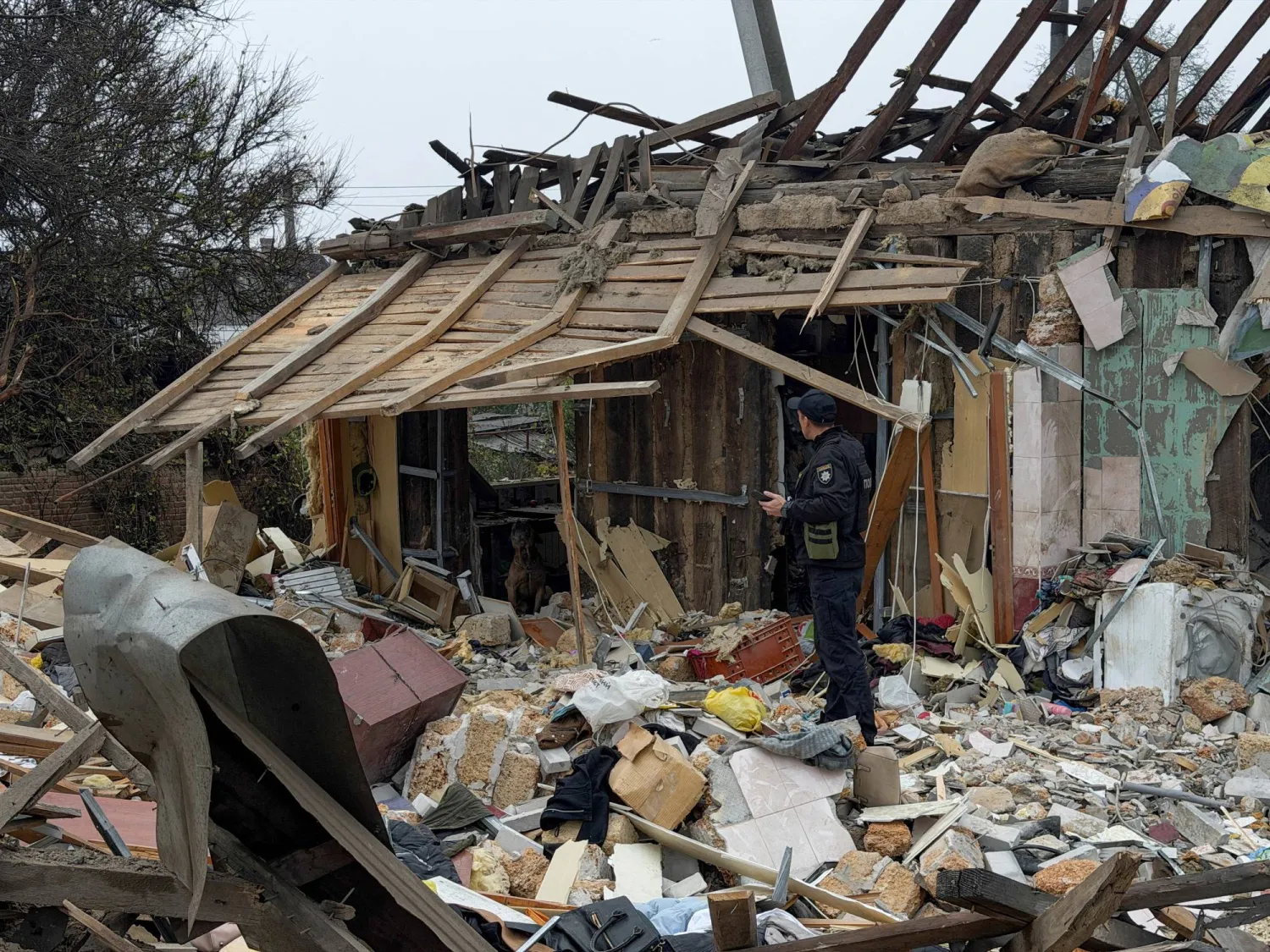
 A police officer inspects the site of a residential house damaged by a Russian military strike, amid Russia's attack on Ukraine, in Zaporizhzhia, Ukraine November 13, 2026. (Reuters)
A police officer inspects the site of a residential house damaged by a Russian military strike, amid Russia's attack on Ukraine, in Zaporizhzhia, Ukraine November 13, 2026. (Reuters)
TT

Europe Pushes for Seat at Ukraine Peace Talks ‌but Lacks Unified Voice

 A police officer inspects the site of a residential house damaged by a Russian military strike, amid Russia's attack on Ukraine, in Zaporizhzhia, Ukraine November 13, 2026. (Reuters)
A police officer inspects the site of a residential house damaged by a Russian military strike, amid Russia's attack on Ukraine, in Zaporizhzhia, Ukraine November 13, 2026. (Reuters)

European nations are seeking an envoy to represent them in talks on ending the Russia-Ukraine war, concerned that a US-backed process will leave them sidelined and Kyiv vulnerable as Moscow and Washington decide the fate of a conflict that has roiled the continent.

Whether Europe should be represented by one person or a team — and who should take on the role — is being debated Friday as leaders from the 27-nation European Union meet at a summit in Dublin. Senior EU officials and politicians have been suggested, but there is not yet a consensus.

What the job might entail is also unclear and contested. But there is broad agreement by governments from the UK to Ukraine on the need for Europe to join the ongoing negotiations involving Moscow, Kyiv and Washington.

“This needs to be resolved," Irish Prime Minister Micheál Martin said as he arrived at the summit, which will include talks on AI as well as the Russia-Ukraine war.

“I would hope that today’s discussions bring clarity around this,” he said. "It needs to be, in my view, finally decided upon within the next week or two.”

Ukraine is eager for support from its European allies, as it's reluctant to leave the talks solely in the hands of a US administration that has often seemed to lean toward Moscow’s views. Russia does not want European countries involved in direct negotiations, complaining they are financing and supplying Ukraine’s military effort.

European leaders also distrust US President Donald Trump to negotiate on their behalf after a series of tense standoffs over trade, Greenland and conflicts in Iran and Ukraine.

“Without Europeans, there is no support for Ukraine,” French President Emmanuel Macron said at a meeting of the European Political Community in Dublin on Thursday. “There is no more US support."

“At the end of the day, we will be the ones to define and decide for our future security as Europeans,” he said.

Europe is broadly aligned but not unified

European leaders fear Russian President Vladimir Putin will press Trump to back a peace settlement that weakens not just Ukraine but broader European security. Putin has demanded NATO troops be pulled back from Russia’s borders and that no European forces be deployed in Ukraine.

British Prime Minister Andy Burnham rejected the idea that Europe was being sidelined during peace negotiations, saying European countries were determined to “put a bit of a ring of steel around Ukrainian President Volodymyr Zelenskyy.”

As envoys from Washington, Moscow and Kyiv met in Abu Dhabi, several European countries, including the UK, France and Germany, attended discussions nearby.

US envoy Jared Kushner and Zelenskyy said after they met in Dublin late Thursday that Europe would be part of the next round of talks. Zelenskyy said Europe would send a negotiating team, adding, "They will have a voice.”

“We cannot conclude this deal without the Europeans being at the table,” Kushner said. He said Putin "is willing to give it a try.”

Supporters of a single envoy, like Italian Prime Minister Giorgia Meloni, argue that the absence of a united European voice has allowed individual countries or small groups to engage in freelance diplomacy.

“There are too many different groupings discussing the issue,” she said.

Meloni has criticized a series of seemingly uncoordinated initiatives, including a call to Putin by Finnish President Alexander Stubb and Norwegian Prime Minister Jonas Gahr Støre, that she said could undermine European interests.

She has increasingly pushed for a common EU representative for Europe to speak with “a single, authoritative voice” and requested a decision by Friday in Dublin to be formalized in December in coordination with non-EU partners in Europe like Britain and Norway.

Martin said that European representation at the negotiations “can't just be European Union” because the Coalition of the Willing — a group of over two dozen countries that have pledged military support to help maintain a future peace in Ukraine — “has involved far more than the European Union.”

“It's a European continentwide issue,” he said.

Kremlin spokesperson Dmitry Peskov argued that for Europe to join peace talks, it first must name a representative. “The Europeans squabble like spiders in a jar. If someone takes the initiative to establish contact with the Russian side, those people face ostracism.”

An old question with no clear answer

The question of who represents Europe is an old one. Europe itself is loosely defined. Is it the 27-nation EU, the 32-nation NATO military alliance made up mostly of European countries, the 29-nation Schengen zone, or the 47-nation European Political Community?

That has frustrated Washington in the past and present.

After this week's US-brokered talks between Ukraine and Russia in the United Arab Emirates, Kushner said that “if Europe could identify one person to speak on their behalf, that would be a bigger achievement than getting the Russians to include them in the negotiation.”

That echoes the famous question often mis-attributed to former US Secretary of State Henry Kissinger: “Who do I call if I want to call Europe?”

Potential candidates from within the EU France, Germany and the UK, the region’s top three economies collectively known as the European trio or E3, have so far been the most engaged European body in negotiations. But while London is deeply involved with Ukraine, the UK left the EU in 2020.

German Chancellor Friedrich Merz said Thursday that the E3 is “a proven format” for diplomacy.

But an E3 envoy would leave out the other 25 EU nations and rankle smaller nations like those that border Russia and Belarus on the bloc’s “eastern flank,” which face constant hybrid threats, including influence campaigns and disruptive drones.

Some back a top EU official for the job. Even inside Brussels, however, there are two leading contenders: European Council President Antonio Costa and EU foreign policy chief Kaja Kallas.

Costa's current role is to represent national leaders. A former prime minister of Portugal, he spent much of the past year visiting capitals across the bloc.

“European security cannot be discussed without a European voice at the table,” Costa said in Dublin on Thursday. “That European voice needs to be a team effort between European nations, the European Union and NATO.”

But earlier this year, Costa faced criticism within the EU after his office set up a hush-hush back-channel with Moscow.

Kallas, a former prime minister of Estonia, could also lay claim to the envoy role.

She said in Dublin that the E3 represents the “big countries” but then asked “who is representing the European Union?"

"Americans are representing American interests. Europeans are representing European interests,” Kallas said, adding that the EU’s foundational treaties are “very, very clear” that she and Costa were appointed in 2024 to represent the bloc in “security matters.”

Kallas, however, has had a bumpy track record with US diplomats as Washington and Brussels sparred over trade and Ukraine. She's also acknowledged tensions between her office, the EU's External Action Service, and the European Commission.

Another name that has been floated is Stubb, the Finnish president. He has warm relations with Trump and met in Oslo with US envoys Steve Witkoff and Kushner in October. A week after that, he called Putin with Støre, the Norwegian prime minister. Stubb spoke with Zelenskyy by phone on Tuesday.

But some leaders deeply distrust the US-brokered talks. Polish Prime Minister Donald Tusk was critical of the negotiations, reflecting a regional pessimism among EU countries formerly dominated by the Soviet Union.

“In my opinion, calling them negotiations is an exaggeration," Tusk said Thursday. “We will not build a new security architecture simply because the Russian president, or someone in the United States, wishes it."


Russia Says Ukraine Drones Kill Four, Kyiv Reports Hospital Hit

Firefighters work at the site of a reported Russian attack, amid Russia's attack on Ukraine, in a location given as Odesa Region, Ukraine, November 9, 2026, in this screengrab taken from a handout video.(State Emergency Service of Ukraine/Handout via Reuters)
TT

Russia Says Ukraine Drones Kill Four, Kyiv Reports Hospital Hit

Firefighters work at the site of a reported Russian attack, amid Russia's attack on Ukraine, in a location given as Odesa Region, Ukraine, November 9, 2026, in this screengrab taken from a handout video.(State Emergency Service of Ukraine/Handout via Reuters)

Russia said on Friday that it shot down nearly 1,200 Ukrainian drones overnight, one of the largest swarms sent by Kyiv that killed four people.

Ukrainian authorities reported that another night of Russian attacks had set a hospital ablaze and killed at least three people.

The deadly attacks came a day after intense shuttle diplomacy in US-led talks to end the war approaching its fifth year.

US envoys Steve Witkoff and Jared Kushner held hours of talks with Russian President Vladimir Putin in Moscow on Thursday before jetting to Dublin to huddle with Ukrainian President Volodymyr Zelensky.

"In the course of the previous night... aerial defense systems intercepted and destroyed 1,198" Ukrainian drones over more than 15 Russian regions, Russia's defense ministry said in a statement.

Four people working in an industrial zone, home to an oil refinery and a chemical factory, died in the southern Volgograd region, local authorities said.

In Ukraine, a hospital in Kyiv was damaged after a Russian attack triggered a fire and forced people to seek shelter. One person was wounded.

In Odesa, two people were killed and five wounded in the overnight barrage, with "private residential houses and cars" damaged, regional governor Oleg Kiper said on Telegram.

A Russian attack on Zaporizhzhia in the southeast killed a 17-year-old boy, acting regional governor Mykhailo Semikin said.

Four people, who rescuers managed to pull from under the rubble, were wounded.

Another Russian strike hit the city of Rivne, in a northwestern region far from the frontline, damaging a kindergarten and wounding six people, including two children.

Ukraine has intensified its retaliatory drone attacks on Russia's energy industry over the past year-and-a-half, seeking to cut the Kremlin's revenues and undermine its ability to finance the war Moscow launched in February 2022.

Russia is heavily targeting Ukraine's own energy grid with aerial barrages, leaving residents across the country without power as temperatures plunge ahead of winter.


UN Nuclear Watchdog Urges Iran to Take ‘Steps’ Towards Inspections

An Iranian woman walks next to a billboard depicting Iran’s national flag in a street in Tehran, Iran, 09 November 2026. (EPA)
TT

UN Nuclear Watchdog Urges Iran to Take ‘Steps’ Towards Inspections

An Iranian woman walks next to a billboard depicting Iran’s national flag in a street in Tehran, Iran, 09 November 2026. (EPA)

The UN's nuclear watchdog urged Iran to take "incremental steps" to allow inspectors to return to key nuclear facilities in the Islamic republic, adding such access was "critical" in a report seen by AFP Friday.

The International Atomic Energy Agency (IAEA) has not had access to key nuclear facilities in Iran since Israel, joined by the United States, launched a 12-day conflict in June 2025 that included strikes on nuclear sites.

Nuclear facilities have also been hit in the latest war, which erupted on February 28, and the IAEA has repeatedly called for access.

In its report, to be discussed at an IAEA board of governors meeting next week, the agency noted that it was "critical" for it to conduct "verification activities in Iran without further delay".

"The director general encourages Iran to consider technical and gradual measures by which conditions are achieved that allow for the return of agency inspectors to Iran," the report said.

"Such incremental steps could pave the way to normal safeguards implementation in Iran while contributing to a confidence-building atmosphere conducive to a wider agreement," it added.

The report detailed correspondence in recent weeks between the IAEA and Iran.

IAEA inspectors were able to visit Iran's Bushehr nuclear plant in September, but have had no access to other facilities.

The IAEA "acknowledged that the military attacks on Iran's nuclear facilities and sites created an unprecedented situation".

But because of a lack of cooperation "the agency is not able to conclude that there has been no diversion of declared nuclear material from peaceful nuclear activities in Iran", the report said.

"The agency's lack of information about ... nuclear material and access to facilities to verify it is a matter of serious proliferation concern," the IAEA said, adding it "needs to be rectified with the utmost urgency".

The IAEA board in September referred Iran to the UN Security Council over its nuclear "non-compliance", marking the first time Iran has been referred to the UN top body in 20 years for failing to comply with its nuclear reporting obligations.

Before the June 2025 strikes, the IAEA calculated that Iran possessed approximately 440 kilograms of uranium enriched to 60 percent, nearing the 90 percent needed to make a bomb and well above the 3.67-percent limit set by a 2015 now-defunct agreement with Iran.

Since June 2025, the fate of the stockpile has remained uncertain.

Iran has long denied striving to develop a nuclear bomb.