

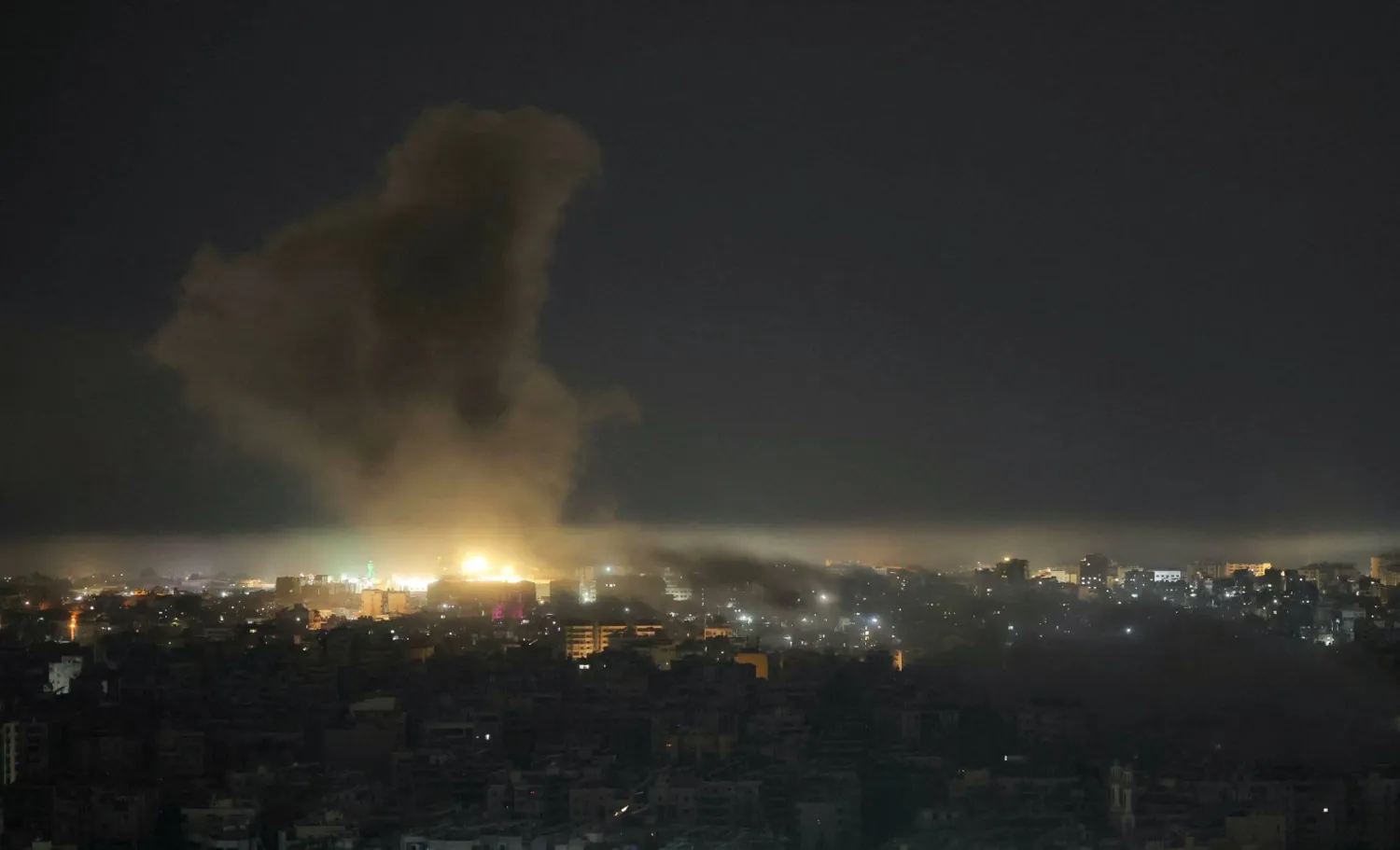

Israeli Strike Near Beirut Kills 2 While Raids Target Southern Suburbs

Smoke rises from the site of an Israeli airstrike that targeted an area in Beirut's southern suburbs on March 24, 2026. (AFP)
TT

Israeli Strike Near Beirut Kills 2 While Raids Target Southern Suburbs

Smoke rises from the site of an Israeli airstrike that targeted an area in Beirut's southern suburbs on March 24, 2026. (AFP)

An Israeli strike on Bshamoun, south of Beirut, killed two people on Tuesday, Lebanon's health ministry said, while strikes on the capital's southern suburbs continued throughout the night.

"The Israeli enemy raid on the town of Bshamoun in the Aley district resulted, in a preliminary toll, in the martyrdom of two citizens and the injury of five others," the ministry said in a statement.

Located in the mountainous, Druze-majority Aley district southeast of Beirut, Bshamoun lies outside of Hezbollah's traditional strongholds.

Lebanon was pulled into the Middle East war when Iran-backed Hezbollah began firing rockets into Israel on March 2 to avenge the killing of Iran's supreme leader Ali Khamenei in a US-Israel attack. 

Israel has since launched strikes across Lebanon, killing at least 1,039 people, and sent ground troops into the country's south. 

Separately, Lebanon's state-run National News Agency reported that Israel's overnight attacks on Beirut's southern suburbs, where Hezbollah holds sway, had targeted seven areas. 

"Enemy warplanes launched seven raids overnight on the southern suburbs, targeting the areas of: Bir al-Abed, Al-Ruwais -- outskirts of Al-Manshiyya, Haret Hreik, Hadi Nasrallah Highway, Saint Therese, Burj al-Barajneh and Al-Kafaat," NNA said on Tuesday. 

The Israeli military on Monday renewed its calls for residents of the southern suburbs to evacuate. 

A spokesperson for the UN secretary-general estimated this week that the ongoing war has displaced about one in five residents of Lebanon. 

Meanwhile, Israel's military said it captured two Hezbollah members in southern Lebanon.

In a statement on Monday, the Israeli army said that "during an activity to locate weapons in southern Lebanon, (Israeli) troops identified several armed Hezbollah Radwan Force terrorists who were planning to fire an anti-tank missile", referring to the group's commando force.

"After being identified, the terrorists surrendered. They were apprehended by the troops and transferred to Israeli territory for further questioning," it added.

The Israeli military told AFP two Hezbollah members were captured.

- 'Only just begun' -

The two Hezbollah members captured in the south were the latest additions to a list of Lebanese who have been held in Israel since the last war between it and the group.

Hezbollah lawmaker Hussein al-Hajj Hassan said in January that Israel was holding "20 Lebanese prisoners", alleging 10 had been abducted "inside Lebanese territory after the ceasefire" that sought to end the previous conflict in 2024.

The next month, Israeli forces seized a member of the Hamas-allied Jamaa Islamiya in southern Lebanon.

The Israeli army's Arabic-language spokesperson Ella Waweya said on Monday "the battle against Hezbollah... has only just begun".

In a video statement, Israeli Prime Minister Benjamin Netanyahu said his country will "continue to strike both in Iran and in Lebanon".

Israel earlier struck a bridge linking areas in southern Lebanon to the Bekaa Valley in the east of the country, a day after a major bridge in the Tyre region was targeted.

Israeli Defense Minister Israel Katz said on Sunday he and Netanyahu had instructed the military to "destroy all the bridges over the Litani River that are used for terrorist activity".



Hamas Gives ‘Positive Response’ in Cairo, Raising Hopes of Near-Term Deal

Palestinians in Khan Younis, southern Gaza Strip, on Saturday (AFP)
TT

Hamas Gives ‘Positive Response’ in Cairo, Raising Hopes of Near-Term Deal

Palestinians in Khan Younis, southern Gaza Strip, on Saturday (AFP)

Sources within Hamas said the group’s delegation in Cairo has delivered a “positive response” to a revised proposal from mediators, particularly Egypt, potentially paving the way for an agreement on Gaza soon.

Negotiations on the deal remain stalled. Hamas and other factions insist Israel must first meet its phase-one ceasefire commitments, including humanitarian relief and the entry of aid trucks into the enclave, before they undertake further obligations. Israel, backed by the US, is pressing to move directly to the central element of phase two: disarmament.

A senior Hamas source told Asharq Al-Awsat that Zaher Jabarin and Ghazi Hamad, members of the group’s political bureau and its negotiating delegation, have returned to Cairo after leaving last Tuesday for internal consultations. Khalil al-Hayya, who heads Hamas’s negotiating team, remained in Egypt to continue talks.

The delegation returned with a “positive answer” to a proposal for handling phases one and two in parallel, the source told Asharq Al-Awsat.

The mediators’ plan stipulates the immediate start of phase-one steps while discussions continue on phase two, with no second-phase measures implemented before full completion of the first. Progression within phase two would also be conditional on completing each preceding step.

Hamas has set conditions, including the swift entry of a Gaza administrative committee to assume agreed responsibilities, along with “clear and credible guarantees” within a defined timeline to ensure Israel carries out its obligations in both phases.

Sources said Hamas held broad consultations in recent days, inside and outside Gaza, involving all its internal bodies, including religious frameworks that have historically played a key role in decision-making.

They described a “consensus,” including from the group’s armed wing, the Qassam Brigades, in support of the mediators’ proposal and negotiations over potential amendments related to weapons.

Mediators are aiming for rapid negotiations on phase two while phase one is completed, with expectations that international actors, including the US, will press Israel to comply.

A Palestinian faction source in Cairo said “contacts and meetings are ongoing at all levels,” adding that many expect a breakthrough that could lead to a deal.

However, the outcome ultimately depends on Israel’s government, which has signaled through international envoy Nikolay Mladenov and US representatives that acceptance of the bridging proposal should include Hamas agreeing to disarmament.

Sources said mediators had asked the group to approve the proposal, while officials linked to the administration of Donald Trump and Mladenov had pushed for Hamas to sign a disarmament document before negotiations proceed — a demand the group fears could be used to impose terms it opposes.

During discussions, some factions proposed reducing phase two from eight months to three or four to accelerate humanitarian improvements and reconstruction in Gaza, particularly for displaced residents living in harsh conditions.

A senior Hamas official said the group has no objection to shortening the timeline, stressing its priority is to ensure implementation of any agreement to ease civilian suffering, including by enabling the Gaza administrative committee to begin relief and service delivery.


Israeli Military Publishes Map of South Lebanon Territory Under Its Control

 Israeli military vehicles drive in southern Lebanon, near the Israel-Lebanon border, amid a 10-day ceasefire between Lebanon and Israel, as seen from Israel, April 19, 2026. (Reuters)
Israeli military vehicles drive in southern Lebanon, near the Israel-Lebanon border, amid a 10-day ceasefire between Lebanon and Israel, as seen from Israel, April 19, 2026. (Reuters)
TT

Israeli Military Publishes Map of South Lebanon Territory Under Its Control

 Israeli military vehicles drive in southern Lebanon, near the Israel-Lebanon border, amid a 10-day ceasefire between Lebanon and Israel, as seen from Israel, April 19, 2026. (Reuters)
Israeli military vehicles drive in southern Lebanon, near the Israel-Lebanon border, amid a 10-day ceasefire between Lebanon and Israel, as seen from Israel, April 19, 2026. (Reuters)

The Israeli military published ‌for the first time a map of its new deployment line inside Lebanon on Sunday, bringing dozens of mostly abandoned Lebanese villages under its control, days after a ceasefire with Hezbollah took effect.

There was no immediate comment from Lebanese officials or from Iran-backed Hezbollah.

Israel and Lebanon agreed on Thursday to a US-backed ceasefire in fighting between Israel and Hezbollah. The deal, which followed the first direct talks in decades between Israel and Lebanon on April 14, is meant to enable broader US-Iran negotiations but with Israeli forces maintaining positions deep inside southern Lebanon.

Stretching east to west, the deployment line on the ‌map runs 5-10 km ‌deep from the border into Lebanese territory, where Israel ‌has ⁠said that it ⁠plans to create a so-called buffer zone. Israeli forces have destroyed Lebanese villages in the area, saying their aim is to protect northern Israeli towns from Hezbollah attacks.

It has created buffer zones in Syria and in Gaza, where it controls more than half the enclave.

"Five divisions, alongside Israeli Navy forces, are operating simultaneously south of the forward defense line in southern Lebanon in ⁠order to dismantle Hezbollah terror infrastructure sites and to ‌prevent direct threats to communities in northern ‌Israel," the military said in a statement accompanying the map.

Asked whether people who fled ‌the Israeli strikes would be allowed to return to their homes, ‌the Israeli military declined to comment.

Lebanese civilians have been able to access some of the villages that fall on or beyond the Israeli-set line, but Israeli forces still prevent people from accessing most of those south of the line, a Lebanese security ‌source said.

Israeli Defense Minister Israel Katz said on Sunday that homes on the border exploited by Hezbollah would ⁠be demolished and ⁠that "any structure threatening our soldiers and any road suspected of (being planted with) explosives must be immediately destroyed".

Lebanon was dragged into the war on March 2, when Hezbollah opened fire in support of Tehran, prompting an Israeli offensive that has killed more than 2,100 people, including 177 children, and forced more than 1.2 million to flee, Lebanese authorities say.

Hezbollah has not disclosed its casualty figures. At least 400 of its fighters had been killed by the end of March, according to sources close to the group.

Hezbollah has fired hundreds of rockets and drones at Israel. Its attacks killed two civilians in Israel while 15 Israeli soldiers have died in Lebanon since March 2, Israel says.


Israel Re-Establishes Evacuated West Bank Settlement

Israeli Defense Minister Israel Katz, (3rd-L), Yossi Dagan, Head of the Shomron Regional Council (4th-L), and Israel's far-right Finance Minister Bezalel Smotrich (4th-R) stand for the national anthem as they attend the resettlement ceremony of Sa-Nur, south of Jenin, in the Israeli-occupied West Bank on April 19, 2026. (AFP)
TT

Israel Re-Establishes Evacuated West Bank Settlement

Israeli Defense Minister Israel Katz, (3rd-L), Yossi Dagan, Head of the Shomron Regional Council (4th-L), and Israel's far-right Finance Minister Bezalel Smotrich (4th-R) stand for the national anthem as they attend the resettlement ceremony of Sa-Nur, south of Jenin, in the Israeli-occupied West Bank on April 19, 2026. (AFP)

Israeli ministers on Sunday officially reopened Sa-Nur, a settlement in the occupied West Bank that was evacuated 20 years ago, marking the occasion with defiant declarations against Palestinian statehood and calls to resettle Gaza.

Several cabinet members and lawmakers attended the ceremony near a cluster of white prefabricated homes arranged in rows on a hilltop.

Excluding east Jerusalem, more than 500,000 Israelis now live in the West Bank in settlements that are illegal under international law, among some three million Palestinians.

"On this exciting day, we celebrate a historic correction to the criminal expulsion from Northern Samaria," Finance Minister Bezalel Smotrich said, using the Israeli biblical term for part of the West Bank.

Sa-Nur's settlers were evicted in 2005 as part of Israel's so-called disengagement policy that also saw the country withdraw troops and settlers from the Gaza Strip.

The policy promoted by then-prime minister Ariel Sharon was framed as a security measure intended to reduce Israel's civilian and military footprint in densely populated Palestinian areas.

Israel's current government, considered one of the most right-wing in the country's history, approved the reconstruction of all four northern West Bank settlements evacuated in 2005.

Authorities have approved 126 housing units in Sa-Nur alone.

"We are cancelling the shame of the disengagement, burying the idea of a Palestinian state and returning to the settlement of Sa-Nur," Smotrich said.

Smotrich, a far-right minister in the ruling coalition and a settler himself, also called for the resettlement of the Gaza Strip as a "security belt" for the State of Israel.

Israeli media reported that 16 families had moved into the re-established settlement in recent days, adding that the new residents included Yossi Dagan, head of the northern West Bank Settlements Council.

Dagan was among those evacuated from Sa-Nur in 2005.

"For me, this is both a national and a personal closing of a circle," Dagan said after cutting the ribbon at the ceremony.

"No more uprootings, no more retreats. We have returned to stay."

Israel has occupied the West Bank since 1967 and since then settlement expansion has been a policy under successive Israeli governments.

But it has accelerated significantly under the current coalition government of Prime Minister Benjamin Netanyahu.

More than 100 settlements have been approved since the government came to power in 2022, according to activists and authorities.