Syrian Army Says Base Targeted by Missiles from Iraq

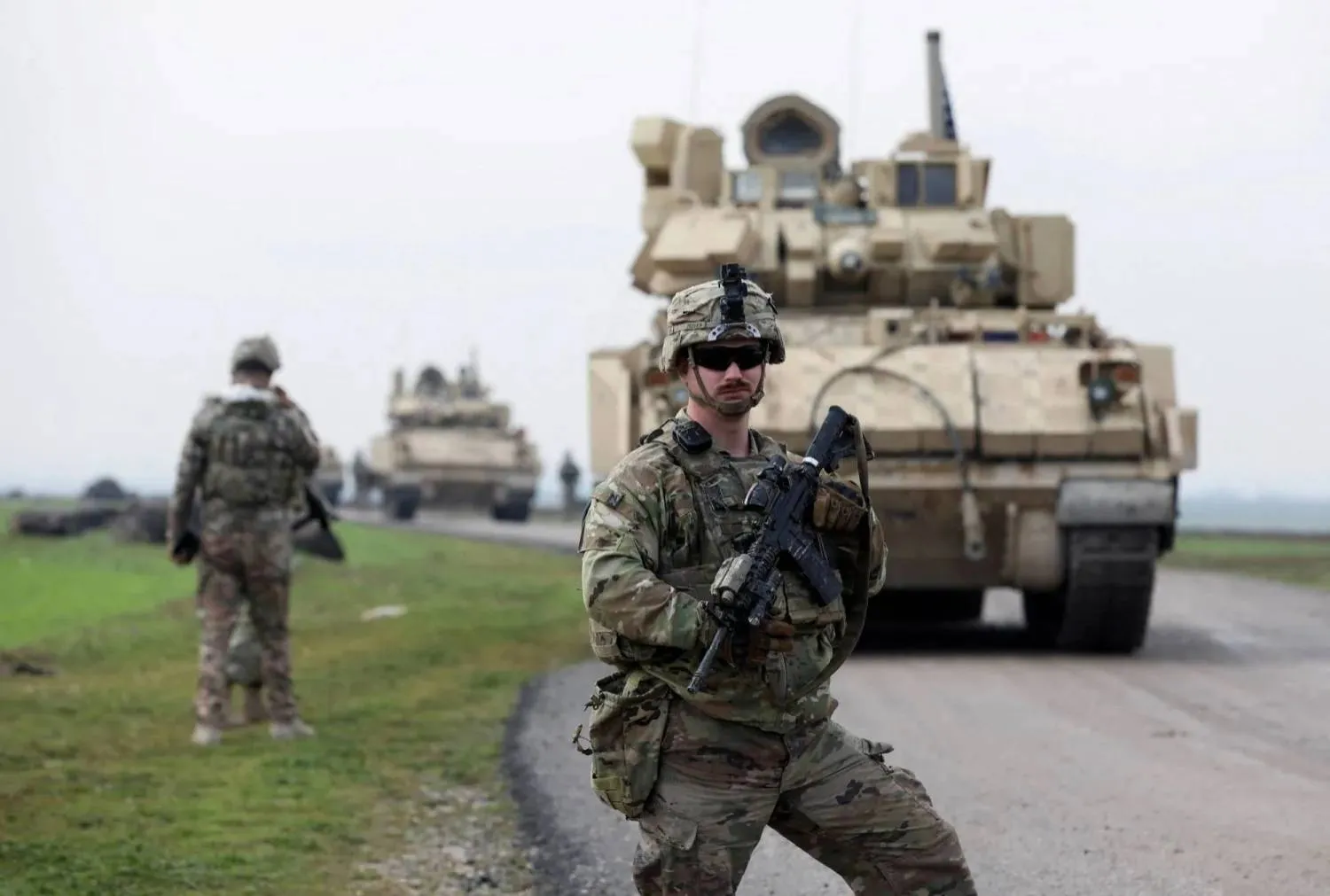
A soldier from the US-led coalition stands guard during a joint US- Kurdish-led Syrian Democratic Forces (SDF) patrol in the countryside of Qamishli in northeastern Syria February 8, 2024. (Reuters)
TT

Syrian Army Says Base Targeted by Missiles from Iraq

A soldier from the US-led coalition stands guard during a joint US- Kurdish-led Syrian Democratic Forces (SDF) patrol in the countryside of Qamishli in northeastern Syria February 8, 2024. (Reuters)

Syria's army said on Monday that one of its bases in the northeast was targeted by a missile attack from neighboring Iraq, while an Iraqi official said a local armed group was behind the attack.

"One of our military bases near the town of al-Yarubiyah in the Hasakeh province was targeted by a missile attack," the army said in a statement.

The Iraqi official, requesting anonymity, told AFP that "an Iraqi faction fired seven Arash-4 rockets, an improved version of the Grad rocket, towards a base in the Hasakeh region".

He added that a rocket launcher platform had been found abandoned in the northern Rabia area, near the Syrian border.

This month, the Syrian army took over the Rmeilan base in Hasakeh after the withdrawal of a US-led international coalition against the ISIS group from it.

"We have been in contact and coordination with the Iraqi side regarding the incident, and they have confirmed that the Iraqi army has begun a search operation to locate the perpetrators," the Syrian military added.

Syrian Kurdish military official Sipan Hamo, who was recently appointed as Syria's Assistant Minister of Defense for the eastern region, said they "condemn the attack targeting" Rmeilan.

"We hold the Iraqi authorities fully and directly responsible for this act, due to their failure to control their territory and prevent its use to launch attacks that threaten our security and territorial integrity," he added stating that the incident resulted in "material damage, but no casualties".

Iraq has been unwillingly drawn into the conflict started on February 28 when the US and Israel launched a massive wave of strikes on Iran.

Pro-Tehran armed groups have claimed responsibility for near-daily attacks on US interests in Iraq and across the region, while strikes have also targeted these groups.


Marib Raises Military Readiness Amid Houthi Escalation

Government airstrikes target Houthi fighters in Marib. (Military media)
TT

Marib Raises Military Readiness Amid Houthi Escalation

Government airstrikes target Houthi fighters in Marib. (Military media)

Yemen's government has intensified military, security and diplomatic efforts against the Iran-backed Houthis, ordering heightened readiness and preemptive action against threats. Meanwhile, its Human Rights Ministry reported more than 3,300 violations that left over 1,800 civilians dead or wounded in less than four months.

The violations, which also included mass displacement and extensive damage to vital infrastructure, come as the government seeks tougher Arab and international action against the group.

In Marib, Presidential Leadership Council member and Governor Lt. Gen. Sultan Al-Arada called for a shift from reacting to threats to anticipating them through early intelligence gathering, monitoring and risk assessment.

He said the latest Houthi escalation demanded greater military and security readiness and closer coordination between state institutions and local communities.

Al-Arada made the remarks at an expanded meeting in Marib attended by Lt. Gen. Sagheer bin Aziz, chief of the General Staff and other senior military and security officials.

The meeting reviewed battlefield developments in Marib and Al-Jawf, Houthi movements, emerging security threats and measures to strengthen coordination between military units and security agencies.

Al-Arada urged closer intelligence-sharing, tighter monitoring and stronger military capabilities, backed by improved training, discipline and regular readiness assessments to tackle threats before they escalate.

He praised the armed forces, security services and popular resistance fighters, as well as Saudi Arabia's support for Yemen.

3,334 Houthi violations

As military and security preparations intensified, the Human Rights Ministry reported documenting 3,334 violations against civilians and civilian property across several provinces between Aug. 1 and Nov. 15, 2026.

Human Rights Minister Mishdal Omar told a news conference in the interim capital Aden that the violations have killed 594 civilians and wounded 1,255 others, including women and children.

The ministry recorded 233 cases of abduction, arbitrary detention and enforced disappearance, along with the deaths of 260 children recruited by the Houthis and sent to the frontlines.

The violations included attacks on 412 civilian sites and 93 educational facilities, as well as 517 violations affecting the healthcare sector. Nineteen mosques were targeted, while 15 extrajudicial killings were recorded.

The figures reflect the mounting toll on civilians, infrastructure and essential services as fighting in western Yemen drives further displacement, said the ministry.

Citing figures from the International Organization for Migration, Omar said more than 347,000 people have been displaced.

Taiz hosted the largest number, with 143,130 people, followed by Lahj with 91,314 and Aden with 70,404. The rest were spread across Abyan, Hodeidah, Shabwa, Marib, Al-Mahra, Al-Dhale and Hadramout.

The ministry also documented 53 ballistic missile attacks on Marib, Al-Dhale, Hodeidah, Taiz, Shabwa and Hadramout, involving more than 121 missiles and at least 137 attack drones.

Landmines and explosive devices killed another 13 people and wounded 16, Omar said.

2.5 million people at risk in Taiz

The ministry also warned of worsening humanitarian conditions in Taiz, where the Houthi siege continues to restrict the flow of aid and essential supplies.

Omar said the siege has put around 2.5 million people at risk and blocked the delivery of 2,450 tons of food aid.

It has forced 186 healthcare facilities out of service, threatened the lives of 1,456 patients and newborns, and contributed to 1,400 reported cases of acute watery diarrhea and suspected cholera, he said.

Yemen seeks tougher international action against Houthis

On the diplomatic front, Foreign Minister Afrah Al-Zouba stepped up efforts to rally Arab support for the Yemeni government, warning that Houthi threats now extended beyond the country's borders to regional security and international shipping.

Briefing Arab ambassadors accredited to the Netherlands, Al-Zouba outlined the latest developments in Yemen, including Houthi military escalation and attacks on civilians, civilian property and infrastructure.

She warned that the group posed a growing threat to regional and international security through its activities targeting shipping in the Red Sea and the Bab Al-Mandeb Strait, as well as cooperation with terrorist organizations in the Horn of Africa, particularly Somalia's Al-Shabaab movement.

She said Yemen had designated the Houthis as a terrorist organization and approved measures targeting the group's leaders, financial backers and overseas networks to dismantle its financial and organizational structures and protect civilians.

The foreign minister called for similar international measures, including stronger cooperation to cut off Houthi funding and weapons supplies and hold those responsible for violations accountable.



World Bank Official Says Lebanon Reconstruction Slow to Get Off the Ground

This picture taken from the southern Lebanese village of Zawtar al-Gharbiyeh shows Israeli military excavators demolishing houses in the neighboring village of Zawtar al-Sharqiyeh, where Israeli forces are stationed, on November 18, 2026. (AFP)
TT

World Bank Official Says Lebanon Reconstruction Slow to Get Off the Ground

This picture taken from the southern Lebanese village of Zawtar al-Gharbiyeh shows Israeli military excavators demolishing houses in the neighboring village of Zawtar al-Sharqiyeh, where Israeli forces are stationed, on November 18, 2026. (AFP)

Lebanon has been slow to use international assistance to rebuild areas battered by two recent wars, a top World Bank official told The Associated Press.

The international financial institution approved $250 million in June 2025 to help Lebanon clear rubble and repair “damaged critical public infrastructure” after a bruising 2024 war between Israel and the Iran-backed Lebanese group Hezbollah.

The World Bank initially projected that $100 million would be disbursed by July 2026, but a September progress report showed that only $4.2 million had been paid out.

“I think we have to be honest and say it’s slower than where we want it to be,” World Bank Managing Director of Operations Anna Bjerde said Tuesday during a trip to Lebanon, including visits to war-damaged areas in the south.

She said security issues had contributed to the delays but that the World Bank wants to see the work go more quickly.

Even the full $250 million would cover only a fraction of Lebanon’s reconstruction needs.

The World Bank estimated that rebuilding after the 2024 war would cost about $11 billion. Another Israel-Hezbollah war, which broke out in March, caused further destruction, and the Israeli military now occupies a large swath of southern Lebanon. A ceasefire has held in other parts of the country since late June.

Overstretched institutions and security problems delay work

Bjerde said that “institutions in Lebanon are very thinly stretched” after years of crises and the security situation has required “very careful planning around where you can start and where you don’t start” to remove rubble and repair infrastructure.

The World Bank needs to be “insistent” and “very close to monitoring on a daily basis” to make sure the work gets done, she said, “because you cannot let the people down.”

The office of Lebanese Prime Minister Nawaf Salam said in a statement: “Parliament ratification of the said loan experienced considerable delays and the worsening security situation due to the conflict with Israel delayed the timely launch of project activities.”

It said Lebanon's Council for Development and Reconstruction has taken measures to speed up implementation and that $70 million worth of projects are expected to be launched by the end of the year.

At the height of the latest war, more than 1 million people were displaced in Lebanon. About 300,000 remain unable to return home.

Hezbollah has accused Lebanon of failing to carry out its duties to help the displaced. Last month, the group announced it will pay up to $14,000 to families whose homes were destroyed or made uninhabitable during the war with Israel.

US officials have said that large-scale reconstruction aid is contingent on the group’s disarmament, but that is not a condition for the World Bank assistance.

Iran war's effects ripple across the region

Bjerde also visited Syria on Wednesday, where hopes that foreign funding would help finance reconstruction after nearly 14 years of civil conflict have been dashed by the regional war that began when the US and Israel attacked Iran on Feb. 28.

The war has disrupted energy exports through the Strait of Hormuz, and Iran has fired missiles and drones at Gulf countries. In normal times, 20% of the world’s oil supply passes through the strait.

The conflict has driven up prices, with 80% of countries worldwide seeing inflation rise this year, Bjerde said. The effects have been felt acutely in the Middle East.

“Lebanon and Syria and the broader region are affected by this conflict, and it’s affected by what happens in the Gulf countries,” Bjerde said. “Those are a big, big part of the economy in this region.”

Since the war began, countries in the region have pushed ahead with plans for transportation and energy networks that would provide alternatives to routes through the strait. These include a rail line connecting Iraq’s Basra port to Türkiye and an oil pipeline linking Kirkuk in northern Iraq to the ports of Baniyas in Syria and Tripoli in northern Lebanon.

Bjerde said the World Bank had received more requests for help building such “economic corridors” and was conducting “a lot of due diligence” on potential projects.

“This is a new, emerging, large transformative opportunity,” she said.

The projects are costly and will require a mix of public and private funding, Bjerde said, “but these are worthwhile investments that can really change a country’s opportunity and make a region, a sub-region, an economic unit.”


Israel Army Launches Ground Operation in Hamas-Controlled Area of Gaza

Palestinians transport their belongings on a donkey cart as residents evacuate their homes and tent shelters in Nuseirat, in the central Gaza Strip, following an Israeli army order to leave the area amid a military operation on November 18, 2026. (AFP)
TT

Israel Army Launches Ground Operation in Hamas-Controlled Area of Gaza

Palestinians transport their belongings on a donkey cart as residents evacuate their homes and tent shelters in Nuseirat, in the central Gaza Strip, following an Israeli army order to leave the area amid a military operation on November 18, 2026. (AFP)

The Israeli military said it had launched an operation on Wednesday in a Hamas-controlled area of central Gaza, where an AFP journalist saw Israeli tanks position themselves east of the Nuseirat refugee camp.

The rare ground operation comes after inconclusive Israeli elections, with the opposition's Gadi Eisenkot trying to form a government without caretaker prime minister Benjamin Netanyahu, who has built his brand on saying he will ensure Israel's security.

A Gaza security source told AFP there was "intense Israeli artillery shelling" north of Nuseirat refugee camp and reported Israeli military vehicles in central Gaza "amid ongoing gunfire and airstrikes since midday".

The military said it had "launched a precise operation within the Gaza Strip earlier today west of the Yellow Line... to remove a threat posed to IDF troops operating in the Gaza Strip".

The Yellow Line, declared by Israel following the start of the current ceasefire in October 2025, separates Israeli and Hamas-controlled areas, with the Israeli military saying it controls more than 60 percent of the Palestinian territory.

"There is Hamas infrastructure in the area in the central Gaza Strip," the military said, adding that the operation involved military and Israeli Security Agency personnel.

Residents of the affected areas told AFP they had fled for their safety, many of them not for the first time.

Most of Gaza's 2.1 million people have been displaced at least once since the devastating war erupted following Hamas's October 7, 2023 attack on Israel.

"When we heard the sounds of shelling and explosions, we were terrified, especially since the area we live in is close to the points of incursion," Um Ahmad al-Tartoori, a resident of the Al-Bureij camp, told AFP.

"We fear this may be the start of a broader operation and that displacement will begin anew, as we have not yet recovered from the effects of the previous war and displacement," another Al-Bureij resident, 27-year-old Mahmoud al-Saafin, told AFP.

- 'Flagrant violation' -

The Israeli defense ministry body in charge of civilian matters in the Palestinian territories, COGAT, urged residents of the targeted neighborhoods to leave the area for the duration of the operation.

In a message sent to international aid organizations working in Gaza, COGAT also warned against any movement in the concerned areas.

COGAT had said the military operation was to take place near the Al-Bureij and Nuseirat refugee camps and that Gaza's main thoroughfare, the Salah al-Din road, would be closed to traffic there.

Hamas called the operation "a flagrant violation of the ceasefire agreement and confirmation that the occupation has reneged on its obligations".

The military told AFP that it was responding to Hamas ceasefire violations.

Israel and Hamas regularly accuse each other of violating the US-brokered ceasefire deal that came after two years of war.

More than 1,600 Palestinians have been killed since the start of the ceasefire, according to an AFP tally based on data from the Gaza health ministry, which operates under Hamas authority and whose figures are considered reliable by the United Nations.

Over the same period, the Israeli military says seven of its soldiers have been killed, as well as one civilian contractor.