


8 Arrested in Brazil for 'Brutal' Attack on Capybara

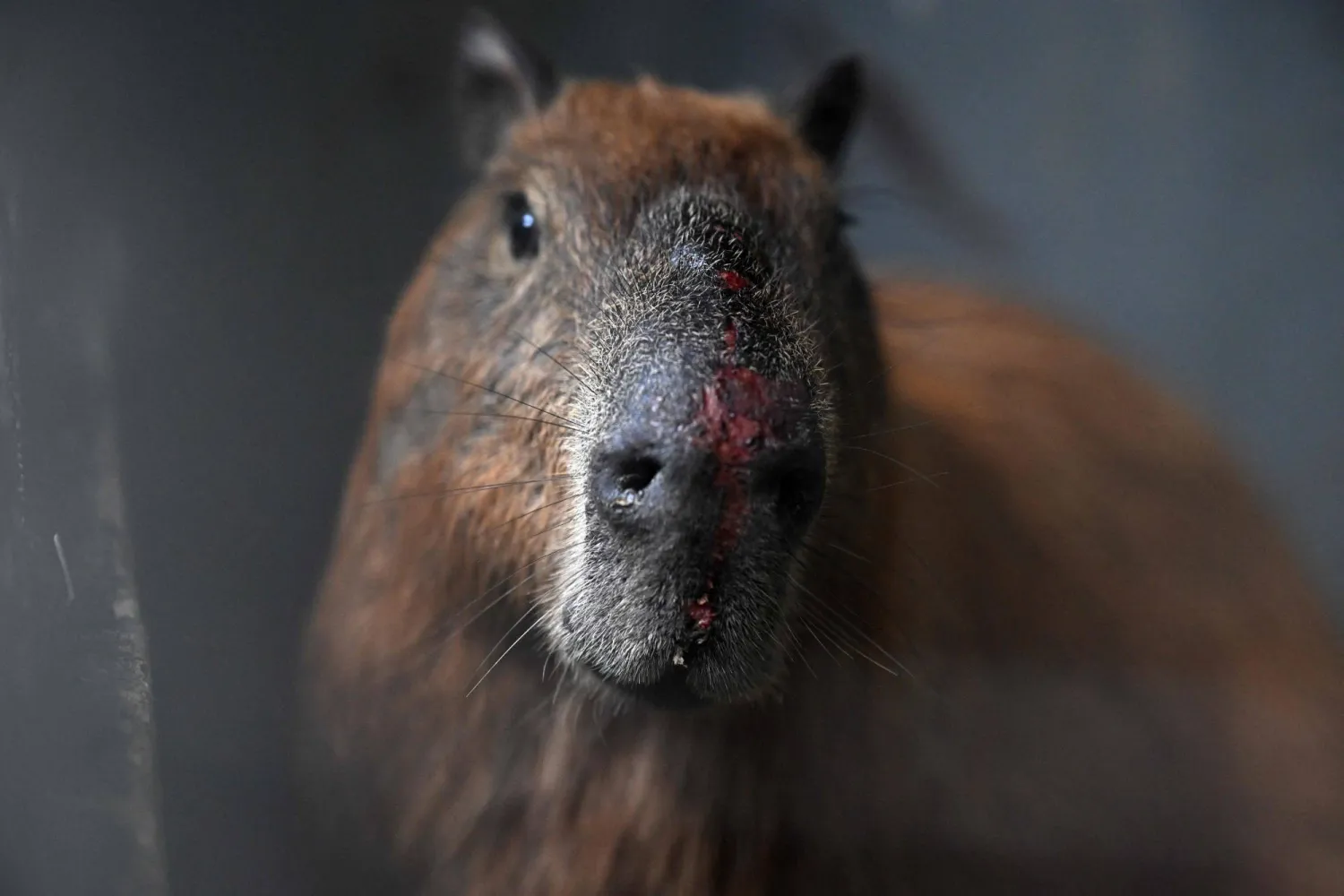
Wounds are seen on the muzzle of a capybara (Hydrochoerus hydrochaeris) under care at the Center for Wildlife Animal Recovery of Estacio de Sa University in the Vargem Pequena neighborhood, in the southwest zone of Rio de Janeiro, Brazil, on March 23, 2026. (Photo by MAURO PIMENTEL / AFP)
TT

8 Arrested in Brazil for 'Brutal' Attack on Capybara

Wounds are seen on the muzzle of a capybara (Hydrochoerus hydrochaeris) under care at the Center for Wildlife Animal Recovery of Estacio de Sa University in the Vargem Pequena neighborhood, in the southwest zone of Rio de Janeiro, Brazil, on March 23, 2026. (Photo by MAURO PIMENTEL / AFP)

Rio de Janeiro police said Monday they had arrested eight people for brutally beating a capybara -- the world's largest rodent whose chill demeanor has inspired countless memes online in recent years.

Resembling a giant, gentle guinea pig, the shaggy, light brown capybara (Hydrochoerus hydrochaeris) is often seen roaming in the Brazilian city, particularly near streams and lagoons.

In an incident filmed by security cameras before dawn on Saturday, a group of attackers beat the capybara with sticks and iron bars in the working-class neighborhood of Ilha do Governador.

"This is a brutal crime that shocks society," said Felipe Santoro, the police commissioner in charge of the investigation, was quoted as saying by the O Globo daily newspaper.

"It is an act of extreme cruelty toward a creature that posed absolutely no threat...yet was deliberately attacked nonetheless," he added.

The attackers -- including two minors -- were identified through CCTV footage and arrested on Saturday, AFP quoted police as saying in a statement.

The capybara, a 65-kilogram (143-pound) male, was taken to the Wildlife Care Center (CRAS) at the private Estacio University in southwestern Rio.

"We have been treating Rio's wildlife here for 22 years, and I have never before received a capybara subjected to such extreme aggression," veterinarian and head of CRAS Jeferson Pires told AFP on Monday.

He said the creature was doing better, but was "suffering from head trauma, swelling with internal bleeding around his left eye, and multiple injuries to his back."

In recent years the semi-aquatic capybara -- native to South America -- has gained a devoted following online, and its image is increasingly used on toys, clothing and home decor items.

It is often used in posts about being zen and going with the flow.

One popular meme is "Comrade Capybara" -- depicting the animal as a communist revolutionary -- inspired by the 2021 "invasion" by capybaras of a luxury gated estate in Argentina that was built on a wetland that had been their natural habitat.

In early January, the death of a stray dog after it was beaten to death by teenagers sparked a massive wave of outrage in Brazil, even prompting a reaction from First Lady Rosangela "Janja" da Silva.



France to Illuminate Statue of Liberty for US 250th Birthday

The lower Manhattan skyline, including the new One World Trade Center building at right, is shown as viewed from near the Statue of Liberty, Jan. 31, 2014, in New York.  (AP)
The lower Manhattan skyline, including the new One World Trade Center building at right, is shown as viewed from near the Statue of Liberty, Jan. 31, 2014, in New York. (AP)
TT

France to Illuminate Statue of Liberty for US 250th Birthday

The lower Manhattan skyline, including the new One World Trade Center building at right, is shown as viewed from near the Statue of Liberty, Jan. 31, 2014, in New York.  (AP)
The lower Manhattan skyline, including the new One World Trade Center building at right, is shown as viewed from near the Statue of Liberty, Jan. 31, 2014, in New York. (AP)

France will stage an elaborate light show at the Statue of Liberty to mark the 250th anniversary of the United States, the French consulate said Monday.

Described as a "monumental artistic creation," the show will be recorded in advance and broadcast by the ABC network at the start of its 25 hours of programming for Independence Day, July 4.

"The Statue of Liberty will be revealed to the public as it has never been seen before, in a staging designed to magnify its symbolic and emotional power," the consulate said.

"Our friendship goes back 250 years, it is still very strong, it runs deep, and that is why we wanted to do something significant," France's consul to New York Cedrik Fouriscot told AFP.

The Statue of Liberty in New York Harbor was given to the United States by France in 1886, and is one of the country's most famous monuments.

France also dispatched its air force acrobatics team to the United States this month to mark the 250th anniversary.

On June 9, eight Alpha jets of the Patrouille de France filled the skies above Manhattan with the colors of the French tricolor -- soaring above the iconic statue.


Brooch Given to First Passenger to Board Doomed Steamship Found at Roadshow

The brooch contains a dedication with the date April 21 1894 (AP)
TT

Brooch Given to First Passenger to Board Doomed Steamship Found at Roadshow

The brooch contains a dedication with the date April 21 1894 (AP)

A brooch given to the first passenger to board a Dundee-built steamship 37 years before she sank has surfaced at an antiques roadshow.

The decorative item was presented to Elizabeth Anderson on April 21 1894, the date of the maiden voyage of the SS Citrine, according to the British website ‘itv News.’

Built by Dundee shipbuilders W B Thompson & Co, the Citrine was one of a number of vessels in the Glasgow-based “Gem line,” all of which were named after gemstones or minerals.

The shipping firm was owned by William Robertson, who started out with a single barge in 1852 before growing it into one of the largest coastal bulk shipping fleets in Britain.

The brooch was presented to Anderson by Robertson and is inscribed with the words “SS Citrine, April 21 1894, Elizabeth McIntyre Anderson, from William Robertson.”

The sides of the gold-colored item are shaped as a ship’s rope and its center has been designed as a life ring mounted with a citrine stone, echoing the name of the vessel.

The Citrine sank on March 17 1931 after striking rocks at Bradda Head, Port Erin, on the Isle of Man.

Accounts at the time described the ship’s final moments in darkness, heavy weather and confusion, and the disaster claimed the lives of nine of her 11 crew members.

William Robertson had been dead for 12 years by the time of the sinking but the business remained in family hands under his sons, William Francis Robertson and James Robertson.
The brooch was discovered at a WeBuyVintage roadshow in Fleetwood, Lancashire.


NASA Robot Mission Aiming to Rescue Space Telescope

This handout photo released by NASA on July 31, 2004, shows the Swift spacecraft being unwrapped in Hangar AE at Cape Canaveral Air Force Station at Kennedy Space Center, Florida. (Photo by Handout / NASA / AFP)
TT

NASA Robot Mission Aiming to Rescue Space Telescope

This handout photo released by NASA on July 31, 2004, shows the Swift spacecraft being unwrapped in Hangar AE at Cape Canaveral Air Force Station at Kennedy Space Center, Florida. (Photo by Handout / NASA / AFP)

NASA on Tuesday is set to launch a daring robotic rescue mission, a long shot bid to prevent one of its aging telescopes from vanishing into dust.

If successful, the effort could pave the way for giving other satellites a second life.

The operation is set to last several months, kicking off with the launch of a robot designed to rescue the Swift space telescope that's currently falling towards Earth.

Without intervention, Swift is expected to soon burn up in the atmosphere.

The rescue spacecraft developed by the US startup Katalyst is slated to lift off Tuesday at 1023 GMT from a Pacific Ocean atoll aboard a small rocket named Pegasus.

The rocket-propelled launch vehicle will not take off from a launch pad. Instead, it will be released from a jet.

"Everything about this mission is so crazy," said NASA astrophysicist Regina Caputo with a laugh during an interview with AFP.

After it reaches an orbit near that of the telescope, the robot must locate Swift across the vastness of space.

The aim is then for the robot to maneuver around the telescope and latch on with three movable arms.

It will then vie to tow Swift into a stable orbit over the course of at least a month, rescuing it from destruction by moving it about 300 kilometers higher.

"This is a lot of firsts stacked on top of each other," said Shawn Domagal-Goldman, the director of NASA's astrophysics division, during a recent call with reporters.

"I'm just deeply thankful that we're even giving this a go."

The idea of such a rescue might seem odd at first glance.

The Neil Gehrels Swift Observatory telescope was launched in 2004, and was originally designed for a two-year mission.

The device was intended to study gamma-ray bursts, what Caputo called "the most energetic things that happen in the universe."

She likened it to a supercharged version of a supernova, which is a dramatic, explosive death of a star.

Gamma-ray bursts are extremely brief, she explained, so the telescope was placed at an altitude of approximately 600 kilometers in low Earth orbit, so it could remain in constant communication with researchers.

But with that pro came a con -- at such an altitude, the device without its own propulsion would eventually drift closer to Earth and burn up in the atmosphere.

Caputo said that phenomenon was expected and normal, because when the Sun is in its more active cyclical stages, it emits more particles and causes an expansion of Earth's atmosphere.

That creates drag, meaning satellites in low Earth orbit lose altitude.

Yet when forecasts in early 2025 indicated the telescope was nearing the end of its life, NASA began considering a possible rescue.

"We decided, yeah, we want to go save this one this time, because of how special it is," said Domagal-Goldman.

Despite its age, the Swift telescope remains in high demand within the scientific community, not least for its rapid response capabilities.

Should it burn up, it could not be immediately replaced.

The mission attempting unprecedented maneuvers has a projected cost of $30 million to save the device, which originally cost $250 million.

The rescue robot named LINK will have to overcome numerous challenges and unknowns.

For example, engineers do not have a clear picture of what the back of the telescope actually looks like -- even though that's where the robot must latch on.

With a laugh, Caputo projected the chances of success at "maybe 50-50."

Still, both NASA and the company Katalyst believe the mission -- which could run into the fall -- might pave the way for new possibilities in spacecraft management, and is worth a shot.

Robert Lamontagne, a vice president at Katalyst, said during a call with journalists that it could represent the "start of a new model" to "refuel, reposition, repurpose, repair, and even upgrade satellites, even if they were never prepared for it."