


China Positions Itself as a Stable Economic Force Amid Global Uncertainty at Beijing Forum

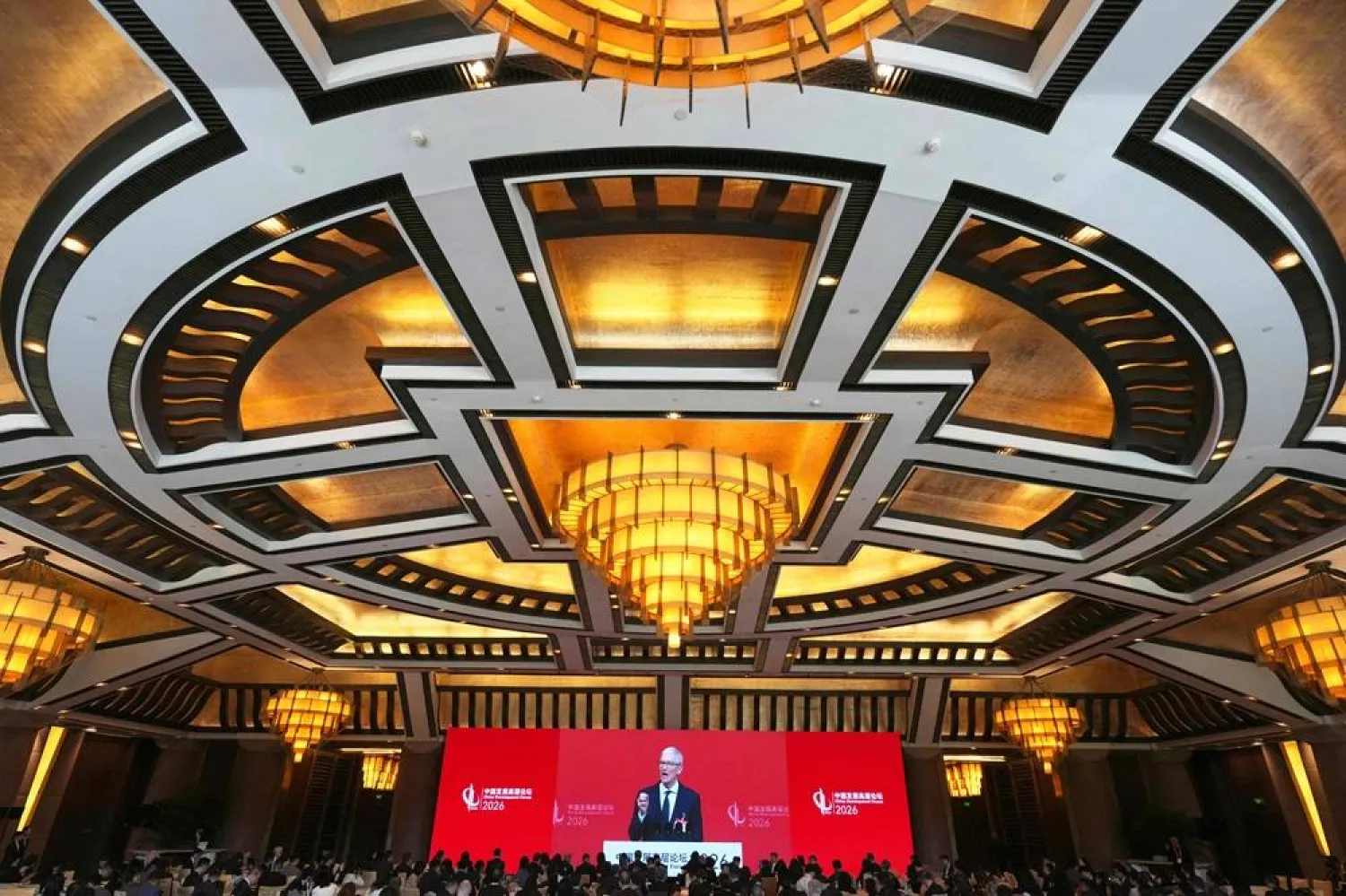
 Apple CEO Tim Cook is seen on a big screen live broadcasting his speech at the opening of the China Development Forum 2026 held at the Diaoyutai State Guesthouse in Beijing on March 22, 2026. (AFP)
Apple CEO Tim Cook is seen on a big screen live broadcasting his speech at the opening of the China Development Forum 2026 held at the Diaoyutai State Guesthouse in Beijing on March 22, 2026. (AFP)
TT

China Positions Itself as a Stable Economic Force Amid Global Uncertainty at Beijing Forum

 Apple CEO Tim Cook is seen on a big screen live broadcasting his speech at the opening of the China Development Forum 2026 held at the Diaoyutai State Guesthouse in Beijing on March 22, 2026. (AFP)
Apple CEO Tim Cook is seen on a big screen live broadcasting his speech at the opening of the China Development Forum 2026 held at the Diaoyutai State Guesthouse in Beijing on March 22, 2026. (AFP)

Global corporate executives attending China's flagship annual business conference this week were reassured by leaders of the world's second-largest economy that it remains a predictable anchor at a time of geopolitical flux and global uncertainty.

The tone at this year's China Development Forum (CDF), which ended on Monday, was noticeably more confident than in recent years, analysts said, marking a shift from previous post-pandemic forums where officials tended to emphasize support measures and recovery trajectories.

"Compared to previous CDFs, the China messaging was the most confident,” said Han Lin, China Country Director at US-based strategy consultancy, The Asia Group. “While identifying challenges in the international system and without naming the US directly, (Premier Li Qiang’s) opening speech focused on what China was doing right to encourage innovation, trade and other opportunities to collaborate."

The timing of the ‌forum sharpened that ‌message. Nearly a year into a bruising trade war and ahead of a ‌postponed summit ⁠between President Xi ⁠Jinping and US President Donald Trump, Beijing is navigating strained ties with Washington and faces rising trade barriers elsewhere off the back of a record $1.2 trillion trade surplus in 2025.

The US-Israeli war with Iran has caused a surge in energy prices that is rippling across the wider global economy and given Beijing another opportunity to promote itself as a bastion of calm.

REFLECTION OF SHIFTING GEOPOLITICAL LANDSCAPE

Attendance patterns reflected shifting geopolitical boundaries. A higher share of US corporate leaders travelled to Beijing compared with previous years, among them the CEOs of Apple, ⁠McDonald’s, Eli Lilly, Coach parent Tapestry and Mastercard.

Their presence suggested that despite tensions, American multinationals ‌remain keen to keep channels open with Beijing, as the two ‌countries recalibrate trade and investment flows.

Stability, a recurring theme from last year’s CDF, resonated more strongly this year, said Albert ‌Hu, professor of economics at the China Europe International Business School in Shanghai.

“Given all the erratic policies ‌introduced by Donald Trump and the uncertainty his policies have introduced to the world economy, the message of China being a stabilizing force probably finds a more willing audience this year than last year,” Hu said.

Absent, however, were Japanese executives — a stark contrast with last year, when their involvement included a widely publicized meeting between top global CEOs and Xi.

Their non-attendance this year ‌comes amid a diplomatic rift between Beijing and Tokyo, underscoring how China’s promises of renewed openness still operate firmly within geopolitical red lines.

EYES ON POTENTIAL MEETING WITH ⁠XI

A decision on whether ⁠Xi will reprise his recent practice of hosting a roundtable with select CEOs had not been confirmed by the close of the forum.

Han Lin believes the absence of an immediate announcement reflects sequencing rather than reluctance.

“I think Xi has every intention to meet CEOs, but only after a Trump visit,” he said. “Beijing wants trade terms set at the leadership level first, then multinationals get their signal on what comes next.”

Chinese policymakers also used this year's forum to underline priorities that now define its medium-term strategy: technological self-reliance, industrial upgrading and “high-quality development.”

All three pillars are central to the country’s latest five-year plan, released earlier this month and set as the theme of this year’s CDF.



QatarEnergy Declares Force Majeure on LNG Contracts

QatarEnergy's liquefied natural gas (LNG) production facilities, amid the US-Israeli conflict with Iran, in Ras Laffan Industrial City, Qatar March 2, 2026. (Reuters)
TT

QatarEnergy Declares Force Majeure on LNG Contracts

QatarEnergy's liquefied natural gas (LNG) production facilities, amid the US-Israeli conflict with Iran, in Ras Laffan Industrial City, Qatar March 2, 2026. (Reuters)

QatarEnergy declared on Tuesday force ‌majeure ‌on some ‌of ⁠its affected long-term ⁠LNG ⁠supply contracts, ‌with ‌counterparties including ‌customers in ‌Italy, Belgium, ‌South Korea, and ⁠China.

It said it was ‌continuing ‌to assess ‌the ⁠full impact of ⁠these recent events on its operations.

It added that it was assessing the impact ⁠and repair ‌timeline ‌for damaged facilities.

Missile ‌attacks on QatarEnergy's Ras Laffan production ‌hub on March 18 and 19 ⁠⁠caused significant damage.


Saudi Arabia Says World Economic Forum Postpones Jeddah Meeting

A World Economic Forum (WEF) logo. AFP
TT

Saudi Arabia Says World Economic Forum Postpones Jeddah Meeting

A World Economic Forum (WEF) logo. AFP

The World Economic Forum ⁠has postponed its Global ⁠Collaboration and Growth Meeting, originally ⁠set for April 22–23 in Jeddah, following consultations with the Saudi Ministry of Economy and ⁠Planning, citing ⁠current regional developments.

Saudi Minister of Economy and Planning Faisal Alibrahim stressed in January the need for sustained dialogue to accelerate global growth, calling on participants to engage actively in the meeting.

The Ministry of Economy and Planning affirmed Tuesday that the Kingdom has made comprehensive preparations to host the meeting and remains fully equipped to convene it, reflecting its continued role as a global platform for dialogue and agenda setting.

Building on its proven track record of convening major international gatherings, including the World Economic Forum Special Meeting in Riyadh in 2024, the ministry said it looks forward to hosting the Global Collaboration and Growth Meeting at a date to be announced in due course.

The World Economic Forum said: “The Global Collaboration and Growth Meeting will serve as a leading platform for shaping constructive global dialogue. Following coordination between the World Economic Forum and the Ministry of Economy and Planning of Saudi Arabia, it has been agreed to reschedule the meeting to maximize its global impact.”


IMF: Conflict Casts Shadow on Morocco's Economic Growth

FILE PHOTO: An MSC container ship crosses the Strait of Gibraltar from the Atlantic Ocean to the Mediterranean Sea, near the northern tip of the port of Tangier, Morocco, January 8, 2026. REUTERS/Amr Abdallah Dalsh
TT

IMF: Conflict Casts Shadow on Morocco's Economic Growth

FILE PHOTO: An MSC container ship crosses the Strait of Gibraltar from the Atlantic Ocean to the Mediterranean Sea, near the northern tip of the port of Tangier, Morocco, January 8, 2026. REUTERS/Amr Abdallah Dalsh

The International Monetary Fund has warned that in the near term, growth in Morocco would be impacted by the ongoing conflict in the Middle East.

The Executive Board of the IMF concluded last week the 2026 Article IV consultation with Morocco and completed the Mid-Term Review under the Flexible Credit Line Arrangement (FCL), which was approved on April 2, 2025.

The Staff Report issued on Monday said that real GDP growth is projected at 4.4 percent for 2026, 4.5 percent for 2027, and 4 percent over the medium term, assuming normalized agriculture production and continued infrastructure investment with greater private sector participation.

Real GDP growth in 2025 accelerated to an estimated 4.9 percent, supported by a rebound in agricultural output and a surge in large-scale infrastructure projects, the IMF said.

Nonetheless, high unemployment remains a significant challenge. Average inflation remained low at 0.8 percent, allowing Bank Al-Maghrib to maintain a neutral policy stance after earlier rate cuts.

The IMF lauded strong revenue performance that facilitated a smaller than anticipated overall fiscal deficit at 3.5 percent of GDP.

The overall fiscal deficits for 2026 and the medium term are consistent with a gradual reduction in debt to GDP to 60.5 percent by 2031.

The current account widened to 2.1 percent of GDP as imports rose with investment, partly offset by buoyant tourism.

“Sustainable job creation remains a pressing priority, and calls for a more dynamic private sector, leveling the playing field between public and private entities, and further reforms in the labor market,” the IMF said.

“Morocco continues to meet the qualification criteria for the Flexible Credit Line arrangement. Morocco has a sustained track record of implementing very strong macroeconomic policies and remains committed to maintaining such policies in the future, and continues to have very strong economic fundamentals and institutional policy frameworks. The authorities intend to continue treating the FCL arrangement as precautionary and to gradually exit it, depending on the evolution of external risks,” said IMF Deputy Managing Director and Chair Kenji Okamura.