

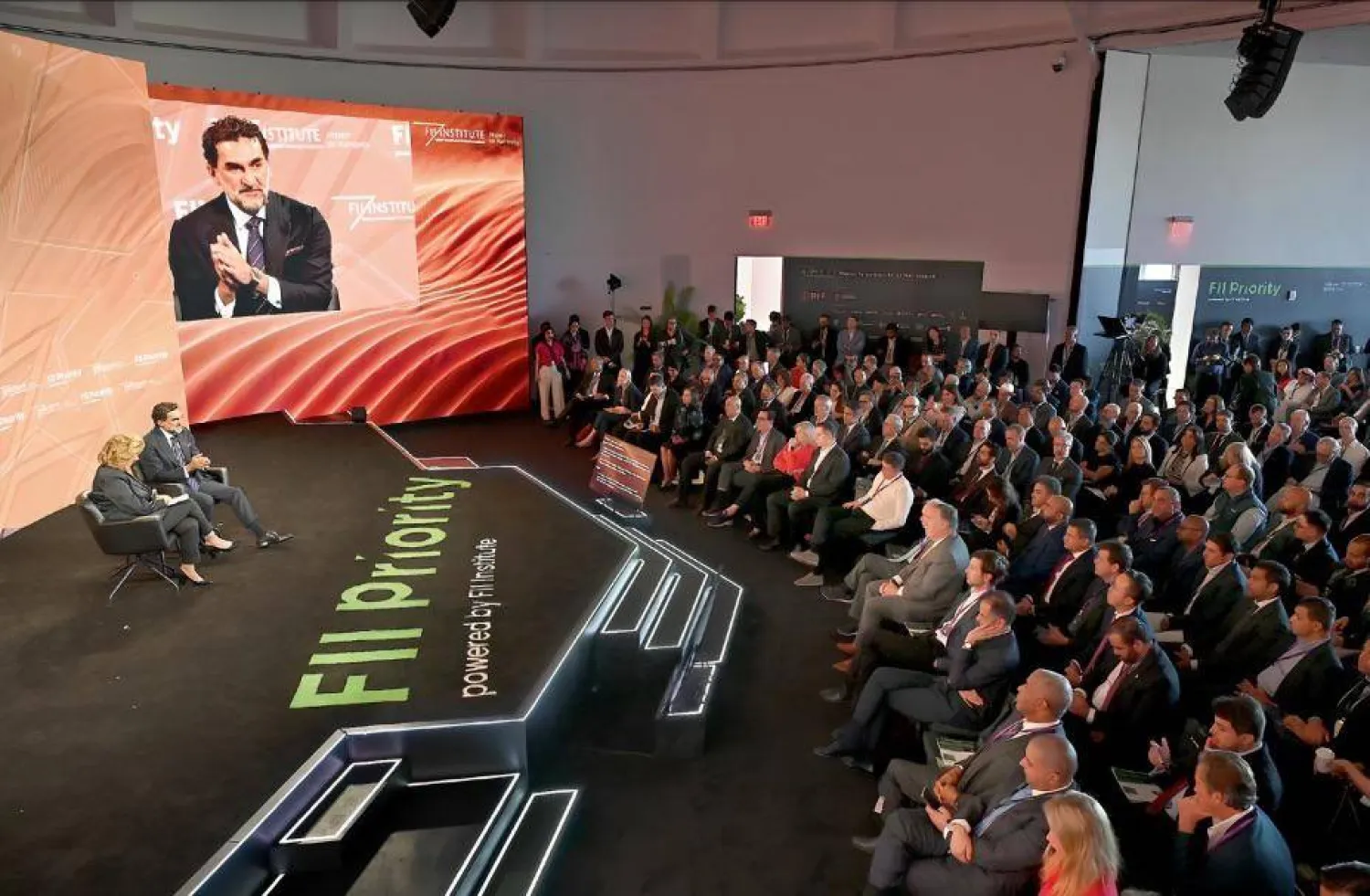

Miami Hosts FII Summit on Wednesday, Eyes Role of Capital in Global Shifts

PIF Governor Yasir Al-Rumayyan during a previous FII summit in Miami. (Asharq Al-Awsat)
TT

Miami Hosts FII Summit on Wednesday, Eyes Role of Capital in Global Shifts

PIF Governor Yasir Al-Rumayyan during a previous FII summit in Miami. (Asharq Al-Awsat)

Miami will host the fourth FII PRIORITY summit from March 25 to 27 under the theme “Capital in Motion,” as global economic and geopolitical shifts accelerate and investments and ideas move faster across borders and sectors.

More than 1,500 business leaders, policymakers and investors from the United States, Latin America, the Middle East, Europe, Asia and Africa will gather to rethink global capital flows and advance sustainable, inclusive growth.

The Future Investment Initiative Institute said the summit comes “at a moment when capital is being reallocated, repriced and reimagined,” adding that understanding and shaping these shifts responsibly is what brings this global community together.

The summit opens with a special forum titled “The New LATAM Order,” featuring sessions on the macroeconomic outlook for the Americas and discussions on who stands to gain from the emerging economic system and how capital is flowing through the region’s digital economy.

The focus reflects Latin America’s rising role in the global economy, with sessions examining investment in infrastructure and digital transformation, including whether the region’s infrastructure can become a global platform and where capital is heading in the digital economy.

Participants include Princess Reema bint Bandar Al Saud, Saudi Arabia’s ambassador to the United States, Yasir Al-Rumayyan, governor of the Saudi Public Investment Fund, Saudi Finance Minister Mohammed Al-Jadaan and Tourism Minister Ahmed Al-Khateeb.

International executives include Ripple CEO Brad Garlinghouse, Mary Erdoes of JPMorgan and Nelson Griggs of Nasdaq.

Sessions will also examine investment ties and economic relations, including the resilience of US-Gulf investment partnerships and the future structure of US-Latin American agreements as economic alliances evolve.

Technology will take center stage, with discussions on artificial intelligence and the digital economy, including where returns on AI investment are emerging and how infrastructure for the AI economy is being built, alongside debates on whether governments are leading or following in the AI race.

The agenda also covers energy and resources, including how energy deals could reshape power and profitability, the race for critical minerals, and aviation and tourism, with sessions on competitiveness and investment in travel infrastructure.

Emerging sectors will feature prominently, including the creator economy, gaming and the role of sports and culture in generating returns, reflecting the growing weight of the creative economy.

Broader themes include the global economic outlook, the flow of power and capital and how to address a $3 trillion exit crisis, alongside closed sessions for decision-makers to set investment priorities.

US President Donald Trump will deliver the closing address on March 27 as the guest of honor, underscoring the summit’s role as a platform linking politics, economics, and investment.

The event also reinforces Miami’s position as a strategic bridge between North and South America and a hub for redirecting global capital flows, while setting the stage for the 10th Future Investment Initiative in Riyadh later this year.



China Shipping Giant Cosco Resumes Bookings to Some Gulf Countries

A cargo ship operated by Cosco Shipping is docked at the foreign trade container terminal of Qingdao Port, operated by Shandong Port Group, in China's eastern Shandong province on March 25, 2026. (Photo by CN-STR / AFP)
TT

China Shipping Giant Cosco Resumes Bookings to Some Gulf Countries

A cargo ship operated by Cosco Shipping is docked at the foreign trade container terminal of Qingdao Port, operated by Shandong Port Group, in China's eastern Shandong province on March 25, 2026. (Photo by CN-STR / AFP)

Chinese shipping giant Cosco said on Wednesday that it was resuming new bookings for container shipments to some Gulf countries, after a three-week suspension in response to the Middle East war.

The state-owned, Shanghai-based firm was among several major shipping groups to pause operations in the Strait of Hormuz, a key waterway through which one-fifth of the world's oil and gas passes normally.

Tehran has said several times it was not targeting friendly nations, but transits through the Strait had nevertheless largely ground to a halt.

Iran said in a statement circulated by the International Maritime Organization on Tuesday that "non-hostile vessels" would be granted safe passage through the waterway.

Cosco "resumed new bookings for general cargo containers for shipments" from the "Far East" to the UAE, Saudi Arabia, Bahrain, Qatar, Kuwait, and Iraq "with immediate effect", according to a company statement.

It did not mention shipments travelling in the opposite direction, from the Gulf.

"New booking arrangements and the actual carriage are subject to change due to the volatile situation in the Middle East region," it added.

Cosco, which operates one of the world's largest oil tanker fleets, announced on March 4 that it would suspend new bookings for services for routes through the Strait of Hormuz owing to the "escalating conflicts in the Middle East region and resultant restrictions on maritime traffic".


Qatar Emir Makes Minor Changes to QIA Board

People visit a mall in Doha on March 23, 2026. (Photo by AFP)
TT

Qatar Emir Makes Minor Changes to QIA Board

People visit a mall in Doha on March 23, 2026. (Photo by AFP)

Qatar's Emir Sheikh Tamim bin Hamad Al Thani issued a decree on Wednesday ⁠making minor changes to ⁠the board of the ⁠Qatar Investment Authority, while keeping Sheikh Bandar bin Mohammed bin Saud Al Thani as chairman and Sheikh ⁠Mohammed ⁠bin Hamad bin Khalifa Al Thani as deputy chairman.

The decision stipulated that QIA’s Board of Directors would be restructured as follows: Sheikh Bandar bin Mohammed bin Saud Al Thani as Chairman, Sheikh Mohammed bin Hamad bin Khalifa Al Thani as Deputy Chairman, Ali bin Ahmed Al Kuwari as a member, Saad bin Sherida Al Kaabi as a member, Sheikh Faisal bin Thani bin Faisal Al-Thani as a member, Nasser bin Ghanim Al Khelaifi as a member, and Hassan bin Abdullah Al Thawadi as a member.

The decision is effective starting from its date of issue and is to be published in the official gazette.


Oil Falls More Than 5% and World Shares Gain Over Possible de-escalation of Iran War

A man fills his car with petrol at the petrol station in Port Dickson, Negri Sembilan, Malaysia, 25 March 2026. EPA/FAZRY ISMAIL
TT

Oil Falls More Than 5% and World Shares Gain Over Possible de-escalation of Iran War

A man fills his car with petrol at the petrol station in Port Dickson, Negri Sembilan, Malaysia, 25 March 2026. EPA/FAZRY ISMAIL

Oil prices fell more than 5% and world shares gained on Wednesday over the possibility of a de-escalation of the Iran war and negotiations between the United States and Iran. US futures were up 0.9%.

In early European trading, Britain's FTSE 100 rose 1% to 10,072.60. France's CAC 40 was up 1.4% to 7,855.31, while Germany's DAX was 1.6% higher at 22,989.80.

Tokyo’s Nikkei 225 was up 2.9% to 53,749.62. South Korea’s Kospi gained 1.6% to 5,642.21.

Hong Kong’s Hang Seng rose 1.1% to 25,335.95, while the Shanghai Composite index was 1.3% higher at 3,931.84. Labubu doll maker Pop Mart's Hong Kong-listed shares fell 22.5%, after it announced annual revenue for last year that was largely in line with analysts’ estimates.

Australia’s S&P/ASX 200 climbed 1.9%. Taiwan’s Taiex was up 2.5%.

US President Donald Trump's claims of progress being made from talks with Iran this week and his postponement on Monday of a deadline to “obliterate” Iran’s power plants over the reopening of the Strait of Hormuz have also fueled optimism that an end to the Iran war could come soon.

Trump's administration has offered a 15-point ceasefire plan to Iran, but an Iranian military spokesperson mocked the US’ attempt at a ceasefire deal Wednesday.

With the Strait of Hormuz being a key waterway for crude oil and liquefied natural gas transport, oil and gas prices have spiked and fluctuated in recent days.

Oil prices fell again on growing hopes for a de-escalation. Brent crude, the international standard, fell 5.2% to $94.97 per barrel. It was around $104 on Tuesday.

Benchmark US crude was down 5.3% early Wednesday to $87.44 a barrel.

While Iran has denied negotiations were taking place, and attacks in the Middle East continued, Pakistan has offered to host talks between Washington and Tehran. And as Trump raised optimism of a de-escalation of the war, at least 1,000 more American troops from the 82nd Airborne Division are said to be deployed to the Middle East in the coming days.

On Tuesday, US stocks closed lower. The S&P 500 lost 0.4% to 6,556.37. The Dow Jones Industrial Average edged down 0.2% to 46,124.06, while the Nasdaq composite was 0.8% lower to 21,761.89.

Shares of Estee Lauder sank more than 9%, following confirmation that the US-listed company is in merger talks with Spanish beauty and perfume group Puig.

In other dealings early Wednesday, gold prices resumed its rise after falling earlier. It dropped in part because of rising US Treasury yields over dimming expectations of a Federal Reserve rate cut after the spike in oil prices threatened to fuel global inflation.

The price of gold was up 3.6% early Wednesday to $4,561.90 per ounce. It was above $5,000 earlier this month.

The US dollar was at 158.84 Japanese yen, up from 158.69. The euro was trading at 1.1602, down from $1.1608.