

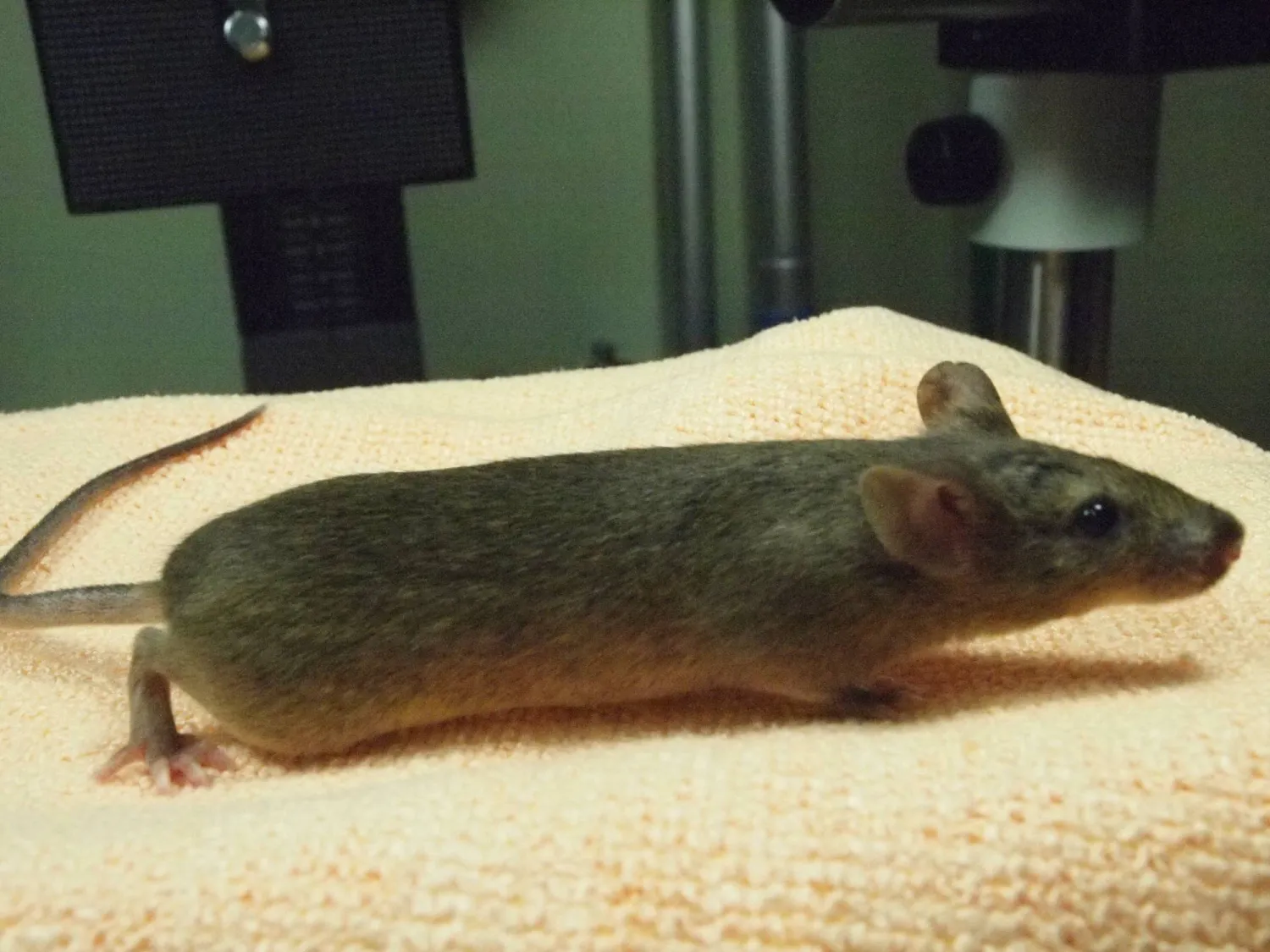

Mouse Study Shows Repeated Cloning Causes Grave Genetic Mutations

A cloned female mouse inside a laboratory at the University of Yamanashi in Yamanashi, Japan, in this undated photograph released on March 24, 2026. Teruhiko Wakayama/Handout via REUTERS
TT

Mouse Study Shows Repeated Cloning Causes Grave Genetic Mutations

A cloned female mouse inside a laboratory at the University of Yamanashi in Yamanashi, Japan, in this undated photograph released on March 24, 2026. Teruhiko Wakayama/Handout via REUTERS

Revealing the limitations of cloning, researchers who repeatedly cloned mice for two decades have discovered that such serial duplication triggers grave genetic mutations that accumulate over the generations and ultimately become fatal.

A total of 1,206 cloned laboratory mice were generated by the scientists from a single female donor mouse from 2005 to 2025 in research conducted in Japan. There were no outward signs of trouble through the first 25 generations, but mutations subsequently began piling up until becoming fatal. The 58th generation of clones, burdened by mutations but with no visible physical abnormalities, died within a few days of birth.

The research contradicted the notion that clones are identical copies of the original donor animal and disproved the idea that cloning using current technology could be carried out indefinitely with no ill effects.

"No one has ever continued re-cloning for this long before. As a result, this is the first time we've discovered that repeated re-cloning eventually reaches its limits," said developmental biologist Teruhiko Wakayama of the University of Yamanashi, senior author of the research published on Tuesday in the journal ⁠Nature Communications.

"It was ⁠once believed that clones were identical to the original, but it has become clear through this study that mutations occur at a rate three times higher than in offspring born through natural mating," Wakayama said.

"Because all these mutations continue to accumulate, mammals cannot sustain their species through cloning. This study has revealed one of the reasons why mammals, unlike plants and lower animals, cannot maintain their species through cloning."

After generating the first clone, the researchers repeated the process every three to four months, cloning each generation from the one preceding it. Like the original donor mouse, all the clones were females with brown fur.

The researchers published preliminary results in 2013 spanning the first 25 generations ⁠that found the clones to be healthy, with no apparent negative effects.

"At that time, we concluded that re-cloning could likely continue indefinitely. However, in that study, we did not examine the genetic sequences. We continued our research for 13 more years, and as a result, we discovered that our previous conclusion was incorrect - that is, there is a limit to re-cloning," Wakayama said.

The researchers sequenced the genomes of 10 clones from the various generations to understand what was happening at the genetic level.

They found that serial cloning produced an effect akin to duplicating a picture using a copying machine. With the first copy, the image quality deteriorates slightly. When copying that copied image, the quality deteriorates further.

Repeating the process numerous times yields an image very different from the original.

The study results, they said, pointed to the importance of sexual reproduction in countering deleterious genetic mutations in mammals.

The researchers gauged the fertility of the clones by mating them with ordinary male mice. Up to the 20th generation, they gave birth to about 10 babies per litter, ⁠just like ordinary female mice. But ⁠eventually the clones began having smaller litters, reflecting the effects of accumulating mutations.

The researchers used a technique called nuclear transfer to generate the clones. The same method was used to produce Dolly the sheep, the first successfully cloned mammal, at a laboratory in Scotland in 1996, and Cumulina, the first successfully cloned mouse, at a lab in Hawaii in 1998.

With nuclear transfer technology, researchers create an embryo by transferring the nucleus, a cell's primary repository of genetic information, from a donor cell into an egg cell whose own nucleus was removed. A specialized ovarian cell, called a cumulus cell, that surrounds and nurtures a developing egg was used in the cloning.

"We had believed that we could create an infinite number of clones. That is why these results are so disappointing. At this point, we have no ideas for overcoming this limitation. I believe we need to develop a new method that fundamentally improves nuclear transfer technology," Reuters quoted Wakayama as saying.

An increase in large-scale harmful mutations began with the 27th generation including chromosomal abnormalities. For instance, one copy of the X chromosome was lost.

Chromosomes are threadlike structures that carry genetic information from cell to cell. In mammals, females carry two X chromosomes, one inherited from each biological parent.

"In cloning, all genes are passed on to the next generation, meaning that all defective genes are also passed on," Wakayama said.



Europe Braces for Prolonged Heatwave as Temperatures Approach 40C

 People wait in the heat the arrival of guests of the Prada's Spring/Summer 2027 men's collection presented in Milan, Italy, Sunday, June 21, 2026. (AP)
People wait in the heat the arrival of guests of the Prada's Spring/Summer 2027 men's collection presented in Milan, Italy, Sunday, June 21, 2026. (AP)
TT

Europe Braces for Prolonged Heatwave as Temperatures Approach 40C

 People wait in the heat the arrival of guests of the Prada's Spring/Summer 2027 men's collection presented in Milan, Italy, Sunday, June 21, 2026. (AP)
People wait in the heat the arrival of guests of the Prada's Spring/Summer 2027 men's collection presented in Milan, Italy, Sunday, June 21, 2026. (AP)

A severe heatwave gripped much of Europe on Sunday, with temperatures nearing 40 degrees Celsius (104 degrees Fahrenheit), prompting nationwide warnings, transport disruption and signs of strain on wildlife and at tourist hotspots.

The heat surge on June 21, the summer solstice in the northern hemisphere and typically the start of the three hottest months of the year, raised concerns of an early and persistent onset of extreme conditions.

After several days of temperatures above 35C, Italian authorities issued a red alert for June 21 in eight cities, including Bologna, Florence, Milan, and Turin.

In Rome, pilgrims in St Peter's Square used parasols and umbrellas to shield themselves from the blazing sun as the ‌Pope led a traditional ‌Sunday prayer from a window of the Apostolic Palace.

The spike in ‌temperatures ⁠is being driven ⁠by a mass of hot air moving north from the Sahara, fueled by a strong high-pressure system known as the "African anticyclone."

Meteorologists say the system is creating a so-called "heat dome," trapping hot air over western and central Europe and allowing temperatures to build day after day. Madrid residents and tourists used fans and drank plenty of cold drinks as they browsed the city's famous El Rastro flea market.

“I'm dressed all in white because it's so hot, and I'm carrying my little electric fan everywhere ⁠I go,” said Haily San Cesario, a 22-year-old engineer from Miami.

Spain's ‌AEMET weather agency issued red and orange alerts across several ‌regions, warning of temperatures exceeding 39 to 40 C across large parts of the Iberian Peninsula and ‌Mallorca, and said the heatwave would last at least until midweek.

TRAINS CANCELLED IN FRANCE

The extreme ‌heat has begun to disrupt infrastructure.

Speaking from Paris’ Gare Montparnasse station, SNCF chief Jean Castex said the rail network was “strongly impacted” by high temperatures that risk damaging overhead power lines and expanding tracks.

He said 3,500 staff had been mobilized to monitor the network and 2,000 more would conduct emergency repairs. He urged vulnerable ‌passengers to delay travel. The operator has cancelled 71 intercity trains until Monday on key routes.

In Germany, where temperatures have already reached ⁠as high as 38C, ⁠the DWD weather service warned of severe thunderstorms in eastern regions including Berlin, where heavy rain disrupted the open-air Fete de la Musique festival.

Organizers had to evacuate the grounds of the Berlin Open as heavy rain and strong winds set in, and as fans awaited the tennis tournament's singles final between Jessica Pegula of the US and Linda Noskova of the Czech Republic.

HEAT STRESS ON NESTLINGS

Wildlife rescuers are also reporting mounting pressure.

A center near the Belgian city of Namur said it had taken in around 150 heat-stressed animals in recent days, with young birds particularly at risk.

“Nestlings prefer to jump rather than let themselves die and literally cook in their nests,” said CREAVES founder Romain De Jaegere, adding that centers across Belgium were overwhelmed.

Experts say the situation reflects a broader trend, with heatwaves in Europe becoming more frequent and intense due to climate change.


France Presses Ahead with Music Festivals Despite Extreme Heat

Two women walk in front of the sea at the beginning of the "Promenade des Anglais" on the French riviera city of Nice, on June 20, 2026. (AFP)
TT

France Presses Ahead with Music Festivals Despite Extreme Heat

Two women walk in front of the sea at the beginning of the "Promenade des Anglais" on the French riviera city of Nice, on June 20, 2026. (AFP)

France on Sunday prepared to host its annual street music festival in boiling heat, with a third of the country placed on red alert and alcohol consumption banned.

Every year on June 21, musicians take over France, filling street corners and rooftops as revelers celebrate midsummer late into the night.

This year, however, the Fete de la Musique coincides with a ferocious heatwave, with a record 35 departments -- roughly a third of the country -- placed under the highest heat alert.

Weather service Meteo-France warned that temperatures could reach as high as 41C in some places.

While some cities have cancelled street events, celebrations in others - including Paris, Lyon and Strasbourg - will go ahead.

Last year, around two million people attended the festival in Paris alone, many of them travelling from Britain.

To ensure public safety, authorities will deploy 4,800 police officers and gendarmes, along with 2,500 firefighters, in and around the capital.

Gatherings along the lower banks of the Seine will be prohibited to reduce the risk of people falling into the water.

According to AFP estimates, around 53 million people in France will be affected by the heat on Sunday, with a further 45 departments under orange alert.

The number of departments on red alert has reached a record high, surpassing the previous peak of 20 recorded on July 24-25, 2019.

The Atlantic port city of Nantes is offering free access to swimming pools and museums until the end of the red alert period.


After Samurai Blue Sweep Aside Tunisia, Japan Fans Clean Up Monterrey Stadium

 A fan of Japan collects trash after the World Cup Group F match between Tunisia and Japan in Guadalupe, near Monterrey, Mexico, Sunday, June 21, 2026. (AP)
A fan of Japan collects trash after the World Cup Group F match between Tunisia and Japan in Guadalupe, near Monterrey, Mexico, Sunday, June 21, 2026. (AP)
TT

After Samurai Blue Sweep Aside Tunisia, Japan Fans Clean Up Monterrey Stadium

 A fan of Japan collects trash after the World Cup Group F match between Tunisia and Japan in Guadalupe, near Monterrey, Mexico, Sunday, June 21, 2026. (AP)
A fan of Japan collects trash after the World Cup Group F match between Tunisia and Japan in Guadalupe, near Monterrey, Mexico, Sunday, June 21, 2026. (AP)

Japanese ‌fans celebrated their team's 4-0 victory over Tunisia in the 1,000th match in World Cup history on Saturday by staying behind at Monterrey’s stadium to collect rubbish from the stands.

The practice, known in Japan as gomi hiroi, reflects an emphasis on taking responsibility for shared spaces.

Ken Okawa, 30, said he was happy to bring this tradition to his very first World Cup match as he stooped down to collect discarded cups and other garbage ‌from the floor ‌around his seat.

"We are guests in ‌Mexico," ⁠he said. "I have ⁠been treated wonderfully, so this is my way of showing my appreciation."

The practice is instilled from a very young age in Japan, where schoolchildren are taught to clean up their own classrooms.

Miku Takeya, 41, said that the habit of tidying up after herself has become second ⁠nature.

"It's a natural part of our culture," she ‌said. "We do this to ‌ensure that everything we use is left clean so that the ‌next person can use it comfortably."

Images of Japanese ‌fans cleaning up in stadiums after Samurai Blue matches during this year's World Cup have gone viral.

Ahead of Saturday's match, Nuevo León Governor Samuel García said he had arranged for 20,000 ‌trash bags to be distributed in the stadium during the match, as well as ⁠at Fanfest ⁠and other tourist sites, following requests from Japanese fans, according to local media.

While this practice has captured global attention, many Japanese fans say it is nothing out of the ordinary for them.

"It's common sense in Japan," said Ichiro Oyo, 27.

Still, Ryo Matsuoka, 32, said he was proud to bring this part of Japanese culture to the world stage.

"I think it is a matter of great pride that this is being showcased in a stadium like this, where people from all over the world are watching," he said.