


A Nonprofit in France Is Fighting Fast-Fashion Waste, One Sneaker at a Time

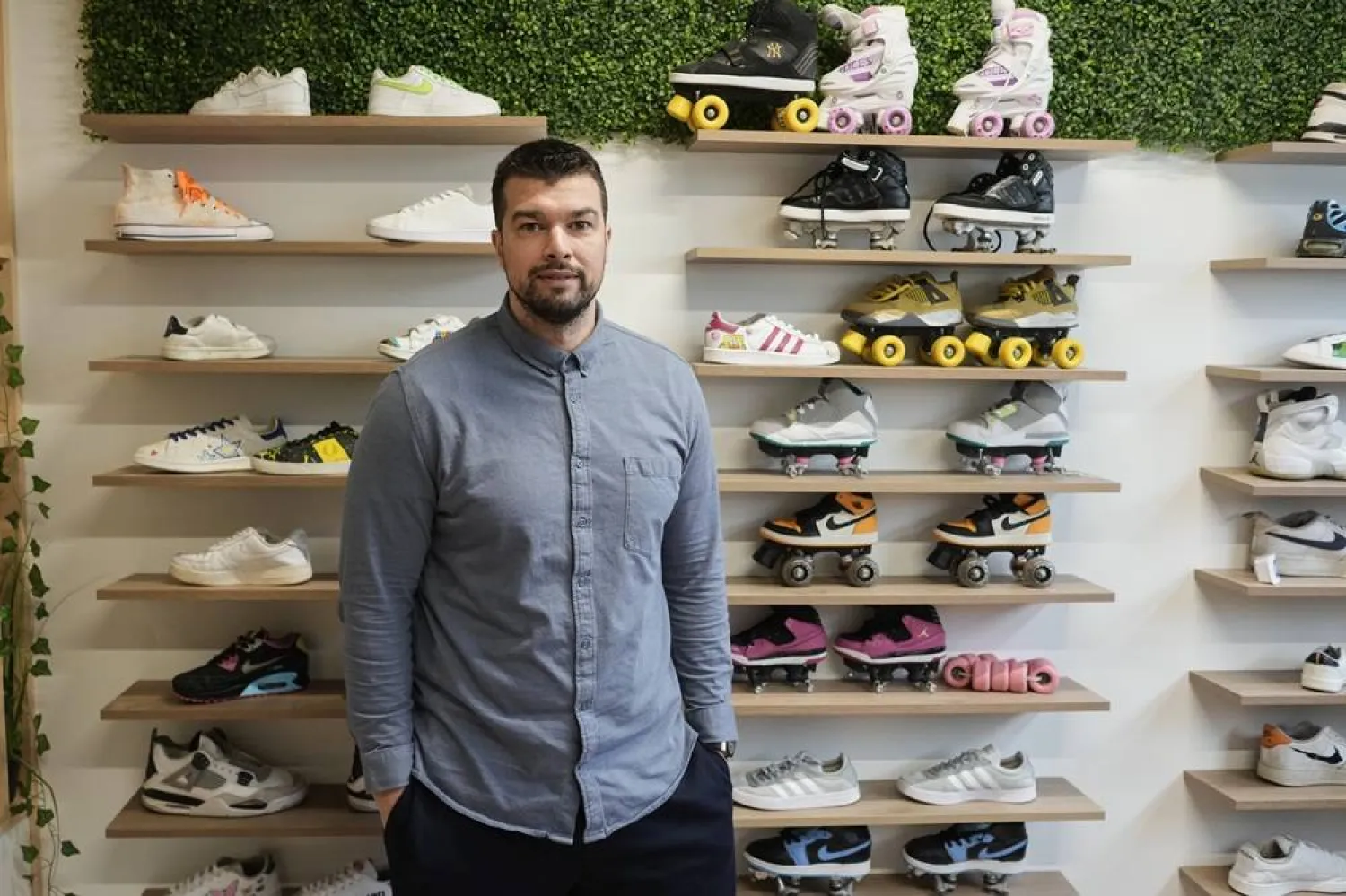
 Mohamed Boukhatem, co-founder and director of SneakCoeurZ, a nonprofit organization giving used footwear a second life, poses in Champs-sur-Marne, east of Paris, Wednesday, March 25, 2026. (AP)
Mohamed Boukhatem, co-founder and director of SneakCoeurZ, a nonprofit organization giving used footwear a second life, poses in Champs-sur-Marne, east of Paris, Wednesday, March 25, 2026. (AP)
TT

A Nonprofit in France Is Fighting Fast-Fashion Waste, One Sneaker at a Time

 Mohamed Boukhatem, co-founder and director of SneakCoeurZ, a nonprofit organization giving used footwear a second life, poses in Champs-sur-Marne, east of Paris, Wednesday, March 25, 2026. (AP)
Mohamed Boukhatem, co-founder and director of SneakCoeurZ, a nonprofit organization giving used footwear a second life, poses in Champs-sur-Marne, east of Paris, Wednesday, March 25, 2026. (AP)

Hundreds of used sneakers arrive each week at a workshop east of Paris, where workers inspect them and ask a simple question: Can a shoe be saved?

The nonprofit SneakCœurZ is in the business of sorting the shoes to check which ones can be resold or redistributed, and which have to be rejected. It says it collected 30,000 pairs of used sneakers last year and resold 2,000 pairs, and wants to scale up that process.

“Today, there is no project of this scale in the sneaker sector,” said Mohamed Boukhatem, the organization's director general and co-founder. “We are the only ones able to industrialize both the processes and the collection of sneakers for reuse.”

The group's work underscores a growing waste problem in France, where the capital Paris is long one of the world’s fashion and luxury hubs.

The stakes are huge: the textile industry is among the world’s most polluting, and the fashion and textiles sector accounts for up to 8% of global greenhouse gas emissions, according to the United Nations. The European Parliament has said textiles were the third-largest source of water degradation and land use in the European Union in 2020.

Refashion, the French government-approved eco-organization for clothing, household linen and footwear, says 259 million pairs of shoes were sold in France in 2024.

It says only about a third of used textiles and footwear are separately collected, with much of the rest left in cupboards or thrown away with household waste.

At its workshop in Champs-sur-Marne, workers for SneakCœurZ inspect the used shoes and check which can be salvaged.

“The structural elements of the shoe are what determine whether we can refurbish it or not,” workshop manager Paul Defawes Abadie said.

“A damaged Velcro strap isn’t a deal breaker. A lace isn’t a deal breaker. Dirt is never a deal breaker,” he said. “What really matters is the wear of the structural materials, especially the outsole.”

Pairs that make the cut are cleaned from the sole upward, disinfected inside and, in some cases, whitened under UV light before being put back into circulation.

The nonprofit says it redistributed more than 7,000 pairs to people in need and helped create 19 jobs.

“Over the next three years, the goal is to triple or even quadruple these volumes and move to an industrial scale,” Boukhatem said.

France has tried to respond to the issue of fast-fashion waste with law, as well as rhetoric.

Its 2020 anti-waste law requires unsold nonfood goods to be reused, donated or recycled instead of destroyed.

Authorities introduced a state-backed repair bonus for clothing and shoes in November 2023. Separately, lawmakers are still working on a bill aimed at reducing the textile industry’s environmental impact.

The bill passed the National Assembly in March 2024 and the Senate in June 2025, and the government said in February that it was still aiming for a joint parliamentary committee this spring.




Kering Names Former Prada Brand CEO as New Alexander McQueen Boss

The logo of French luxury group Kering is pictured on the day of the Kering General Assembly meeting at the company's headquarters in Paris, France, May 28. (Reuters)
TT

Kering Names Former Prada Brand CEO as New Alexander McQueen Boss

The logo of French luxury group Kering is pictured on the day of the Kering General Assembly meeting at the company's headquarters in Paris, France, May 28. (Reuters)

Kering has appointed former Prada brand CEO Gianfranco D'Attis as chief executive of struggling British luxury house Alexander McQueen, the French group said on Monday.

D'Attis will start on June 3, Kering ‌said, as ‌the British label grapples ‌with ⁠a slump in ⁠sales, which have triggered a restructuring and layoffs.

Job losses recently led to a strike at the group's Italian operations where McQueen is cutting almost ⁠a third of its roughly ‌180-strong workforce ‌as it seeks to break ‌even after revenue fell by around ‌60% over the past three years, unions have said. The brand also confirmed job cuts in ‌its UK office last year.

D'Attis previously ran the Prada brand ⁠and ⁠left the role last year.

"Alexander McQueen is entering a new phase focused on strengthening its distinctive positioning, supported by a leaner and more disciplined model built around focused collections, a rightsized retail network and a streamlined organization," Kering said in a statement.


Gap, American Eagle Fall as Weak Apparel Demand Signals Constrained Consumer Spending

A man walks past a Gap store on Oxford Street in London, Britain, July 1, 2021. (Reuters)
TT

Gap, American Eagle Fall as Weak Apparel Demand Signals Constrained Consumer Spending

A man walks past a Gap store on Oxford Street in London, Britain, July 1, 2021. (Reuters)

Shares of apparel makers Gap and American Eagle Outfitters dropped 15% and 10%, respectively, in premarket trade on Friday after weak annual forecasts, as consumers curb discretionary spending amid a tough macroeconomic climate.

Gap cut its annual sales forecast, while American Eagle maintained its full-year comparable sales and operating profit outlook but flagged a contraction in current-quarter gross margin, stoking worries about near-term demand.

US inflation posted its biggest increase ‌in three ‌years, while consumer sentiment hit a record low ‌in ⁠May, forcing households to ⁠tap savings and cut back on discretionary purchases such as clothes and accessories.

Both companies flagged weakness in certain women's seasonal categories, weighing on current-quarter results.

At Gap, which is undergoing a turnaround under CEO Richard Dickson, pressure centered on Old Navy, its largest banner, where seasonal women's apparel failed to connect ⁠with shoppers.

"Old Navy was the key swing ‌factor," BTIG analysts said in ‌a note.

"Weakness was concentrated in seasonal categories like dresses, where the assortment missed ‌on fashion and value, weighing on conversion despite solid traffic."

American ‌Eagle also came under pressure as strong demand at Aerie failed to offset weakness at its namesake brand, with women's bottoms hurt by changing fashion trends and a colder spring.

In a bid to ‌attract Gen Z shoppers and boost sales, the denim retailer, last month, unveiled a second ⁠campaign with "Euphoria" ⁠star Sydney Sweeney for its summer season denim shorts collection, a year after a viral and controversial ad featuring the actress fueled a stock rally.

Barclays noted heavy marketing spending is expected to recur in Q2 2026, but "bottoms including denim have since returned to underperformance".

It added American Eagle brand may struggle to lap its high-profile Sydney Sweeney and Travis Kelce campaigns and drive earnings growth in H2 2026.

Gap currently trades at 10.30 times its estimated earnings for the next 12 months, compared with 9.70 times for American Eagle and 7.43 times for Abercrombie & Fitch, according to LSEG data.


Clothing Rental Services Promise a Sustainable Alternative to Fast Fashion. Experts Say It Depends

A shopper browses for clothing at a Walmart store in Flagstaff, Arizona, US, October 19, 2022. (Reuters)
TT

Clothing Rental Services Promise a Sustainable Alternative to Fast Fashion. Experts Say It Depends

A shopper browses for clothing at a Walmart store in Flagstaff, Arizona, US, October 19, 2022. (Reuters)

For weddings, vacations or other special occasions, more consumers are turning to clothing rental services instead of buying something new.

These subscription-based services, often marketed as a sustainable alternative to fast fashion, ship straight to customers everything from everyday and workwear to dresses, handbags and formalwear. Then, the items are returned for someone else to use.

“I haven’t bought anything for a big occasion since 2019,” said Sasha Eck, a user of clothing rental services.

Along with giving her continuous and affordable access to newer, trendier clothes, she said renting formalwear made more sense than spending the equivalent of a month's rent on a dress she would only wear once. A recent survey from ThredUp suggests others face the same predicament, with the resale platform finding 87% of wedding guests said they had purchased at least one outfit they wore only once.

Clothing rental services appear to be an environmentally ethical alternative: One garment can be worn by multiple people instead of being tethered to a single closet. But fashion and logistics experts say the reality of rental subscriptions is more complicated, especially once shipping, returns and consumer habits are factored in.

The promise (and problem) of rental fashion

Kate Fletcher, a professor of sustainability, design and fashion systems at Manchester Metropolitan University, said rental services can sometimes encourage the same mindset that drives fast fashion.

“In theory, the embodied resources within that garment get a chance to be worked harder by having that many more people wear it. And so that’s the sort of compelling argument of it,” she said.

But Fletcher said many of those environmental benefits can be undermined by repeated shipping, returns and cleaning.

Aja Barber, a sustainability consultant and writer, said people often overlook the footprint of those processes.

“When you think about rental, you don’t think about the packaging that comes every time you get something from rental. You don’t think about the carbon footprint of shipping the item to you. And you certainly don’t think about the carbon footprint of dry cleaning,” said Barber.

Still, both experts said rental services can have advantages in certain situations.

“If you are someone who occasionally has to wear occasion-wear and you don’t want to buy a dress that you’re going to wear just once, I think it can be really impactful,” said Barber.

Fletcher pointed to older, more localized rental models, like with suit or gown rentals, where customers visited a shop, were fitted in person and later returned the item. She said those systems often had a very different environmental profile than modern, app-based rental services that rely on repeated shipping.

Why shipping matters

The rise of online shopping has heightened the environmental affect of “last mile delivery" — the final stage of transporting a package from a fulfillment center to a customer’s home. Transportation is already one of the largest contributors to greenhouse gas emissions, said Johanna Amaya, assistant professor of supply chain management at Pennsylvania State University.

“The more deliveries going to our homes, the more delivery that goes to our preferred location, the more that impact on the environment,” said Amaya.

Rental services can also create an added logistical challenge because the process involves two trips — one to deliver the clothing and another to return it.

Amaya said fast shipping can also make delivery systems less efficient because companies have less time to consolidate packages into fuller routes.

“The longer they can wait to consolidate more orders and use the capacity of the delivery vehicles, the better,” said Amaya.

She added that returning items to centralized locations, like parcel lockers or post offices, may be less environmentally impactful than home pickup services.

So what should consumers do?

Experts say renting can still be a better option in some situations, particularly for special occasion outfits that may otherwise only be worn once. But they also said consumers should think carefully about how often they are ordering, shipping and returning clothing.

Fletcher encouraged people to “look within a wardrobe and yourself before you look without and try and get a new piece.”

Amaya said consumers can reduce the environmental impact by avoiding rush shipping and choosing consolidated or pickup delivery options when possible.

And the broader sustainability challenge in fashion cannot be solved by a single service or product alone, Fletcher said.

For consumers trying to shop more sustainably overall, experts said some of the simple options may still be the most effective, like re-wearing clothing, repairing items, swapping with friends, buying secondhand or donating pieces so they continue to be used.

“The best thing we can do is engage with fashion as a practice. So, a lived experience of what it is to be dressed — full of capabilities of who I can be in the world — and not as something to buy,” Fletcher said. “Fashion as shopping, that sort of idea of it, is something that industry has encouraged us to believe is the only way of engaging with fashion. And fundamentally, that’s only going to lead to more climate impacts.”